 A-TEC
A-TEC
 AEA Airguns
 AKAH
AKAH
 ASG
ASG
 Aimpoint
 Alpen Optics
 Alpha Industries
 Anschütz
 Antonio Zoli
 Ares
Ares
 B&T Schalldämpfer
 Baikal
 Ballistol
 Balzer
 Barbour
 Barnes
 Barnett
 Benelli
 Beretta
 Bergara
 Blaser
 Brandit
 Bremer Tresor
 Brenneke


If I break down the process into one sentence: When buying a firearm from a US FFL, the NICS check only starts after the complete ATF Form 4473 is submitted, then returns Proceed, Delay, or Deny and thus determines whether the transfer continues immediately, must wait, or ends.
I mainly see these points in the process:
- Start only with complete form: Even small discrepancies in name or data can trigger a Delay.
- The dealer queries NICS: The check runs against III, NCIC, and the NICS Index.
- Three possible responses: Proceed, Delay, or Deny.
- For Delay, a 3 business day deadline applies: Weekends and holidays do not count.
- The NTN is the key: Without the NICS Transaction Number, any later clarification is difficult.
- Deny means the end: Anyone suspecting an error can appeal to the FBI.
- Important for practice: Delayed cases are deleted from the NICS system after 88 days.
- Interesting figure: In 2024, according to the FBI, 28.6% of challenged decisions were overturned.
In short: Fill out the form cleanly, secure the NTN, keep deadlines in mind, and leave nothing to chance with Delay or Deny. This pretty much outlines the whole process clearly.
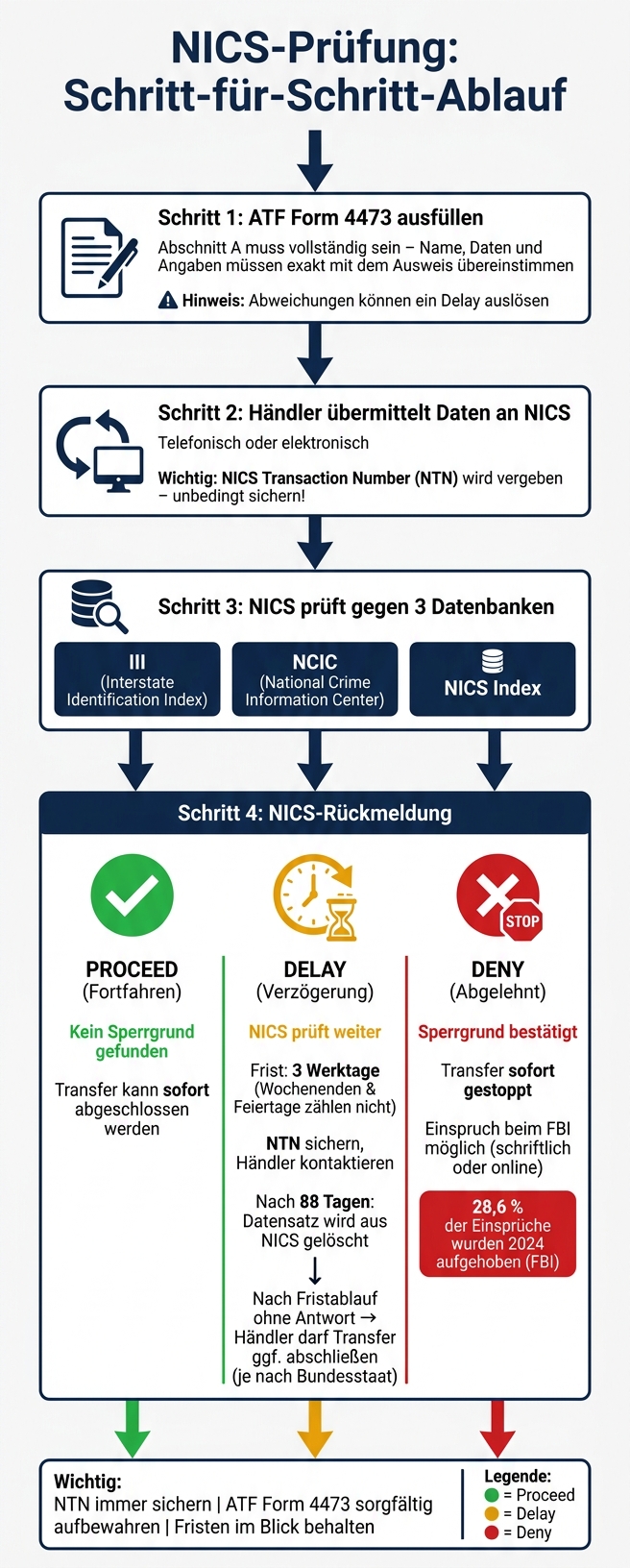
NICS Check Process: From ATF Form 4473 to Proceed, Delay or Deny
Gun Background Delayed NICS Check - What's going on?
sbb-itb-1cfd233
Step 1: How the NICS Check is Started
The dealer only starts the NICS query after the ATF Form 4473 has been completely filled out and reviewed. The transfer is stopped until a response is received. The key point is therefore a fully completed ATF Form 4473.
ATF Form 4473 and the Buyer Data
The ATF Form 4473 is the required transaction form for firearm transfers at an FFL dealer. It contains the buyer’s information as well as the legally required yes/no answers regarding possible disqualifications. Section A must be complete before the query.
Even small discrepancies compared to the ID can slow down the matching. A transposed number, an abbreviated name, or a different spelling might seem minor at first. In practice, however, such things can cause delays.
After that, the dealer submits the data to NICS.
Submission by the Dealer and Database Check
The dealer sends the data to NICS by phone or electronically. A NICS Transaction Number (NTN) is assigned for the query.
NICS then checks the information against three databases in parallel. Specifically, NICS compares these systems:
- III
- NCIC
- the NICS Index
The resulting response will be explained in the next step.
Step 2: NICS Response and Dealer Reaction
After submission, NICS returns exactly one of three answers: Proceed, Delay, or Deny. This completes the technical query. From this point on, the response determines how the transfer proceeds.
The dealer only continues once this response is received. They also record the result along with the NTN. The next steps in the process are based exactly on this.
Initial Response: Proceed, Delay, or Deny
NICS initially returns one of these three answers:
- Proceed: The dealer can continue the transfer.
- Delay: The process is temporarily halted because NICS needs more time to review.
- Deny: The transfer may not proceed.
In short: The decision is not based on the dealer’s gut feeling but on this response.
What the Dealer Records and Communicates
The dealer documents the response along with the NTN. This is the core of tracking in the further process.
To the buyer, the dealer then communicates the status, whether the transfer can continue, must wait for now, or is not allowed. The technical inquiry itself is already done at this point; now it’s just about what Proceed, Delay, or Deny triggers in the specific case.
Official Results and Waiting Times
Proceed, Delay, and Deny in Direct Comparison
As soon as the NICS response arrives, it’s clear how the transfer proceeds: go ahead immediately, wait for now, or stop completely.
The respective status determines the next step:
| Result | Meaning | Transfer possible? | Next step |
|---|---|---|---|
| Proceed | No disqualifying reason found | Yes, immediately | Dealer completes the transfer |
| Delay | NICS is still reviewing | Not for now | Dealer waits for the final response |
| Deny | Disqualifying reason confirmed | No | Transfer is stopped |
Delay is the only case still open. That means: NICS needs more time because a record is unclear, incomplete, or ambiguous.
The Three-Business-Day Rule in Practice
From the Delay notification, the three business day period starts. Weekends and public holidays do not count.
If no final response with Proceed or Deny arrives within this period, the dealer may complete the transfer. However, stricter rules may apply depending on the state. Then the dealer must also follow those rules.
How buyers and dealers proceed after Delay or Deny follows in the next step.
What Buyers and Sellers Should Do After a Delay or Denial
As soon as NICS reports a Delay or Deny, three things matter: deadline, documentation, and the next step.
After a Delay: Wait, Request Feedback, Secure Documents
A Delay does not automatically mean a denial. It just means the case is still being reviewed. That’s exactly why you should immediately secure the NICS Transaction Number (NTN). Without this number, any later status inquiry or appeal quickly becomes a shot in the dark.
Write down immediately:
- NTN
- Date
- Dealer
- Firearm data
Also, stay in contact with the dealer. Only this way will you find out if NICS later sent a new response.
One point is often overlooked: delayed transactions are deleted from the NICS system after 88 days.[1][4] After that, any resolution basically relies only on your own documents and the dealer’s data. So you should keep this deadline clearly in mind.
If a Denial comes immediately instead of a Delay, the transfer ends right away.
After a Denial: Stop transfer and check for appeal
With a Denial, the transfer stops immediately.[2][3] The dealer records the result including NTN and date on the ATF Form 4473 and keeps the documents.
As a buyer, you should not try to bypass the issue through another dealer. That won’t improve the situation. If you believe the Denial is due to an error, the proper way is to file an official FBI appeal. You submit this in writing or via the appropriate portal. You must provide the NTN and your current address.
According to the FBI, 28.6% of challenged decisions were overturned in 2024.[4] This shows: an appeal can be worthwhile if the decision was incorrect.
| Situation | Buyer | Dealer |
|---|---|---|
| Delay | Secure NTN, request feedback, keep documents, watch the deadline | Document Delay on Form 4473, track the 3-business-day deadline, and complete the transfer only after a final Proceed or after the deadline expires according to the rules |
| Denial | Do not continue transfer, do not attempt bypass, file official appeal if you suspect an error | Stop transfer immediately, record Denial on Form 4473 and keep the documents |
Summary: The key steps at a glance
In the end, process, deadline, and documentation decide. Without NTN and ATF Form 4473, any later clarification becomes much harder.
FAQs
Who performs the NICS check?
The NICS check (National Instant Criminal Background Check System) is usually conducted by the FBI in the USA.
In some states, it works differently: there, so-called Point-of-Contact agencies perform the check directly instead of forwarding the request to the FBI.
Why does a Delay occur despite correct data?
A Delay can also happen even if the data itself is correct. This usually occurs when automated systems reach their limits or submitted documents are not clear enough.
Typical triggers are:
- incomplete documents
- hidden or cropped information
- redacted fields
- poor image quality
- contradictory information
- multiple use of the same document in different accounts
In short: It’s not just the content that matters, but also how clearly and cleanly the documents are submitted.
What happens if I have lost my NTN?
The NTN is part of the US American NICS system. In Germany, there is no direct equivalent.
Here, the identity and acquisition check is handled by the responsible firearms authority. Proof can be, for example, the firearms ownership card or a hunting license.
If there are doubts, direct contact with the firearms authority is the safest way to ensure legal clarity.

 Auction