12 Criteria for Buying a Used Firearm
The purchase of a used firearm can save money but carries risks. Safety, technology, and legality are crucial. Here are the 12 most important criteria at a glance:
- Legal Documentation: Check the firearm ownership card (WBK), verify the serial number, and ensure proper transfer of ownership.
- Technical Inspection: Examine the barrel, bolt, trigger, and safety mechanism closely.
- Performance Test: Conduct a shooting test to evaluate precision and reliability.
- Seller Evaluation: Assess the seller's credibility, compare prices, and account for additional costs.
A systematic approach protects against defects and legal issues. Read on for detailed tips and a downloadable checklist.
Legal Requirements
The requirements can be divided into three main areas:
Check Firearm Ownership Permit
Ensure that:
- Both parties have a valid firearm ownership permit.
- The appropriate WBK (green for hunting, yellow for sports, red for collectors) is present.
Cross-Check Serial Number with Documentation
Verify the serial number for the following points:
- Is it clearly legible and intact?
- Does it match the entries in the WBK?
- Does the firearm have the correct import marking if it originates from abroad?
Steps for Ownership Transfer
Before Purchase:
- Buyer: Obtain acquisition permit.
- Seller: Have original documents ready.
At Purchase:
- Create a written purchase contract with all transaction details.
After Purchase:
- Complete registration with the firearms authority within 14 days.
- Have the seller's WBK entry deleted.
After the legal check, the firearm should also be technically inspected.
Technical Inspection of the Firearm
Here are the key areas that should be checked:
Examine Barrel Condition
The barrel is the heart of any firearm. A thorough inspection with a bore light is essential. Pay particular attention to:
- Rust or pitting inside the barrel
- Condition of the lands and grooves
- Damage at the muzzle
- Wear in the chamber
"The most important areas in a used firearm are the barrel condition, the bolt, and the trigger mechanism. These components directly affect safety and performance." - Mark DeYoung, former CEO of Remington Outdoor Company
Check Bolt and Locking Mechanisms
The locking system is crucial for safety and function. Perform the following checks:
- Smooth bolt movement: The bolt should move without hesitation.
- Locking surfaces: No excessive wear marks.
- Extractor and ejector: Must function smoothly.
- Magazine well: The magazine should be easily inserted and removed.
Test Trigger and Safety
A functioning trigger and safety system are essential for operational safety. According to SAAMI standards, the trigger weight for rifles should be between 1.1 and 2.7 kg (2.5–6 pounds). Check:
- Trigger characteristics: How clear is the pressure point, how smooth is the follow-through?
- Safety function: The safety must block effectively.
- Trigger reset: The trigger should reset clearly.
- Consistent trigger weight: The weight must remain stable.
Inspect Wear Parts
Wear parts such as closing springs or firing pins are safety-relevant. Check:
- Closing spring: Tension and possible deformations.
- Extractor and ejector: Wear on contact surfaces.
- Firing pin: Damage to the tip.
- Magazine catch: Secure and firm locking of the magazine.
After the technical inspection, the practical test is the next step. In the following section, learn how to test the firearm under realistic conditions.
Performance and Shooting Test
Conducting the Shooting Test
A practical shooting test is essential to realistically assess the performance of a used firearm. This should always be conducted at an approved shooting range.
Use brand new ammunition in the appropriate caliber. Start with single shots to check basic function, then move on to multiple shots to test reliability.
Use different types of ammunition: Standard ammunition (30 rounds), Match ammunition (15 rounds), and Service ammunition (20 rounds) to comprehensively evaluate function, precision, and reliability.
"A proper shooting test is the ultimate litmus test for any used firearm. It reveals problems that even the most careful visual inspection might overlook." - Tom Beckstrand, firearms expert and former U.S. Army Ranger
Assess Precision and Function
Pay attention to the grouping of shots: Hunting firearms should have a grouping of ≤3 cm at 100 m, defensive firearms ≤8 cm at 25 m.
Other important points include:
- Consistent recoil and stable point of impact
- Smooth magazine changes and reliable case ejection
Interestingly, 23% of tested used firearms show defects such as worn recoil springs or barrel wear only during the shooting test.
Warning signs during the shooting test:
- More than 2-3 malfunctions per 100 shots
- Irregular shot groups without a clear pattern
- Fluctuating trigger pressure
- Noticeable noises or vibrations while shooting
Document all shot groups and any malfunctions thoroughly – this information is crucial for the purchasing decision. After the test, inspect the barrel, bolt, and trigger again to identify any potential damage or wear.
Following the practical test, you can finally evaluate the seller's competence and pricing.
sbb-itb-1cfd233
Seller and Price Assessment
Check Seller's Credibility
The trustworthiness of the seller is crucial when buying a used firearm. Commercial dealers should have a valid firearms dealer license and ideally be a member of professional associations such as the NSSF.
For private sellers, these points are particularly important:
- Communication behavior: A credible seller answers questions openly and in detail.
- Inspection location: Willingness to meet at a neutral location (such as a shooting range or gun shop) indicates credibility.
Compare Market Prices
Prices in the used firearm market can fluctuate significantly, influenced by:
- Seasonal demand: Prices often rise before the hunting season.
- Changes in legislation: New regulations can temporarily increase demand.
- Model cycles: Older models lose value.
- Economic conditions: Supply increases during crises.
For price determination, consider:
- Marketplaces: Use established online platforms and local gun shows.
- Price guides: The "Blue Book of Gun Values" provides helpful benchmarks.
- Comparative offers: Obtain at least three quotes from local dealers.
Calculate Additional Costs
In addition to the purchase price, there are often additional costs, such as:
- Authority fees: €20–70
- Basic cleaning: €20–50
- Maintenance materials: €30–70
- Storage: Gun safes starting at €100
- Optics/Accessories: €50–1,000
Tip: Plan about 15–30% of the purchase price for potential repairs or spare parts. Especially for older firearms, spare parts and specialized maintenance can significantly increase the total price.
Important wear parts to keep an eye on:
- Seals: Must be replaced regularly.
- Firing pins: Often wear out and should be checked.
"A proper shooting test is the ultimate litmus test for any used firearm. It reveals problems that even the most careful visual inspection might overlook." - Tom Beckstrand, firearms expert and former U.S. Army Ranger
A thorough examination of these points helps avoid unpleasant surprises. Be cautious with suspiciously low prices – they can be a warning sign.
After evaluating the seller and costs, you can use the final checklist to summarize all important inspection points.
Conclusion: Key Points When Buying a Used Firearm
Buying a used firearm requires careful planning and a systematic approach. Three main aspects should be the focus:
Safety and Legality
Compliance with legal requirements is of utmost priority. Thoroughly check the documentation and serial numbers to ensure everything is legally sound.
Technical Inspection
The condition of the firearm affects both its value and safety. Pay particular attention to:
- The condition of the barrel, the function of the safety, and the wear of components.
- A flawless function of all safety mechanisms – there are no compromises here.
Costs and Planning
In addition to the purchase price, additional costs should also be considered. Plan about 15-30% of the purchase price as a reserve for potential repairs.
Practical Tips for Buying a Used Firearm
- Use online tools like price comparison portals and databases to determine the current market value.
- Insist on a written purchase contract and a handover protocol.
- Consider hidden costs such as cleaning materials or insurance.
- Bring an experienced shooter or gunsmith for the initial inspection.
Well-inspected used firearms can be a cost-effective alternative – often with savings of 30-50% compared to new firearms. Use the provided checklist to review all important points step by step.
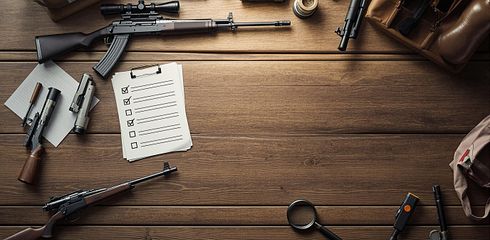
Downloadable Checklist for Buying a Used Firearm
Use this clear checklist to document all important points when buying a used firearm:
| Inspection Area | Elements to Check | Confirmed? |
|---|---|---|
| Legal | • Check WBK • Verify serial number • Check transfer documents |
Enter document number |
| Technical Inspection | • Barrel condition • Bolt mechanism • Test trigger and safety |
Use evaluation scale |
|
Shooting Test Results (see Section 4) |
• Conduct shooting test • Assess precision • Check function processes |
Record results |
| Price Analysis | • Compare market value • Calculate additional costs • Consider accessories |
Create cost overview |
Tips for Application:
A careful examination protects you from future problems. Take your time and proceed step by step.
[Download Checklist] (PDF, 2 pages, 0.5 MB)