Payment Monitoring for Firearms Trade: Guide
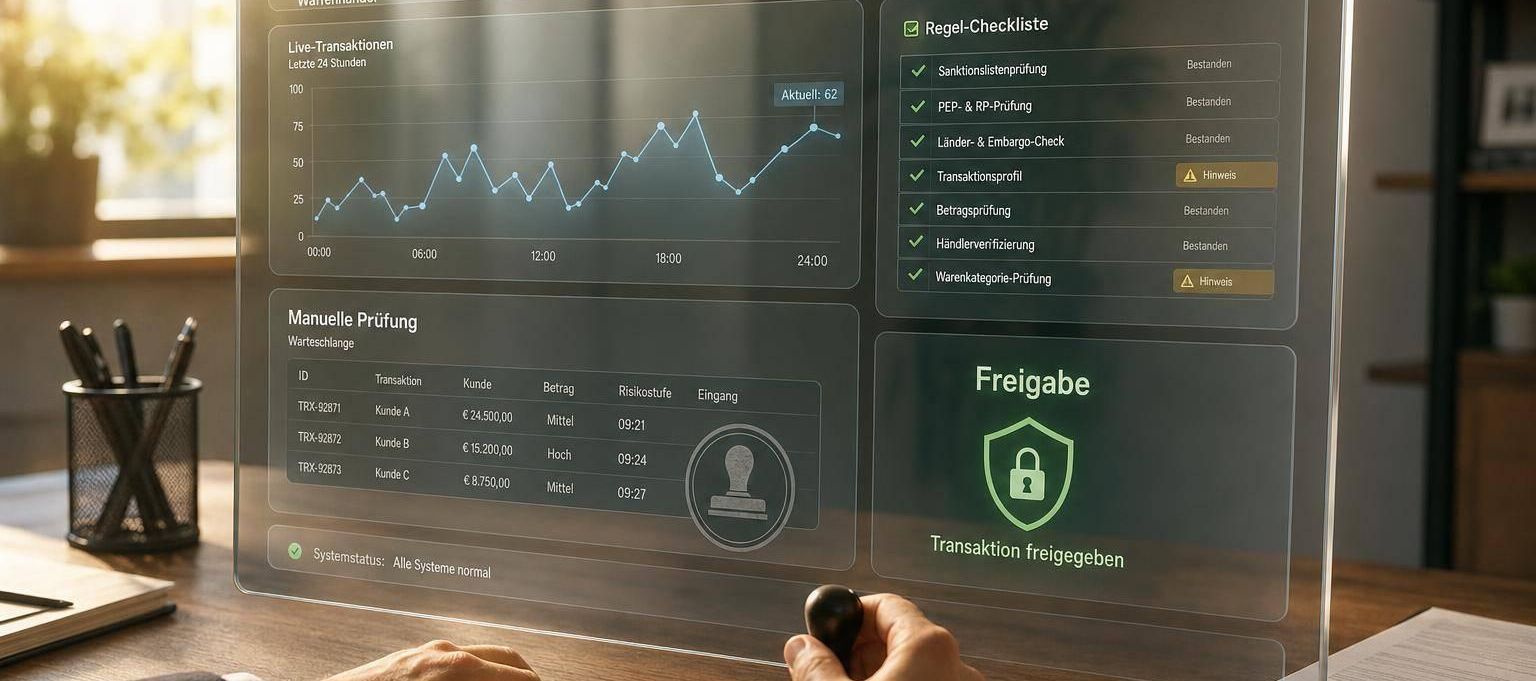
If I boil down Payment Monitoring in firearms trade to one sentence, it is this: I only allow an authorized payment to proceed when amount, account, device, address, authorization, and pattern all match.
In short, I check four things here:
- What was purchased? For example, handgun, suppressor, or hunting clothing.
- Who is buying? That means account history, age, identity, and proof of acquisition.
- How does the purchase appear? For example, high cart value, new device, or differing delivery details.
- What happens next? Release, manual review, rejection, or escalation.
The core of the article is clear and direct:
- Payment Monitoring sits between authorization and shipping release
- Only about 5–15 % of payments go into manual review
- Typical rules are thresholds, velocity checks, and deviations from normal account behavior
- A case often only becomes critical when multiple signals occur simultaneously
- As long as
risk_hold = trueapplies, shipping and payout remain blocked - In the marketplace, onboarding, checkout, shipping, and payout must use the same risk signals
Therefore, I do not see the text as a legal guide, but as a clear process for payment checks for regulated goods. The goal is simple: not just to authorize payments, but to properly check, document, and hold them if necessary before release.
After that, the article covers data sources, alerts, manual review, real-time methods, and integration into the entire marketplace process.
Data Sources and Warning Signals for Risk Checks
A single data point is not enough to safely classify a payment. That’s why the system uses multiple layers of data. Only from this interplay does the later risk decision arise: a payment is automatically released, goes into manual review, or is blocked. Simply put, basic data checks value and category, context signals check origin, and behavioral signals detect suspicious patterns.
Basic Payment and Transaction Data
Every transaction first brings a set of basic data. This includes the amount in euros, for example €1,249.00, the payment method used, buyer and seller ID, as well as date and time in German format, e.g. 08/12/2026, 2:37 PM. Added to this is the item category.
This point often makes the difference. A transaction for a handgun or a suppressor carries a different risk weight from the start than a purchase in the hunting clothing category. That’s obvious: not every product group requires the same depth of checks.
Account history also plays a big role. An account that has been unremarkable for a long time usually appears less risky than a new account that immediately makes a high-value purchase. Added to this is the proof of acquisition authorization. Especially for regulated items, this is a central check point and not a minor detail.
Behavioral and Technical Warning Signals
In addition to the basic data, context and behavior also count. Context signals show from where and with which device a purchase is made. If the IP address deviates from the registered region or a new device is suddenly used for a purchase in a regulated category, the risk increases. Such deviations are not always proof of misuse, but they are a clear warning sign.
Behavioral signals are often harder to see but often particularly insightful. Typical patterns are repeated payments just below internal thresholds – a classic sign of Smurfing – or a sudden increase in order frequency on a previously inactive account. A sudden switch to a regulated category also stands out. Exactly such patterns should be automatically forwarded to manual review [2].
| Signal Category | Examples | Purpose | Higher Weight for |
|---|---|---|---|
| Basic Payment Data | Amount, payment method, category | Compliance basic check and financial risk measure | High-priced items or sellers with chargeback history |
| Context Signals | IP address, device ID, address deviation, acquisition eligibility | Fraud prevention and verification of acquisition eligibility | Deviations between IP, billing and shipping address or new device for regulated item |
| Behavioral Signals | Order frequency, smurfing, activity spikes, category changes | Detection of money laundering, straw purchases or illegal hoarding | Previously inactive account with sudden high purchase activity in regulated category |
sbb-itb-1cfd233
Step by Step: From Alert to Manual Review and Approval
Payment Monitoring im Waffenhandel: Vom Alert zur Freigabe
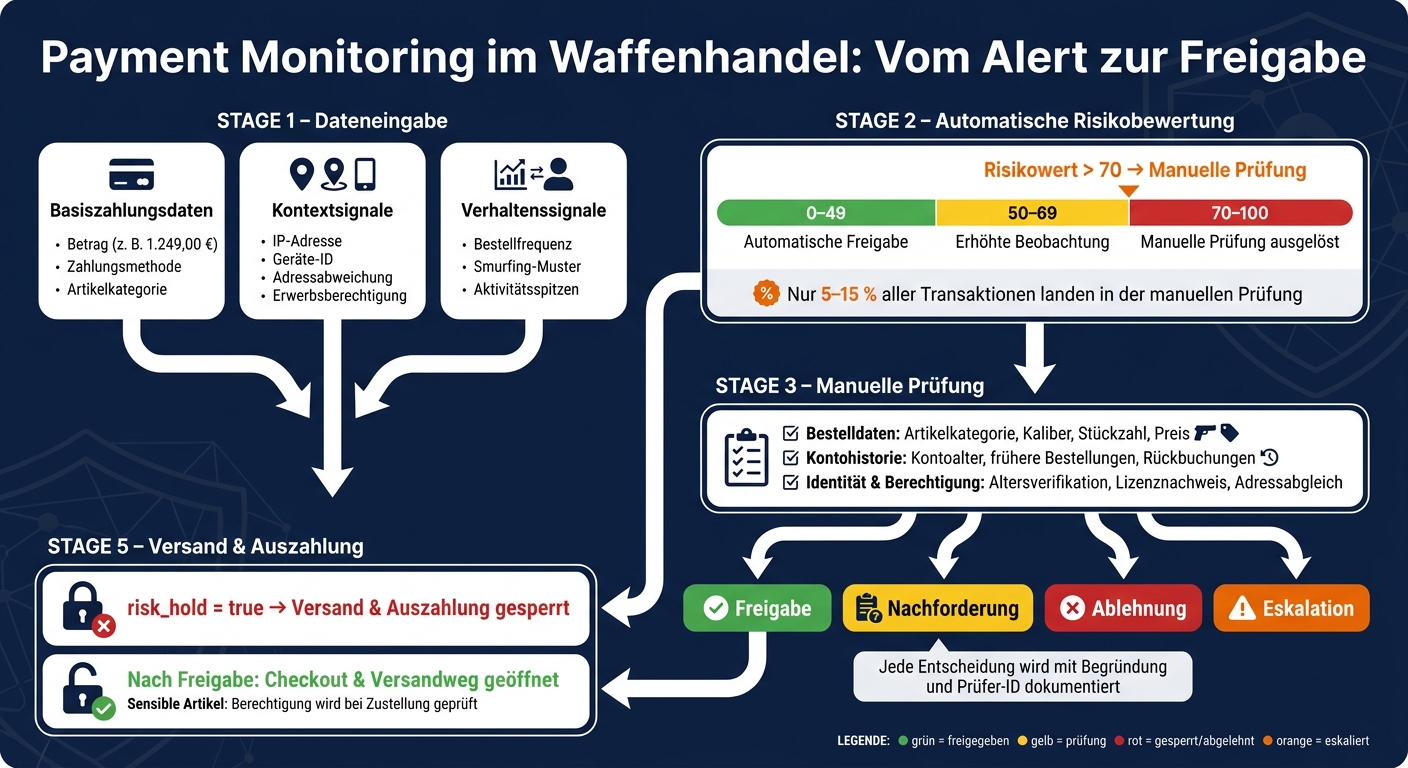
Based on the payment, context, and behavioral signals mentioned in the last section, the system evaluates each transaction in real time. In practice, only about 5–15 % of all transactions end up in manual review [3].
How Rules and Scoring Alerts Trigger
Multiple rules and a risk score combine the signals into a decision. Threshold rules apply, for example, when a single order for certain long gun categories exceeds €3,000.00. Velocity rules trigger when more than three high-value purchases occur within 60 minutes. Additionally, there are deviations from comparison groups: If a new account buys several high-value long guns within 24 hours, this clearly doesn’t fit the usual pattern of similar new customers and is flagged [4].
The model usually only gains significance when multiple signals come together. A high order value alone doesn’t necessarily mean anything. But if there’s a new account, unusual IP data, and different billing data, the picture looks different. If the risk score exceeds a set threshold, for example 70 out of 100, the case goes to manual review [6][7].
What Happens During Manual Review
The reviewer sees order, account, and identity data as well as suspicious communication in a combined view. Three areas are checked:
- Order data: Item category, caliber, quantity, and price compared to the usual market price. Also, whether this combination seems plausible for a private hunter or sport shooter.
- Account history: Account age, previous orders, chargebacks, cancellations, and compliance notes.
- Identity and authorization: Identity verification, age verification, matching name and address with the payment method, and appropriate license proofs for regulated items.
In the end, there is always one of four decisions: approval, request for more information, rejection, or escalation. Each decision is documented with reasons, the checked signals, and the reviewer ID, and triggers the appropriate notifications [8][10].
After the review, the case proceeds to approval, inquiry, or blocking.
How the release is linked to shipping and checkout
Release does not automatically mean shipping. As long as risk_hold = true is set, shipping and payout remain blocked [5][9]. In checkout, strong customer authentication also applies before the payment is considered successfully authorized. Only after the release are checkout and shipping reopened. For sensitive items, shipping is additionally tied to an approved shipping method that verifies authorization upon delivery [1].
The status is clearly visible to buyers in checkout. Sellers receive the shipping confirmation only after the release.
Automatic releases quickly process standard cases. Manual review handles borderline cases. How such decisions are detected in real time is shown in the next section.
Real-time monitoring methods for firearms marketplaces
As soon as an alert is triggered, the marketplace needs the appropriate real-time method in the background. Because with risks in real time, one check is almost never enough. In practice, three approaches are usually combined: rule-based monitoring, anomaly detection, and network or graph analysis. This creates the audit trail that turns a simple signal into a verifiable case.
Rule-based monitoring for clear, verifiable controls
Rule-based systems work according to a simple pattern: If a transaction meets a set condition, it is automatically flagged or stopped. This is direct, easy to verify, and easily documented for audits.
In firearms trading, there is one more point: checking P-ID and E-ID. If a valid P-ID or E-ID is missing for regulated purchases, the system automatically stops the transaction. [11]
Anomaly detection for patterns that rules overlook
Rules are strong, but they have a catch: They only apply when a set value or clear trigger is met. Sometimes a transaction looks unremarkable on paper but seems odd in the overall picture.
This is exactly where anomaly detection comes in. The system compares each transaction with the usual behavior of buyer and seller. An example makes this tangible: A longtime hunter usually buys only one or two items per quarter. Then suddenly, within 48 hours, he starts ten high-priced firearm purchases on a new device. Even without a clear rule violation, this pattern stands out. The system therefore flags the case as a deviation and raises the risk score, for example to 85 out of 100. From this point, the transaction goes into manual review.
Network and Graph Analysis for Linked Risk Patterns
Rules and anomaly detection mainly focus on individual transactions or individual users. Graph analysis goes one step further and looks at the entire network behind it. Accounts, devices, payment methods, and shipping addresses are evaluated as linked data records.
This allows especially three risk patterns to be well identified:
- a shared device across multiple accounts
- the same delivery address for different buyers
- a shared payment method across multiple buyer profiles
If a data record is identified as high risk, it directly affects later approvals. Future orders related to these data records automatically receive a higher risk score. These signals later flow together into onboarding, checkout, and payout.
The following table shows the three methods in direct comparison:
| Method | Strengths | Limitations | Use on a German firearms marketplace |
|---|---|---|---|
| Rule-based Monitoring | Transparent, auditable, quickly implementable | Rigid; new fraud patterns can deliberately bypass thresholds | Basic Compliance: Category rules, verification of P-ID and E-ID |
| Anomaly-based Detection | Detects unusual behavior without rule violation; adapts to user behavior | Less transparent; requires data basis and calibration; may falsely flag legitimate bulk buyers | Behavioral Risk: Purchase patterns, device changes, volume spikes |
| Network/Graph Analysis | Uncovers coordinated abuse, such as shared devices, addresses, or payment methods | More complex; requires good assignment of identities, devices, and addresses; more for investigations than hard real-time blocks | Cluster Risk: Strawman purchases, multi-account fraud, linked fraud rings |
Embedding Payment Monitoring into a Secure Marketplace Process
Connecting Onboarding, Checkout, and Payout
Rules, scores, and patterns only make sense when they lead to clear approvals at the critical points in the process. Payment monitoring only works cleanly if risk signals from onboarding, checkout, shipping, and payout converge and support the same decision. Exactly these signals must remain visible at all approval points.
An alert from monitoring must not stand alone. It must influence the next purchase again. For example, if a document is not properly assigned, the risk score automatically increases at the next purchase. If a hunting license expires, the seller payout remains blocked until the case is resolved. And a Trusted Seller status can also flow into the approval as an additional risk signal.
The following overview shows only the points that matter in the payment and approval process:
| Marketplace Component | Monitoring Data & Applied Rules |
|---|---|
| Onboarding | Verification status, identity and authorization checks, linkage checks |
| Checkout | License verification, expiration dates, real-time checks |
| Shipping Release | Matching authorization and item, release only after confirmed payment |
| Seller Payout | Final risk value, shipping confirmation via approved shipping providers, blocking during open verification process |
That only covers the minimum for now. Real security only arises when these rules are consistently enforced in daily practice.
Conclusion: The Minimum for Safer Payment Monitoring
The minimum is clear: connect signals, check license data, block payouts, document decisions.
FAQs
When is a payment manually checked?
A manual check comes into play when extra careful scrutiny is needed. This often happens via video call, for example to directly verify documents or identity.
Also, if important account data changes or a re-check is due, the account is manually reviewed. Identity verification usually only happens once. It’s different with firearms-related documents: they are re-checked according to fixed official cycles.
Why is a payment authorization not enough?
A payment authorization only confirms that money is flowing. Nothing more.
It says nothing about identity, age, or required firearms-related proofs like WBK or hunting license.
In firearms trade, you must therefore check these documents separately and document them properly. If you skip this, it can get expensive. Fines or even revocation of your own firearms permit may be threatened.
Which signals especially increase the risk?
It gets particularly tricky when identity and authorization don’t match cleanly. This is the case, for example, if name, birthdate, or other details differ between ID, WBK, hunting license, and account.
The risk also clearly increases if documents are incomplete or hard to read. The same applies to ID documents used in multiple accounts. With foreign documents, it quickly becomes critical if they don’t align with residence permit and firearms authorization.