5 cases for manual ID verification in firearms trade
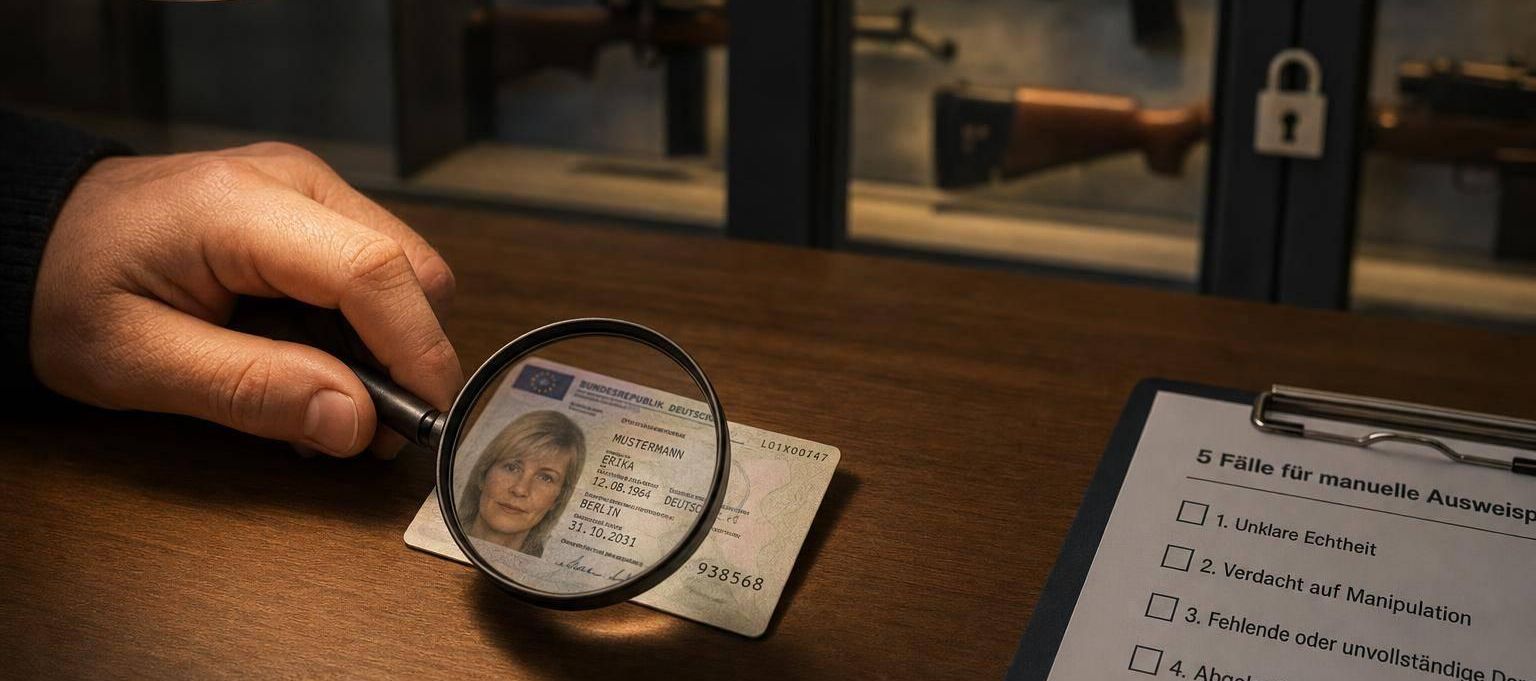
My brief conclusion: In firearms trade, I may only approve a purchase if person, document, and permit match perfectly without gaps. As soon as there are issues with name, legibility, multiple use, or foreign papers, I stop the approval and check manually.
This applies especially in these 5 cases:
- Name differs: ID, firearms license, hunting license, or account do not match exactly.
- Documents are incomplete: corners, MRZ, number, or validity are missing.
- Photos are poor: blurry, dark, reflective, or partially obscured.
- Documents appear multiple times: same ID document in several accounts.
- Foreign IDs or residence permits: data, validity, and firearms permit must match.
What matters to me: not speed, but a clean verification process. Even small discrepancies can lead to a stop. And if documents are not clearly legible, I request new pictures instead of approving “on suspicion.”
In short: I check manually when the case is no longer clear. This reduces the risk of incorrect approvals, issues with the WaffG, and trouble with authorities.
| Case | How I recognize it | What I do |
|---|---|---|
| Name discrepancy | Spelling, double name, old data after marriage | Compare data, request proof, document decision |
| Incomplete copy | MRZ, number, date, or pages missing | Request new complete images |
| Poor image quality | blurry, dark, reflection | Request resubmission |
| Document used multiple times | same ID in several accounts | Check account and document, document case |
| Foreign documents | passport, permit, firearms license/hunting license must match | Check identity, residence, and permit |
I summarize the article to the essentials: Automation for clear cases, manual check for borderline cases.
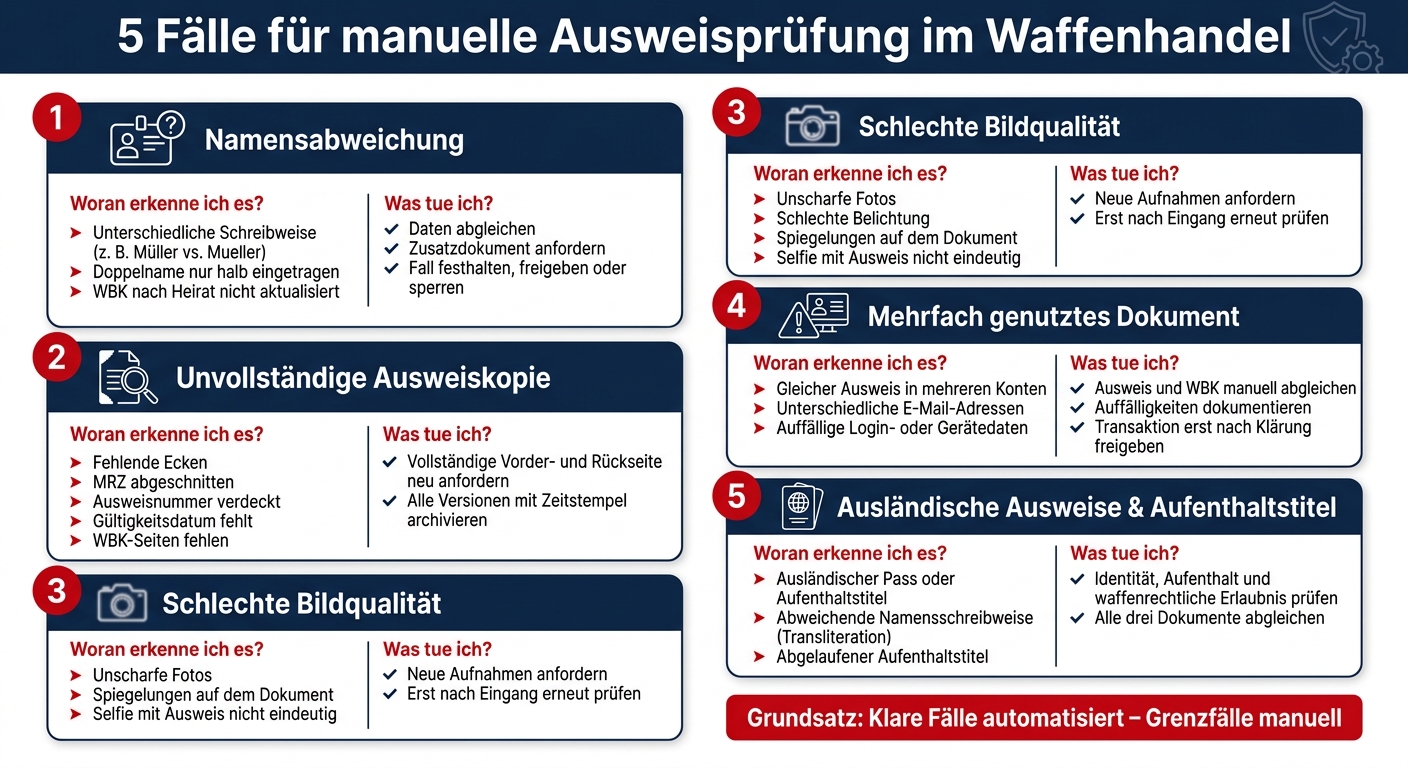
5 Cases for Manual ID Verification in Firearms Trade – Overview
Why Manual ID Verification is Essential in Online Firearms Trade
Automated systems usually only check if documents appear formally consistent. Whether the person, the ID, and the firearms license actually match must be verified by a human. [10]
In the German firearms trade, every authorization check involves more than a quick data comparison. Identity, age, as well as conditions and time limits in the WBK or hunting license must be verified. [2][8] It is exactly at these points that deviations appear in the five practical cases below.
What matters? Precision down to the detail. Even small differences in name, date of birth, or spelling can require a manual check. [7][8]
If ID and WBK are available, the firearms authority compares the data after the holder’s consent. [6]
The five cases below show which deviations trigger a manual check. [2][8][9]
sbb-itb-1cfd233
1. Name spelling does not match – ID, WBK and account data differ
A differing name is a typical reason for a manual check. In the NWR, the name must match the ID exactly. Even small differences can trigger the check.[2][11] Once the name is clarified, the next point comes immediately: Is the ID complete and clearly readable?
Typical cases are quickly told: The account says “Müller,” but the ID says “Mueller.” Or a double name was only partially entered. After a marriage, deviations often occur if the WBK has not yet been updated. In such cases, an additional document can explain the difference.
It becomes more critical if the first names do not match or even indicate different persons. That is a clear stop signal. The same applies if the date of birth or address also differ or if the user cannot explain the difference.
Then it basically always works the same way: compare data, record the case, and then approve or block it. If the identity remains unclear despite name discrepancies, the process is blocked.
2. Hidden or incomplete ID copies
Even if the name and account data match, it often ends immediately at this point: As soon as a document is not fully readable, approval is usually stopped. This applies to the ID as well as the WBK. If something is hidden, cut off, or only partially visible, the automatic check often no longer works.
For verification, the system needs the complete document. This includes:
- all four corners
- the machine-readable zone (MRZ)
- ID number
- validity date
- photo
In firearms trading, this is not a small technical problem but a clear compliance case. Anyone who approves a transaction based on an incomplete copy as a dealer takes a high risk. Violations of the identity and age verification obligations under the WaffG are at stake – in the worst case fines or even revocation of the firearms license.[6] It is not decisive whether something probably is correct. What matters is reliable proof.
Typical cases are quickly named: hidden ID numbers, cut-off MRZ, missing validity date, hidden WBK pages, or blacked-out fields. The last point often causes trouble. Some customers black out data for privacy reasons. That sounds reasonable at first, but with firearms-related documents, it directly conflicts with documentation obligations.
As soon as complete images are available, the case goes into manual final review. Set the process to “under review”, request complete front and back sides as well as WBK or hunting license if needed, check again afterwards, and archive all versions with a timestamp.
3. Poor lighting or blurry document photos
Even a complete upload can fail if light, sharpness, or reflections make the data unreadable. Poor lighting, reflections, or a blurry photo are often enough for the check to stop immediately. Then there is only one option: resubmit – with better images.
This mainly concerns these documents:
- ID card, front and back
- WBK
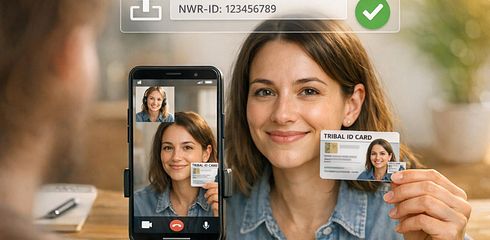
- Selfie with ID
As soon as data, photo, or security features are blurry, overexposed, or reflecting, it cannot be reliably checked. That’s exactly when the automatic check reaches its limit, and a human must review it. New photos are almost always necessary in such a case.[1][5]
“When checking your information, we could not clearly verify that you are who you claim to be.” – Gunfinder Help Center [5]
Before approval, ID, WBK, and selfie must be clearly readable and consistent. If information is hidden, the image is too dark, or light reflects on the document, request new shots and only then continue checking.
4. Duplicate Accounts and Reused Documents
If ID and WBK are clearly readable, the next step is to check whether the same data has already been used elsewhere. If the same ID document appears in multiple accounts, that is a clear warning sign. Such a case belongs in manual review. Often it goes like this: after a block, a second account is created with the same ID copy but a different email address. From then on, not only the document counts but also the behavior in the account.
Repeated use of a genuine, foreign ID can be punishable – even with digital upload.
If ID data has been used multiple times, you should manually compare the identity card and WBK, carefully record any irregularities, and only then decide on approval.
For multiple accounts, a mere name check is not enough. Specifically check these patterns:[7][14]
- Does the photo on the ID match the account holder?
- Are there discrepancies in payment methods or delivery addresses between the accounts?
- Are there login or device data that indicate identity misuse by third parties?
Only when these points are clarified may the transaction be approved.
Record the review note, correspondence, and decision. This way the process remains traceable for internal teams, supervisory authorities, and, if necessary, law enforcement.[14][12]
5. Foreign IDs and Residence Permits
Another typical review case concerns foreign IDs and residence permits. Such documents often end up in manual review because many systems are primarily designed for German IDs.
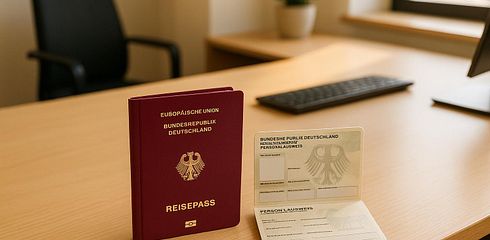
For approval, three points must be clarified: identity, residence permit, and the appropriate weapons law authorization.[15] Check name, date of birth, nationality, and document number in passport, residence permit, and WBK. If details differ, this must be properly clarified before approval.[4][3]
These are the typical document combinations in practice:[15][16][17]
| Buyer group | Typical documents |
|---|---|
| EU citizens residing in Germany | Identity card or passport of the home country + WBK or hunting license |
| Non-EU citizens residing in Germany | Foreign passport + valid residence permit + WBK or hunting license |
What really matters in the end? Not the country of origin, but the seamless verification of person, residence, and authorization. Also check if the residence permit is still valid. If it has expired, the transaction can be legally problematic despite a valid passport.[16]
Another point is different spellings of names. Especially with transliterated names, discrepancies occur. This is not automatically a reason for exclusion. But it must be documented and carefully verified.[4][3]
What inspectors must check before approval
After the case review, there is always the same final check: name, document, and account must match perfectly. If there is any discrepancy, approval may only be granted once the issue is resolved.
Expired documents immediately stop the approval. Additionally: the submitted document must also match the firearm and the respective authorization.
If a picture is not clearly readable, new documents must be submitted [1][13]. This also applies if the selfie with the ID does not clearly show that the account holder and document holder are the same person. In other words: if you have to look twice, it’s not good enough yet.
The account itself can also trigger a new review. Suspicious logins, many unusual transactions, or later changes to account data are warning signs that must be checked before approval.
| Check point | Action |
|---|---|
| Name does not match (ID, WBK or hunting license, account) | Clarify before approval |
| ID or hunting license expired | Do not approve |
| Image quality insufficient | Request resubmission |
| Selfie with ID not clear | Request resubmission |
| Account irregularities (login, transactions) | Re-examination |
How Marketplaces and Sellers Stay Compliant – Without Unnecessary Hurdles
The five cases show where checks are necessary. Now it’s about setting up processes so these checks are needed less often.
The biggest leverage lies in clear upload requirements. The clearer the upload process, the less often the same mistakes occur – like unreadable or incomplete documents. A short step-by-step guide right in the upload area helps a lot. Notes on image quality, completeness, and all required document pages prevent many inquiries upfront [1]. Cases that are still unclear should go into a fixed manual review path. This way, legal buyers and sellers aren’t unnecessarily slowed down.
When a case escalates, one thing counts above all: a clean internal trail. Every review decision must be recorded – when a case escalated, why it happened, and how it was resolved. This makes decisions transparent and ensures similar cases are treated equally. Communication and documents belong in the platform chat, not in external channels [6].
Case 5 also clearly shows another point: The team must be able to securely classify foreign IDs and residence permits. Knowing the common European documents saves time and avoids unnecessary delays in cross-border transactions. This is often where everyday issues arise.
Already verified accounts should only be rechecked if critical data changes. This keeps approvals fast without losing review quality.
Conclusion
Automated checks don’t always work in firearms trading. When data conflicts, documents are hard to read, or accounts stand out, a human must review the case. The five examples in the article show exactly this limit.
At this point, the five cases separate the standard case from the borderline case. The principle is clear: clear cases automated, borderline cases manual.
In the end, speed doesn’t count, but a clean review process. For Gunfinder, that means: secure approval over speed. Clean verification is the basis for safe and compliant trading. When in doubt: stop automatically, review manually, then approve.
FAQs
Which name deviations are still uncritical?
For identity verification, name, address, and date of birth must generally match exactly your official records. This also applies to middle names and name additions.
If you’re unsure, ask your responsible firearms authority for a master data sheet. This shows which details are stored in the National Firearms Register and helps you avoid problems with identity verification on Gunfinder.
Which documents do I need to submit for IDs from abroad?
For IDs from abroad, proof of identity alone is usually not enough. You generally also need a Waffenbesitzkarte (WBK), in addition to a document like a passport or an EU national ID card.
For non-EU citizens, there’s a bit more: A residence or settlement permit is only accepted together with a WBK. That’s why it’s worth checking the documents carefully beforehand. All documents must be valid, and the personal data must match exactly.
The verification is often done manually. That means: your documents might be checked, for example, in a video call.
When is an already verified account checked again?
An identity check is usually only needed once. However, your account will be checked again if you change important account data or if a new check is required for another reason.
Separate from that, the verification cycles for firearms law documents like the Waffenbesitzkarte apply. Official deadlines apply here: your need will be checked again after five years and once more after ten years.