Adjustable stock: purchase check

If the stock doesn't fit, the shot often doesn't fit either. I always check fit, mechanics, system compatibility, weight, price, and condition before purchasing.
In short:
An adjustable stock is only worth it if it works play-free, fits the weapon and optics, and is immediately correct when shouldered. Even few millimeters in stock length or up to 30 mm in cheek height can make the image through the scope clearer. For weight, it usually applies: under 800 g carries comfortably, over 1.3 kg often lies steadier when shooting.
These are my first points of focus:
- Fit: stock length, cheek height, butt pad
- Material: wood, laminate, plastic, or carbon/magnesium
- Mechanics: no wobbling, no loose locking
- Compatibility: system, magazine, barrel channel, bolt travel
- Weight: suitable for stalking, sitting, or shooting range
- Cost: stock plus spacer, butt pad, sling swivel
- Condition: for used items, pay special attention to cracks, bedding, and threads
My brief conclusion:
Those who often shoot with optics, wear thick clothing in winter, or shoulder differently depending on the type of hunting usually benefit from an adjustable stock. However, I would never buy solely based on price. Fit and secure seating are usually more important than many adjustment options or extra parts.
| Point | What I look for |
|---|---|
| Fit | Is my eye cleanly behind the optics? |
| Material | Does the stock withstand moisture, cold, and recoil? |
| Adjustment | Does everything remain firm and repeatable? |
| Compatibility | Does the stock fit my system without problems? |
| Weight | Rather light for carrying or heavier for more stability? |
| Condition | Is there play, cracks, or damage to the bedding? |
With this, I keep an eye on the points before purchasing that will make a difference later in the field and at the range.
Geartester Festival 2024: Haenel presents the new Jaeger NXT Adjustable with height-adjustable stock

sbb-itb-1cfd233
Material Check: Solid Wood, Laminated Wood, Plastic, and Carbon/Magnesium Composite
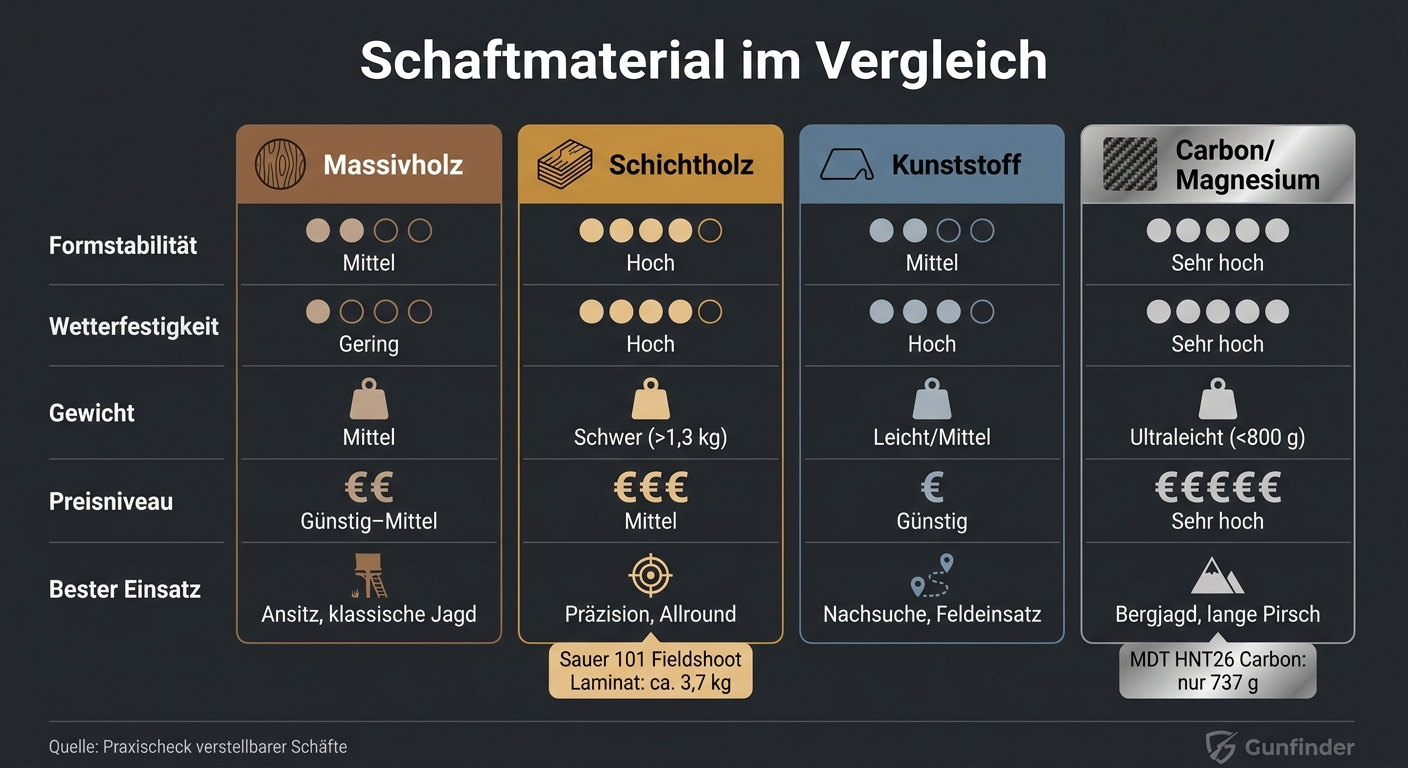
Adjustable Stock: Material Comparison at a Glance
How Material Affects Handling and Durability
After the fit, the next point is directly: the material. It determines how well the stock retains its shape in everyday use. It also affects weight, weather resistance, and stability. This is even more important for adjustable stocks, as the material must withstand adjustments over time without play.
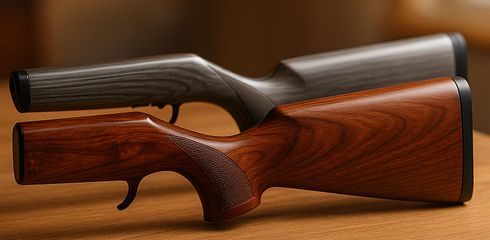
Solid wood – usually walnut – looks good and often feels warmer in cold weather than plastic. The downside: wood is sensitive to moisture and temperature fluctuations. It can swell, warp, or in the worst case, develop cracks. This is especially true if the surface is not properly sealed[9].
Laminate is significantly more robust and very shape-stable[6]. For this reason, it is well-suited for hunting and precision. However, it comes with more weight than carbon. A Sauer 101 Fieldshoot with a laminate stock weighs around 3.7 kg[5]. When considering laminate, pay special attention to sealed inner edges. Open areas attract moisture[5].
Plastic is low-maintenance and weatherproof. However, at the adjustment points, the material can give way. If noticeable play develops there, it affects the point of impact.
Carbon/Magnesium composite stocks provide the highest shape stability at a very low weight[1]. The MDT HNT26 weighs only about 737 g in the lightest configuration and uses a V-block bedding that reduces stresses between the system and the stock[1]. Good carbon stocks are often foam-filled to prevent them from sounding hollow when bumped[4]. This is a clear advantage, especially for mountain hunting or long stalks.
Checklist for Material Quality and Processing
When checking, you don't need to be a gunsmith. A few simple checks are often enough to identify weaknesses.
For solid wood, ask: Is the surface completely sealed? Are there hairline cracks on the pistol grip or at the transition to the system? Small dents are normal wear. Cracks, on the other hand, are more concerning because they can expand under recoil[8].
With laminated wood, you should pay attention to break points and cracks, especially if the stock has fallen before[2]. For plastic, press the fore-end lightly. If it visibly bends, it can affect the point of impact. For carbon/magnesium composite, check the bedding and pay close attention to the maximum torque values of the system screws. Too much torque can permanently damage the material[1].
| Material | Shape Stability | Weather Resistance | Weight Class | Price Level | Suitable For |
|---|---|---|---|---|---|
| Solid Wood | Medium | Low | Medium | rather inexpensive to medium | Stalking, classic hunting |
| Laminated Wood | High | High | Heavy | medium | Precision, all-round hunting |
| Plastic | Medium | High | Light/Medium | rather inexpensive | Tracking, rough field use |
| Carbon/Magnesium Composite | Very High | Very High | Ultra Light | very high | Mountain hunting, long stalking |
After that, check how smoothly the adjustment works.
Mechanics and Compatibility Check
Adjustment Mechanism: Locking, Repeat Accuracy, and Usability
Here, one thing counts above all: firm fit, no play, clean repeatability.
With spacer systems like the MDT HNT26, the LOP adjustment runs over fixed inserts. The cheek height is secured with two set screws. This is less variable but stiff and free of play [1][4]. Push-button systems like the GRS SpeedLock can be adjusted for LOP and cheek without tools. This is convenient in everyday use, but must be checked carefully for play and repeat accuracy [2].
When purchasing, a quick hardness test is worthwhile: Set the cheek and LOP across the entire range and then press lightly against the side. Nothing should wobble, nothing should rattle.
If the locking and repeat accuracy are correct, then take a look at the system, optics, and barrel channel.
| Adjustment Type | Robustness | Use | Price Level |
|---|---|---|---|
| Only Back (e.g. Blaser R8) | High | Hunting with optics | Medium (approx. 400–500 €) [10][11] |
| Only LOP (Spacer) | Very high | Fixed base setting | Low (included) |
| Fully adjustable (GRS SpeedLock) | Medium/High | Frequent position changes | Medium-High (600–800 €) [2] |
| Folding/Telescopic stock (MDT HNT26) | High | Compact transport | High (from 2,000 €) [1] |
The type of adjustment only says something about the operation at first. Whether the stock fits as it should is only shown by testing on the system.
Fit to system, optics, and mounting points
Proceed in this order: System fit, magazine, barrel channel, then bolt travel. This way you won't overlook anything.
“Drop-in" initially sounds like install and done. In practice, it is often not that simple. GRS explicitly recommends a professional bedding for Sako systems [2][7]. Without bedding, group sizes can be larger than expected [3]. With the Blaser R8, there is one more point: Aftermarket stocks are often only compatible with the R8 Professional trigger, not with the Professional Success [7]. Such details are not trivial. They simply determine whether the stock can be mounted or not.
| System category | Compatible stock types | Notes |
|---|---|---|
| Remington 700 (SA/LA) | MDT HNT26, GRS Berserk, GRS Hunter | Usually without rework; check magazine fit [1][4] |
| Tikka T3/T3x | MDT HNT26, GRS Varmint, KKC | Mostly without rework [1][2][7] |
| Blaser R8 | GRS Sporter, KKC | R8 Professional trigger required [2][7] |
| Sako-Systeme | All aftermarket stocks | Professional bedding recommended [2][7] |
| Strasser RS700 | MDT HNT26 (Rem-700 footprint) | Uses Remington 700 short action dimensions [4] |
Another point that often only becomes apparent late is the barrel channel. It must match the contour profile of your barrel: Standard 17 mm, medium heavy 19 mm, match 22 mm. If the channel is too tight, it lifts the barrel. Then the barrel no longer oscillates freely [7].
And before buying: Pull the bolt all the way through once. High combs or wide grips must not block the bolt travel or the safety [2].
Weight, price, and useful accessories
Weight and balance in real use
When fit and mechanics are right, it becomes quite simple in everyday life: Weight, accessories, and budget then decide whether a stock is enjoyable or annoying in the field.
The weight of the stock directly affects carrying comfort, stability, and recoil. Carbon stocks usually weigh less than 800 g. Laminate stocks often exceed 1.3 kg. The rule of thumb is clear: lighter is more comfortable to carry, heavier shoots more steadily. More mass takes some of the sharpness off the recoil and helps keep the aim steadier.
In use, the difference becomes apparent quickly. For walking and tracking, heavy adjustable stocks are often simply too heavy and sluggish. When sitting and shooting at long distances, it looks different. There, the extra weight is not a disadvantage, but rather a plus. Total weights of 3.7 to 3.95 kg without optics are common in such setups [5][6].
| Material Type | Stock Weight (approx.) | Recoil Behavior | Typical Use |
|---|---|---|---|
| Carbon | < 800 g [4] | Higher recoil feeling [4] | Mountain hunting, stalking [4] |
| Synthetic | 900 g – 1.2 kg [3] | Medium damping [3] | All-round, driven hunt [3] |
| Laminate | > 1.3 kg [2] | High damping [2] | Long-range, sitting, shooting range [5][2] |
Price Range, Accessories, and Where You Search
Regarding price: The more adjustment range, the more elaborate the material, and the better the bedding, the higher the amount will be. And that's where many misjudge. Not only does the stock itself cost money. Accessories like spacers, sling swivels, and adjustable butt pads should also be included in the budget from the start.
If you want to prioritize, start with the parts that provide the most benefit in everyday use:
- LOP Spacer
- Adjustable Butt Pad
- QD Sling Swivel
M-Lok is nice, but more of an addition than a must.
After that, it is worth taking a direct look at new and used offers. On Gunfinder, you can compare new and used adjustable stocks as individual stocks or in a rifle package with price information.
New and used: Checklist and purchasing decision
What you check for new and used stocks
Once the material, mechanics, and compatibility are clarified, it comes down to one thing: the condition of the specific stock.
For a new stock, you look for completeness, dimensional accuracy, and a clean adjustment. The scope of delivery should be complete. This includes screws, spacers, stock caps, and adapters. The cheek or stock height must also be adjustable so that you can achieve a clean, repeatable position. Therefore, there should always be a position with mounted optics before the purchase.
For used stocks, a very close look is worthwhile. Small defects may seem harmless at first glance but can later become annoying or expensive.
| Check Point | Wood / Laminate | Synthetic / Composite |
|---|---|---|
| Surface | Hairline cracks along the grain, moisture damage | Deep scratches, UV discoloration, chalking |
| Load Zones | Cracks at the system mount or tang, compressed wood fibers | Cracks around screw holes, deformation due to heat |
| Bed | Oil-soaked or compressed bedding surfaces | Stripped threads, loose pillar bedding |
| Mechanics | Rusty adjustment screws, stiff mechanics | Loose adjustment knobs, worn threads |
| Stock Cap | Hardened, cracked rubber | Worn surface, loose attachment |
Hairline cracks in wooden stocks are tricky because they often hide directly in the grain. Therefore, you should examine the stock from multiple angles and check the load zones particularly carefully. A small crack rarely remains just a small crack.
Short purchasing decision list
In the end, a quick check helps so you don't get sidetracked:
- Is the material suitable?
- Is the adjustment free of play?
- Is compatibility ensured?
- Is the weight within range?
- Do the total costs including accessories fit?
For used stocks, there is one more thing to consider: Always personally check load zones and bedding. Photos are not sufficient for this. If you are buying online, arrange with the seller, if possible, for a short inspection period of about 10 days before finalizing the purchase [12].
FAQs
When is an adjustable stock really worth it?
Especially when you want to adapt your weapon to your body shape or to changing operational conditions.
This is particularly important when the height of the optics changes, you shoot in dynamic disciplines, or multiple shooters use the same weapon. In such cases, an adjustable cheek rest or stock length can often make a clear difference: better shooting posture, more precision, and noticeably more comfort.
Which adjustment is useful for my application?
That mainly depends on your area of use and your requirements. If you switch between different types of hunting or are sometimes out with thick and sometimes with light clothing, adjustability can make a big difference. It helps you maintain a consistent stance and achieve a clean shot pattern.
Especially in precise, dynamic applications, height or length adjustment can be ergonomically beneficial. This is not a luxury, but often simply practical. With a classic sitting weapon, it often looks different: If the standard stock fits well, a complicated mechanism is usually not that important.
What should I check first on a used stock?
First, check the external condition and the connections. Pay particular attention to cracks, breaks, visible repair spots, and fine hairline cracks. Especially with wooden stocks, they can easily blend into the grain.
It is also important to check the fit of the stock as well as the secure seating of screws and pins. This will give you a quick first impression of the condition.