Condition ratings for firearms: Guide for buyers
A condition rating is just a starting point - not proof of the condition. Therefore, I always look at three things at once: Technique, Appearance, and Originality. Because the difference between "very good" and "good" often amounts to 10–20% of the new price. For a firearm costing €1,500, that quickly translates to a difference of €150–300.
When I review an advertisement, I proceed briefly and clearly:
- Do not blindly trust the rating: "like new", "very good" or "good" are often subjective.
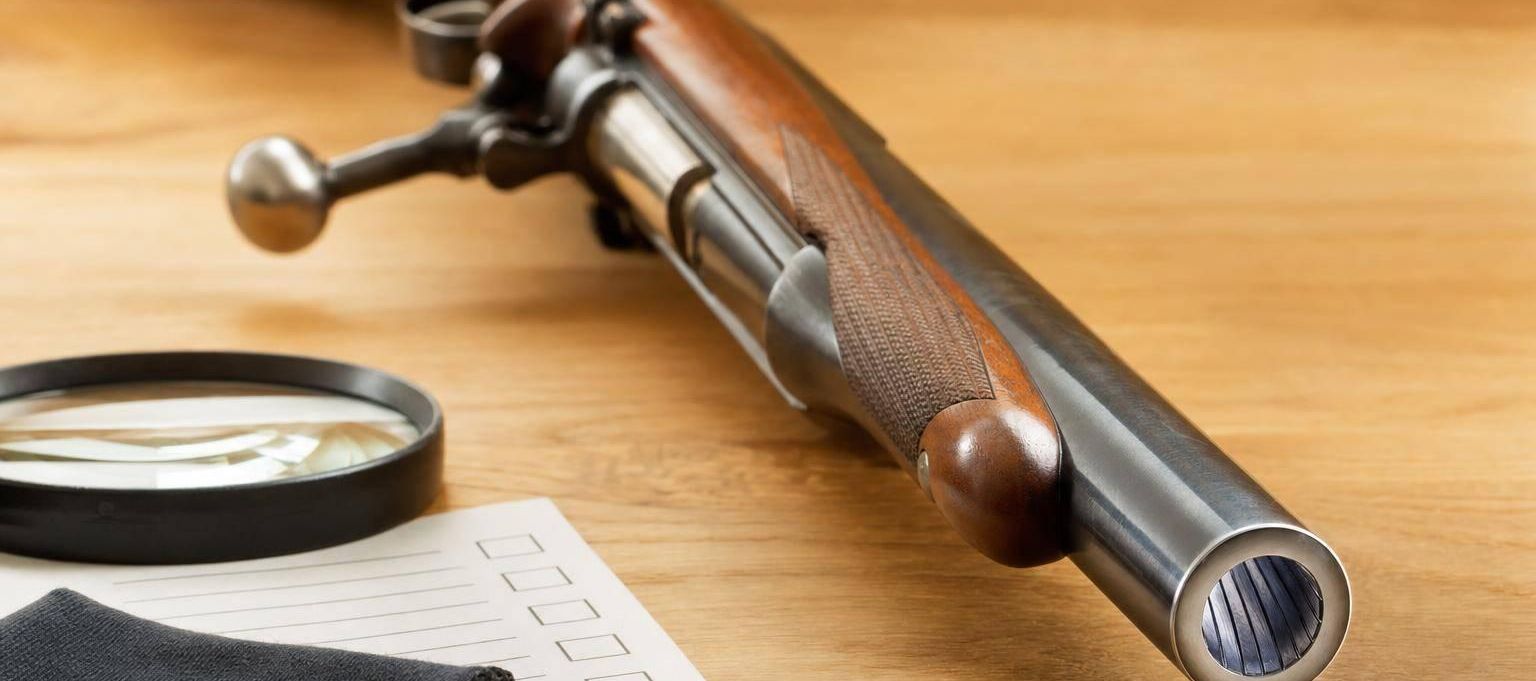
- Check the barrel first: sharp rifling and lands, clean muzzle crown, no scars in the barrel.
- Examine metal and bluing: wear is often still acceptable, active rust and pitting are not.
- Inspect the stock closely: small dents are normal, cracks in the grip or action area are not.
- Test the bolt and safety: clean barrel, clear engagement, no spongy feel.
- Evaluate modifications openly: often acceptable for hunting or sport firearms, usually a minus for collector condition.
- Always request photos: especially of the muzzle, barrel interior, chamber, bolt, and stock transitions.
In short: A firearm may appear heavily used on the outside but still be in good condition inside. Or it looks clean but has defects in the barrel, crown, or mechanics. That’s why I never judge just the rating, but always the entire firearm.
| Area | What I pay attention to | What often lowers the rating |
|---|---|---|
| Barrel | Bright barrel appearance, sharp rifling/lands, clean crown | Corrosion scars, dull spots, crown damage |
| Metal | Even bluing, no deep marks | Rust, pitting, heavy tool marks |
| Stock | Normal wear marks, no cracks | Hairline cracks, breaks, significant dents |
| Mechanics | Action operates smoothly, safety engages clearly | Jamming, play, unclear trigger |
| Originality | Matching parts, no silent modifications | Re-bluing, new stock, muzzle threads |
With this, I have sorted the key points of an advertisement in just a few minutes - and I can much more easily recognize whether the price and condition rating match.
How to properly inspect a used pistol before buying. #firearmseducation #firearmtraining
sbb-itb-1cfd233
Common Condition Ratings in the German Firearms Trade
Condition Ratings for Firearms: What Each Rating Really Means
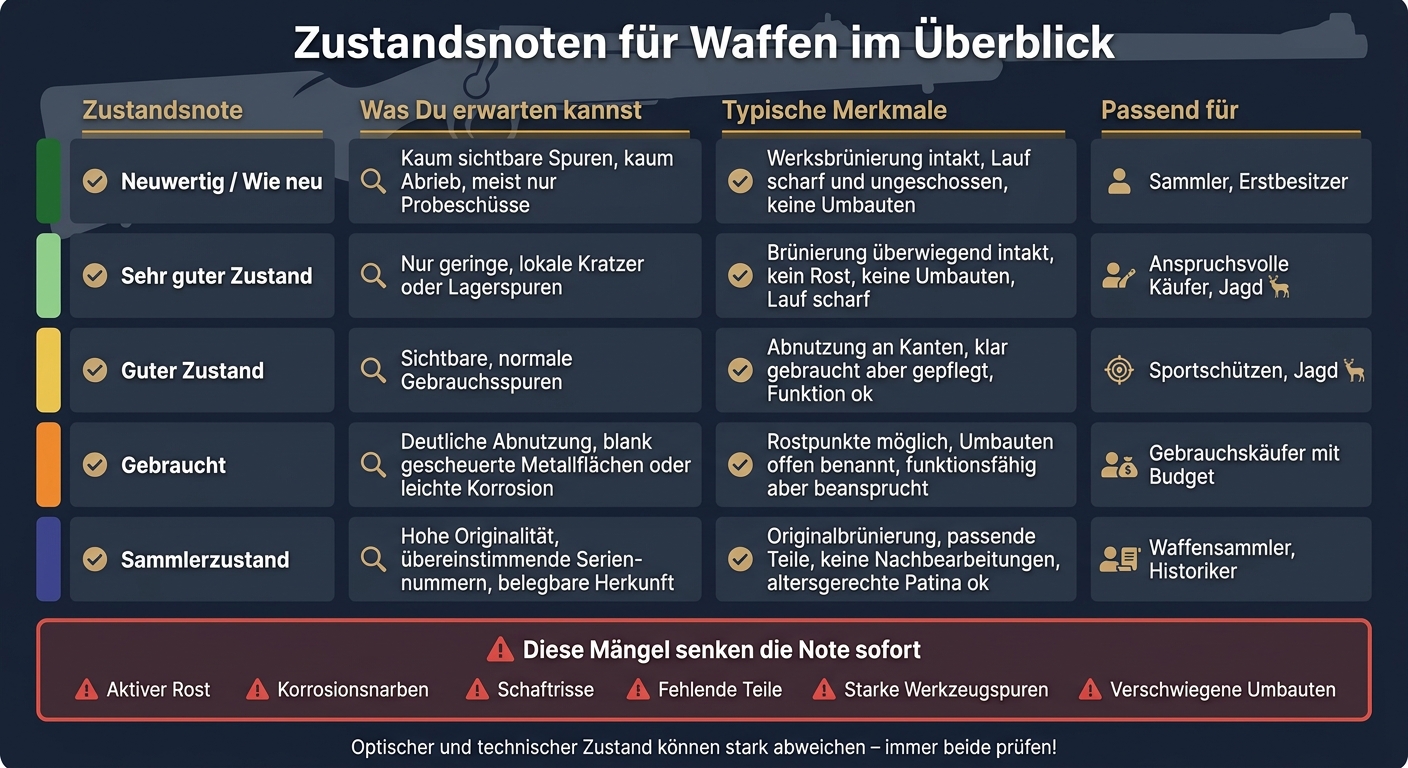
To help you categorize listings more quickly, a simple translation of common terms is useful. In the German-speaking firearms trade, conditions are usually described with phrases like as new / like new, very good condition, good condition, used, and collector's condition. The point is: the term alone does not say enough. More important is whether the listing clearly mentions scratches, rust, wear, or modifications.
As new, very good, good, used, and collector's condition explained
The following table categorizes the most common designations and shows what you can roughly expect as a buyer.[3][4][5]
| Condition Rating | What you can expect as a buyer |
|---|---|
| As new / like new | Hardly visible traces, minimal wear, usually only test shots. |
| Very good condition | Only minor, localized scratches or storage marks; bluing mostly intact; no rust, no modifications. |
| Good condition | Visible, normal signs of use; wear on edges; clearly used, but well-maintained firearm. |
| Used / used condition | Significant wear, bare metal surfaces or slight corrosion; functional, but visibly worn. |
| Collector's condition | High originality, matching serial numbers, and verifiable provenance; age-appropriate patina possible, as long as it does not stem from neglect. |
In listings, you often see mixed specifications like “1–2" or “2–3".[6] This is quite normal. In practice, the boundaries are often fluid, not sharply defined.
Collector's condition heavily depends on originality. This refers to unaltered parts, matching serial numbers, and a provenance that can be documented. Modifications or re-coatings immediately reduce collector value. There is usually no leeway here.
Technical condition versus optical condition
A condition rating often refers to both together. Nevertheless, optical and technical condition can be far apart. A classic hunting rifle from the 1980s may have many dents in the walnut stock, worn bluing at the muzzle, and polished spots on the action - and still have a bright, sharp barrel, correct headspace, and a crisp trigger. Visually, it may be more “used,” but technically it could be “very good.”
That’s exactly why you should always look at both points separately in a listing. Does the seller only mention scratches and stock marks? Or does he also write something about the barrel, mechanics, and trigger? Only then can the condition be accurately assessed. In the end, barrel, mechanics, and stock are what really matter. That’s where it shows whether the stated condition rating sounds good - or actually fits.
Check used gun before you trust the condition rating
Now let's get to the points where wear shows up the fastest: metal, stock, action and barrel. This is exactly where an honest offer separates itself from a condition rating that sounds too good to be true.
Metal, stock and moving parts
Start with what immediately catches the eye. Is the bluing even? Or do you see rubbed spots, color differences, or areas that look like they have been refinished? Surface rust can often still be removed. Corrosion scars cannot. Small dark pits on metal parts remain and simply do not fit with "very good" or "like new".
With the stock, scratches and small dents are nothing unusual for a hunting gun at first. It gets tricky with cracks. Especially at the pistol grip, at the system transition, and near the stock screw, you should take a close look. Even fine hairline cracks in the grain are not a detail to dismiss. They can become larger under recoil.
Then to the action: Move it slowly through. It should run smoothly and evenly, without jamming or jerking. The safety must engage clearly, not mushy and not somewhere in between. Play in the action, an unclear trigger point, or a safety that does not feel good do not match a high condition rating.
Next comes the part that often counts more for the technical value than small exterior blemishes: the barrel.
Barrel and barrel interior
The condition of the barrel often says more about the value of a gun than almost anything visible from the outside. Take a bore light or an LED lamp and look best from the chamber side. A good barrel appears bright and even. The lands and grooves should be sharp and clearly visible.
If the grooves are rather rounded, this often indicates heavy use or poor maintenance. Particularly critical are corrosion scars in the barrel. You recognize them as small dark spots or pits. Especially in the last 5–10 cm of the barrel and at the transition to the chamber, this is a clear warning signal.
The muzzle crown also deserves a close look. It should be perfectly round, symmetrical, and free of notches or burrs. Damage in this area can noticeably degrade precision, even if the rest of the gun looks top-notch at first glance.
Defects that lower the rating
If such points are noticed, the condition rating must be adjusted downwards. This includes especially:
- active rust
- corrosion scars
- stock cracks
- missing parts
- heavy tool marks
If you see an ad on Gunfinder with such features, request specific photos. Especially important are images of muzzle, barrel interior, and stock transitions before you decide to make a purchase.
How modifications and originality affect the condition rating
Wear is only part of the assessment. Equally important is the question of how original the gun still is – especially when it comes to collector condition. A gun can be almost flawless externally and still not correspond to the original delivery condition.
When modifications are acceptable – and when they lower the value
For hunting and sporting firearms, many changes are completely normal. A skeleton stock, a modern trigger, or a later cut muzzle thread can even increase practical utility. The crux is: These changes must be openly stated in the advertisement.
“Much more important than small dents or scratches... is the impeccable condition of the material exposed to stress." - Gunfinder Magazine [2]
It becomes critical when such modifications are concealed or the weapon is still offered as original. Because a new stock, a modernized trigger system, or a later cut muzzle thread permanently change the original condition. For a service weapon, this is often not a big issue. The situation is different for collector value.
What collector condition really means
“Collector condition" is the strictest condition rating – and also the one that is often used too loosely. It means that the weapon has remained original in the important aspects: with original bluing, matching parts, and, if relevant, with number matching. Even a well-done re-bluing can weaken this claim, as it alters the original surface.
| Modification | Impact on collector condition | Impact for service weapon |
|---|---|---|
| Subsequent stock (e.g., skeleton stock) | Significantly lowers the rating | Can increase ergonomics and value |
| Muzzle thread | Significantly lowers the rating | Positive for suppressor operation |
| Re-bluing | Weakens collector status | Can be sensible maintenance for a service weapon |
| Modern trigger instead of set trigger | Loss of originality | Improves handling for shooters |
For collectors, contemporary parts, matching numbers, and as unchanged original bluing as possible are not a nice addition, but a requirement. If even one of these points is missing, the designation “collector condition" usually no longer applies – no matter how good the weapon looks at first glance.
Using condition ratings correctly in Gunfinder advertisements
A condition rating is just a shorthand. What ultimately matters are clear statements about the barrel, mechanics, stock, and possible modifications.
When you check these points, you should also name the results in the advertisement exactly as such. The technical inspection is of little use if the text later only states a vague “good condition.”
A clear structure for advertisements
It’s best to write in this order: model, caliber, technology, barrel, stock, metal, modifications, overall rating.
“Buyers pay attention to the condition of the wear parts and especially to the condition of the bore, the chamber, and the muzzle." - Gunfinder Help Center [1]
Instead of simply writing "good condition," a concise, precise description is much stronger. For example: "Action cycles smoothly, grooves and lands still sharp, bluing with slight silver spots on the edges, stock with minor signs of use, no cracks, no rust, no modifications." This makes the condition rating tangible. Anyone reading the ad can then better assess whether the evaluation is accurate.
Defects and Condition Ratings at a Glance
Typical characteristics of a suitable condition rating can be assigned as follows:
| Characteristic | Suitable Rating |
|---|---|
| No wear, factory bluing, unfired | Like new / as new |
| Only minimal edge wear, no rust, barrel sharp | Very good |
| Visible signs of use, function ok | Good |
| Significant wear, rust spots, modifications clearly stated | Used |
| As original as possible, matching parts, documented provenance | Collector's condition |
Conclusion: Read the Rating, Check the Details, Assess the Weapon as a Whole
It's better to describe the condition a bit more cautiously and accurately. This reduces inquiries and prevents false expectations. The classification always results from the interplay of technology, optics, and originality.
“An important sign of good weapon maintenance and the condition of the weapon is evident from the bluing.” - Gunfinder Help Center [1]
FAQs
How much can a condition rating deviate from the actual condition?
There is no fixed margin for deviations. Condition ratings are meant to provide buyers with reliable guidance, as the condition directly affects the value and thus the price.
Therefore, the information in the ad should correspond to the actual condition. Hidden defects, such as those in the barrel, bolt, or firing pin spring, can compromise safety and reliability.
When is a used weapon worth it despite modifications?
A used weapon with modifications can be worthwhile if it is technically flawless and the work has been done neatly. Usually, the original condition remains more stable in value. Nevertheless, good modifications can be sensible if they better meet your requirements or improve precision.
The key factor is the technology. Trigger, bolt, and all safety-relevant parts must function without defects. If you are unsure, have the weapon checked by a gunsmith before purchase.
What photos should I always request before purchasing?
Request meaningful photos before the purchase so that you can thoroughly check the overall condition of the weapon.
What matters? Especially images of the bore, chamber, and the muzzle. Additionally, there should be clear detail photos of the metal parts, the bluing, any rust spots, and the stock.
Also markings and serial numbers must be clearly legible. Only then can you safely identify the weapon and match the data with the firearms ownership card.