Effective range of subsonic ammunition: Myths and facts
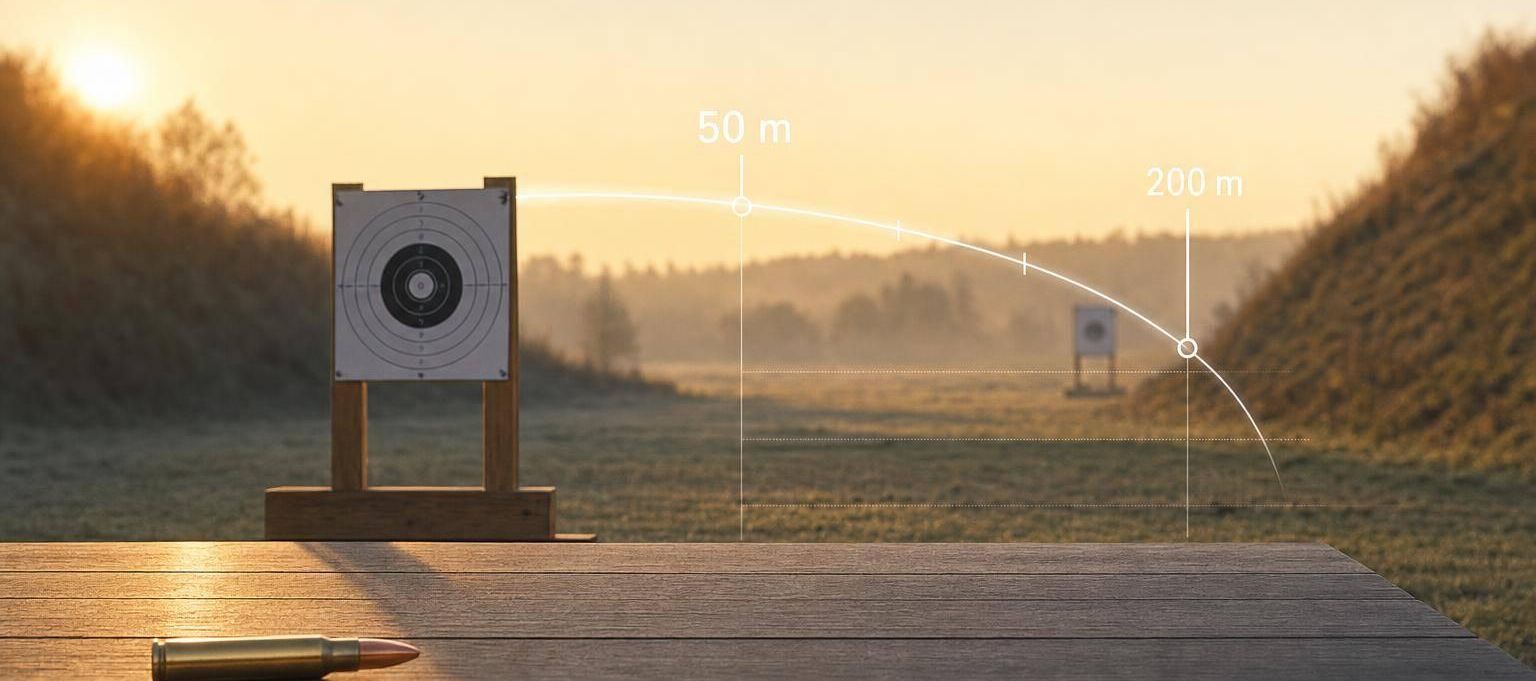
In short: Subsonic ammunition is quieter, but its hunting range is usually short. I would plan to use it only at short distances in most cases, because trajectory, energy, and effect reach their limits early.
If you want to quickly categorize the topic, here are the main points:
- Subsonic means: below about 340 m/s
- Quiet shot: With a suppressor, the supersonic crack is also eliminated
- Big catch: The energy is much lower than with supersonic ammunition
- At 100 m, the necessary power is often already lacking
- Bullet drop is significant: With .308 Subsonic, there is about 20 cm drop from 50 m to 100 m
- For game in Germany, usually not permitted, because the E100 values are often not met
- Meaningful primarily for small game, predators, or nuisance wildlife at short distances, depending on local law
I see it this way: Effective range is not the distance a bullet still travels. It refers to the distance at which you can still hit cleanly, the bullet works on target, and the use is legally permitted.
Quick comparison:
| Point | Subsonic Ammunition | Supersonic Ammunition |
|---|---|---|
| Speed | below 340 m/s | above 340 m/s |
| Volume | quieter | louder |
| Energy at 100 m | often significantly lower | usually much higher |
| Trajectory | more curved | flatter |
| Hunting for game in DE | usually not allowed | often possible depending on caliber |
| Typical distance | short | often longer |
When I evaluate subsonic ammunition, I always look at three things at once: precision, residual energy, and legal situation. This is exactly what clears up the usual myths.
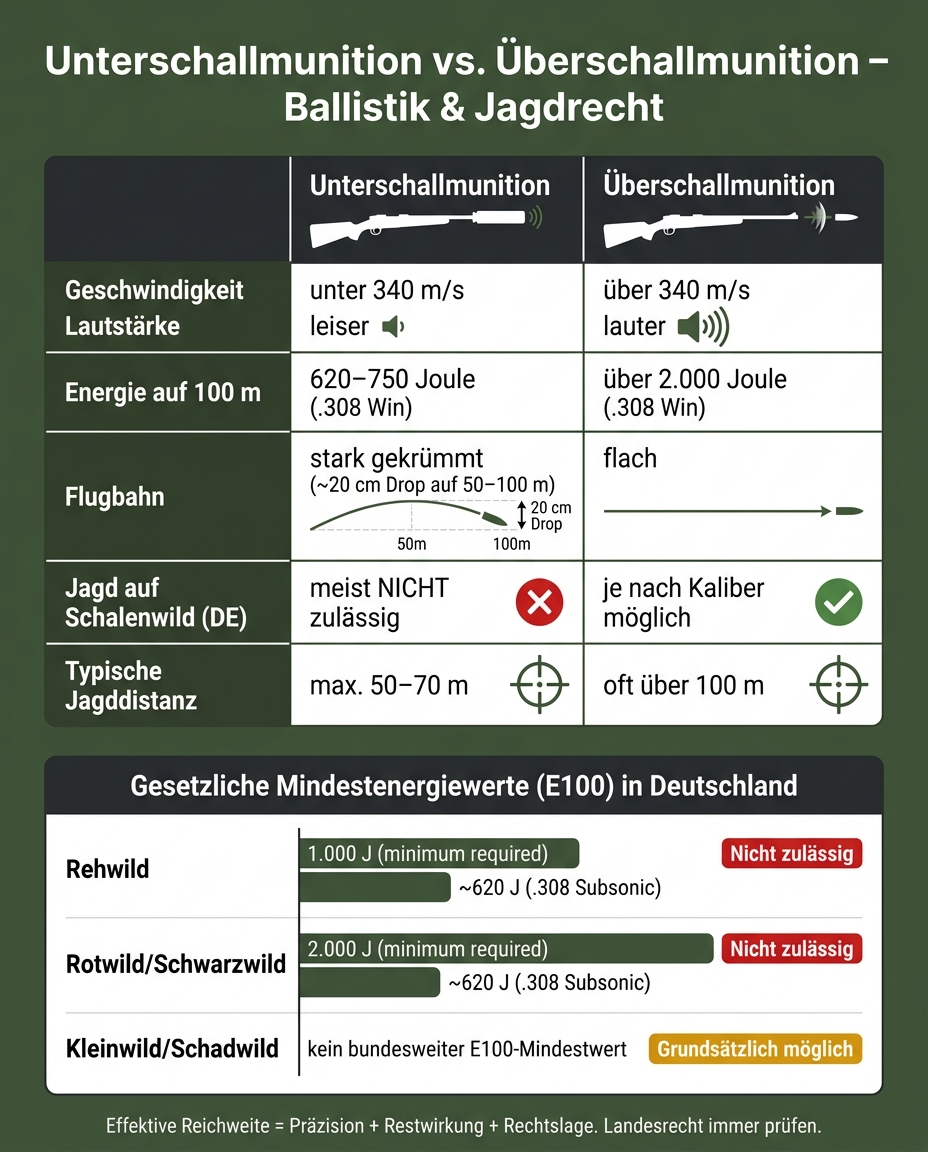
Subsonic Ammunition vs. Supersonic Ammunition: Ballistics & Hunting Law Comparison
Widespread Myths About Subsonic Range – and What Really Is True
Myth 1: Subsonic ammunition only works at short distances
This is not entirely true. Subsonic ammunition can shoot accurately at short to medium distances, if the weapon and barrel are suitable. The most important point is often the twist of the barrel. A .308 Win with a 1:10 twist can shoot groups of about 1 cm at 50 m. A 1:12 twist, on the other hand, can produce a spread of 20 to 30 cm with the same heavy subsonic bullets [2]. This clearly shows: The problem lies not only with the ammunition but primarily with stabilization.
Distance alone is therefore not the key point. What matters is the interplay of precision, trajectory, and residual effect. A .308 Win subsonic bullet zeroed at 50 m will be about 20 cm lower at 100 m [2]. From 150 m, the trajectory is so curved that precise shots are only justifiable with exact distance measurement [2]. For small game, 40 to 70 m is a sensible range. For larger game beyond 100 m, subsonic ammunition is generally not suitable [2][3].
And that brings us to the next point: Range alone says nothing about the effect on target.
Myth 2: Heavy subsonic bullets hit as hard as supersonic ammunition
This is not physically sustainable. Kinetic energy is calculated by E = 1/2 × m × v². Because velocity is squared in the formula, a higher bullet weight cannot compensate for the loss due to the much lower speed.
A 220-grain bullet in .308 Win at 340 m/s has a muzzle energy of about 824 Joules [2]. At 100 m, about 620 to 750 Joules remain [2]. A standard .308 Win supersonic load, on the other hand, is clearly above 2,000 Joules at 100 m [2][4]. The difference is therefore not small, but massive.
Even more important is the behavior on target. Most conventional hunting bullets are designed to deform at about 450 to 550 m/s [5]. Below 343 m/s, they often work unreliably and behave more like full metal jacket bullets. This leads to a narrow wound channel and insufficient effect on target [2][3][5]. This is a serious problem in hunting.
Myth 3: A quieter shot is not automatically ethical or legal
A quieter shot sounds good at first. But quieter does not automatically mean ethical. A shot is only ethical if the animal dies quickly and safely. For this, it needs enough energy and reliable bullet deformation. This is exactly where subsonic ammunition often reaches its limits: In Germany, it usually does not meet the legal minimum values for large game at 100 m [1][3].
The requirements are clear. For roe deer, an E100 of at least 1,000 Joules applies. For large game, an E100 of at least 2,000 Joules and a minimum caliber of 6.5 mm are required [4]. Typical subsonic loads in .308 Win or .300 AAC Blackout usually do not achieve these values at 100 m [2][4]. In practice, subsonic ammunition is thus mainly limited to predators and short distances [1][3].
The ballistic data will follow in the next section.
sbb-itb-1cfd233
Ballistic Facts on Effective Range
Speed, Energy, and Impact on Target
Behind the common myths lies a simple physical limit: With subsonic ammunition, the usable range ends sooner. The reason is not only the lower speed. Energy, trajectory, and target effect also diminish early over distance. In other words: If speed and energy are low from the start, there isn't much reserve left after a few meters.
Anyone wanting to use subsonic ammunition for hunting should therefore choose deformable projectiles specifically designed for low speeds. Normal projectiles often do not perform as desired in this range.
And it's not just about the effect on target. The trajectory also imposes tight limits. This is where it quickly becomes tricky in practice.
Bullet Drop from 50 m to 100 m
A .308 Win subsonic bullet, zeroed at 50 m, is already about 20 cm lower at 100 m [2]. This is not a small outlier, but a point that directly affects the hit. Even a distance error of 10 m can noticeably worsen the shot [2].
Therefore, from 50 m onwards: A laser rangefinder is mandatory. Anyone who only estimates is playing with the risk of a miss. With such a curved trajectory, a few meters of error are enough, and the point of aim no longer fits.
Realistic Hunting Distances by Caliber
The differences between calibers are particularly evident in energy, trajectory, and stability.
| Caliber | Typical Muzzle Velocity | Energy at 100 m | Bullet Drop (50–100 m) | Meaningful Hunting Distance |
|---|---|---|---|---|
| .22 LR (Subsonic) | ~315–330 m/s | ~100–130 J | ~10–15 cm | Max. 50 m (Small Game) |
| .300 AAC Blackout | ~310–330 m/s | ~600–700 J | ~15–20 cm | 50–70 m (Small Game/Pests) |
| .308 Win (Subsonic) | ~300–330 m/s | ~620–750 J | ~20 cm | 50–60 m (Small Game/Pests) |
The values are approximations and depend on load, bullet weight, and zeroing distance [2][3][6].
With the .300 AAC Blackout, it becomes clear what the caliber was designed for: subsonic operation with heavy projectiles. Especially from short barrels, it showcases these strengths well [2][6]. The .308 Win, on the other hand, requires the appropriate twist - at least 1:10 - for heavy subsonic projectiles to fly stably [2]. And with .22 LR, the problem is simply the low energy. There is little room for anything larger than small game.
This makes the ballistic limits quite clear. What is legally permissible for hunting is then regulated by the legal minimum values.
Legal and Ethical Limits for Hunters in Germany
Minimum Energy Values at 100 m for Common Game Species
Legally, it does not matter how loud a shot is when hunting. What counts is the impact energy at 100 m. In other words: It is not the noise level that matters, but whether the projectile delivers enough power for the respective game species.
For roe deer, 1,000 J at 100 m is required. For other ungulates, 2,000 J at 100 m and a minimum caliber of 6.5 mm apply. Typical .308 subsonic loads are clearly below this with about 620 to 750 J [2][7][8]. Therefore, common subsonic loads in rifle calibers are generally not permitted for hunting ungulates in Germany.
In practice, subsonic ammunition is usually limited to small game, pest control, and game enclosures [1][2].
Additionally, there is another point: At low speeds, expanding projectiles are needed, which are specifically designed for this purpose [2][9]. Otherwise, the necessary effect on target is often lacking.
Practically, the limit often lies at 50 m. Beyond that, the risk of misses and legal violations increases significantly. This is the point where technology and hunting ethics directly intersect.
The following overview shows why typical subsonic loads fail legally:
| Game Species | Legal Minimum Energy (E100) | Typical .308 Subsonic E100 | Legal Status |
|---|---|---|---|
| Roe Deer | 1,000 J | ~620 J [8] | Not permissible |
| Red Deer / Wild Boar / Fallow Deer | 2,000 J + min. 6.5 mm | ~620 J [8] | Not permissible |
| Small Game / Pest Animals (e.g., Fox, Raccoon) | No nationwide E100 minimum value | ~620 J [8] | Generally possible, check state law |
Even where these federal values do not apply, the matter is not automatically resolved. Federal law only sets the minimum framework. State hunting laws can be stricter. Therefore, before using in the field, it is simply: Check state law.
Practical Recommendations and Conclusion
Determine Your Effective Range
According to physics and legal situation, the practical test takes place at the shooting range. Test your subsonic load at 50, 75, and 100 m and keep a clean record of point of impact, dispersion, and bullet drop. Only when the point of impact and dispersion are correct does it make sense to look at the effect on the target.
Check the bullet effect in a suitable test medium. Test instead of assume.
Your personal maximum range is the distance at which you can reliably hit the vital zone consistently and the bullet still has enough effect on the target. If any of these points can no longer be assured, the limit has already been reached.
Choose the Right Ammunition and Equipment
If the load is correct, it’s about the weapon. It determines whether the performance is consistently available in practice. Check the recommended twist rate and the manufacturer data for your load before purchasing. Also, ensure that your weapon feeds reliably with the chosen subsonic ammunition.
Suitable rifles, suppressors, and subsonic ammunition can be found at Gunfinder.
The Most Important Points at a Glance
In the end, the interplay of precision, effect, and legal situation counts. Effective range is not just a number of meters. It refers to the distance at which your subsonic load is still precise, effective, and permissible.
Subsonic ammunition and suitability for large game hunting: The whole truth! - Marksman 101
FAQs
How do I know if my barrel twist is suitable for subsonic ammunition?
Subsonic ammunition often uses heavier projectiles. For them to fly cleanly, the barrel needs enough twist. If the twist is too slow, precision suffers. In the worst case, the projectile is not stabilized properly.
It's best to check this with a few test shots on a paper target. Two warning signs quickly become apparent:
- Oval bullet holes
- Poor precision even at short distances
Both indicate that the barrel twist is too slow for the chosen projectile weight. With a mounted suppressor, the risk of damage increases further.
Which subsonic projectiles reliably deform even at low speeds?
Reliable deformation at subsonic speeds is difficult. The reason is simple: The low energy often does not even activate the usual deformation mechanisms.
Many conventional soft-point lead projectiles hardly expand at these low speeds. This makes them problematic for hunting use.
In subsonic ammunition, a higher projectile weight plays a significant role. It helps to deliver enough energy to the target despite the low speed.
When is subsonic ammunition no longer ethically acceptable for hunting?
For game such as deer, chamois, or red deer, subsonic ammunition is only very limited or not usable at all. The reason is simple: Due to the low speed, the projectile noticeably loses energy and range.
Additionally, another problem arises. Often, there is hardly any deformation while the energy significantly decreases after a short distance. The stopping effect is therefore clearly limited.
For this reason, its use in hunting practice is usually considered not relevant. At most, shots at precisely measured distances of up to a maximum of 50 meters may be considered.