Material comparison: Which mount fits your riflescope?

The short answer: I choose the mount not by feeling, but based on weight of the optics, recoil, add-on device, frequency of change, and shooting distance. For lightweight hunting scopes, aluminum is often sufficient. For heavy optics, magnum calibers, and clip-on devices, I tend to opt for steel or hybrid. For long distances, a mount with cant is often the factor that makes the difference.
The topic is simple when I break it down into five questions:
- How heavy is my scope?
- How strong is the recoil?
- Am I using a night or thermal add-on?
- Do I often remove or change the optics?
- Do I shoot at 500 m and beyond?
In the end, it almost always comes down to four points:
- Weight
- Stiffness
- Recoil resistance
- Repeat accuracy
A few clear guidelines help immediately:
- Aluminum: lightweight, often suitable for stalking, mountain hunting, and many sport setups
- Steel: more mass, providing plenty of reserve for strong recoil and heavy setups
- Hybrid: a middle ground between both
- Cant mount: for long-range, when the internal adjustment range of the scope becomes tight
Important: Even 6 MIL or about 20 MOA of cant can make a significant difference at long distances. However, too much cant, such as 40 MOA, can interfere with zeroing at 100 m.
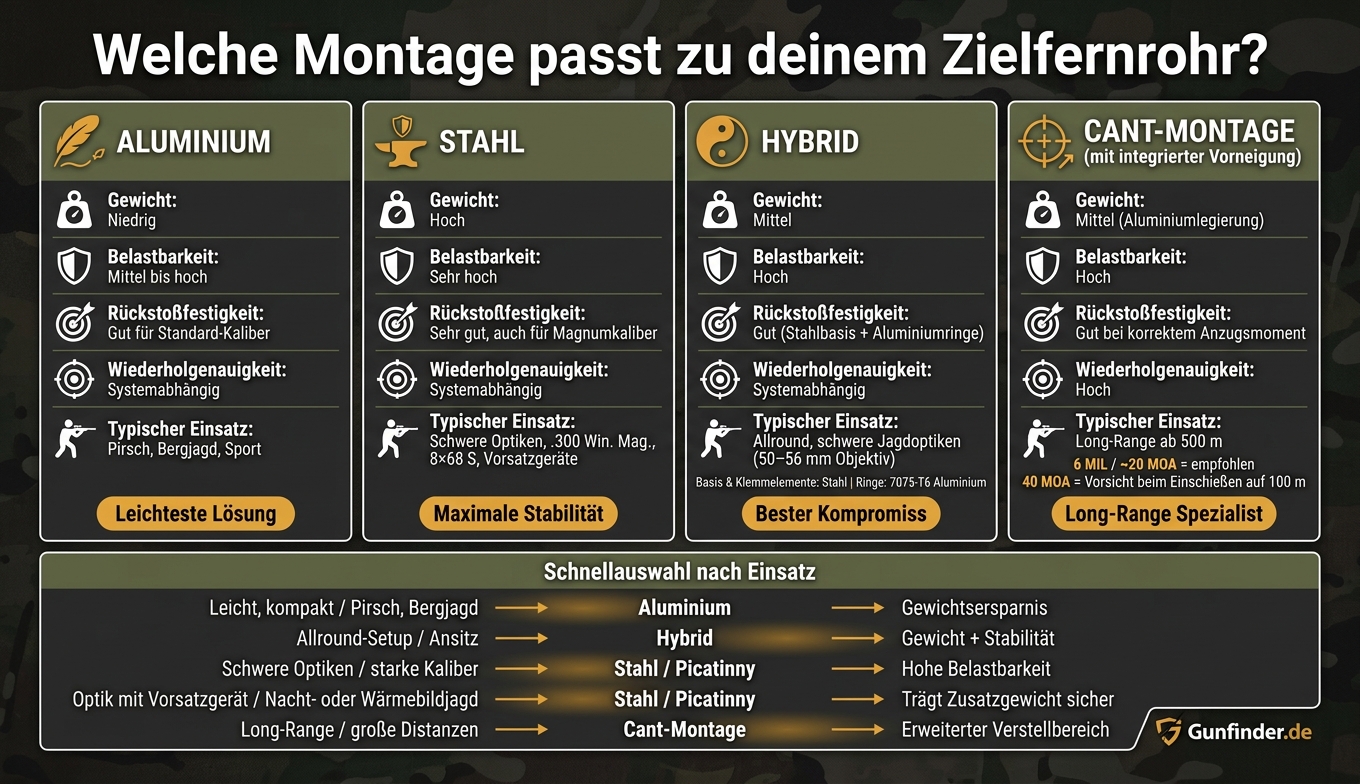
Scope mounts compared: Aluminum, Steel, Hybrid & Cant
Geartester TV - Which scope mounts are suitable for which applications?

sbb-itb-1cfd233
Quick Comparison
| Type | Weight | Load | Typical Use | What I pay attention to |
|---|---|---|---|---|
| Aluminum | low | medium to high | Stalking, mountain hunting, many hunting and sport optics | clean manufacturing, good load distribution |
| Steel | high | high | heavy optics, magnum calibers, add-on devices | firm fit, good force transfer to the rail |
| Hybrid | medium | high | All-round setup with more reserve | coating of contact surfaces |
| Mounting with Cant | mostly medium | depending on the system | Long-Range | appropriate forward tilt, clean torque |
I summarize the article as follows: Not the lightest or heaviest material is automatically the right one. The mounting is suitable when it holds your scope securely, absorbs the recoil cleanly, and keeps the point of impact constant.
1. Aluminum Mounts
Aluminum is the lightest standard solution when low weight and good everyday usability are important.
Weight
Aluminum mounts made from high-strength aluminum are lightweight and stable enough for most setups of hunters and sport shooters [2].
Stiffness & Recoil Resistance
Modern aluminum mounts are manufactured using CNC milling with tight manufacturing tolerances. In Picatinny mounts, cross pins or cross glass plates hold the mount better in position than a pure clamping [2]. This is especially important when more mass comes into play. The heavier the optics and attachment device are, the more important a clean load distribution over multiple grooves becomes.
Application Area by Scope Type
Aluminum mounts fit most hunting and sport optics, including for long-range setups. There are many suitable models for 1 inch (25.4 mm) and 30 mm [2]. With heavy combinations of optics and thermal or night vision attachments, the load noticeably increases. In such cases, mounts that distribute the load over multiple Picatinny grooves are sensible [1] [2].
2. Steel Mounts
Weight
Steel mounts are heavier than aluminum mounts. This extra weight can be worthwhile, especially with heavily recoiling calibers and heavy optics. In the end, it comes down to a simple question: Does your setup need to withstand high forces over time?
Stiffness & Recoil Resistance
Steel shows its strengths especially when significant recoil is present. The material remains dimensionally stable under continuous load and provides the system with a lot of support.
With Picatinny mounts, cross pins or cross rail solutions are preferable to round screws because they better transmit forces into the rail [1]. Especially in setups that are shot often or carry a lot of weight, this point makes a noticeable difference.
Application area by scope type
Steel mounts are well suited for:
- heavy optics
- strong recoiling calibers
- add-on devices
Even with removable mounts, having the mount done by a professional can be worthwhile if high repeat accuracy is required [1].
If you are looking for a middle ground in weight and reserve, hybrid mounts are the next comparison point.
3. Hybrid mounts: Aluminum and steel combined
Hybrid mounts are a kind of middle ground: lighter than steel, more durable than pure aluminum mounts. This makes them interesting when aluminum alone seems a bit lacking and steel brings unnecessary weight.
The construction is simple but well thought out. The base and clamping elements are made of steel, where the most load is applied. The rings are made of aluminum and hold the scope securely without adding unnecessary mass to the system.
Weight
In terms of weight, hybrid mounts clearly lie between aluminum and steel. Compared to pure steel mounts, they save noticeable weight, which is especially pleasant with heavier hunting rifles or longer stalking trips.
Stiffness & recoil resistance
Steel is located at the load points. This is the area where things get tough during the shot. Thus, the mount remains stable even when the recoil is strong.
The aluminum rings take care of holding the glass. For this, 7075-T6 aluminum is suitable because it provides enough strength for this job.
Corrosion protection
In the material mix, surface treatment is all the more important. Otherwise, problems can arise at the transitions of the metals. Especially at the contact points, there is a risk of contact corrosion.
Therefore, it is worth taking a look at the coating:
- Aluminum parts should be hard anodized
- Steel parts should be blued, phosphated, or nitrided
Well-finished surfaces help ensure that the contact points remain stable over time.
Application area by scope type
Hybrid mounts are especially suitable for heavy hunting optics. This refers to scopes with 50 mm or 56 mm objective on magnum calibers such as .300 Win. Mag. or 8×68 S.
This is a typical case where both count: less weight and high load capacity.
If your setup needs more cant, the next option is the special solution with integrated cant.
4. Special Mounts with Integrated Cant
If you want to shoot at long distances, good materials alone are often not enough. Then the inclination comes into play. Mounts with integrated cant are designed for long-range setups and solve a very specific problem: From about 500 m, the internal adjustment range of many scopes is often not sufficient to provide enough elevation correction. Often, 6 MIL (approx. 20 MOA) are installed. This saves adjustment travel for long shots [3][4].
Weight
In the long-range sector, such special mounts are often made of high-strength aluminum alloys. This keeps the weight lower than steel while remaining stable enough for use [4].
Stiffness & Recoil Resistance
Here, fit accuracy is especially important. When the tube and ring fit together cleanly, no adjustment range is lost. When tightened with the appropriate torque, the mount can withstand strong recoil. You don't need glue for this. Even more: It can damage the scope and disturb the mechanics due to uneven pressure [4].
Corrosion Protection
Good coatings ensure that the mount remains stable over a long period [4].
Application Area by Scope Type
Such mounts are especially suitable for precise long-range optics [3][4]. For hunting at normal distances or for short sport ranges, you usually don't need them.
Too much cant can even be a hindrance. 40 MOA can be a problem, for example, if the scope does not have enough downward adjustment to zero at 100 m. The mount height must also match your shooting stance.
In the end, the benefit always shows in practice: Does the extra adjustment travel at long distances provide you with more than the additional mounting effort?
Advantages and Disadvantages in Everyday Use
After weight, stiffness, and corrosion protection, one thing ultimately counts: What must the mount withstand in everyday use?
Your usage profile primarily sets the tone here. When stalking, low weight is often a clear advantage. Sitting and shooting ranges usually require more stability and steadiness. And during driven hunts, it quickly becomes clear how well a system maintains its point of impact. Especially strong calibers and heavy setups make it clear without detours whether aluminum, steel, or a hybrid is a better fit.
For powerful calibers like .300 Win. Mag., there is a simple rule: The heavier the setup and the harder the recoil, the more work the mount has to take on. With strong recoil, steel mounts and robust Picatinny systems bear the load best [1].
Practice can be summarized as follows:
| Criterion | Aluminum | Steel/Hybrid | Pivot Mount |
|---|---|---|---|
| Weight | Low | Higher | Medium weight depending on the system |
| Load Capacity | For lighter setups | Very high for powerful calibers and heavy optics | High |
| Repeat Accuracy | System dependent | System dependent | Very high |
| Typical Use | Stalking | Magnum caliber | Optic change |
Pivot mounts and quick-change systems offer the highest repeat accuracy [1].
Conclusion: Which mount fits your scope?
When choosing based on weight, stiffness, corrosion protection, and cant, only a few obvious options remain. The key factor is how weight, recoil, and frequency of use interact in your setup.
For lightweight optics in stalking and mountain hunting, aluminum is often the first choice because it saves weight. For heavy optics, powerful calibers, or setups with attachment devices like night or thermal imaging technology, steel or a robust Picatinny system is usually the safer solution. The reason is simple: These systems distribute the forces over multiple points.[1]
If you frequently switch between different optics or remove them regularly, repeat accuracy should be at the top of your list. This is where hybrid or quick-change systems show their strengths.
Have the mount professionally installed to ensure it properly absorbs load and recoil.[1]
The following overview reduces the choice to four clear use cases:
| Scope / Use | Recommended Material | Key Advantage |
|---|---|---|
| Light, compact / Stalking, mountain hunting | Aluminum | Weight savings |
| All-round setup / Sitting | Hybrid | Good compromise of weight and stability |
| Heavy optics / powerful calibers | Steel / Picatinny | Very high load capacity under strong recoil |
| Optic with attachment device / Night or thermal imaging hunting | Steel / Picatinny | Safely carries additional weight |
| Long-range / large distances | Mount with integrated cant | Extends the available adjustment range |
On Gunfinder, you can filter suitable mounts for your setup.
FAQs
How do you find the right mounting height?
Consider the technical data of the mount as well as the dimensions of the weapon and scope. As a rough guideline, divide the objective diameter by 2. This gives you an initial value for the necessary minimum height.
Then choose the height so that the objective does not touch the barrel or the rail. The height is usually measured from the base rail to the center of the ring or to the bottom edge of the ring. Use this value as a basis – or go a bit higher – so that your scope has enough clearance.
When is a detachable mount worthwhile?
A detachable mount is worthwhile when the sighting optics need to be changed quickly and accurately or should be removed frequently.
This is useful, for example, during transport, cleaning, or when switching between different weapons.
How do I know if my setup is too heavy for aluminum?
Pay attention to load and recoil: Aluminum is lightweight and corrosion-resistant. However, with Magnum calibers or very strong recoil, it is often less suitable than steel.
Warning signs of overload include a bent rail or loose fittings. Therefore, regularly check the mount for a secure fit and for wear. With high loads, a steel mount is usually the better choice.