Solid wood or laminate: What suits your rifle?

The choice between solid wood and laminate depends on your requirements and hunting style. Both materials have advantages, but also limitations. Here’s a quick overview:
- Solid Wood: Aesthetically pleasing, warm to the touch, and customizable. Ideal for moderate weather conditions and classic hunting situations. Disadvantage: Sensitive to moisture and temperature fluctuations.
- Laminate: Robust, weather-resistant, and dimensionally stable. Perfect for demanding conditions like mountain hunts or driven hunts. Disadvantage: Often heavier and less customizable in appearance.
Your priorities are crucial: Aesthetics and tradition with solid wood or stability and weather resistance with laminate. Platforms like Gunfinder help you find the right option.
Solid Wood Stocks: Classic Design and Natural Materials
What are Solid Wood Stocks?
Solid wood stocks are made from a single piece of wood – often walnut or beech. The stock is carved, shaped, sanded, and then finished from a solid wood block. In contrast to laminate stocks, which consist of multiple glued wood layers, solid wood displays a natural grain and individual density variations. This makes each stock a unique piece.
Walnut is considered the top choice: it is robust, easy to work with, and features an attractive grain. Additionally, it is relatively break-resistant and absorbs surface treatments like oil or varnish exceptionally well. Beech, on the other hand, is more affordable and easier to process but appears simpler. It is often used in entry-level and standard firearms. Particularly elegant are walnut root wood stocks, which are sorted by grain and quality. Such high-quality blanks can be more expensive than complete standard firearms.
Advantages and Disadvantages of Solid Wood
Solid wood stocks provide a pleasant grip feel and remain warm in the hand even at cold temperatures. The higher weight of the material helps reduce recoil and keeps the rifle stable on target. The natural grain and color variety of walnut give hunting firearms a special visual elegance. Moreover, wood can be easily adapted to individual needs – for example, in stock length, pistol grip, or checkering, which can be customized by gunsmiths as desired.
However, solid wood is more sensitive to weather influences. It can swell or shrink, leading to point of impact shifts or even cracks. Fine areas like the pistol grip or the stock cap are more susceptible to bumps and scratches than laminate stocks. Regular maintenance with oil or wax is necessary to protect the wood – which requires more effort compared to weather-resistant alternatives. These characteristics influence where solid wood stocks are best used – we will discuss this in more detail in the next section.
Best Use Cases and Price Range
Solid wood stocks are particularly used in sitting positions, such as in the hunting area, on high seats, or in hides. Here, aesthetics and classic handling are paramount, and the rifle is only exposed to moderate stress and relatively stable weather. They are also very popular in traditional hunting firearms like combination guns or break-action rifles, as well as in shooting disciplines with moderate shooting loads.
The limitations of solid wood stocks become apparent in demanding conditions. For hard use like driven hunts in bad weather, mountain hunting with a lot of movement, or dynamic sports disciplines, laminate or synthetic stocks are better suited due to their higher dimensional stability and robustness.
In terms of price, simple beech stocks range from about €150 to €400, while high-quality walnut stocks can cost between €400 and €1,000 or more. Custom-made or exclusive luxury blanks can significantly increase the price.
Laminate Stocks: Engineered Stability and Weather Resistance
How Laminate Stocks are Made
Laminate stocks, also known as layered wood stocks, offer a modern alternative to traditional solid wood stocks – especially for use in difficult weather conditions. They consist of several thin layers of wood that are layered in different directions and firmly bonded with resin. This crosswise gluing ensures that the material remains dimensionally stable even under strong temperature fluctuations or moisture. Unlike solid wood, which tends to swell and shrink, laminate retains its original shape.
The manufacturing process combines the natural wood appearance with the stability of modern materials. Each wood layer is oriented to compensate for potential weaknesses of the others – similar to plywood, but with significantly higher precision and robustness. This construction makes laminate stocks a reliable choice for demanding applications.
Advantages and Disadvantages of Laminate
A clear advantage of laminate stocks is their weather resistance. Even under extreme conditions, such as during mountain hunts or rainy weather, they remain stable and prevent point of impact shifts. This makes them ideal for precision shooters and long-range applications. Additionally, laminate stocks are more resistant to dents and chipping than solid wood.
Of course, there are also disadvantages. The surface of laminate can be more sensitive to pressure, and the multi-layered material often weighs more than a comparable solid wood stock. Those who value the natural grain of wood must also settle for the rather uniform appearance of laminate stocks, as they appear less individual.
Design Variants and Pricing
Laminate stocks are now available in many ergonomic designs. Particularly popular are variants like the thumbhole design, used in models like Predator or Ranger. Many stocks feature height-adjustable cheek pieces with stainless steel mechanisms that can be individually adjusted – an advantage in changing hunting positions.
German manufacturers like German Gun Stock offer high-quality laminate stocks specifically designed for systems like the Tikka T3(x). These products are often developed in collaboration with professional hunters and snipers. An example is the Raptor model, optimized for target and long-range shooting. It features aluminum bedding and stainless steel recoil lugs to ensure the highest precision. Prices for such high-quality stocks are around €799, with many customization options offered at no additional cost.
Laminate Guns, Are They Any Good?
sbb-itb-1cfd233
Solid Wood vs. Laminate: Direct Comparison
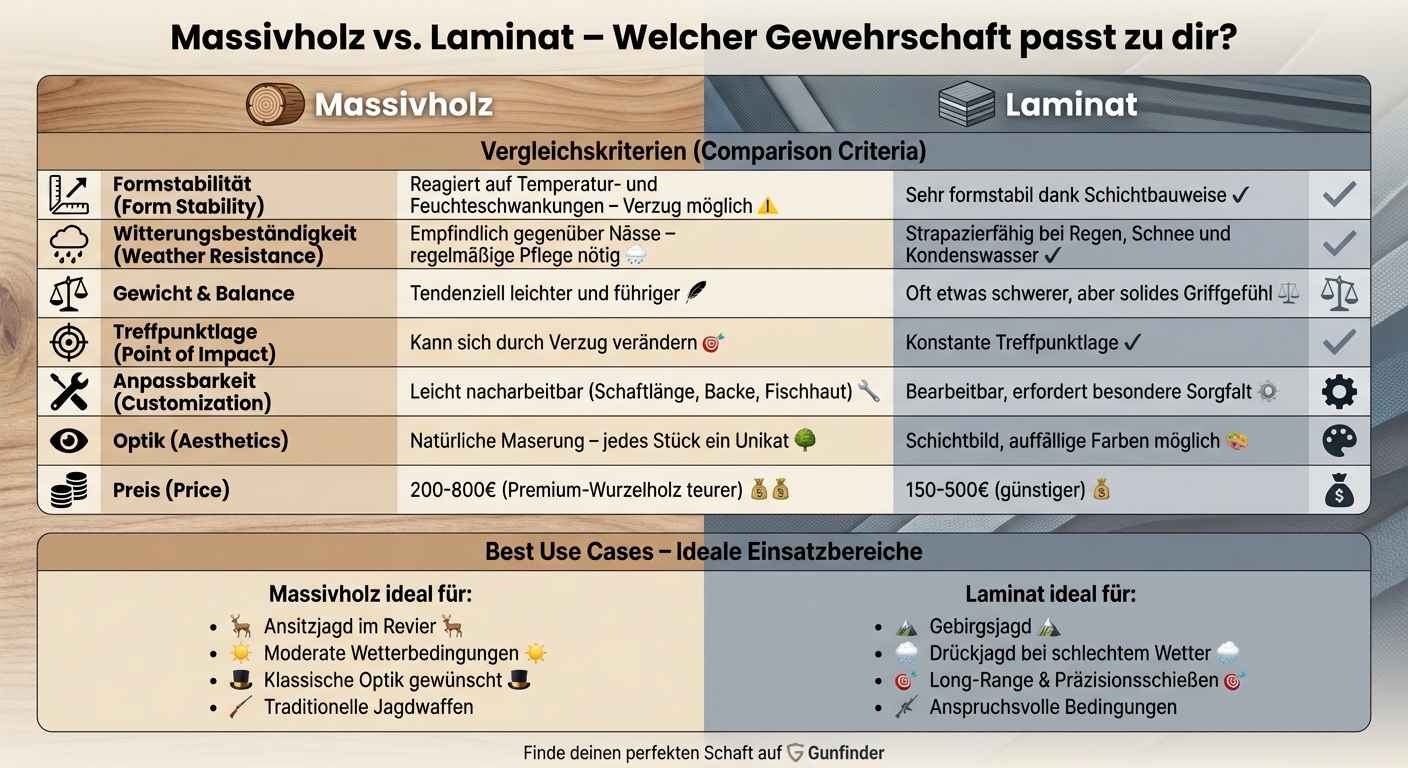
Solid Wood vs Laminate Rifle Stocks: Direct Comparison of All Features
Comparison Table: Performance Criteria
| Criterion | Solid Wood | Laminate |
|---|---|---|
| Dimensional Stability | Responds to temperature and moisture fluctuations – warping possible | Significantly less shrinkage due to layered construction – very dimensionally stable |
| Weather Resistance | Sensitive to moisture and temperature fluctuations; regular maintenance required | Durable against rain, snow, and condensation |
| Weight & Balance | Tends to be lighter and more maneuverable | Often slightly heavier, but with a solid grip feel |
| Point of Impact | Can change due to warping, especially with direct barrel contact | Consistent point of impact even under changing conditions |
| Customizability | Easy to modify (stock length, cheek piece, checkering) | Can be modified, but the layered structure requires special care |
| Aesthetics | Natural grain, classic-elegant – each piece is unique | Polarized layered appearance; allows for striking colors and designs |
| Price | High-quality root wood stocks in the premium segment | Generally cheaper than premium solid wood variants |
The table provides a quick overview of the differences between both materials and helps make an informed decision.
Which Material for Which Purpose?
The choice between solid wood and laminate strongly depends on individual requirements and areas of use:
Solid Wood is the preferred choice for classic hunting situations. Its natural grain, pleasant feel, and timeless appearance give each stock a unique character.
Laminate, on the other hand, is ideal for mountain hunters and driven hunt shooters. Thanks to its high dimensional stability and weather resistance, the point of impact remains constant even under difficult conditions.
For sport and long-range shooters, laminate offers significant advantages. The high stability of the material ensures precise and reproducible shots. Many German manufacturers combine laminate wood with aluminum bedding to further enhance repeat accuracy. Additionally, the slightly higher weight helps better control recoil in large-caliber firearms.
Those who value individual adjustments will find solid wood to be more suitable. It is easier to work with, for example, in terms of stock length or checkering. Laminate stocks, on the other hand, are often offered as complete systems with integrated adjustment options.
On platforms like Gunfinder, you can directly compare both variants and select the appropriate material for your needs.
How to Choose and Adjust Your Rifle Stock
Questions You Should Clarify Before Purchase
Before deciding between solid wood and laminate, you should closely examine your hunting routine. Do you primarily hunt in damp forests, rugged mountains, or dry fields? The shooting discipline also plays a central role: whether driven hunt, stalking, or precision shooting – the purpose of use influences the choice of stock material. Laminate stocks have the advantage of minimizing point of impact shifts due to temperature fluctuations.
The weight of your rifle is another important factor. Especially in mountain hunting, the total weight of the rifle ideally should be under 3.5 kg. Aesthetics are also not to be underestimated for many hunters: solid wood impresses with its classic elegance, while laminate allows for modern designs and even signal colors. And of course, the budget plays a role: high-quality walnut stocks often fall into the upper price segment, while laminate stocks are usually more affordable.
Once you have clarified your priorities, you can explore the options for customizing your stock.
Post-Purchase Adjustment Options
Solid wood stocks offer high flexibility for post-processing. You can have the stock length, cheek piece, or pistol grip customized. Smaller repairs, such as fixing dents or re-cutting the checkering, are also easily possible. Gunsmiths can optimally adjust used stocks to your body measurements through milling and polishing. The costs for such work typically range from €100 to €300.
Laminate stocks offer different advantages in terms of adjustment. Many models come with integrated aluminum bedding made from 7075 aluminum, height-adjustable cheek pieces, or ambidextrous designs that allow for flexible shooting positions. An example of this is the German Gun Stock systems for the Tikka T3, which allow for stepless adjustment – ideal for precision shooters. If you switch from solid wood to laminate, you can reduce the deformation of the stock by up to 80%. Additionally, laminate offers better weather resistance, which is particularly advantageous in mountain hunting. For mounting, including bedding, you should expect costs between €200 and €500.
Find Rifle Stocks on Gunfinder

Once you have defined your requirements, Gunfinder helps you find the right stock. With the practical filter function, you can specifically search for the desired material – whether solid wood (typically €200–800) or laminate (usually €150–500). You can also combine criteria such as caliber, model (e.g., Tikka T3), and condition (new or used). The comparison tools display important specifications like weight, length, and price side by side. For example, you can directly compare an elegant walnut stock with a modern laminate stock in TimberSmith style. Thanks to secure transactions and auctions, the purchasing process is simplified, and with the filter function "laminate stock weather-resistant," you can quickly find suitable offers from partners.
Conclusion
The decision between solid wood and laminate entirely depends on your needs and preferences. If you value timeless elegance, natural grain, and a pleasant grip feel and are willing to invest in regular maintenance, solid walnut wood is the perfect choice. However, if you often hunt in changing weather conditions and seek a material that is dimensionally stable and low-maintenance, then laminate is the more robust alternative.
Solid wood scores with individuality and traditional charm, while laminate impresses with precision and durability. Both materials have their strengths – the choice depends on your requirements.
Consider carefully where and how you hunt or shoot. For mountain hunting in rain and snow, laminate is often more practical, while the advantages of solid wood are more pronounced in an occasional sit in a dry area. The correct stock shape and adjustability are also often more decisive than the material itself.
On Gunfinder, you will find the stock that fits your style and requirements. Whether you choose the elegant look of solid wood or the robust stability of laminate – there you can specifically filter by material, caliber, and model, compare prices, and securely purchase your ideal stock, both new and used.
FAQs
Why is a laminate stock advantageous in extreme weather conditions?
A laminate stock excels due to its remarkable resistance to moisture and temperature fluctuations. Unlike solid wood, it does not tend to warp in wet or changing weather conditions. This ensures that the stability and precision of your rifle are maintained.
Especially under extreme weather conditions like heavy rain or icy cold, a laminate stock remains dimensionally stable and reliable. Therefore, it is an excellent choice for hunters and shooters who need to trust their rifle even under difficult circumstances.
How does the weight of a solid wood stock affect precision and handling?
The weight of a solid wood stock plays a crucial role in precision and handling. Heavy stocks provide greater stability when shooting, which is particularly helpful for precise shots. However, they can become tiring during longer sessions. Light stocks, on the other hand, are easier to carry and more comfortable to handle, but may offer less stability. Ultimately, the decision depends on whether you prioritize precision or carrying comfort.
How can you customize a solid wood stock?
Solid wood stocks offer a variety of options for personal customization. The surface can be smoothed by sanding and then treated with oil or wax. This not only protects the wood from external influences but also emphasizes the natural grain – a real eye-catcher.
The shape of the stock can also be customized. Whether by removing wood or adding new elements – this way, the stock can be perfectly tailored to your requirements.
For a personal touch, you can add engravings or finishes. This makes your rifle not only functional but also visually a true one-of-a-kind piece.