5 Long-Range Rangefinders in Setup Comparison

When I measure from 500 m, it’s not just the range that counts, but the whole setup. In this comparison, it’s clear to me: Leica CRF MAX leads in ballistics, Kahles HELIA RF-M is the easiest device for everyday use, Zeiss Victory RF 8x42 is the most expensive comfort solution, Leica CRF 2400-R covers the compact mid-range, and Nikon Monarch 2000 is the affordable entry.
For me, these points matter most:
- Setup: How much do I have to adjust before use?
- Menu and operation: Can I get to the target without long pressing?
- Target modes: Does the device help with grass, branches, or small targets?
- Ballistics: Is there only EHR or a solver with app connection?
- Display: Can I read values clearly in sunlight and twilight?
- Price in Germany: from about 169 € to about 3,240 €
In summary, I’d classify them like this:
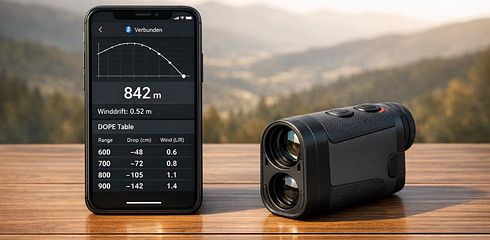
- Leica CRF MAX: for extensive ballistics and long distances up to 3,400 m
- Leica CRF 2400-R: for minimal setup and solid range up to 2,200 m
- Kahles HELIA RF-M: for clear operation and good value under 620 €
- Nikon Monarch 2000: for simple distance measurement without app
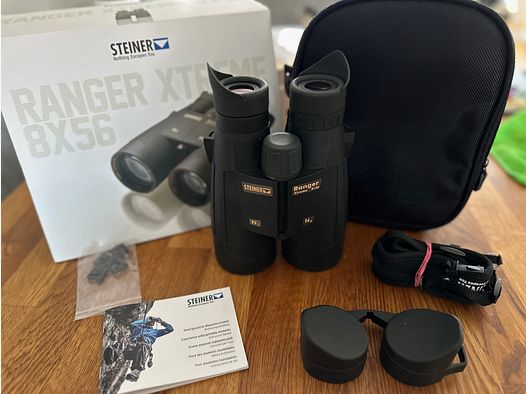
- Zeiss Victory RF 8x42: for those who want binoculars and rangefinder in one
Quick Comparison
| Model | Range | Ballistics | Format | Price approx. |
|---|---|---|---|---|
| Leica Rangemaster CRF MAX | 3,400 m | Applied Ballistics Elite | Monocular | 1,320 €–1,500 € |
| Leica Rangemaster CRF 2400-R | 2,200 m | EHR / Angle | Monocular | 550 €–629 € |
| Kahles HELIA RF-M | 2,000 m | EHR, Temperature, Air Pressure | Monocular | 489 €–620 € |
| Nikon Monarch 2000 | 910 m | Basic distance measurement | Monocular | 169 € |
| Zeiss Victory RF 8x42 | 2,300 m | App, 9 profiles | Binoculars | 3,240 € |
My short conclusion: When I have little time, I want a device that delivers immediately. That’s exactly what this article is about: not brochure specs, but which model holds you up the least outdoors.
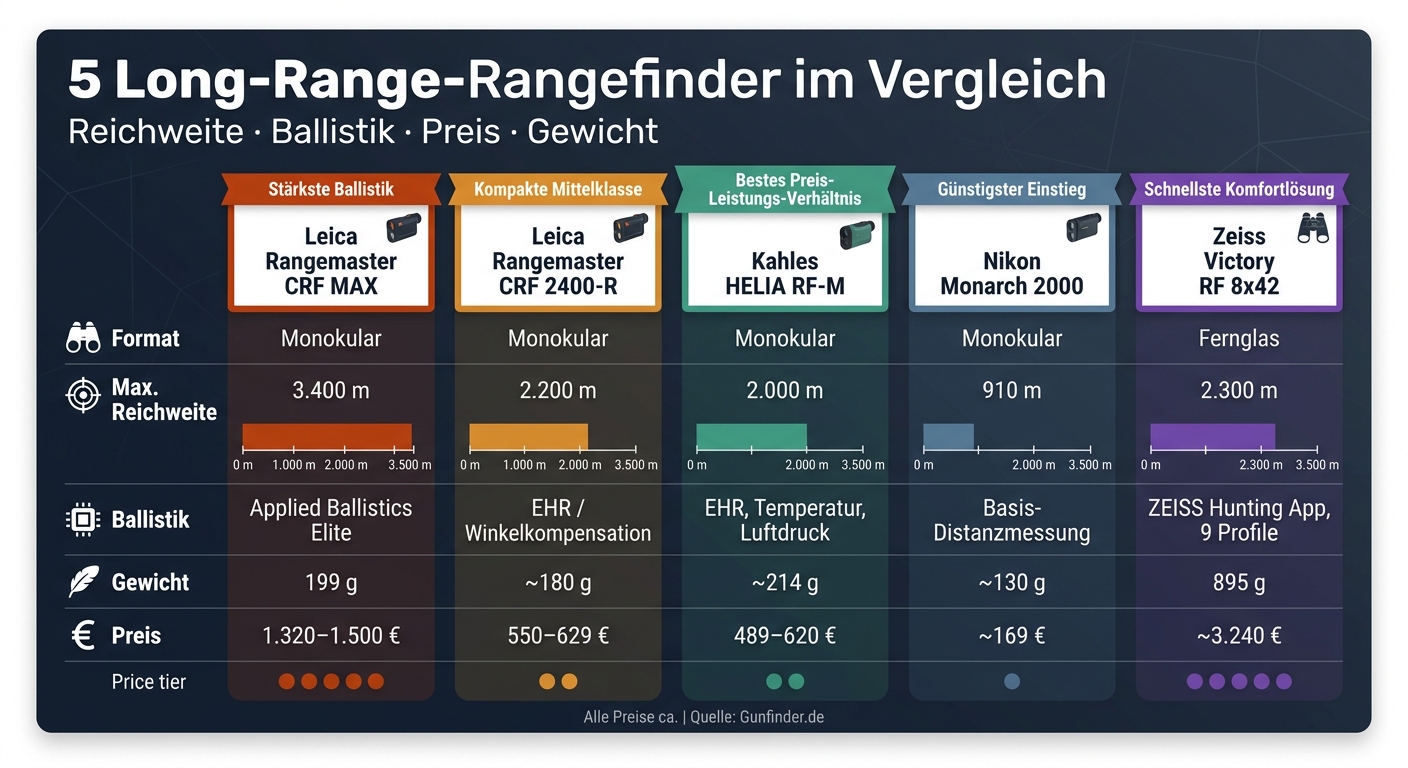
5 Long-Range-Rangefinder im Vergleich: Reichweite, Ballistik & Preis
Test Method and Comparison Criteria
Selection Criteria: Range, Ballistics, Optics, Ergonomics, Price
All five devices are rated based on range, target modes, ballistics, optics, ergonomics, and price. In the end, one thing counts above all: How quickly can you get a usable measurement outdoors?
The focus is on the measuring range on reflective and non-reflective targets, from steel to game-sized targets. Added to this are first, last, and best target modes. These functions often make the difference when grass, branches, or bushes stand in front of the target and can interfere with the measurement.
For ballistics, we look at what each device can do:
- Does it have its own ballistic solver on board?
- Does it only output the equivalent horizontal range (EHR)?
- Or does it work via Bluetooth with an app?
Optics also play a big role. Compared are light transmission, contrast in low light, and lens coating, for example AquaDura or LotuTec. Ergonomics covers weight, housing shape, one-handed operation, and whether a tripod is useful in practice or just dead weight.
The price range is wide: from the Kahles HELIA RF-M for around 489 € to the Zeiss Victory RF for about 3,240 € [2][4]. You can find current prices and availability directly on Gunfinder.
Field Setup and Test Routine
Measurements are taken at known distances, for example at 300 m and over 1,000 m. This allows accuracy and repeatability to be checked cleanly. Testing is done handheld and with a tripod, in daylight and at dusk. Because that’s exactly when it shows whether the display and optics are still usable in practice or not [1][3].
Targets include steel plates, game decoys, and non-reflective targets. Measurements are also taken on sloped terrain to evaluate the angle compensation of the individual models [1][3].
In the field, the wheat quickly separates from the chaff: a device may look strong on paper but cost time due to cumbersome menus, a sluggish display, or slow target acquisition. And these seconds often make the difference outdoors.
These criteria form the basis for the direct comparison of the five models in the next section.
Comparison Table: Test Criteria of All 5 Models
The table shows the hard data. After that, the field focuses mainly on menu navigation, display, and operation.
| Model | Max. Range (reflective) | Ballistics | Weight | Price in Germany (approx.) |
|---|---|---|---|---|
| Leica Rangemaster CRF MAX | 3,400 m | Applied Ballistics Elite | 199 g | 1,320 to 1,500 € |
| Leica Rangemaster CRF 2400-R | 2,200 m | EHR / Angle Compensation | around 180 g | 550 to 629 € |
| Kahles HELIA RF-M | 2,000 m | EHR / Temperature / Air Pressure | around 214 g | 489 to 620 € |
| Nikon Monarch 2000 | 910 m | Basic Distance Measurement | around 130 g | approx. 169 € |
| Zeiss Victory RF 8x42 | 2,300 m | Zeiss Hunting App, 9 Profiles | 895 g | approx. 3,240 € |
The table summarizes maximum ranges, weights, and price ranges of the five models [1][2][4].
sbb-itb-1cfd233
The 5 Long-Range Rangefinders in Direct Setup Comparison
After the basic data, the direct comparison clearly shows how much operation and information output differ out in the field. In the field, it’s not the nicest data list that counts in the end, but how quickly a device is ready to use, how well the display can be read, and how little you have to fiddle with it.
Leica Rangemaster CRF MAX vs. Zeiss Victory RF 8x42
The Leica Rangemaster CRF MAX imports ballistic profiles via the Leica Ballistics App and displays ballistic distance, click corrections, and environmental data such as temperature, air pressure, and angle directly on the device. The Active-Matrix microLED display is said to be one of the brightest in this class according to the source [1]. Added are the target modes First, Last, and Best [1].
The Zeiss Victory RF 8x42 relies on the ZEISS Hunting App, stores up to nine individual ballistic profiles, and delivers measurement results in under 0.3 seconds [4]. This is a point that immediately stands out in use: measure, read, move on.
| Feature | Leica CRF MAX | Zeiss Victory RF 8x42 |
|---|---|---|
| Format | Compact monocular | Binocular |
| Display | Active-Matrix microLED display [1] | LED with automatic brightness control [4] |
| Ballistics | Applied Ballistics Elite [1] | ZEISS Hunting App, up to 9 profiles [4] |
| Target modes | First / Last / Best [1] | – |
At 199 g, the CRF MAX is very light. Additionally, Leica ProTrack (LPT) helps with GPS and compass to find your way back to the measurement point [1]. This is especially useful when every step after measuring needs to be precise.
The Victory RF plays its strengths elsewhere: it is not only a rangefinder but also a fully functional observation binocular with integrated ballistics and very fast measurement output [4]. If you want observing and measuring in one device, this is where you take a closer look.
The crucial question remains the same: Which device delivers the fastest and cleanest solution under time pressure in practice?
Swarovski EL Range TA
The Swarovski EL Range TA combines observing and measuring in one binocular. Especially in the mountains or during stalking, this built-in concept is often the bigger plus compared to monocular solutions [3][6].
The next section focuses mainly on one thing: Which model can be set up the fastest and read the clearest?
Interim conclusion: Setup, measurement performance and price-performance ratio
Which model is easiest to set up and operate in the field?
The practical test clearly shows which device turns the setup criteria into a measurable advantage without detours. The Leica Rangemaster CRF MAX is the easiest to set up: once configured, the ballistics run directly on the device, without any further adjustments in the field [1]. This is a big plus in use.
The Zeiss Victory RF 8x42 scores with nine storable profiles and a measurement output of under 0.3 seconds [4]. The Leica Rangemaster CRF 2400-R and the Kahles HELIA RF-M provide solid angle compensation without requiring an app [1][2]. If you prefer it simple, you end up with the Nikon Monarch 2000: no ballistic computer, no app, but a fast basic measurement at the lowest price in the field. In the end, what counts most is how much operating comfort you get for your budget.
Comparison table: all 5 models at a glance
The following overview shows which model offers the best mix of setup, speed and price.
| Model | Setup | Ballistics | Display / Operation | Price (approx.) |
|---|---|---|---|---|
| Leica CRF MAX | App + device, target modes First/Last/Best [1] | Applied Ballistics Elite® [1] | microLED, brightest class according to manufacturer [1] | 1,275–1,500 € [1][2] |
| Leica CRF 2400-R | directly on device, EHR [1] | Angle compensation [1] | compact, one-handed operation [1] | 550–629 € [1][2] |
| Kahles HELIA RF-M | directly on the device, EHR [2] | temperature / air pressure [2] | clear layout, robust housing [2] | 489–620 € [2] |
| Nikon Monarch 2000 | no configuration needed [2] | basic distance measurement [2] | simple, no app required [2] | approx. 169 € [2] |
| Zeiss Victory RF 8x42 | app, 9 profiles [4] | ZEISS Hunting App [4] | measurement under 0.3 sec., binoculars [4] | approx. 3,240 € [4] |
The next step then shows where the practical benefit justifies the purchase price – and where it doesn’t.
Price-performance in the German market and on Gunfinder
If you’re looking for maximum ballistic depth, there’s hardly a way around the Leica CRF MAX. It offers the strongest setup in comparison, and the price on Gunfinder is noticeably below the MSRP [1][2].
The best price-performance ratio is offered by the Kahles HELIA RF-M. You get solid ballistics, a robust housing, and stay under 620 € [2]. The Zeiss Victory RF 8x42 remains the most expensive comfort solution in the field: a combo device of binoculars and rangefinder with the fastest measurement output in comparison [4].
Current prices can be found on Gunfinder.
Conclusion: Which long-range rangefinder fits which setup
The most important insights from the 5-device comparison
When it comes to range, ballistics, and operation, it becomes quite clear which model fits which use.
If you want a device for everyday hunting that works without much menu navigation, the Kahles HELIA RF-M is the best choice [5]. Also compact and reliable is the Leica Rangemaster CRF 2400-R. It measures distances up to 2,200 m [5] and fits well in the hunting grounds and on the shooting range.
When it comes to ballistics at the highest level, the Leica Rangemaster CRF MAX leads [1]. At this range, a tripod is clearly worthwhile if you want to use the measuring potential precisely [1]. The Zeiss Victory RF 8x42, on the other hand, is the fastest comfort solution: measurement values in under 0.3 seconds and up to nine ballistic profiles via app [4]. The Nikon Monarch 2000 remains the most affordable basic solution, completely without app dependency [2].
For quick orientation:
- Kahles HELIA RF-M: simplest setup
- Leica Rangemaster CRF 2400-R: compact mid-range
- Leica Rangemaster CRF MAX: strongest ballistics
- Zeiss Victory RF 8x42: fastest comfort solution
- Nikon Monarch 2000: most affordable basic solution
You can get the Kahles HELIA RF-M and the Leica Rangemaster CRF 2400-R in the DACH region for under 620 € [5]. Current prices can be found on Gunfinder.
FAQs
Which device suits my use?
The right device mainly depends on your area of use and how much you need in terms of ballistics.
For ambitious long range, the Vortex Razor HD 4000 GB is a strong choice. The device works with GeoBallistics-Solver and includes environmental sensors. So if you shoot at long distances and want more than just a simple distance measurement, this model fits well.
The Leica Rangemaster CRF MAX is suitable if you want a compact device but still don’t want to do without Applied Ballistics and GPS connectivity. This is especially interesting when space is limited and you still want to use a lot of data.
For hunting at medium distances, the SIG Sauer KILO3K is a user-friendly choice. The device is well suited if you want to get clean measurement values without much hassle.
If you want a rangefinder and binoculars in one, a device like the Zeiss Victory RF is especially useful for stalking and stand hunting. It saves equipment and often makes handling in the hunting grounds a bit more comfortable.
Do I really need a ballistics app?
That mainly depends on what you use the rangefinder for.
For shots over 500 meters, an app is almost mandatory. The reason is simple: it can calculate bullet drop, environmental data, and the angle of inclination in real time. Especially at long range, this makes a clear difference.
For shorter distances, a standard model without an app is often completely sufficient. In many cases, this is the simpler way.
Also practical: many modern rangefinders can be set up once via an app and then continue to operate reliably without a smartphone in use.
When is a binocular with rangefinder worth it?
A binocular with rangefinder is especially worth it if you want to work precisely in hunting or sport shooting.
For shots over 500 meters, it is almost indispensable. The reason is simple: ballistic factors like angle of inclination, temperature, and air pressure must be taken into account in real time.
Even in general hunting, such a device provides more safety. You can measure distances quickly and reliably instead of just estimating them. Many modern models also provide you directly with the appropriate holdover correction.