Wood or plastic: hunting stock compared

If I had to give a short answer: synthetic is usually the better choice in rain, dirt, and with little care. Wood often fits better when warm grip feel, more calmness in the shot, and classic looks are important to me.
I would base the choice on 5 points:
- Wetness: Synthetic usually stays dimensionally stable. Wood can swell with a lot of moisture.
- Cold: Wood usually feels more pleasant in winter. Synthetic often feels cold.
- Care: I wipe synthetic. Wood needs drying, oil, and a bit more attention.
- Weight: Synthetic is often lighter. You especially notice that on long walks and in the mountains.
- Price: Standard synthetic is often the cheaper entry. Good walnut wood and carbon are often more expensive.
Important for me: Even a difference of a few 100 g can be noticeable on the stalk. And with stronger calibers like 9.3×62, a heavier stock often feels more comfortable because the extra weight helps reduce recoil.
In short:
- For stand hunting I prefer wood.
- For driven hunts, tracking, and wet days rather synthetic.
- For mountain hunting rather light synthetic or carbon.
Quick comparison:
| Criterion | Wood stock | Synthetic stock |
|---|---|---|
| Wetness | can swell or warp | usually stays dimensionally stable |
| Cold feel | rather warm in the hand | often cold |
| Care | more effort | little effort |
| Weight | usually heavier | usually lighter |
| Recoil feel | often somewhat more comfortable | often more noticeable on light models |
| Price | from cheap to expensive, depending on wood | standard often cheaper, carbon more expensive |
So if I hunt a lot in bad weather, I usually want less work and choose synthetic. If I sit a lot and grip feel and shot calmness are more important to me, I tend to go for wood.
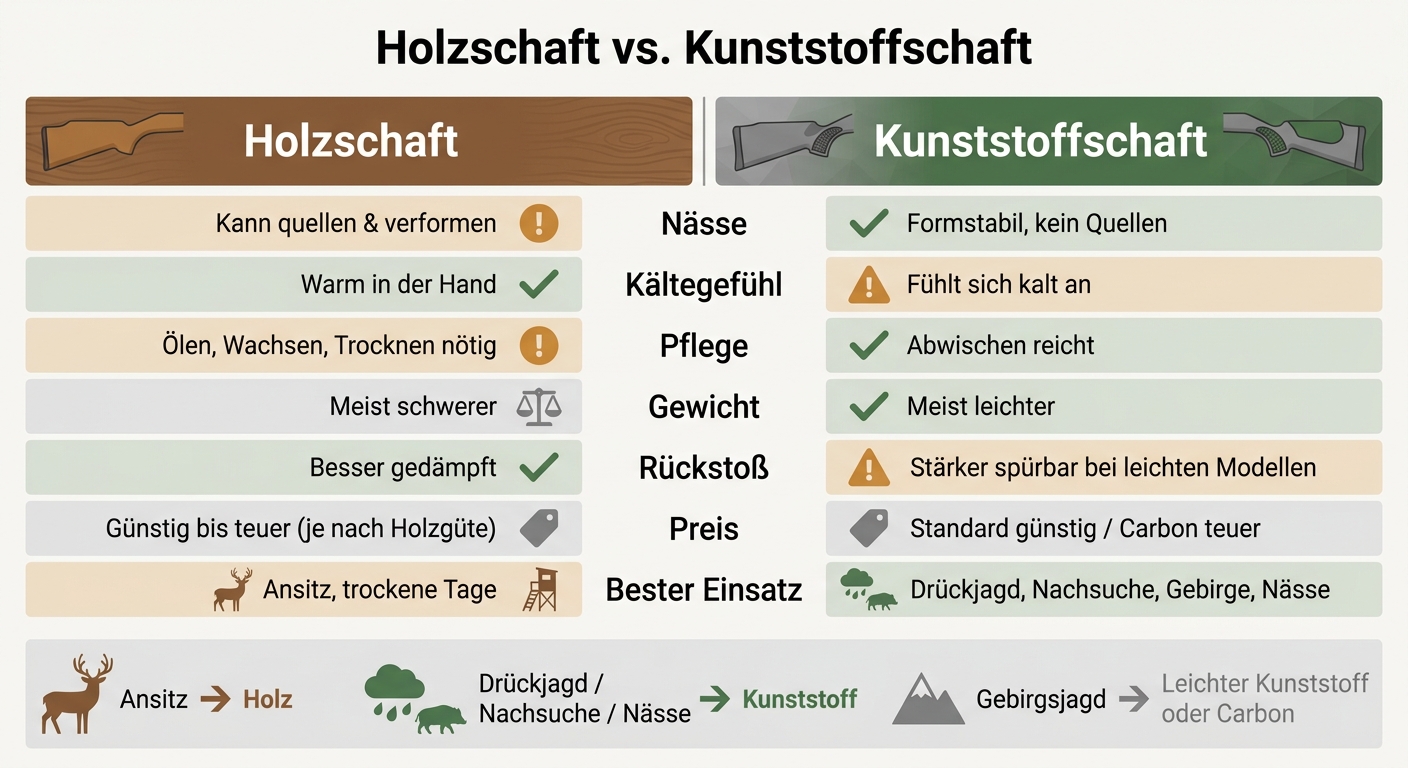
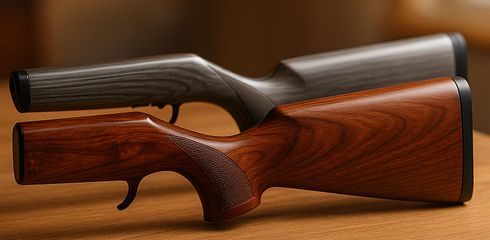
Wood stock vs. Synthetic stock: The big comparison
WOOD vs SYNTHETIC STOCK
sbb-itb-1cfd233
Wood Stocks: Strengths and Limits in the Field
Wood is still in demand. There are good reasons for that: it looks classic, feels warm, and can be easily refinished if needed. Many hunters appreciate exactly that. If a stock has dents, a gunsmith can sand a good wood stock, re-oil it, and restore it [4].
In the field, wood is not just about looks or feel in the hand. In the end, two things matter most: how well the stock handles weather and how much maintenance it requires.
Wetness, Cold Feel, and Maintenance Effort
It's not just the rain that's the problem, but what moisture does to the wood. Wood swells when wet and shrinks when dry [2][6]. That’s where it gets tricky: in the worst case, the stock touches the barrel, which can change the point of impact [2]. Especially the rough inner surfaces, like the action recess and barrel channel, are vulnerable. They absorb water faster than the smooth, polished outside [6].
That’s why maintenance for wood isn’t just a nice extra, it’s part of the deal. After a wet hunt, the stock should dry slowly in the air — never directly on a heater. Otherwise, the wood can crack [1][6]. Twice a year, apply some oil, like tung oil, and before the wet season, a wax coating: that’s enough for most conditions [6]. For even more peace of mind, you can have an epoxy bedding installed. This prevents the action from shifting due to wood movement [6].
A clear plus remains the cold feeling. Wood simply feels more pleasant in winter than many other materials. Especially during long sits, you quickly notice the difference.
Weight, Recoil, Price and Use in the Field
Besides maintenance, weight plays a big role. Wooden stocks are usually heavier than synthetic stocks. That sounds like a disadvantage at first, but it brings a solid plus when shooting: The extra weight dampens the perceived recoil. This is noticeable with stronger calibers like the 9.3x62 [1][3]. Often, there is also a steadier balance because many synthetic stocks are lighter in the rear area [2][7].
The price range varies widely. Simple standard woods are often affordable. Hand-selected walnut, on the other hand, can noticeably drive up the price of a firearm [4]. For sitting hunts or driven hunts, wood is often a good choice because the extra weight usually bothers less there than on long stalking trips.
| Aspect | Strength | Limitation | Typical Use |
|---|---|---|---|
| Moisture | Oiled surfaces provide basic protection | Can swell or warp, point of impact may shift | Dry days or well-maintained gear |
| Cold Feeling | Warmer and more pleasant in the hand | – | Winter sitting hunts |
| Maintenance | Scratches can be sanded and re-oiled | Regular oiling and waxing needed | Hunting with focus on appearance and care |
| Weight & Recoil | More mass dampens recoil, often better balance | Tiring on long stalking trips over time | Sitting hunts, driven hunts |
| Price | Entry models are affordable | Good walnut can clearly increase firearm price | All types of hunting, depending on budget |
Synthetic Stocks: Strengths and Limits in the Field
Compared to wood, synthetic shows its strengths especially in moisture and maintenance effort. If you are often outside in rain, snow, or on driven hunts, that’s a clear plus. The reason is simple: low effort, high everyday practicality.
Weather Resistance, Cold Behavior and Care
Plastic does not absorb water, remains dimensionally stable, and keeps the point of impact stable even after getting wet [2]. Blood and dirt can be easily wiped off, oil is not necessary.
The biggest downside shows up in winter: Plastic feels cold. If you sit for a long time on a stand, you often notice this quickly. There is also a point that can be annoying in the field: Many plastic stocks sound hollow and conspicuous when bumped. This can be disturbing especially when stalking [2][3].
Something often overlooked: Without grip inserts or soft-touch coating, a plastic stock can become slippery when wet. With wet hands and thick clothing, good grip quickly becomes a safety factor. Textured grip surfaces, rubber inserts, or grip tape help noticeably here.
In the end, it’s not just about how well the stock withstands weather, but also how securely it feels in your hand.
Weight, Price, Features and Durability
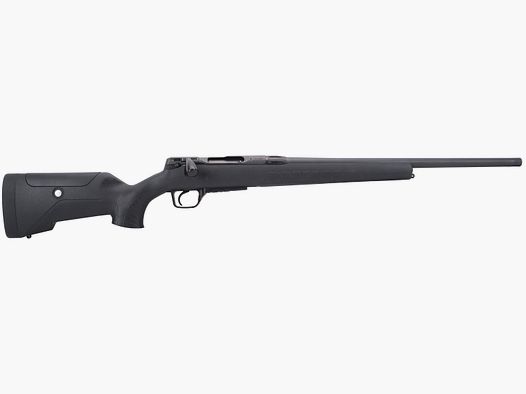
Plastic stocks are usually lighter than wooden stocks. This is often pleasant when hunting on foot or in the mountains. However, with quick follow-up shots, the low mass also has its downside: the perceived recoil often feels stronger [5].
Price-wise, plastic is often the easier entry. Many models come from the factory with a plastic stock because this solution is cheaper in series production. Carbon is clearly more expensive but saves even more weight.
In everyday use, many modern plastic stocks also make a good impression in terms of features. Adjustable cheekpieces and spacers for length adjustment are often missing or cost extra with wood. With plastic, they can often be adjusted without tools. This is practical if you hunt in summer with light clothing and in winter with a thick jacket [2][8].
| Aspect | Strength | Limitation | Typical Use |
|---|---|---|---|
| Weather | No swelling, no deformation when wet | Surface feels cold in frost | Driven hunt, tracking or wet stalking |
| Care | Wiping off is enough, no oiling needed | Scratches remain permanently visible | Tracking, driven hunt |
| Ergonomics | Adjustable cheekpiece, spacers, thumbhole stock | Hollow construction can amplify noise | Driven hunt, active hunting |
| Weight & Recoil | Lighter, more mobility | More perceived recoil with light models | Stalking, mountain hunting |
| Price | Entry-level often cheaper than quality wood | Carbon costs significantly more | All hunting types, depending on budget |
So it’s not just about what’s lighter. What matters is which stock fits your use in the field.
Direct Comparison: Wetness, Cold, Care, Weight and Price
After the details, here’s a quick decision guide.
| Feature | Wood Stock | Plastic Stock |
|---|---|---|
| Wetness | Can swell and deform | Dimensionally stable, no swelling |
| Cold Feeling | Warms up quickly, pleasant | Feels cold |
| Care | Needs regular oiling and drying | Usually just wiping, no oiling |
| Weight | Usually heavier | Usually lighter |
| Recoil Feel | Better dampened due to higher weight | More noticeable on light models |
| Everyday Use | Repairable but more maintenance-intensive | More robust in use, cosmetic scratches secondary |
| Price Level | Highly dependent on wood quality | Standard plastic usually cheaper, carbon significantly more expensive |
| Best Use | Still hunting: Wood | Driven hunt, tracking, wet conditions: Plastic | Mountains: light plastic or carbon |
Where Wood Wins and Where Plastic Wins
Wood has some clear strengths: It feels warmer, often dampens recoil better, and can usually be well repaired. Small scratches or damage on a wood stock are often no big deal. A good gunsmith can often refurbish such a stock cleanly.
Plastic shows its strength especially in wet conditions. The material stays stable and needs hardly any care. Just wipe it off, done. Wood is different: The stock should stay dry to keep point of impact stable [2].
In the end, one thing counts most: How do you use the firearm in the field?
Which Stock Fits Which Hunting Situation in Germany
When still hunting, a bit more weight usually doesn’t matter much. That’s exactly why wood often fits well here. It feels comfortable in the hand and brings calm to the shooting behavior.
For driven hunts, rain, or when the rifle often comes into contact with branches, ground, and rough field conditions, plastic is often the more sensible choice. Textured grip surfaces provide more hold, especially when it’s wet or hectic.
For mountain hunting, it’s different again. When every gram counts, a light plastic or carbon stock is usually the most practical solution. The catch: Carbon is often noticeably more expensive [2].
Recoil can also play a role in your choice. With stronger calibers like 9.3×62, a heavier wood or laminate stock can feel noticeably more comfortable [3].
Conclusion: Which Stock Suits You?
There is no universally best stock. If you consider wetness, cold, maintenance, weight, and price, the choice ultimately comes down to a few clear questions. The key factors are especially use case, weather, and maintenance effort.
Plastic is good for wet conditions with little maintenance. Wood is preferable if you often sit in a stand, like the classic look, and are willing to invest a bit more time in care.
There’s also a clear picture when it comes to price: Standard plastic is usually the cheapest option. High-quality wooden stocks and carbon stocks generally cost more.
The Most Important Decision Aids at a Glance
Wood suits you if you value warmth, classic looks, and a soft shooting behavior and maintenance is no problem for you. Plastic is the better choice if you want weather resistance, low effort, and robustness in the field.
On Gunfinder you can filter rifles with wood or plastic stocks by features and budget.
FAQs
When is a Laminate Stock Worth It?
A laminate stock is worth it if you’re looking for a dimensionally stable alternative to solid wood that also holds up under tough use. Thanks to the cross-glued wood layers, it warps much less in wet conditions and with strong temperature changes.
Its strengths really come into play in demanding situations like mountain hunts or driven hunts. If you like the feel of wood but want something more weather-resistant and low-maintenance, it’s a good choice.
How Much Does the Stock Affect Point of Impact?
The point of impact is mainly influenced by the stock’s dimensional stability. This is often where the wheat is separated from the chaff.
Solid wood can swell or shrink with moisture and temperature changes. This can cause the stock to warp. The result: the point of impact shifts. This is especially true if the barrel rests directly on the wood.
Plastic and laminate stocks usually remain more consistent in wet and cold conditions. This is often a real plus in everyday hunting. But they’re not without their quirks.
With plastic stocks, precision can also suffer if the fore-end is too flexible, there’s play at adjustment points, or the bedding is poor.
Which Stock Length Suits Me?
The right stock length depends on your anatomy, your shooting position, and the use case. If the stock fits, the rifle comes quickly to your shoulder, rests steadily in your hand, and you get a clear sight picture through the scope right away.
If you don’t immediately look through the center of the optic when mounting or the rifle just doesn’t feel comfortable to handle, you should adjust the stock length. That’s exactly why adjustable stocks are so practical: they can be more easily tailored to you and your use.