Capricorn hunting: ammunition for extreme distances

The hunting of chamois in the high mountains presents hunters with significant challenges: shots over 300 meters, steep angles, and changing winds require precise equipment and careful preparation. The right caliber choice, high-quality ammunition, and realistic training are crucial to achieve ethical hits in the small target area (15–20 cm).
Important Points:
- Caliber Choice: Magnum calibers such as .300 Win Mag, 7 mm Rem Mag, and .270 WSM offer flat trajectories and high energy at distance.
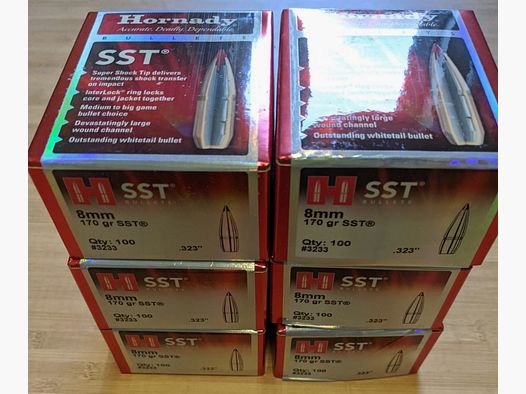
- Ammunition: Bullets with a high ballistic coefficient (e.g., Norma Bondstrike, Hornady ELD-X) minimize wind drift and energy loss.
- Training: Testing at 300–400 m under realistic conditions is essential to optimize precision and shot placement.
- Ethics: Shots over 400 m are risky and should only be taken under ideal conditions.
For a successful hunt, informed planning, the right equipment, and responsible handling are crucial.
Long Shots in Hunting – How Far is Still Ethical?
The Right Caliber Choice for Long-Distance Chamois Hunting
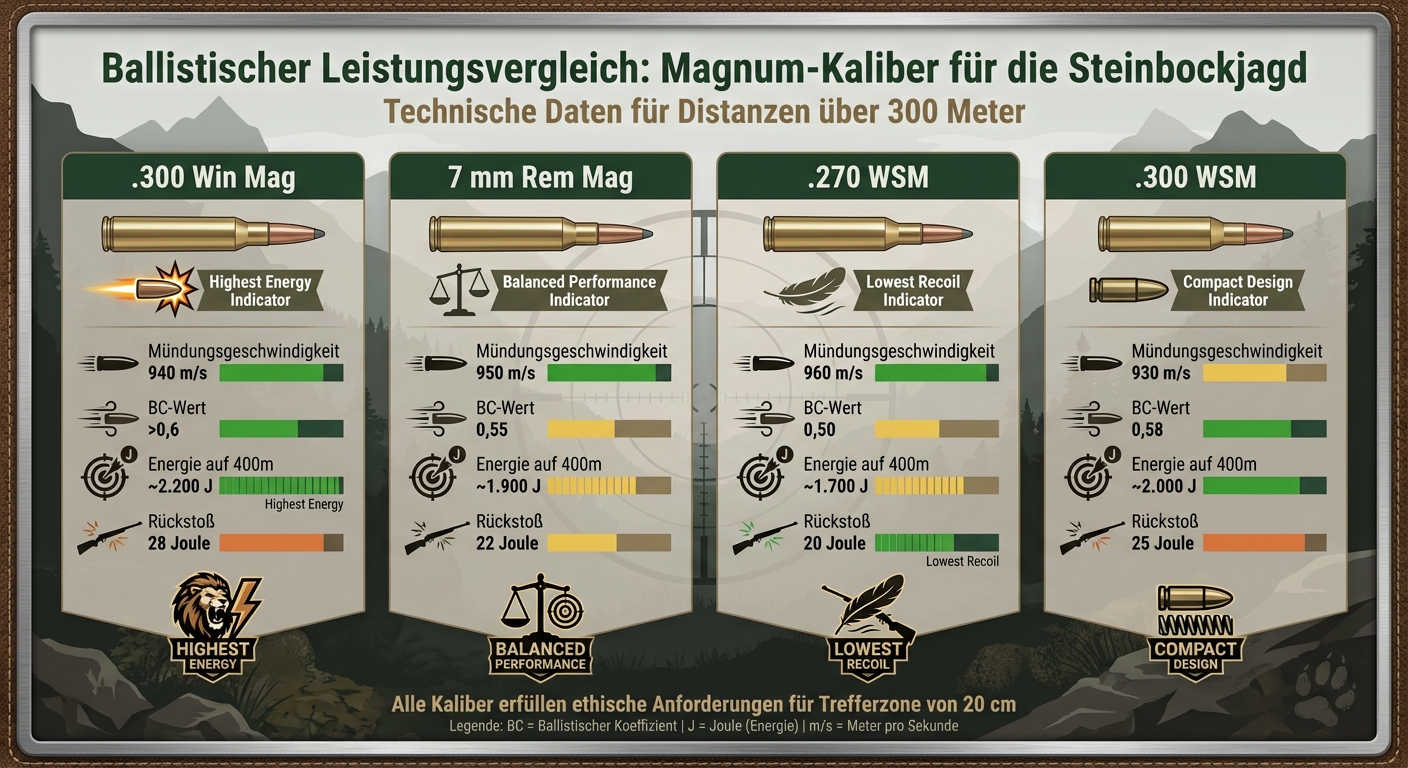
Magnum caliber comparison for chamois hunting: ballistic performance data
For chamois hunting at distances over 300 meters, magnum calibers have proven effective. Particularly popular are .300 Win Mag, 7 mm Rem Mag, .270 WSM, and .300 WSM – calibers specifically developed for game up to 100 kg and shooting distances up to 400 meters. These calibers excel in three essential characteristics: high muzzle velocities over 900 m/s, flat bullet trajectories, and strong energy retention even at long distances. The following options will be highlighted, which optimally meet both technical and ethical requirements.
Best Caliber Options for Extreme Distances
The choice of the right caliber is crucial for precision and impact at long distances – especially with the small target area of the chamois.
The .300 Win Mag is considered a classic in the high mountains. With the Norma Bondstrike Extreme (11.7 g / 180 grs), it achieves a ballistic coefficient over 0.6, a muzzle velocity of about 940 m/s, and retains over 2,200 Joules of energy at 400 meters.
The 7 mm Rem Mag offers a balanced combination of performance and reduced recoil. With a muzzle velocity of 950 m/s, it generates about 22 Joules of recoil – significantly less than the .300 caliber. Additionally, the wind deviation at 300 meters and 5 m/s crosswind is about 35 centimeters. Especially in steep terrain, where shots are often taken freehand, the lower recoil is a significant advantage.
The .270 WSM stands out with its high bullet speed of over 960 m/s when loaded with 130 grs Nosler Ballistic Tip. It achieves group sizes of under 10 mm at 100 meters and produces only 20 Joules of recoil, the lowest among the mentioned calibers. The .300 WSM delivers similar performance to the .300 Win Mag but is more compact, making it ideal for lighter rifles – a significant advantage during strenuous ascents in the mountains.
Ballistic Performance Comparison
The following table summarizes the key ballistic values of the four calibers:
| Caliber | Muzzle Velocity | BC | Energy at 400 m | Recoil |
|---|---|---|---|---|
| .300 Win Mag | 940 m/s | >0.6 | ~2,200 J | 28 Joules |
| 7 mm Rem Mag | 950 m/s | 0.55 | ~1,900 J | 22 Joules |
| .270 WSM | 960 m/s | 0.50 | ~1,700 J | 20 Joules |
| .300 WSM | 930 m/s | 0.58 | ~2,000 J | 25 Joules |
All four calibers meet ethical requirements and allow for precise hits in the only 20-centimeter target area. The choice of caliber ultimately depends on personal preferences: those seeking maximum energy should opt for the .300 Win Mag, while the .270 WSM is the best choice for a low-recoil shot.
Bullet Types for Long-Distance Precision and Performance
The bullet plays a crucial role in precision and impact. Its ballistic coefficient (BC) describes how well it overcomes air resistance. A high BC value ensures flatter trajectories, reduces speed loss, and minimizes wind drift over long distances – a clear advantage for shots at great distances.
For chamois hunting beyond 300 meters, polymer-tipped bullets with a boat-tail design have proven effective. This construction combines aerodynamic efficiency with controlled deformation and sufficient penetration power. According to Active Hunting, the RWS Speed Tip Professional is a “good choice” for such distances, as its optimized external ballistic shape and higher BC outperform traditional bullets. Especially in the high mountains, where over half of the shots are taken at over 300 meters, this performance is crucial.
Examples like the Norma Bondstrike Extreme (BC > 0.6) demonstrate how high BC bullets significantly reduce wind drift and enable precise hits even in challenging wind conditions. At the same time, the bullet must also perform reliably at reduced impact velocities. Technologies such as a bonded core and polymer tips ensure controlled expansion and sufficient penetration. The following sections will delve into proven bullet types and the importance of matching bullet weight and barrel length.
Best Bullet Types for Long-Distance Chamois Hunting
After discussing the aerodynamic fundamentals, it is worthwhile to look at specific bullet variants that excel in practice. Four models have proven particularly effective:
- Norma Bondstrike Extreme: This bullet was specifically designed for precise long-range shots. It combines a polymer tip, bonded core technology, and a boat-tail design. With a BC of over 0.6 in .30 calibers, it offers excellent penetration depth and strong stopping power.
- Hornady ELD-X: In tests with the .270 WSM, the 145-gr bullet achieved impressive results, including a group size of only 8 millimeters at 100 meters. Its higher weight provides more energy at long distances and stable trajectories in wind. Even at 300 meters, the hits remained within a group size of 42 millimeters – perfect for the small target area of a chamois.
- Nosler Ballistic Tip: This bullet also delivers excellent precision, with a 10-millimeter group size for five shots at 100 meters. It is particularly suitable for mountain hunting at distances up to 400 meters and offers reliable deformation and good penetration power, even for game up to 100 kilograms.
- RWS Speed Tip Professional: With its aerodynamic shape, this bullet minimizes wind drift and ensures controlled expansion without excessive deformation.
Matching Bullet Weight and Twist Rate
The optimal matching of bullet weight and twist rate is as important as choosing the right bullet type. The twist rate indicates how many rotations a bullet makes over a certain barrel length (e.g., 1:10 means one rotation over 10 inches). Lighter bullets (130–145 gr) require a faster twist rate (1:8 to 1:10), while heavier bullets (180 gr) are better stabilized with slower twist rates (1:10 to 1:12).
An incorrect combination leads to stability issues, resulting in larger group sizes and increased wind susceptibility beyond 300 meters. In practical tests, a .270 WSM with the appropriate twist and a Hornady ELD-X 145-gr bullet achieved impressive 8-millimeter group sizes at 100 meters. To achieve optimal results, the manufacturer's specifications for the recommended twist rate should be observed. Those unsure can use platforms like Gunfinder to find not only suitable ammunition but also detailed technical specifications for their own firearm.
Ammunition Recommendations for Long-Distance Chamois Hunting
Top Ammunition Selection for Extreme Distances
Here are three proven factory cartridges that have particularly excelled in practice for shots at extreme distances:
Norma Bondstrike Extreme 11.7 g / 180 gr in .300 Win. Mag. was specifically developed for precise shots at long distances. With a BC over 0.6, it offers a very flat trajectory and retains its energy even at distances over 400 meters. This cartridge impresses with its strong penetration depth and reliable stopping power. However, at shorter distances, there may be increased game meat loss and noticeable recoil.
Hornady ELD‑X in 7 mm Rem. Mag. is characterized by a flat trajectory and reliable energy retention beyond 400 meters. Practical tests show that this cartridge also delivers reliable performance beyond this distance. However, at shorter distances, more sensitive impacts and increased game meat loss may be observed.
RWS Speed Tip Professional in calibers like .300 Win. Mag. impresses with its aerodynamically optimized bullet shape. The higher BC compared to conventional hunting bullets ensures an extremely flat trajectory and high shock and stopping power. The fragmentation of the front bullet part leads to strong effects but may cause more significant bruising with softer impacts or at close range.
The key performance features of this ammunition are summarized in the following table:
| Ammunition | BC Value | Energy Retention | Target Ballistics | Disadvantages |
|---|---|---|---|---|
| Norma Bondstrike Extreme (.300 Win. Mag., 11.7 g) | > 0.6 | Very high | Deep penetration, strong stopping power | Increased game meat loss at close range, noticeable recoil |
| Hornady ELD‑X (7 mm Rem. Mag.) | Very high | High | Controlled deformation, reliable > 400 m | More sensitive impacts at short distances |
| RWS Speed Tip Professional (.300 Win. Mag.) | Higher than conventional bullets | High | High shock effect, flat trajectory | More significant bruising with softer impacts |
To find the ideal ammunition for your hunt, it is worthwhile to check Gunfinder. There you can compare and order these loadings. It is advisable to test several types to find the best choice for your needs. Additionally, you will find practical tests and reviews from other hunters there.
sbb-itb-1cfd233
Testing and Preparation for Long-Distance Hunting
How to Test Ammunition Performance
Before you embark on chamois hunting, you should test your ammunition under as realistic conditions as possible. A precise rifle should achieve a group size of 2 cm at 100 m. At 300 m, the combination of weapon and shooter dispersion results in a group size of about 18 cm – just under the target zone of 20 cm, which is crucial for a chamois.
Start by zeroing at 100 m. Shoot series of five shots and aim to achieve a group size of less than 2 cm. Then test at 300 m and 400 m to better assess bullet drop and wind drift. A laser rangefinder will help you determine the distances accurately.
Test your ammunition under varying weather conditions as well. Start on calm days to establish baseline values, and repeat the tests in wind (in the mountains, the typical base wind is about 5 m/s), rain, and extreme temperatures. This way, you can determine how these factors affect the speed and precision of your bullets. Document the group size, ballistic drop, wind drift, and remaining energy for each distance. This data is essential for your preparation for the challenges of alpine terrain.
Practice Under Realistic Hunting Conditions
Since over half of chamois hunts occur at distances of more than 300 m, you should simulate high alpine conditions as closely as possible. Use elevated shooting ranges or hills to practice shots at least 300 m, and place your targets at steep angles. Ideally, the targets should be partially obscured by rocks to replicate typical conditions in the high mountains.
Train from the prone position and after a strenuous hike to simulate the exhaustion situation during the hunt. Use targets with a hit zone of about 20 cm for distances between 300 and 400 m. Plan for about 50 shots per ammunition type: approximately 20 shots at 100 m for zeroing and 30 shots at 300 m, supplemented by additional exercises under simulated wind and altitude conditions. Only with a well-coordinated system of weapon, ammunition, and optics can you reliably hit at distances up to 300 m for chamois and up to 350 m for mountain sheep.
With thorough testing and practical training sessions, you will be well-prepared for the demanding conditions in the high mountains. You can find suitable ammunition for your tests on Gunfinder – there you can compare and order loadings like .300 Win. Mag. or .308 Win. before heading into the mountains.
Tips for Ethical and Successful Chamois Hunting
After familiarizing yourself with the technical fundamentals and testing methods, here are some tips to help you hunt ethically and precisely.
Ethical Shot Placement and Maximum Distance
In the high mountains, it is not only important to shoot technically accurately but also to act responsibly. Shots that exceed 400 meters are considered risky. Accuracy decreases, and energy transfer is often insufficient. Especially the small target zone in the heart-lung area, with a diameter of about 20–30 cm, requires the highest precision. For calibers like .270 WSM and 7 mm Rem. Mag., a quick and humane effect is only guaranteed if this distance is maintained.
Aim for the upper heart-lung area just behind the shoulder blade. Avoid shots when the game is positioned unfavorably or external factors such as strong wind (>10 m/s) or extreme angles (>30°) impair shot accuracy. Experts recommend personalized loadings and at least 1,500 Joules of impact energy to ensure a humane hunt.
Wind corrections are crucial at long distances. A crosswind of 5 m/s can lead to a deviation of 20–50 cm at 400 m. With ballistic apps or dope charts, you can calculate such factors. With a 10 m/s crosswind, you should plan for about 10–20° of correction. Observe mirages and the terrain, as there is often a base wind of about 5 m/s in the mountains. Practicing with wind flags or a Kestrel measuring device helps to quickly and accurately assess the conditions.
Find Ammunition on Gunfinder
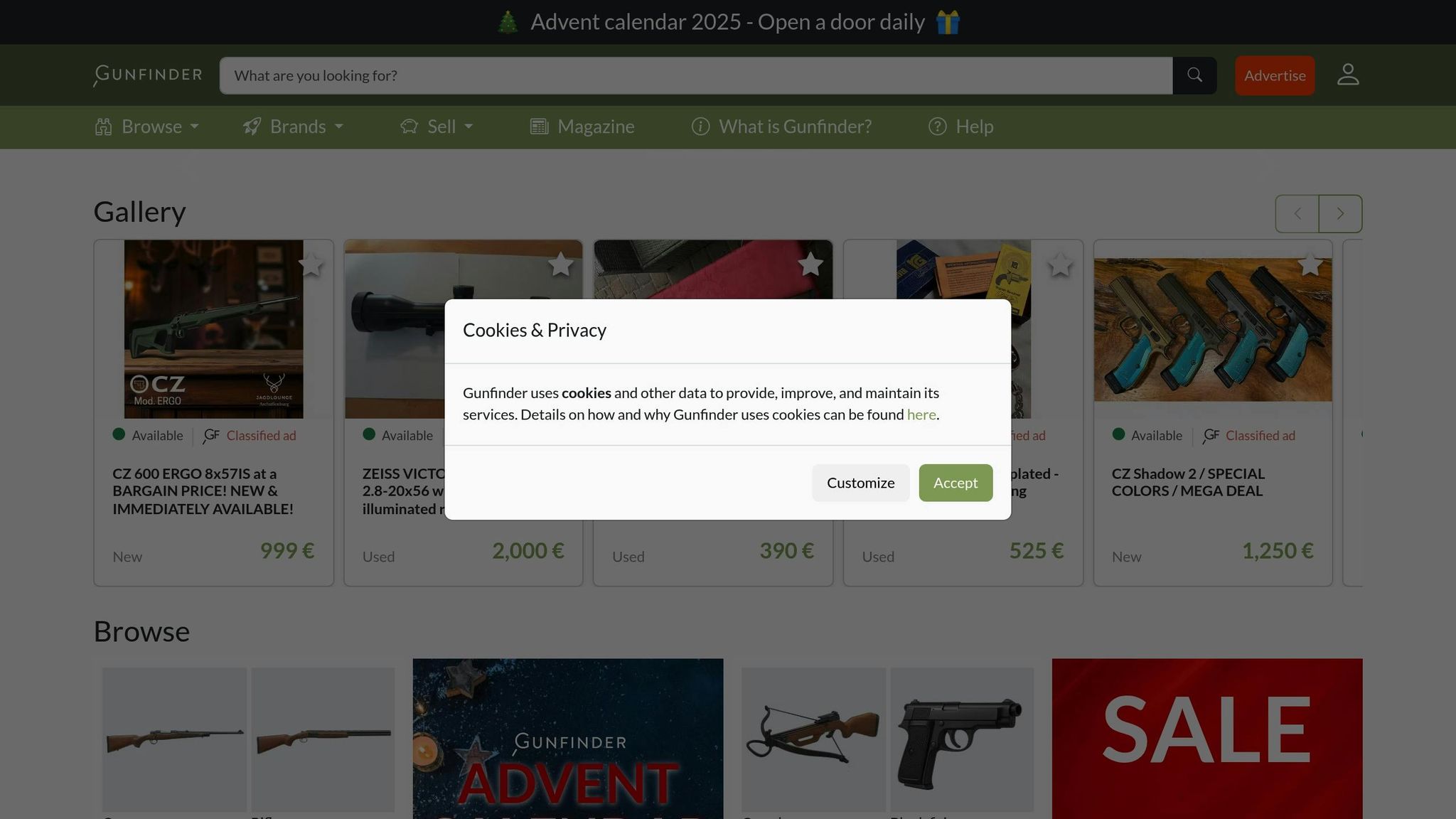
Gunfinder (gunfinder.de) is a helpful platform to find precise long-distance ammunition, such as Norma .300 Win. Mag. Bondstrike or Hornady ELD-X. The search function allows you to filter ammunition by caliber, ballistic coefficient (BC), and distance rating. Especially for rare high-BC loadings suitable for demanding chamois hunts, Gunfinder is a useful resource.
Ensure that your ammunition achieves a speed of over 788 m/s and an energy of more than 3,600 Joules at 300 m. Also, check if the ammunition fits your barrel and read user reviews. With the filter option for “Big Game” approvals, you can specifically select loadings like Bondstrike Extreme that have proven effective over greater distances. These features make your preparation easier and ensure that you are well-equipped.
Conclusion
Hunting chamois at distances over 300 meters requires careful preparation and well-thought-out decisions. Magnum calibers like .300 Win. Mag., 7 mm Rem. Mag., or .300 WSM provide the necessary energy and trajectory stability. Bullets with a high ballistic coefficient (BC > 0.6), polymer tips, and boat-tail design – such as Norma Bondstrike, RWS Speed Tip Pro, or Hornady ELD-X – guarantee a flat trajectory and reliable impact on target. These technical prerequisites are essential for success under demanding conditions.
Equally important is intensive training. Shooting exercises at distances between 200 and 400 meters under realistic conditions help you master your combination of weapon and ammunition optimally and achieve precise hits.
Besides technique, knowledge is also crucial: accurately assessing wind, precise distance measurement, and a solid understanding of bullet characteristics are indispensable. It is always important to remember: Ethics come before technique. Shots over 400 meters carry a higher risk and should only be taken under ideal conditions – without strong winds or unfavorable angles. The right mix of high-quality equipment, informed knowledge, and honest self-assessment is key to making a clean hit and avoiding misses. A well-thought-out setup completes the overall package.
On Gunfinder (gunfinder.de), you will find a wide selection of long-distance ammunition and suitable accessories. Thanks to the filter functions, you can specifically search for calibers, bullet types, and distance ratings to find the optimal loading for your chamois hunt. With the right preparation and equipment, you are well-equipped for a successful and responsible hunt in the high mountains.
FAQs
Which calibers are best suited for chamois hunting at long distances?
For chamois hunting at long distances, calibers such as .300 Win Mag, .338 Lapua Magnum, and .375 H&H are particularly well-suited. These calibers provide the necessary precision and penetration power that are indispensable for long shots.
It is crucial to match the ammunition precisely to your weapon and to test it thoroughly before the hunt. Only then can you ensure that you hit accurately and ethically at extreme distances.
How does the ballistic coefficient affect precision when hunting at long distances?
The ballistic coefficient plays a crucial role when it comes to precision at long distances. It minimizes the air resistance that the bullet encounters, allowing it to fly more stably, have a flatter trajectory, and remain more precise over long distances.
Another advantage of a high ballistic coefficient is the more effective energy transfer to the target. This is particularly important when hunting at extreme distances, such as when hunting chamois. To achieve the best results, you should choose ammunition that has a high ballistic coefficient and is optimally suited to your weapon and intended use.
Why should ammunition be tested under realistic conditions?
Testing ammunition under conditions that simulate actual use is essential to assess its reliability, precision, and effectiveness at long distances. Only then can you ensure that it meets the practical requirements.
Regular training in hunting-like scenarios is not just a matter of technique. It enhances your accuracy and builds confidence in your equipment – an invaluable advantage, especially when hunting chamois over long distances.