Pellet shapes in test: precision vs penetration power

The choice of the right pellet shape significantly influences how precisely and powerfully your air rifle shoots. There are four main types, each optimized for different purposes:
- Domed: Best choice for precision at long distances. Remains stable and retains energy.
- Hollow Point: Designed for maximum energy transfer at short distances. Ideal for small game hunting.
- Wadcutter: Perfect for precise target shooting at short range. Cuts clean holes in targets.
- Pointed: Focused on maximum penetration power. Good for harder targets and medium distances.
Summary:
- Precision: Domed and Wadcutter lead the way.
- Penetration Power: Pointed delivers the deepest penetration.
- Energy Transfer: Hollow Point excels with strong expansion.
The right choice depends on your rifle, the distance, and the intended use. Read on to learn more about the advantages and disadvantages of each type.
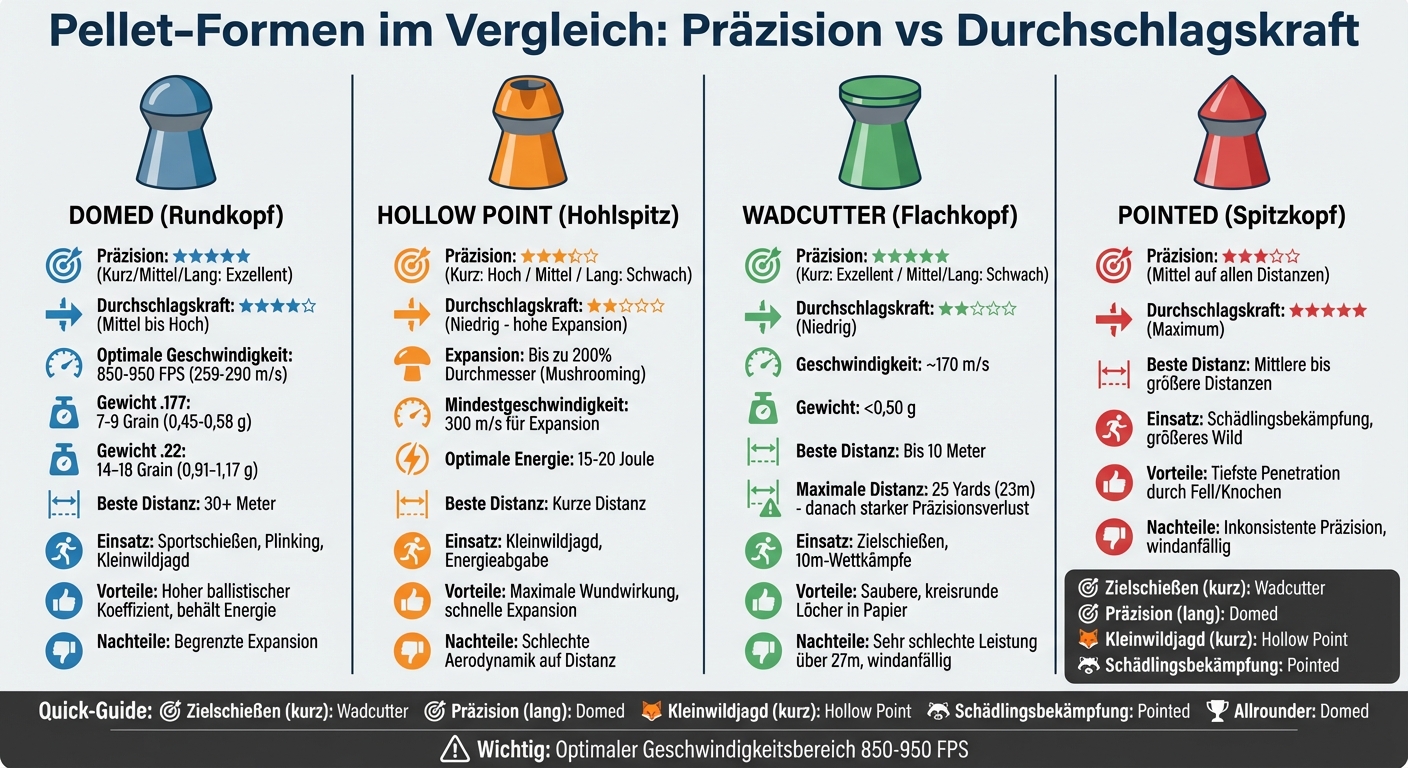
Pellet Shapes Comparison: Precision and Penetration Power by Distance and Purpose
Shooting Test of Various Diabolos on Ballistic Gelatin
sbb-itb-1cfd233
Domed Pellets: Balanced Performance
Domed pellets are the all-rounders among air rifle projectiles. Their rounded head shape provides an excellent ballistic coefficient, ensuring that kinetic energy is retained even over long distances. This aerodynamic property makes them the preferred choice for shooters seeking a combination of precision and penetration power.
Main Features of Domed Pellets
The aerodynamic head shape ensures a stable trajectory with low dispersion – ideal for medium to long distances. While Wadcutter pellets lose precision at around 20–30 meters, Domed pellets remain stable and accurate even at greater distances. For optimal results, experts recommend firing them at speeds between 850 and 950 FPS (approx. 259–290 m/s) [1].
The rounded shape also allows for deeper penetration, as the pellet expands less upon impact. At the same time, domed pellets offer higher precision than pointed pellets, which often suffer from shape inaccuracies and thus fly unstable. Well-known manufacturers like JSB Match Diabolo (Exact series) and H&N Sport (Field Target Trophy) stand for consistently high quality [1]. These characteristics make domed pellets a versatile choice that excels in many scenarios.
Applications for Domed Pellets
Domed pellets are ideal for target shooting, plinking, and small game hunting. Especially at distances over 30 meters, they offer superior performance, where other projectile shapes lose stability. If you are looking for a projectile that combines precision and impact power, domed pellets are an excellent choice.
When selecting the weight, the performance of the rifle should be considered: For weaker .177 rifles, pellets weighing 7–9 grain (0.45–0.58 g) are suitable. Medium .22 rifles achieve the best results with pellets in the range of 14–18 grain (0.91–1.17 g). Domed pellets are versatile – from targets like rats and pigeons to squirrels and rabbits, and even larger pests like raccoons when heavier pellets are used [1].
Hollow Point Pellets: Energy Transfer Upon Impact
Hollow point pellets are designed to release as much energy as possible upon impact. Due to their hollow tip, they deform in a mushroom shape – a phenomenon known as "mushrooming." The diameter of the pellet can expand up to double [2]. This increase in frontal area ensures that kinetic energy is quickly and completely transferred to the target without penetrating it.
Additionally, the hollow tip shifts the center of gravity backward, improving ballistic properties [2]. However, these pellets are primarily intended for short distances. The open tip increases air resistance, making them less stable over longer ranges than domed pellets. However, they are ideal for hunting small game or pest control at short distances, as they create larger wound channels and minimize the risk of ricochets [2]. But how does this expansion work exactly?
Impact Behavior of Hollow Point Pellets
Upon impact, the hollow tip of the pellet deforms, increasing the cross-sectional area. The mass remains constant, which reduces the sectional density (mass per unit area) and allows for a rapid energy release [2]. This often results in a so-called "plug shot," where the pellet remains lodged in the target instead of penetrating it [2].
For reliable expansion to occur, an impact velocity of at least 300 m/s is required [2]. Air rifles with an energy range between 15 and 20 Joules provide optimal conditions for this effect [3]. However, there are also .177 caliber pellets that function even at energies below 5 Joules, while others require at least 10 Joules [3].
Penetration Limits
The construction of Hollow Points explains why their penetration power is limited. While pointed or domed pellets penetrate deeply into the target, Hollow Points stop shortly after impact. This makes them particularly suitable for situations where the risk of over-penetration should be minimized – such as hunting in populated areas [2].
In contrast to pellets with pointed or rounded shapes, which are designed for maximum penetration, Hollow Points focus on energy transfer with low penetration. This is ideal for hunting small game like rats, pigeons, or rabbits, as they deliver a strong effect even at shallow penetration depths [2]. However, if the target offers too little resistance, the desired expansion may not occur [4].
Wadcutter Pellets: Precision at Short Distance
Wadcutter pellets are the preferred choice for shooting at paper targets. Thanks to their flat head, they punch clean, round holes in paper or cardboard discs, making it significantly easier to evaluate hits [5]. This "Clean-Cut" effect is particularly advantageous in competitive shooting, as it allows for precise results.
At short distances – up to about 10 meters with air rifles – wadcutters show their strengths. Their flat surface makes them ideal for disciplines such as target shooting and benchrest shooting. Match Diabolo wadcutters achieve muzzle velocities of around 170 m/s and are the standard for 10-meter competitions with air rifle and air pistol. These characteristics make them perfect for precise shooting at short distances, while their aerodynamic weaknesses make them less suitable for longer ranges.
Advantages of Wadcutters for Target Shooting
A major advantage of wadcutter pellets lies in the precise hit analysis. While other pellets like domed or pointed variants often leave irregular or torn holes in the paper, wadcutters cut clean, circular markings. This reduces scoring errors and provides shooters with a reliable basis for hit evaluation[6].
Moreover, the flat shape at short distances ensures a stable trajectory and consistent precision. This makes wadcutters particularly well-suited for indoor shooting ranges and controlled training conditions.
Disadvantages for Long Range Use
However, at longer distances, the weaknesses of wadcutters become apparent. The flat head creates a high air resistance, causing the pellet to quickly lose kinetic energy[7]. This leads to the pellet becoming unstable at lower speeds, significantly reducing precision.
From a distance of about 25 yards (23 meters), accuracy drops sharply, and at 50 yards (46 meters), wadcutters are practically unusable. Additionally, due to their low weight (often under 0.50 grams) and flat shape, they are very susceptible to wind, making them unsuitable for outdoor or long-range benchrest shooting[7]. For these applications, domed pellets are a better choice, as their streamlined design ensures a more stable trajectory and better aerodynamic properties.
Wadcutter pellets are unbeatable when it comes to precise hits at short distances. However, for greater ranges and outdoor use, other pellet types like domed variants are the better choice.
Pointed Pellets: Maximum Penetration Power
Pointed pellets – also known as pointed projectiles – are specifically designed for maximum penetration power. Compared to domed or hollow-point projectiles, their focus is solely on penetration. Their tapered shape minimizes air resistance and concentrates kinetic energy on a small contact area. This makes them ideal for effectively penetrating harder materials or larger targets.
Design and Performance of Pointed Pellets
The pointed head shape ensures improved aerodynamics compared to flat wadcutters or round-headed domed pellets. This allows the projectile's speed to be better maintained over longer distances. The biggest advantage is the concentration of energy upon impact: all kinetic energy is focused on the tip, enabling impressive penetration power.
However, pointed pellets are more susceptible to air turbulence. Especially in windy conditions, they can lose precision. For this reason, they are less suitable for precise shooting on paper – here, wadcutters and domed pellets excel. Nevertheless, they are an excellent choice in hunting scenarios that require high penetration power.
Best Use Scenarios for Pointed Pellets
Due to their characteristics, pointed pellets are particularly well-suited for hunting situations where high penetration is crucial. They ensure a quick and clean kill, especially on larger game[8]. Additionally, they are ideal for hunting in densely vegetated areas or forests, where a flat trajectory and high penetration power are required[8].
Typically, they are used at medium to longer distances, where their aerodynamic advantages come into play. If you are looking for ammunition that offers both penetration power and a stable trajectory, pointed pellets are an excellent choice. A wide selection of air rifle ammunition for various needs can be found at Gunfinder (https://gunfinder.de).
Comparison Table: Precision vs. Penetration Power
Here is a compact overview that highlights the differences between the various pellet types. Precision and penetration power depend heavily on the shape of the pellet – this table shows which type is suitable for which purpose:
| Pellet Type | Precision (Short/Medium/Long) | Penetration Power | Optimal Use Area | Advantages | Disadvantages |
|---|---|---|---|---|---|
| Domed | Excellent / Excellent / Excellent | Medium to High | General hunting & long-range shooting | Retains energy well; high ballistic coefficient | Limited expansion upon impact |
| Hollow Point | High / Medium / Weak | Low (high expansion) | Small game hunting (energy transfer) | Maximum wound effect; rapid expansion | Poor aerodynamics; loss of precision at distance |
| Pointed | Medium / Medium / Weak | Maximum | Pest control (e.g., raccoons, birds) | Deepest penetration through fur/bone | Inconsistent precision due to shape |
| Wadcutter | Excellent / Weak / Weak | Low | Target shooting & paper hits | Cuts clean, easily assessable holes | Very poor performance beyond 27 meters |
Domed-Pellets are the all-rounders among pellets and offer consistent performance at all distances – perfect for field target and long-range shooting. Wadcutter-Pellets, on the other hand, excel at short distances, especially in precision target shooting.
With this overview, you can more easily decide which pellet is suitable for your needs. In the next section, we will look at what other factors play a role in the selection.
Conclusion: Choosing the right pellet
The choice of the right pellet largely depends on what you want to use it for. For target shooting at short distances, Wadcutter-Pellets are ideal. They create clean and clearly assessable holes in paper targets but lose aerodynamic stability at around 20–30 meters. If, on the other hand, you focus on precision over longer distances, such as in field target shooting, Domed-Pellets are the better choice. Their high ballistic coefficient ensures that they maintain energy and accuracy even over greater distances.
For small game hunting, distance plays a crucial role. At short distances, Hollow-Point-Pellets are ideal as they allow for maximum energy transfer, ensuring a quick, ethical kill. For longer shots, such as on animals like squirrels or rabbits, Domed-Pellets are again recommended. Pointed-Pellets, on the other hand, are particularly suitable for pest control as they can penetrate fur and bone well. However, you should ensure beforehand that these pellets fly accurately in your air rifle.
An important note: Make sure that your pellets fly in the optimal speed range of 850–950 FPS. You can determine this "sweet spot" with a chronograph. Also, adjust the weight of the pellets to the performance of your weapon: Lighter pellets (7–9 Grain at .177) are suitable for weaker air rifles, while heavier pellets (20+ Grain) are better suited for powerful PCP models [1].
On Gunfinder, you will find a wide selection of high-quality pellets from brands like JSB, H&N, and RWS. Compare the different types to find the perfect pellet for your needs and your air rifle.
FAQs
Which pellet shape is best suited for my air rifle?
The choice of the right pellet shape strongly depends on what you want to achieve: precision or penetration power. Round or conical pellets are ideal if you are aiming for high accuracy, such as in target practice. Flat or specially designed pellets, on the other hand, can offer stronger energy transfer and thus more penetration power.
It is worth trying out different shapes to find out which one suits your air rifle and your needs best – especially if you switch between precision shooting exercises and applications with higher energy transfer. This way, you can find the perfect balance for your needs.
How do I find the optimal pellet weight for my joule performance?
The ideal weight of pellets depends on the energy (joules) and precision you want to achieve. Light pellets provide higher speeds, while heavier pellets have greater penetration power. To find the best combination of accuracy and penetration power, you should try different weights and test what best suits your needs.
Why are some pellets inaccurate in my rifle, even though they are considered "better"?
The shape of pellets plays a crucial role in their precision. Whether flat, round, or aerodynamic – each design affects flight stability in its own way. If the shape does not harmonize with the barrel of your rifle, it can lead to deviations.
Production defects such as uneven surfaces or weight differences can also affect accuracy – even with pellets that are considered high quality. To get the best out of your rifle, you should choose pellets that fit your barrel exactly. This way, you achieve the best results.