Pistol calibers compared: effect, recoil and accuracy
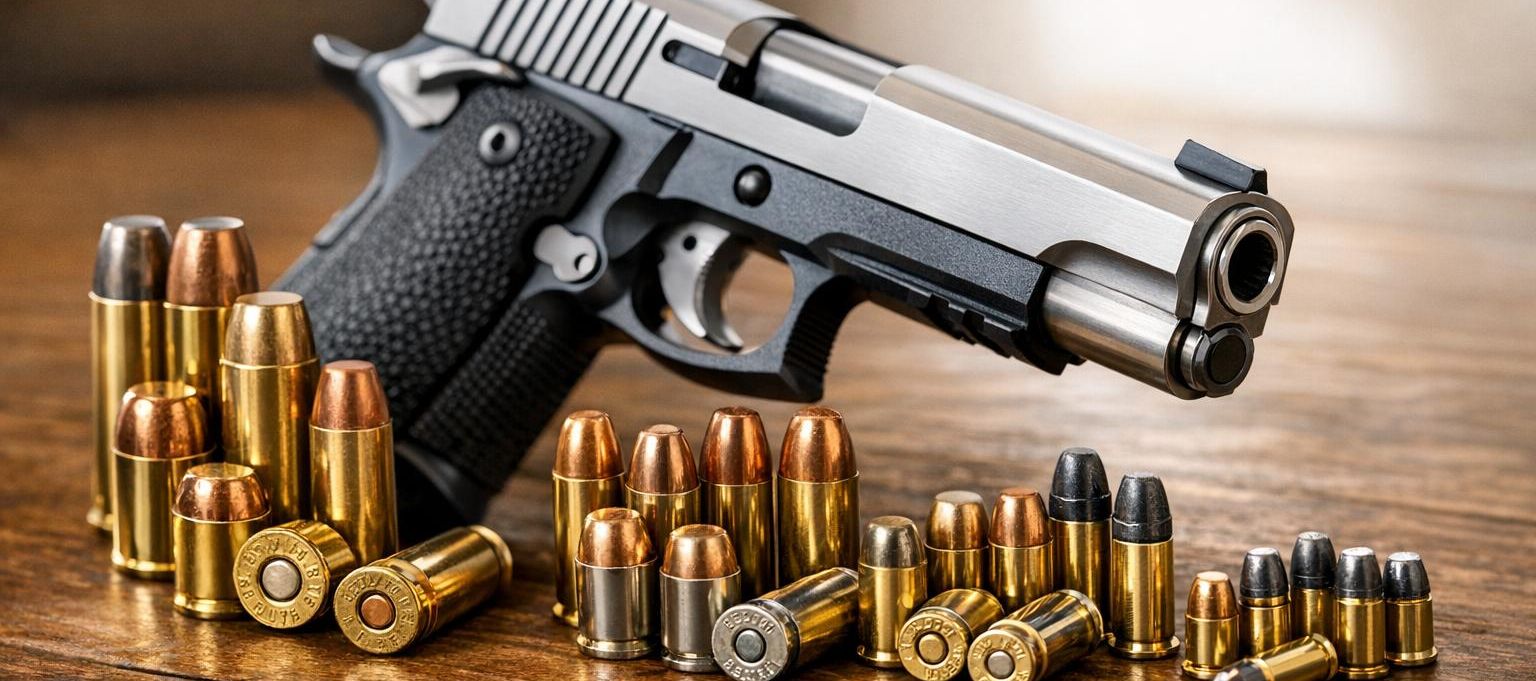
The choice of the right caliber for a handgun significantly affects precision, recoil, and purpose. This guide gives you a clear overview, whether you’re a beginner or want to deepen your knowledge.
Key Points:
- Caliber Basics: Caliber indicates the outer diameter of the bullet (e.g. 9 mm or .45 ACP). It influences recoil and energy.
- Legal Requirements in Germany: For killing shots, at least 200 joules of muzzle energy are required (§ 19 BJG). Hunters are usually allowed to own two handguns.
- Precision: High-recoil calibers can promote shooter errors like “flinching.” Lighter calibers like 9 mm Luger offer a good balance.
-
Popular Calibers:
- 9 mm Luger: Universal, moderate recoil, widely used.
- .22 lfB: Ideal for training and trapping.
- .45 ACP: High stopping power but fewer rounds in the magazine.
- .44 Magnum: High energy, suitable for hunting and sport shooters.
- Costs and Availability: 9 mm Luger is affordable (approx. €0.23–0.27 per shot). High-performance ammo is more expensive.
-
Applications:
- Sport Shooting: 9 mm Luger and .22 lfB are ideal.
- Hunting: At least 9 mm Luger or .38 Special for killing shots.
- Self-Defense: 9 mm Luger is preferred as it’s easy to control.
Whether sport shooter, hunter, or for self-defense – this guide helps you find the right caliber and ammunition.
Caliber Overview #1 [Pistols]
Common Handgun Calibers
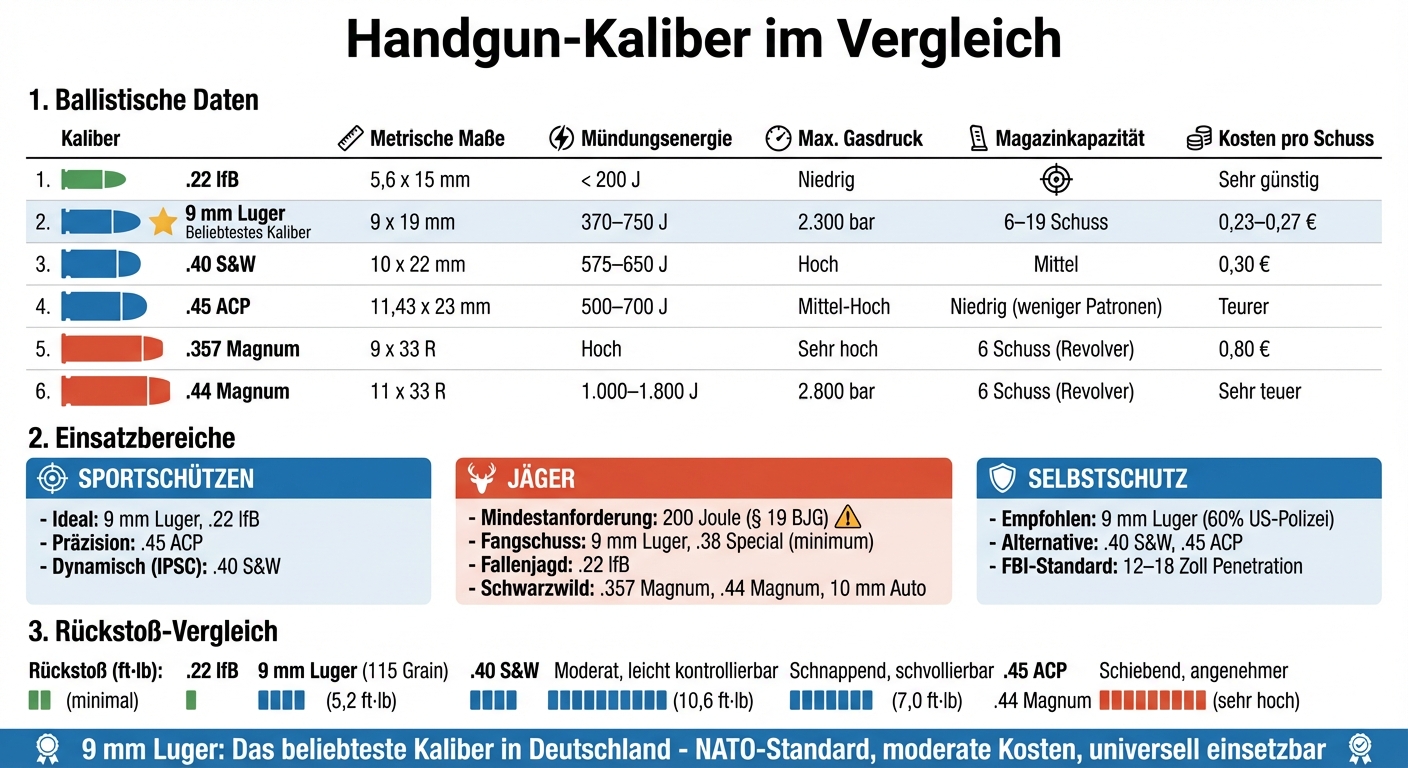
Handgun caliber comparison: ballistic data and application areas
The Most Used Calibers in Germany
The 9 mm Luger (9x19 mm Parabellum) is the most popular caliber for semi-automatic pistols in Germany and is used by most authorities. As the only NATO caliber of German origin, it combines moderate recoil, high magazine capacity (6–19 rounds), and comparatively low cost. With muzzle energy from 370 to 750 joules, it clearly exceeds the legal minimum requirement for killing shots.
For hunters, the .22 lfB (Long Rifle) is especially important for trapping and pest control, as it causes minimal damage to the fur. The .45 ACP is valued for its strong stopping power and large bullet diameter but has drawbacks like fewer rounds in the magazine and higher costs. The .40 S&W offers performance between the 9 mm and the .45 ACP and fits pistols with similar dimensions.
Revolver calibers are often used for special applications: The .357 Magnum is suitable for both self-defense and hunting medium-sized game. The .44 Magnum (11x33 R) is one of the most powerful handgun calibers, with a muzzle energy of 1,000 to 1,800 joules and a gas pressure of up to 2,800 bar. The 10 mm Auto also delivers high energy for hunting medium game but requires robust firearms and produces noticeably stronger recoil.
In the next section, we look at the ballistic properties of various calibers in detail.
Ballistic Data in Comparison
| Caliber | Metric Dimensions | Muzzle Energy (J) | Max. Gas Pressure (bar) | Typical Application |
|---|---|---|---|---|
| .22 lfB | 5.6 x 15 mm | < 200 | Low | Trapping / Training |
| 7.65 mm Browning | 7.65 x 17 mm | ~200 | Medium | Small Handguns |
| 9 mm Luger | 9 x 19 mm | 370–750 | 2,300 | Universal / Authorities / Sport |
| .357 Magnum | 9 x 33 R | – | High | Self-defense / Hunting |
| .44 Magnum | 11 x 33 R | 1,000–1,800 | 2,800 | Hunting / Sport Shooting |
Besides these technical data, the cost and availability of ammunition also play an important role.
Ammunition Prices and Availability
A pack of 50 rounds of 9 mm Luger from Magtech costs about €11.50, while a bulk pack of 1,000 rounds from Geco costs around €265. This corresponds to a unit price of about €0.23–0.27. In comparison, ammunition for .45 ACP, .357 Magnum, and .380 ACP is significantly more expensive. The high production volume of the 9 mm also ensures worldwide availability, making it especially practical for international use.
There are also large price differences in used firearms: A used Ruger SR9 (9x19) costs about €400, a Glock 17 Gen 4 about €580, while older .38 Special revolvers are available starting at €145.
For beginners, the 9 mm Luger is a good choice because it offers moderate recoil, high availability, and low cost. Hunters should use at least 9 mm Luger or .38 Special for finishing shots to ensure sufficient stopping power. Different calibers meet different requirements, whether for hunting, sport, or self-defense.
How Ballistics Affect Precision
Important Ballistic Factors
Bullet velocity plays a central role in the trajectory: higher velocities result in a flatter trajectory, making it easier to aim at different distances. For the 9 mm Luger, velocity typically varies between 320 m/s and 440 m/s depending on bullet weight and powder charge. A longer barrel increases muzzle energy and velocity because the propellant gases act on the bullet for a longer time.
Another important aspect is the bullet weight, which significantly influences recoil. For example, a 115-grain 9 mm bullet produces about 5.2 ft·lb of recoil, while a .40 S&W with 10.6 ft·lb causes almost twice as much recoil. This stronger recoil leads some shooters to “flinching”, an involuntary twitch that can greatly reduce precision. The .40 S&W is often described as difficult to control because its recoil is perceived as “snappy.” In comparison, the .45 ACP, despite its larger caliber, offers a more “pushing” recoil that is considered more pleasant.
The bullet shape also affects precision. Wadcutter and semi-wadcutter bullets are especially suitable for precise hits on targets. Hollow points, on the other hand, require a certain minimum velocity to optimally expand.
Precision Tests in Practice
Ballistic tests show clear differences between calibers. For example, the 9 mm Luger (115 grain) loses about 16% of its velocity (from 1,135 ft/s to 949 ft/s) and 30% of its energy (from 329 ft·lb to 230 ft·lb) at 100 yards. In comparison, the .357 Magnum (125 grain) starts at 1,500 ft/s and drops to 1,163 ft/s at 100 yards. Slower calibers show a more pronounced drop in height beyond about 150 meters, making precise aiming more difficult.
For defensive ammunition, the FBI recommends penetration of 12 to 18 inches (30–46 cm) in calibrated ballistic gel. Interestingly, a 10% increase in expansion doubles the wound channel volume more than a 10% increase in penetration. Average wound volumes are 5.0 cubic inches for 9 mm, 5.3 for .40 S&W, and 5.6 for .45 ACP. So the differences are smaller than often assumed.
These test results illustrate how various ballistic factors interact and influence precision. For precision shooters, heavier guns absorb recoil better. Calibers with moderate recoil, like the 9 mm Luger, also allow faster and more precise follow-up shots compared to stronger alternatives. Understanding these factors helps you choose the optimal handgun and ammunition for your specific purpose.
Caliber Choice by Purpose
Best Calibers for Sport Shooting
For precision shooters training on targets, the 9 mm Luger is the first choice. As Hamza Malalla and Matthias S. Recktenwald write in the trade magazine VISIER:
“9 mm Luger clearly ahead. No other centerfire pistol caliber is so affordable and nowhere is the selection of cartridge types greater.”
This caliber offers a wide range of ammunition – from affordable training cartridges to high-quality match bullets that allow groupings under 25 mm at 25 meters.
The .45 ACP remains a classic in precision shooting and is especially popular on 1911 platforms. Its larger bullet diameter can positively influence hit probability. For beginners, the .22 lfb is ideal, as it provides optimal training conditions with low recoil and low costs.
Dynamic disciplines like IPSC often require the .40 S&W to achieve the “Major Power Factor.” For static disciplines, such as in the ISSF area, the .32 S&W Long is frequently used – a caliber that impresses with minimal recoil. After this overview of sports shooting calibers, we now focus on hunting.
Hunting Calibers for Field Use
For small game trapping, calibers like .22 lfb and 6.35 mm Browning are ideal. They preserve the pelt and minimize the risk of ricochets. For capture shots on hoofed game, the Federal Hunting Law (§ 19) requires a minimum muzzle energy of 200 joules.
Hunting experts recommend at least the 9 mm Luger for pistols and the .38 Special in particularly powerful loads for revolvers for ethical hunting. The 7.65 mm Browning often remains below the legal limit, although it delivers 214 joules according to catalog data.
Powerful calibers are necessary for hunting wild boar and red deer. Revolvers like the .357 Magnum, .41 Magnum, and .44 Magnum have proven effective here. For pistols, .40 S&W, .45 ACP, and 10 mm Auto offer the necessary stopping power. Since 2003, hollow point bullets have been allowed for hunting in Germany, as they significantly improve energy transfer. Besides hunting, there are also situations where self-defense is the priority – more on that in the next section.
Calibers for Self-Defense
The choice of the right caliber for self-defense strongly depends on accuracy, as handguns generally have less “stopping power” than long guns. The FBI standard requires penetration of 12 to 18 inches (approx. 30–45 cm) in ballistic gel to ensure vital organs are hit.
The 9 mm Luger has established itself as a practical compromise. Around 60% of US police agencies use this caliber, and the FBI has also switched back to 9 mm. At a price of about €0.20 per round, it is also cheaper than the .40 S&W (approx. €0.30) or the .357 Magnum (approx. €0.80).
The .40 S&W delivers more energy (575–650 joules) but is often criticized for its “snappy” recoil, which makes quick follow-up shots difficult. The .45 ACP, on the other hand, offers a “pushing” recoil at 500–700 joules and is considered a proven stopper. The .380 ACP with about 275 joules often does not achieve the required 12-inch penetration.
Modern hollow point bullets are almost indispensable for self-defense. They expand on impact, enlarge the wound channel, and reduce the risk of overpenetration. It’s advisable to test ammunition under conditions like “Heavy Clothing” as fabrics can hinder expansion. In the next section, we’ll look at the quality of ammunition, which is crucial for every application.
sbb-itb-1cfd233
Ammunition Quality and Precision
Factory Ammo vs. Reloaded Cartridges
The choice between factory ammo and handloaded ammunition is a fundamental consideration for many shooters. A big advantage of factory ammo is its easy availability. Especially the 9 mm Luger stands out, as it is one of the cheapest centerfire calibers offering a wide range of cartridge types. For most shooters, modern factory ammo provides a quality that is more than sufficient.
However, variations in powder charge can significantly affect shooting performance. Different production lots can also lead to varying results. As the team at all4shooters aptly explains:
“The right choice of ammunition type and sometimes even its production lot determines how well your own firearm shoots.”
When it comes to top precision in competitive shooting, reloading is often unavoidable. Expert Weyland puts it clearly:
“Anyone who wants to compete at the very top in non-dynamic disciplines (‘absolute precision’) will have to load their own ammunition.”
With reloading, you have full control over all variables – from the exact powder charge to the optimal bullet seating depth, tailored specifically to your firearm’s barrel. This control is especially important since match cartridges usually cost about twice as much as training ammo. For high-performance calibers like 6 mm Norma BR, costs can even reach up to €120 per 50 rounds. These price differences highlight how crucial precision and tuning are in reloading.
Choosing Quality Ammunition
Three factors are key for precise results: consistent powder charge, constant bullet seating depth, and high-quality cases. Even small deviations in powder amount can lead to larger group sizes and shifted points of impact.
The quality of ammunition can be recognized by specific measurements: a 5-shot group under 30 mm is considered good, while a group under 20 mm is outstanding. For comparison: the benchmark for perfect precision is 27 mm, which corresponds to three times the caliber diameter. Groups under 15 mm at 10 shots are extremely rare even with high-end match pistols.
Systematic testing is essential to find the optimal ammo for your firearm. Once you find a cartridge type that performs well in your gun, you should buy a larger quantity from the same production lot. Every barrel reacts differently to the same ammunition – what delivers excellent results in one pistol can cause larger groups in another. For evaluating a new precision firearm, it’s recommended to test at least five different factory cartridges.
The storage of ammunition also plays a big role in quality. Moisture can damage cartridges, and strong temperature fluctuations can affect the performance of the propellant. For example, when you buy ammunition at Gunfinder, make sure to store it dry and at a constant temperature to ensure long-term precision.
Practical Tips for All Experience Levels
Entry Calibers for Beginners
If you are just starting with shooting sports, choosing the right caliber is crucial to improve your skills effectively. Here are some tips to make your start easier.
The .22 LR (Long Rifle) is ideal for beginners because it produces hardly any recoil and the ammunition is very affordable. This makes it perfect for intensive training where you can practice basics like trigger control and aiming without breaking your budget.
Another popular caliber is the 9 mm Luger, which offers a good balance between recoil and easy handling. Alice Jones Webb from Ammo.com sums it up:
“The best handgun cartridge is the one you can fire with confidence”.
If you are particularly sensitive to recoil, the .380 ACP might be the right choice for you. Revolver fans should consider the .38 Special, which convinces with moderate recoil and pleasant shooting characteristics.
A tip: Visit a shooting range and test different models. Pay attention to ergonomic grips that fit your hand size. For more precise shots, heavier pistols with steel frames are often better suited, as the extra weight reduces recoil and keeps the aiming more stable.
Once you are familiar with your entry caliber, you can venture into advanced techniques.
Precision Techniques for Experienced Shooters
For experienced shooters, the right technique is crucial to further increase precision. A well-executed grip is key: The dominant hand should grip as high as possible under the beavertail, while the middle finger rests firmly under the trigger guard. The support hand fills the remaining space on the grip to create maximum skin contact. Both thumbs point forward and lie close to the grip and slide to minimize muzzle rise.
Christoph Weber from LOWREADY Magazine describes it aptly:
“If you grip a pistol incorrectly, you are fighting against physics. If you hold it correctly, you use it”.
The wrists should be stable like a vise and slightly tilted forward to maintain control during recoil. A good exercise for this is the Bill Drill: Fire six shots from seven meters and work on your grip and timing.
For powerful calibers like the .44 Magnum, which generate gas pressures up to 2,800 bar and bullet energy between 1,000 and 1,800 joules, it is recommended to use firearms with longer barrels and higher weight. The extra weight helps to dampen the intense recoil.
Where You Can Buy Handguns and Ammunition
If you’re looking for a wide selection of handguns and ammunition, Gunfinder is an excellent place to start. Here you’ll find listings from major online dealers, local shops, and private marketplaces. Whether you’re after entry-level models like the Glock 17 (around €579) or high-end revolvers like the Korth NXR .44 Magnum (up to €3,999) – Gunfinder has something for everyone.
A handy feature is the live chat, where you can get expert advice. Plus, filters help you compare prices and find exactly what you need. Gunfinder also offers a buyback service for used firearms with free shipping and quick instant offers.
Conclusion
Key Points
The choice of caliber depends heavily on the intended use – whether it’s sport shooting, hunting, or self-defense. Larger calibers deliver more energy but come with stronger recoil. Moderate calibers like 9 mm Luger strike a balanced mix of handling and performance.
Recoil directly affects accuracy: too much recoil can cause “flinching,” a reflexive jerking of the trigger out of fear of the shot. That’s why it’s important to choose a caliber you can control confidently. Longer barrels also increase muzzle energy, while a heavier firearm reduces perceived recoil.
For hunting in Germany, there are clear regulations: ammunition for the killing shot must have a minimum energy of 200 joules. Calibers below 9 mm Luger or .38 Special often don’t meet these requirements. These factors should strongly influence your decision.
Next Steps
With this foundation, you can use Gunfinder to search specifically for the right handgun and ammunition. The platform offers useful filters and a live chat to support your choice.
Regular training is key to better accuracy. Use the shooting range to try different calibers and find the ideal combination of firearm and ammunition for you.
FAQs
What Caliber Is Ideal for Beginners in Sport Shooting?
For beginners in sport shooting, the 9 mm Luger caliber (often just called “9 mm”) is an excellent choice. It offers an ideal combination of availability, affordable ammunition, and low recoil. The reduced recoil makes it easier to handle and minimizes the chance of flinching – the involuntary twitch when firing.
Many popular pistol models are chambered in 9 mm, giving you a wide range of options for purchase and training. You can also choose between different bullet weights like 115 gr, 124 gr, or 147 gr – depending on whether you prioritize precision or defensive capability.
If you’re looking for the right firearm or ammunition, check out Gunfinder. You’ll find a large selection and secure buying options – perfect for beginners and experienced shooters alike. Good luck and enjoy getting started in sport shooting!
How does recoil affect shooting accuracy?
When firing a weapon, recoil increases the muzzle rise and the movement of the barrel. This can cause the sight to temporarily move off target. Especially with rapid follow-up shots, this makes it harder to hit precisely. Lower and better controllable recoil, on the other hand, allows for a more stable aiming and results in tighter shot groups.
Another factor is the weight of the firearm. Heavier pistols absorb more energy, which significantly reduces the felt recoil. This not only makes shooting more comfortable but also improves target control and endurance during longer shooting sessions. If you’re looking for a handgun with reduced recoil, Gunfinder offers a wide selection of models that make precise shooting easier.
What legal regulations exist in Germany regarding caliber choice for hunting?
In Germany, the Federal Hunting Act and the hunting regulations of the individual federal states govern the choice of caliber for hunting. These regulations specify, among other things, the minimum calibers and bullet energy required for certain game species to ensure humane hunting.
For detailed and up-to-date information, it is advisable to check the relevant legal bases or contact the responsible hunting authority of your federal state directly. This way, you can ensure that you always comply with the applicable regulations.