Weight vs. Precision: What matters more?
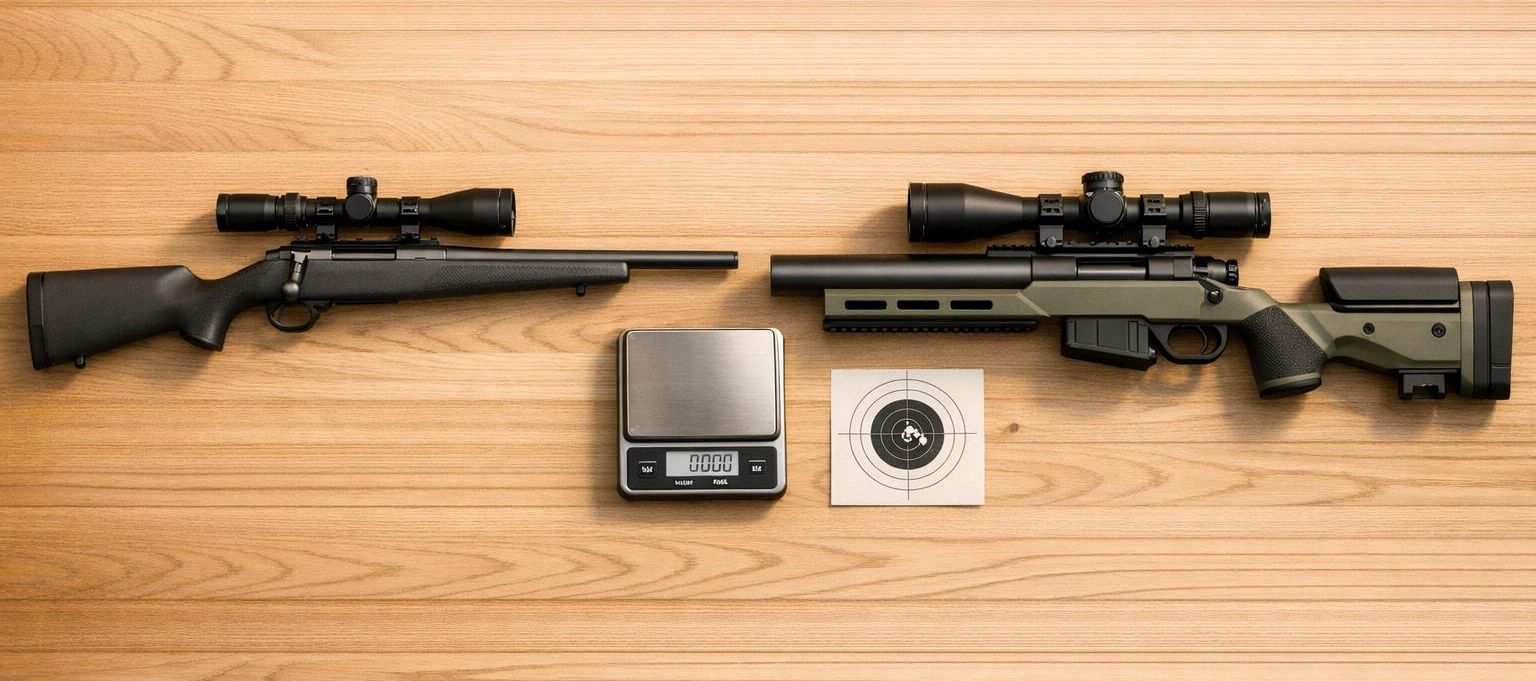
The choice of the perfect rifle depends on what is more important to you: mobility or precision. Lightweight rifles are easier to carry and ideal for movement-intensive hunting types such as stalking or driven hunts. Heavier rifles, on the other hand, offer more stability and accuracy – especially for long-distance shots or when sitting.
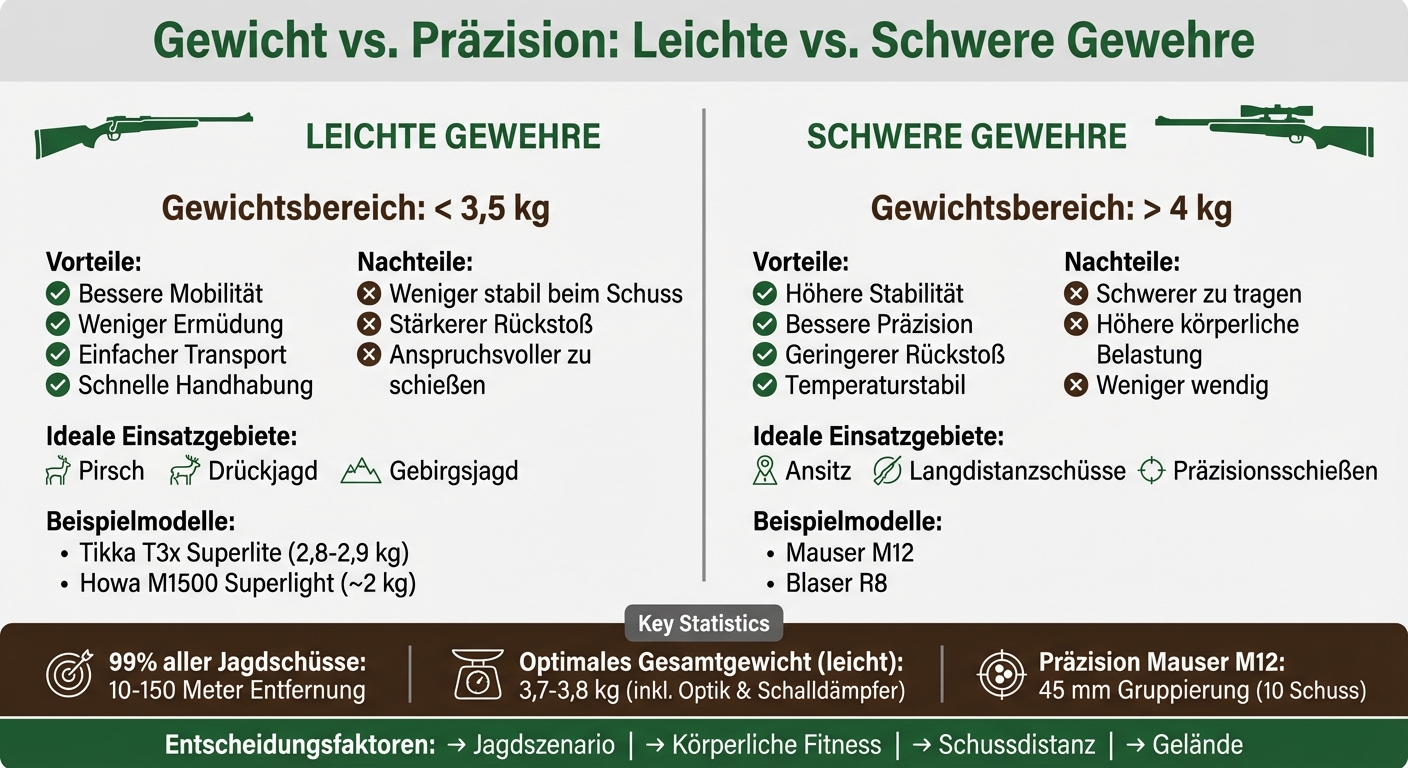
Comparison of lightweight vs. heavy rifles: Weight, advantages, and areas of use
Specialist or Allrounder? The Right Hunting Weapon for Every Use!
sbb-itb-1cfd233
Important Points:
- Lightweight rifles (< 3.5 kg): Better handling, less fatigue, but more challenging to shoot.
- Heavy rifles (> 4 kg): Higher stability, better precision, but harder to transport.
- Barrel length and material: Thicker barrels are more precise and temperature-stable, while shorter barrels are more mobile.
- Hunting scenario is crucial: Sitting requires stability, stalking requires mobility.
Quick Comparison:
| Criterion | Lightweight Rifles | Heavy Rifles |
|---|---|---|
| Weight | < 3.5 kg | > 4 kg |
| Advantage | Mobility, less fatigue | Stability, precision |
| Disadvantage | Less stable when shooting | Hard to carry |
| Area of Use | Stalking, driven hunts | Sitting, long distance |
| Examples | Tikka T3x Superlite | Mauser M12 |
Tip: Your physical fitness and the hunting conditions should play a central role in your selection. You can find a wide selection at Gunfinder.
How the weight of a rifle affects precision
The weight of a rifle has a direct impact on shooting accuracy. Heavier rifles offer more stability due to their higher inertia and are less sensitive to movements of the shooter or external influences such as wind. At the same time, they absorb more recoil energy, which reduces perceived recoil and minimizes unwanted jerks when firing. When a shot is fired, vibrations occur in the barrel – known as barrel harmonics. Thinner barrels tend to heat up faster during longer shooting sessions, which can lead to "stringing" – a shift in the point of impact due to thermal expansion. In contrast, thicker barrels remain more temperature-stable, thus maintaining precision even after multiple shots [1]. These physical relationships illustrate how important the construction of the barrel is for shooting accuracy.
Barrel thickness and material
The thickness and material of a barrel have a significant impact on precision. Thicker barrels are more stable, less prone to vibrations and bending, and thus allow for a more consistent point of impact – especially at long distances. Thinner barrels are lighter and easier to transport, but tend to have greater deviations during longer shooting sessions as they heat up more quickly. For precision shooters, it is important to adjust the bullet seating depth in increments of 0.381 mm (0.015″) to find the optimal load for a specific barrel profile. Modern precision rifles like the Haenel HLR in .308 Win and 6.5 Creedmoor, developed in 2024, combine optimal weight with tuned barrel characteristics to ensure outstanding precision [1][2]. In addition to the material, the combination of weight and barrel length also affects accuracy over various distances.
Precision at different shooting distances
The stability of a rifle under recoil is crucial for precise shooting at distances of 100 m, 200 m, or 300 m. Heavier rifles remain steadier in position when firing, which improves the consistency of the point of impact. This stability also influences the choice of zeroing method – whether it be the "spot at 100 m" or the GEE (most favorable zeroing distance). Longer, heavier barrels can also lead to higher muzzle velocities and different vibration patterns than shorter, lighter variants, which directly affects precision [1][2].
If you are looking for a rifle that perfectly matches your requirements in weight and precision, take a look at Gunfinder. There you will find a wide selection of models tailored to your needs.
Advantages of Lightweight Rifles
Rifles that weigh less than 3.5 kg are perfect for hunting types where mobility and endurance are crucial – such as stalking, driven hunts, or in mountainous terrain. With a well-thought-out combination of a lightweight rifle, optics, and suppressor, the total weight can be reduced to about 3.7 to 3.8 kg. For comparison: standard configurations often weigh over 4.5 kg [3].
An example of this is the Tikka T3x Superlite, which weighs between 2.8 kg and 2.9 kg depending on barrel length (51 cm or 57 cm). Even lighter is the Howa M1500 Superlight, which reaches the technical limit for bolt-action rifles in standard calibers at around 2 kg [3]. These weight advantages are directly noticeable in handling.
Better Handling
Lightweight rifles with a barrel length of 40 to 51 cm offer excellent maneuverability and allow for quick reactions – especially in dense forests or tight sitting areas. Even with a mounted suppressor, models like the .308 Winchester remain compact and handy [5]. The lower weight not only provides better handling but also reduces physical strain.
Less Physical Fatigue
Since about 99% of all hunting shots are taken at distances between 10 and 150 meters [5], the stability of heavy precision rifles in these situations is often less relevant than the portability of a lighter model. A lightweight rifle reduces physical effort, allowing you to remain focused and ready for action even after hours of hunting [5]. This reduced fatigue complements the improved handling and makes lightweight rifles the ideal choice for long trips.
However, extremely lightweight rifles can be more challenging to shoot, as they provide a stronger recoil sensation and less stability. With targeted training, you can adapt to these challenges and master your mountain rifle safely [4]. Additionally, you can further optimize the weight of your setup by using lightweight mounting rings, ultralight suppressors starting at around 231 g, and compact scopes. This can save an additional 200 to 300 g [3].
Advantages of Heavier Rifles
Heavy rifles may lag behind lighter models in terms of mobility, but at long distances, they fully showcase their strengths – particularly due to their impressive stability.
Rifles weighing over 4 kg are predestined for the highest precision, whether in a stand or on the shooting range. The additional weight provides significantly improved stability, which is a decisive advantage, especially for experienced shooters.
More Stability for More Precise Shots
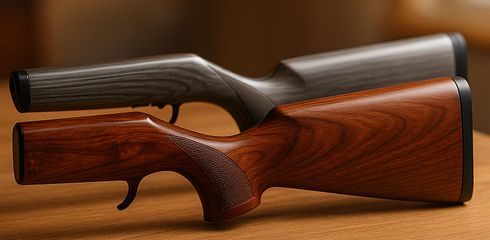
Thanks to their higher inertia, heavy rifles offer remarkable stability, especially when shooting from a stand. Models with laminated wood stocks, such as the Mauser 25 Max, exemplify extreme stability and remain warp-resistant even under adverse weather conditions[6]. Additionally, all-steel constructions in traditional precision rifles provide a robust foundation, which is reflected in tighter shot groups.
Another technical advantage lies in the larger locking surfaces of modern precision systems. The Blaser R8, for example, offers 96 mm² of locking surface, while the Rössler Titan 16 has 84 mm². In comparison, the legendary Mauser 98 system has only 60 mm² – a significant difference that is evident in precision under high stress[7]. These theoretical advantages are confirmed by test results in practice.
Precision Tests: The Results Speak for Themselves
In professional tests, heavy barrels demonstrate their superiority. The Mauser M12, equipped with a 17 mm thick barrel, achieved an impressive grouping of only 45 mm in a 10-shot series[9]. Thicker barrels exhibit better warm shot behavior and maintain precision during rapid fire sequences. The Tikka T3 system, often used in varmint configurations with a heavy barrel, utilizes the same closed system housing as the Hunter models, achieving excellent accuracy[8].
The load capacity of modern heavy systems is also impressive: The Blaser R8 was tested up to a pressure of 14,500 bar – that is more than three times the pressure of a standard Magnum cartridge[7]. Maximum precision is achieved when the dispersion does not exceed four times the caliber value – about 32 mm at .308 Win[9].
Barrel Length and Weight: Finding the Right Balance
After discussing the advantages and disadvantages of light and heavy rifles, we now take a look at the role of barrel length. This not only affects weight but also precision and handling. Longer barrels increase muzzle energy and velocity, but they also add extra weight[10]. Shorter barrels, on the other hand, are lighter and thus ideal for mobile hunting. However, this often comes with a lower bullet velocity[10][11].
For standard calibers with case lengths between 60 and 65 mm, shortening from 660 mm to 510 mm results in a velocity loss of about 30–50 m/s. Such a drop – for example, from 780 m/s to 740 m/s – is hardly relevant in driven hunts[11]. The actual effect of barrel length strongly depends on the combination of caliber, case volume, bullet shape, and the burn rate of the powder[11].
Interestingly, shorter, thicker barrels are often more precise than long, thin barrels. This is due to their higher stiffness, which makes them less susceptible to vibrations[12]. Greg Zeilinger, an expert in long-range and tactical shooting, explains:
“Short barrels are more precise than long ones, but long ones gain a few m/s more. For shots up to 500 m, it doesn't matter whether the barrel is short or long.”[12]
The trend towards shorter barrels has been reinforced especially by the growing use of suppressors. Shorter barrels help keep the overall length of the weapon manageable despite the suppressor[11]. Nevertheless, these barrels are also not protected from temperature influences, which will be discussed in more detail in the next section.
Heat Development and Wind Sensitivity
Thinner barrels heat up faster, which can lead to thermal drift. Thicker barrels, on the other hand, store heat better and thus offer more stability during longer shooting series[12]. Greg Zeilinger points out the disadvantages of thin barrels:
“Thin barrels are too prone to having a constant precision potential... I can't always wait for the barrel to cool down while hunting."[12]
If you are considering shortening a barrel – for example, for the installation of a suppressor – you should definitely consult a gunsmith. It is important to clarify in advance how the caliber and the load will react to the shortening[11]. After any structural change to the barrel, the point of impact should also be checked, as different loads may react differently in the shortened barrel[11].
Conclusion: Choose the Right Rifle for Your Hunting Requirements
The choice of the right rifle depends heavily on your hunting style. For stalking, lightweight rifles are excellent as they are easy to carry and handle. Driven hunts require a balanced medium weight that allows for quick movements. In contrast, for long-distance shots or stand hunting, heavier rifles with thicker barrels are advantageous as they provide greater stability and precision. These considerations will help you find the rifle that best meets your requirements.
Your physical condition and the hunting area are also crucial. In difficult terrain, even a medium-weight rifle can become tiring. Ergonomic stocks provide support by facilitating a stable shooting position even when fatigued. Also consider the overall weight: Additional equipment such as optics, mounts, or suppressors can quickly increase the weight. The combination of barrel length, barrel thickness, and stock material significantly influences how your rifle performs in practice.
To make your selection easier, you can compare up to four models directly on Gunfinder – from well-known brands like Blaser, Mauser, Bergara, or Steyr Mannlicher. With the filter options, you can specifically search for rifles for special types of hunting such as “Long Range” or “Driven Hunt.” This way, you will find the perfect balance between weight and precision that suits your hunting style.
FAQs
What rifle weight is suitable for my type of hunting?
The appropriate weight of a rifle depends on various factors, including your shooting technique, physical fitness, and the type of hunting. Lighter rifles (around 3–4 kg) are easier to handle and ideal if you are out for extended periods. Heavier models (over 4 kg) offer more stability and precision, making them particularly suitable for stand hunting. Be sure to choose a rifle that provides you with sufficient stability without tiring you out too quickly, and that fits well with your hunting style and preferences.
How much weight do optics and suppressors really add?
Optics such as scopes add a weight of about 300 to 700 grams depending on the model. Suppressors add an additional 300 to 600 grams. Although these weights may not seem high at first glance, they can noticeably affect the balance and handling of the weapon. Especially for precise shots or longer engagements, this should be kept in mind to best adjust both accuracy and handling.
When is a thicker (heavier) barrel worth it for me?
A thicker barrel can help you shoot more accurately at longer distances. The additional weight reduces vibrations and provides more stability when shooting. But remember: A heavier barrel is less handy and can change the recoil. Whether it is suitable for you depends on your intended use, your goals, and your individual shooting technique.