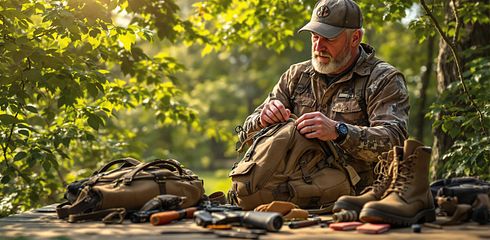
How to build a hunting first aid kit

A hunting first aid kit is essential when you are in remote areas where quick medical help is often not available. It must be tailored to the specific risks of hunting – from bleeding to hypothermia. Here you will learn what belongs in your kit and how to organize it.
The most important contents at a glance:
- Bleeding control: Tourniquet, pressure bandages, hemostatic gauze, trauma shears.
- Minor injuries: Adhesive bandages, tick tweezers, small scissors.
- Hypothermia: Emergency blankets, possibly heated clothing.
- Emergency equipment: Signal whistle, instruction card, marker.
Tips for organization:
- Choose a robust, waterproof bag (e.g., IFAK bag).
- Organize the equipment by priority: bleeding control, securing airways, protection against hypothermia.
- Regularly check expiration dates and functionality.
A well-organized first aid kit can save lives. Read on to learn how to optimally assemble your kit and adapt it to German hunting conditions.
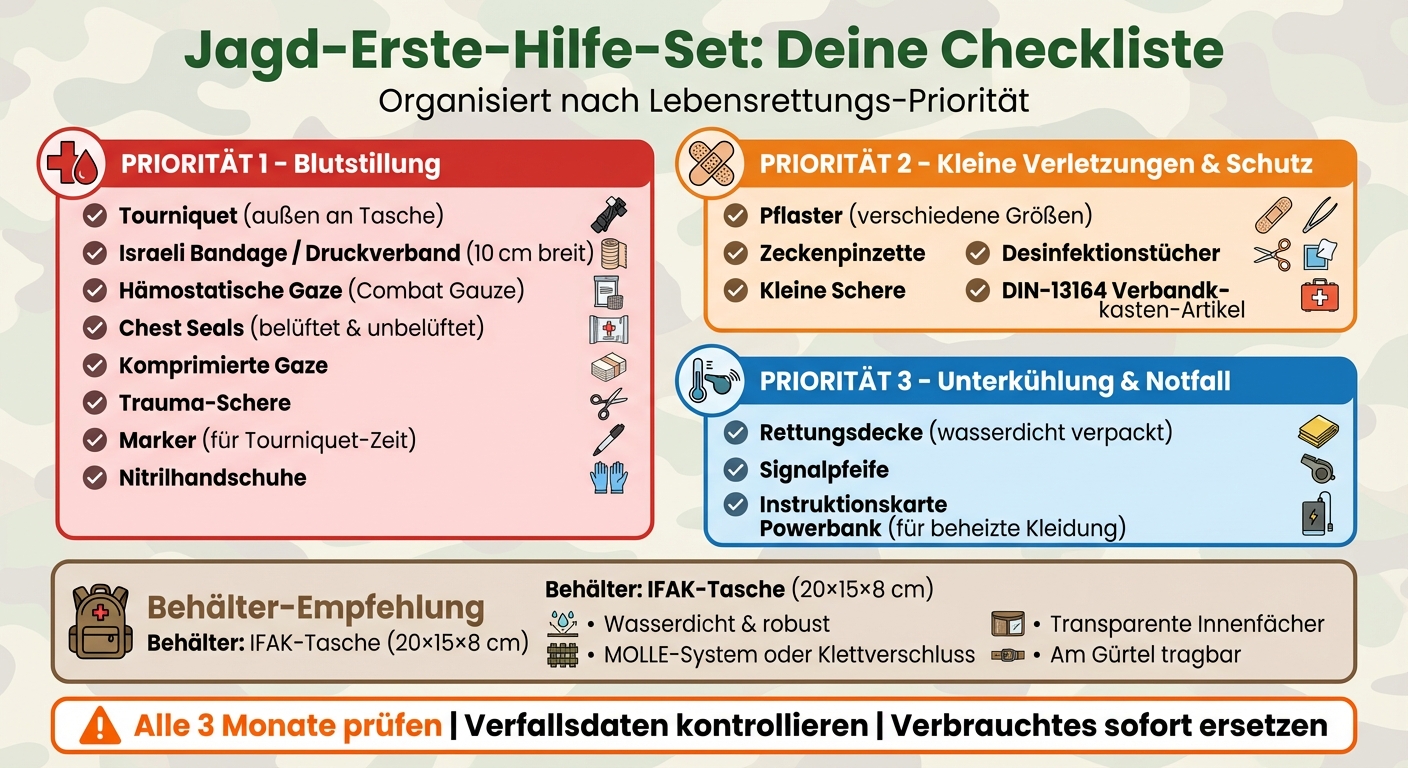
Hunting First Aid Kit Checklist: Essential Equipment by Priority
My Medi-Pack for Driven Hunts
sbb-itb-1cfd233
What You Should Pack in Your Hunting First Aid Kit
Here you will find a detailed overview of which components belong in your kit. It should cover both life-threatening situations and minor injuries. Store everything in a waterproof nylon bag with a transparent inner compartment – this keeps the contents dry and quickly accessible.
Equipment for Bleeding Control
Bleeding control is essential. A tourniquet can be crucial in life-threatening arterial bleeding in arms or legs when every second counts. In addition, the Israeli Bandage (also known as Emergency Bandage) is a pressure bandage about 10 cm wide that applies pressure to deep wounds immediately. For chest injuries from penetrations, you need chest seals (vented and unvented variants) to effectively treat sucking wounds. Compressed gauze is excellent for packing wounds or as a secondary dressing. Trauma shears are indispensable for quickly removing hunting clothing and gaining access to the wound. A marker is also important to note the application time of a tourniquet – a critical piece of information for rescue personnel. Hemostatic dressings like Combat Gauze accelerate blood clotting and can save lives.
"Our tourniquets are effective in controlling emergency bleeding. Emergency bandages and compression bandages can apply pressure to the wound and reduce blood loss." – MEDRESQ [7]
Tools for minor injuries and tick removal
For minor injuries, you should have adhesive bandages, a tweezers for tick removal, and a small pair of scissors. Organize these items in transparent compartments so you can quickly find them in an emergency [1]. Affordable basic supplies are offered by Mil-Tec First Aid Kits in Small and Midi sizes, which are listed on Gunfinder with ratings between 4.0 and 5.0 out of 5 stars [1]. Tick protection is particularly important, as ticks are common in German forests and can transmit diseases.
Items against hypothermia
Emergency blankets are essential to prevent hypothermia – especially during sit-and-wait hunts when you remain motionless for long periods. Store them in a waterproof container so they are ready for use at any time [1]. Heated vests and thermal boots can also help keep you warm. A power bank in the kit ensures that the heating function of your clothing does not fail.
Other necessary items
A signal whistle helps you attract attention in an emergency. An instruction card with clear action guidelines is also important so you can take the right measures even in stressful situations. Carry your first aid kit on your belt to have it readily available [7].
In the next section, you will learn how to optimally assemble and organize your kit.
How to assemble your hunting first aid kit
After going through the essential components, it is now about how to optimally assemble your kit. A well-organized kit saves valuable seconds in critical situations and can make the difference between life and death.
Choose a robust container
The container must be durable and suitable for outdoor conditions. IFAK bags (Individual First Aid Kit) made of resilient nylon are an excellent choice as they are specifically designed for trauma care. Common sizes like 20 × 15 × 8 cm or 17 × 11.5 × 4.5 cm are compact enough to carry on your belt but still provide ample space for the necessary equipment. Look for models with a MOLLE system or sturdy Velcro fasteners to securely attach the bag.
Practical features like mesh pockets or transparent inner pockets help you quickly overview the contents without having to unpack everything. An example is the Rhino Tactical IFAK Pouch for €59.99, which already contains 21 EMT items. Once you have the right container, it's time to organize the contents.
Organize the items by urgency
The order of equipment in the set should follow a clear priority: 1. Stop bleeding, 2. Secure airways, 3. Prevent hypothermia [8].
- Tourniquet: This should be placed on the outside of the pouch or at the very top so you can grab it in seconds.
- Nitrile gloves: These should be easily accessible to protect yourself.
- Dressings and gauze: Place these in the main compartment where they are quickly reachable.
- Emergency blanket and tape: You can store these further down or at the back of the container.
- Marker: Keep it in a separate loop or in a side pocket.
This arrangement ensures that you can act quickly and effectively even under stress, in darkness, or with gloves on [8].
Label the contents and create a checklist
Clear labeling and a checklist help you keep track. Divide the checklist into three categories: “Mandatory Minimum,” “Optimal/Trauma,” and “Scenario-specific.” Also, note the expiration dates of the items [8].
Keep a compact version of the checklist directly in the set so you can quickly see what is missing when restocking. Regular checks are crucial to ensure that your set is complete and ready for use. This way, you avoid relying on expired materials [8].
With thoughtful organization, labeling, and regular checks, your hunting first aid kit will always be ready for emergencies.
Adapting your set to German hunting conditions
After you have organized your set, it is important to adapt it to the specific hunting conditions in Germany. Supplement your set with DIN-13164 items and hunting-specific extras to be prepared for all eventualities.
Supplement DIN-13164 Standard Article
In Germany, the legal basis for first aid kits is based on the DIN-13164 standard, which primarily applies to vehicle first aid kits. This standard provides a compact basis for mobile first aid kits and includes items such as plasters, bandages, compresses, emergency blankets, bandage scissors, disposable gloves, and face masks [9]. For hunting, this basic set should be supplemented with specific items.
Make sure to use sterile materials such as compresses and bandages, as these have an expiration date and need to be replaced regularly to ensure sterility [9]. You should read the included "First Aid Instructions" in advance so that you are prepared in case of an emergency [9]. Currently, the standard also prescribes two face masks and four pairs of disposable gloves to ensure the protection of the first responder [9].
Include hunting-specific risks
In addition to the legal requirements, there are hunting-specific risks that you should consider. German hunting grounds often have special challenges that go beyond the standard first aid kit. For longer stalking trips, blister plasters are essential, while nasal spray can be helpful in dusty conditions in the field [11]. If not already included, a special tick tweezers should be added to your kit, as ticks are widespread in German forests [11].
A good example of a specialized kit is the "First Aid Hunting & Forestry" set from Söhngen, which is available for €24.90. It includes hunting-specific extras such as a tick tweezers, a whistle for emergency signals, and a leather finger cot to protect the hands [11]. The container is made of tear-resistant, water-repellent nylon with a waterproof zipper – ideal for damp hunting areas in Germany [11].
Ready-made set vs. DIY: A comparison
| Criterion | Ready-made set (e.g., Mil-Tec Midi) | DIY (DIN basis + supplements) |
|---|---|---|
| Costs | 20–60 € (complete) [1] | 27,90 € (DIN 13157) + 15–30 € extras [10][11] |
| Completeness | Basic supply available | Trauma-optimized, personalized |
| Organization | Predefined mesh pockets [1] | Freely adjustable according to urgency |
Ready-made sets like the Mil-Tec series (rated 4.0–5.0 out of 5 stars on Gunfinder) are quickly ready for use and offer waterproof packaging [1]. A DIY build based on a DIN-13157 refill kit allows for more precise organization according to priorities as well as the addition of trauma materials such as tourniquets [10].
With these considerations, you can assemble a first aid kit that meets both general requirements and the specific challenges of hunting in Germany.
Maintenance and Use of Your First Aid Kit
Regularly Check and Replenish
Once your first aid kit is fully assembled, it remains important to maintain it regularly. Check every three months to ensure everything is complete and ready for use. During this check, verify the expiration dates of sterile materials such as compresses and bandages. Other components like pressure bandages, tourniquets, or disinfectant wipes should also be checked for functionality and freshness [12]. Sterile items lose their sterility after the expiration date – replace them in time.
After each use, you should immediately replace used items. This keeps your kit always ready for use. Also, ensure that smaller items like gloves or whistles are in good condition. Practical sets like the Mil-Tec First Aid Pack Midi, which is rated 5.0 out of 5.0 stars on Gunfinder, make inventory control easier thanks to transparent zipper pockets [1].
Practice using your set
A first aid kit is only useful if you know how to use it correctly. Especially with tourniquets and pressure bandages, the right technique is crucial. Hunting courses with specialized first aid training are a good way to practice dealing with hunting-related injuries [4]. Outdoor schools like Rangerschule Pfalz offer targeted IFAK training aimed at hunters and outdoor enthusiasts [4].
Plan at least two training sessions per year with your set. Practice applying tourniquets, correctly using pressure bandages for different wounds, and deploying the emergency blanket. This preparation is particularly important, as professional help is often not immediately available in remote hunting areas [3].
Where you should store your set
A first aid kit must be quickly accessible at all times. Therefore, store it in a sturdy hip bag or on your hunting belt so that you can access it immediately in an emergency [3] [5]. If you transport it in a hunting backpack, it should be stored in an outer compartment – never under other equipment. Products like the TACCom JAFEK, designed as a belt bag, allow you to carry your set directly on your body [2].
If you are traveling by vehicle, an additional set in the hunting vehicle is recommended. You can store this in the glove compartment or in a special emergency bag. Ensure that the set is protected from extreme weather conditions. Never separate your set from yourself, especially in remote areas. Here, quick access to life-saving supplies can be crucial [3] [6].
Conclusion: Be prepared for every hunt
Our guide has shown how to assemble a hunting first aid kit that can save lives – from choosing the right container to regular maintenance. A well-organized kit is especially important in remote areas, where quick professional help is often not available.
The starting point is a stable, waterproof container in which you arrange the contents by urgency: tourniquets should be readily accessible at the top, followed by pressure bandages and disinfectants. Make sure to adapt your kit to the conditions in Germany. This includes DIN‑13164 compliant items, tick tweezers, and emergency blankets to prevent hypothermia.
Ready-made kits offer a quick solution, while self-assembled variants provide more flexibility. No matter what you choose, regular checking and practice are crucial. Although serious hunting accidents in Germany are rare, with about 10 to 20 cases per year, a well-prepared kit can be life-saving in 80% of cases with severe bleeding within the first hour [3].
Every second counts. Therefore, you should always carry your kit within reach, such as in a belt pouch or on a stalking belt. Products like the Mil‑Tac First Aid Pack Midi, rated 5.0 out of 5.0 stars on Gunfinder [1], offer transparent compartments for quick access.
Now is the right time to assemble your hunting first aid kit, check it regularly, and ensure that you are well prepared for every hunt. Your safety is in your hands – act accordingly!
FAQs
What contents are really mandatory for my hunting area?
A well-equipped hunting first aid kit is a must to be prepared for possible emergencies. Essential components include:
- Bandaging materials: This includes sterile compresses, gauze bandages, plasters, and a pressure bandage to quickly stop bleeding.
- Wound disinfection: A disinfectant should always be readily available to prevent infections.
- Pain relief: Pain tablets or gel can be helpful for injuries or sudden pain.
- Special equipment: This includes tools such as a tick remover, splinter tweezers, or even a tourniquet for more severe injuries.
It is important to adapt the kit to the conditions of your hunting area. In an area with dense forest and a lot of wildlife, injuries from branches, thorns, or wild animals may occur more frequently. You should also consider possible accidents in rough terrain, such as sprains or falls.
Tip: Ensure that your first aid kit is always complete and easily accessible. It should be organized in such a way that you do not lose time in emergencies. A regular check to ensure that all materials are present and still usable is essential.
How do I pack the kit so that I can immediately grab the right thing under stress?
Sort the items in a waterproof and highly visible bag that has multiple compartments or markings. Divide the utensils into categories such as wound care, bandaging materials, and medications. Important items like plasters, gauze bandages, and disinfectants should be easily accessible. Label the individual compartments or use colored markings to keep track. Regularly check the kit to ensure everything is quickly at hand in an emergency.
How often should I check my hunting first aid kit and what typically needs to be replaced?
A hunting first aid kit should be thoroughly checked at least once a year. This involves not only replacing expired or used materials such as sterile bandages, plasters, antiseptic wipes, and medications. Batteries, for example for flashlights or other electronic devices, may also need to be replaced.
Additionally, it is important to test the functionality of the entire equipment. This ensures that everything is ready for use in case of an emergency and that there are no unpleasant surprises. A well-maintained kit can be crucial in an emergency!