Magnification vs. Field of View: What Matters More?
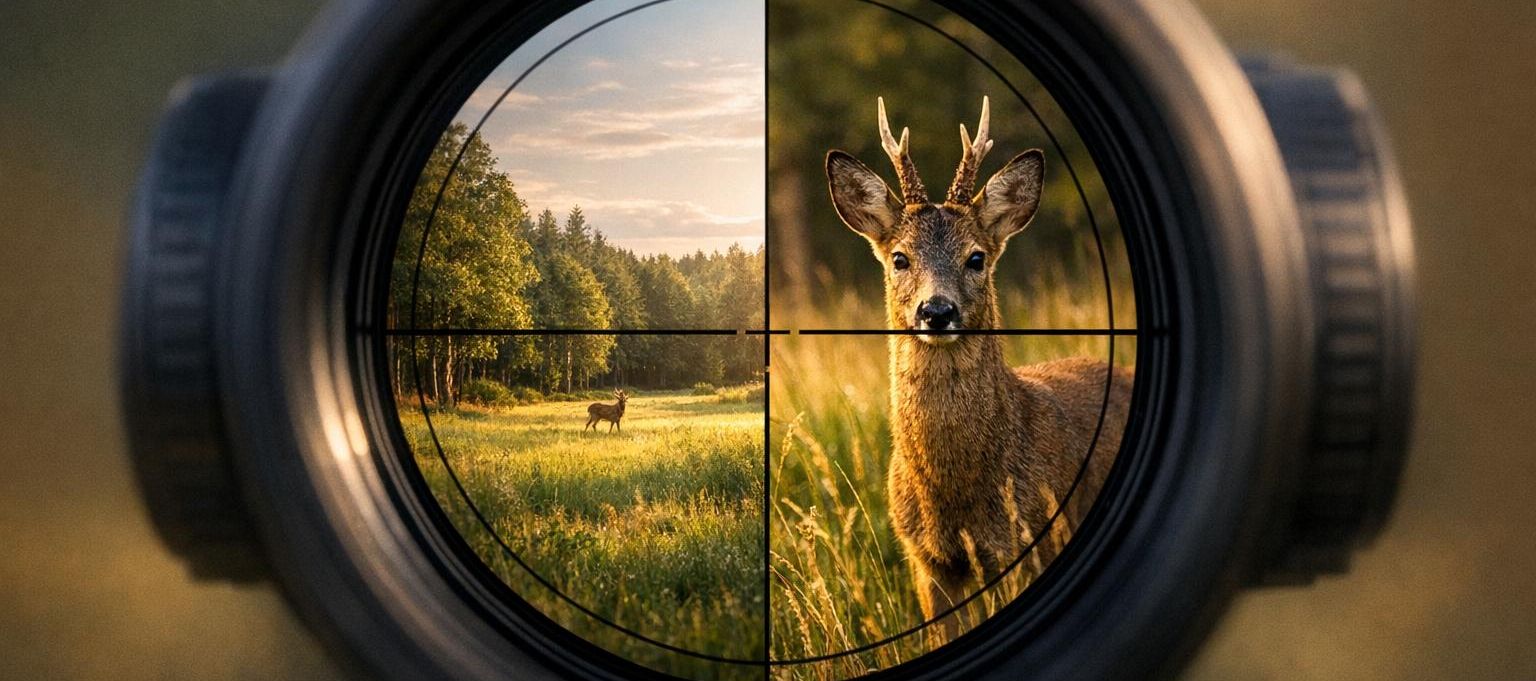
The choice of the right riflescope depends on two crucial factors: magnification and field of view. Both influence how well you can acquire and accurately hit your target. However, they are inversely related: Higher magnification means a smaller field of view – and vice versa.
In short:
- Magnification: Brings distant targets closer and shows more details. Ideal for long distances, but increases shaking and darkens the image.
- Field of View: Gives you a wide overview. Perfect for short distances and moving targets, but with less detail accuracy.
When what matters:
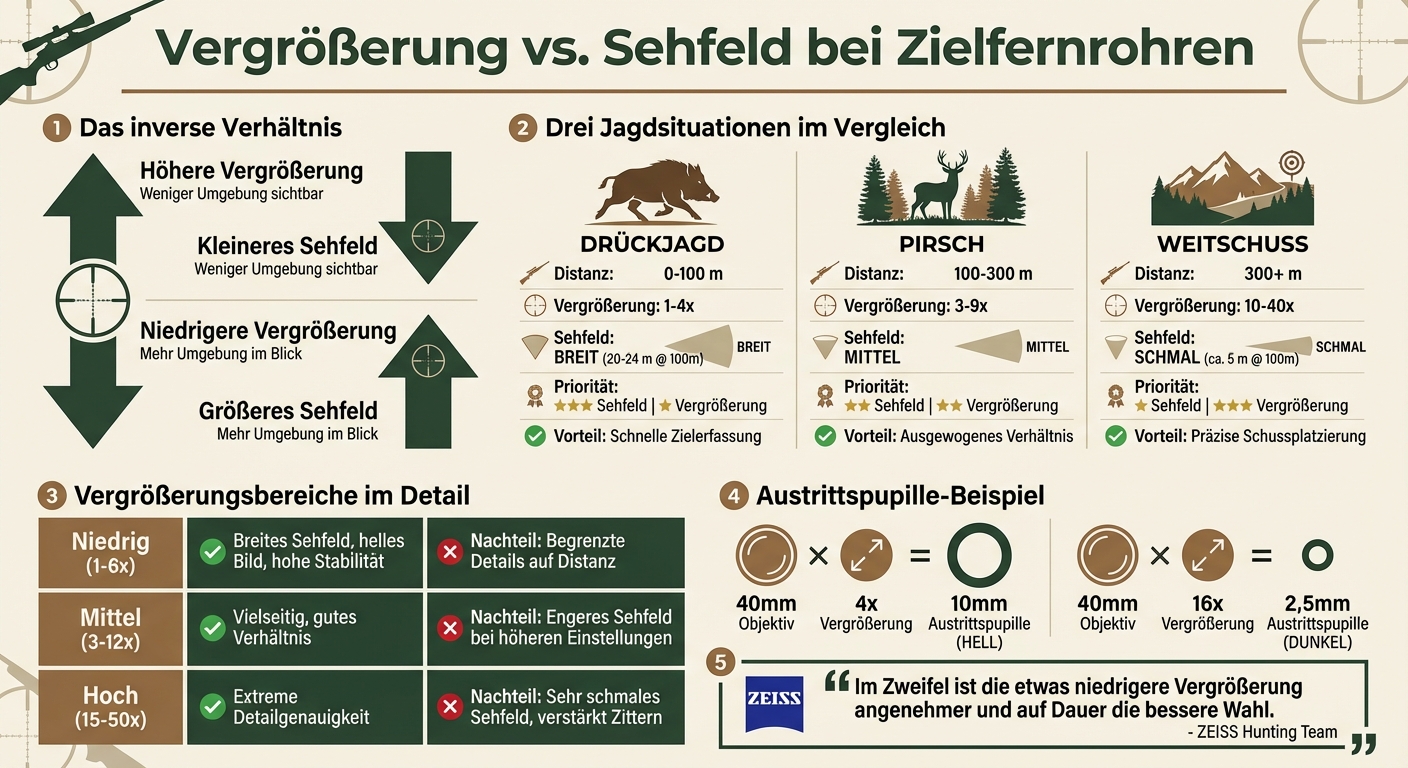
- Driven Hunt (0–100 m): Wide field of view (e.g., 1–4x magnification) for quick target acquisition.
- Stalking (100–300 m): Balanced ratio of magnification and field of view (e.g., 3–9x).
- Long Range Shooting (300+ m): High magnification (e.g., 10–40x) for precise shots.
The right balance between magnification and field of view is crucial to being effective in any hunting situation. Read on to better understand the advantages and disadvantages of both aspects and to find the suitable riflescope for your needs.
Riflescope Magnification and Field of View: Comparison for Different Hunting Situations
Driven Hunt Riflescopes – Our 6 Recommendations from Low Budget to High End
sbb-itb-1cfd233
What is Magnification in Riflescopes?
The magnification of a riflescope makes objects appear larger and closer without affecting the accuracy of the weapon itself. What is improved, however, is the precision when aiming. With magnification, you can see your target more clearly and place the reticle more precisely.
Technically, it works like this: The objective lens of the riflescope collects light, the erector lenses properly align the image, and the eyepiece magnifies it for your eye. However, higher magnification also has its pitfalls. It amplifies the natural shaking of the hands, which can make aiming more difficult, especially at magnifications starting from 10x. Additionally, the image becomes darker as the exit pupil gets smaller. For example: With a 40 mm objective, a 4x magnification results in an exit pupil of about 10 mm – the image is very bright. However, if the magnification increases to 16x, the exit pupil shrinks to about 2.5 mm, which darkens the image[3].
Fixed vs. variable magnification
A riflescope with fixed magnification offers a constant setting, such as 4x. These models are often lighter, more robust, and provide a clearer image due to their simpler lens system. Fewer moving parts also mean fewer potential weaknesses[3][4].
Variable riflescopes, on the other hand, allow for flexible adjustment of magnification, for example in the range of 3–9x. This makes them ideal for different hunting conditions and distances. However, they are usually heavier and more complex in design. Additionally, image quality may decrease at the edges of the magnification range[3].
The choice between fixed and variable magnification largely depends on the intended use.
Common magnification ranges
The optimal magnification depends on the hunting situation:
- Short distances (0–100 m): Magnifications such as 1–4x, 1–6x, or fixed 4x riflescopes are excellent for quick target acquisition, such as during driven hunts or in dense forests[3].
- Medium distances (100–300 m): Ranges like 3–9x, 2.5–10x, or 4–12x are ideal here.
- Long distances (over 300 m): High magnifications like 6–24x or even 10–40x are perfect for precise shots at long ranges. However, the field of view becomes significantly smaller[3].
Choosing the right magnification range is therefore crucial for a successful hunt.
What is the field of view in riflescopes?
The magnification of a riflescope brings distant targets closer, but the field of view determines how much of the surroundings you can see at the same time. The field of view indicates how wide the visible area is without moving the device and is specified for riflescopes in meters per 100 meters (m @ 100 m). For example, a riflescope with 8x magnification has a field of view of about 5 meters at a distance of 100 meters [1].
The higher the magnification, the smaller the field of view becomes. A larger field of view gives you more overview and makes it easier to quickly locate and track moving game. The field of view depends on the optical design, such as the eyepiece and prism size, not on the diameter of the objective lens. The following explains how a wide or narrow field of view can affect your hunting.
Wide vs. narrow field of view
A wide field of view occurs at low magnifications (e.g., 1–4x) and is perfect for hunting at short distances, especially with fast-moving targets. It allows you to spot game more quickly in the scope while keeping an eye on the surroundings – a crucial advantage during driven hunts.
A narrow field of view occurs at high magnifications and is better suited for recognizing details at long distances. However, it becomes more difficult to track moving targets. With a very small field of view, a "tunnel vision" effect can also occur – the image appears smaller and is surrounded by a dark edge.
How is the field of view measured?
The field of view is specified for rifle scopes in meters at 100 meters. In contrast, the specification for binoculars often refers to a distance of 1,000 meters. The larger eye relief (8–9 cm) explains this difference. If the field of view is given in degrees, you can roughly convert it: One degree corresponds to about 1.75 meters at 100 meters.
The next section will highlight the advantages and disadvantages that different magnifications bring in various hunting situations.
Advantages and disadvantages of magnification
After discussing the technical fundamentals of magnification, it is important to consider the practical advantages and disadvantages. The choice of the appropriate magnification strongly depends on the respective hunting situation. Low magnifications (1–6x) offer a wide field of view, allow for quick target acquisition, and provide a bright image – ideal for driven hunts and dense underbrush. However, at long distances, the necessary details are lacking [3]. Medium magnifications (3–12x) are considered versatile all-rounders that are suitable for many hunting scenarios, but they can lose field of view at higher settings and make movements more visible [3].
High magnifications (15x and more) are perfect for precise aiming at long distances. They show the finest details, so a target at 400 meters appears as if it were at 40 meters with a 10x scope [2]. The downside: the field of view becomes narrower, the image darker, and even the smallest body movements are amplified [3].
“When in doubt, a slightly lower magnification is more comfortable and ultimately the better choice." – ZEISS Hunting Team [2]
Another point: High magnifications make atmospheric effects such as the mirage phenomenon (heat shimmer) more visible, which can impair image quality [3]. Therefore, it is advisable to choose the lowest magnification that allows for precise target acquisition. This keeps the field of view optimal, the image bright, and the stability ensured [3].
Comparison Table: Magnification
The following table summarizes the main advantages and disadvantages of the different magnification ranges:
| Magnification Range | Typical Use Cases | Advantages | Disadvantages |
|---|---|---|---|
| Low (1–6x) | Driven hunting, close range (0–100 m), dense underbrush | Wide field of view, quick target acquisition, bright image, high stability | Limited detail recognition at distance [3] |
| Medium (3–12x) | Stalking, sitting, 100–300 m | Good balance of field of view and detail accuracy, versatile | Narrower field of view at higher settings, shaking becomes more visible [3] |
| High (15–50x) | Long-range shooting from 300 m, mountains, shooting range | Precise shot placement, extreme detail accuracy, detection of wind effects | Very narrow field of view, dark image in low light, amplifies shaking, requires stable support [2][3] |
Advantages and Disadvantages of the Field of View
The field of view plays as important a role in hunting as magnification – in some situations, it is even more crucial. A wider field of view helps you quickly acquire moving targets while keeping an eye on the surroundings. This is particularly advantageous during driven hunts: you can recognize targets faster and maintain overview when more animals enter the scene. This helps avoid unwanted "package shots," which increases safety.
Of course, a wide field of view also has its weaknesses. At low magnifications, wildlife appears smaller, making it harder to recognize fine details such as antler contours or subtle wind movements. For precise shots at greater distances – for example, from 300 meters – a higher magnification with a narrower field of view is often the better choice.
A narrow field of view, however, brings other challenges. It can lead to tunnel vision, making orientation difficult and emphasizing movements more. This makes it harder to keep moving targets in sight and complicates steady aiming. At the same time, a very wide field of view can lose sharpness at the edges of the image – not every optic provides a consistently clear representation to the edge. Therefore, it is important to find the right balance between field of view and magnification to act optimally in every hunting situation.
Comparison Table: Field of View
| Field of View Type | Typical Areas of Use | Advantages | Disadvantages |
|---|---|---|---|
| Wide (low magnification) | Driven hunt, dense forest, 0–100 m | Quick target acquisition, good overview, increased safety, easier tracking of moving targets | Fewer details at distance, reduced precision with small targets |
| Narrow (high magnification) | Long shots from approx. 300 m, mountain hunting, shooting range | High detail accuracy, more precise shots, better detection of wind and mirage effects | Tunnel vision, slower target acquisition, limited overview, more noticeable shaking |
The Right Choice of Scope for Different Hunting Situations
Depending on the type of hunting, you need either a wide field of view or high magnification. The wrong decision can be detrimental at the crucial moment.
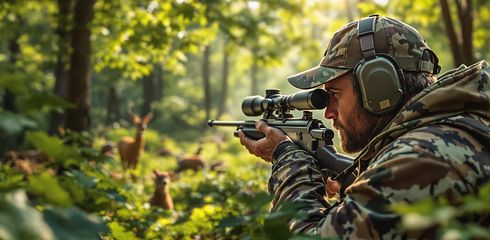
Driven Hunt: Focus on the Field of View
In driven hunting, speed is of the essence. Moving targets at short distances (0–100 m) must be quickly acquired and addressed safely. A wide field of view is indispensable here. Scopes with a magnification of 1–4x or 1–6x provide optimal overview. With a 1x magnification, you can even shoot with both eyes open, which significantly improves your perception of the surroundings [9]. Another advantage is a large exit pupil (objective diameter / magnification), which facilitates quick acquisition of the target image [3].
However, different requirements apply for longer distances.
Stalking and Long-Range Shooting: Focus on Precision
When stalking and taking long shots, precision is paramount. Variable scopes with 3–9x or 4–12x magnification are proven companions [9]. They offer the flexibility to adapt to different distances. For distances of 300 m and more, higher magnifications such as 6–24x, 10–40x, or even up to 50x are necessary. For example, at 10x magnification, a target at 400 m appears as if it is only 40 m away [2]. Also important: For long-range shots, a parallax adjustment is essential to avoid aiming errors [9]. Note that high magnifications can amplify natural shaking – without a stable rest, precise aiming becomes difficult.
Universal Scopes: Flexibility for All Types of Hunting
If you are in different hunting situations, universal scopes are a practical solution. A configuration like 2–16x50 offers versatility: At 2x magnification, you benefit from a wide field of view for driven hunts, 5–7x is ideal for stalking, and at 16x you have enough magnification for challenging long shots [5]. Modern optics with a 6- or 8-fold zoom factor cover almost all hunting situations [5].
„The 6-fold zoom was a revolution... the challenge of previously opposing parameters – more field of view with more eye relief – could be solved,”
explains Florian Kreissl from Swarovski Optik [5]. For universal scopes, a reticle in the second focal plane (SFP) is recommended, as it remains the same size regardless of magnification, thus not obscuring small targets [8][7].
Conclusion: Magnification or Field of View – What Matters More?
Magnification and field of view are directly related: When one increases, the other decreases [2][1]. The choice of the appropriate riflescope therefore depends heavily on your preferred hunting method.
For driven hunts, a wide field of view is essential. A value of at least 20 to 24 m at 100 m allows for quick acquisition of moving targets [10]. In stalking or long-range shooting, however, higher magnification is advantageous. A target at 400 m appears as if it were only 40 m away at 10x magnification [2]. However, magnifications over 10x can amplify hand tremors, often requiring a stable rest [6][2].
“When in doubt, a slightly lower magnification is more comfortable and ultimately the better choice."
– ZEISS Hunting Team [2]
These differences show that the choice of riflescope should always be tailored to the specific hunting situation. Modern universal riflescopes with a 6x or 8x zoom factor offer high flexibility and are suitable for almost all hunting scenarios [5]. On Gunfinder, you can specifically filter riflescopes by magnification and field of view to find the optics that perfectly match your requirements. This way, you make an informed decision for your hunting practice.
FAQs
What magnification do I really need for my typical distances?
The choice of the right magnification depends on the distance at which you are hunting: 3x to 6x is ideal for short distances (50–100 m), 4x to 8x is optimal for medium ranges (100–300 m), and 8x to 12x is perfect for long distances starting from 300 m. It is important to find a balanced ratio between magnification and field of view so that you can aim precisely without losing sight of your target.
How do I recognize if the field of view of my scope is sufficient for driven hunting?
The field of view of a scope indicates how wide your view is at a distance of 1000 meters. Especially in driven hunting, a wide field of view plays a crucial role. It allows you to quickly capture wildlife and surroundings, enabling rapid responses to movements.
A restricted field of view, on the other hand, can feel like tunnel vision. This complicates orientation and makes it harder to keep track of the events. Therefore, it is advisable to choose a scope with as large a field of view as possible to act flexibly and safely in any situation.
Which objective size fits my magnification in dusk?
In poor lighting conditions, such as at dusk, the size of the objective plays a crucial role, as it determines how much light can be captured. The exit pupil is a central factor. It should be at least 4 mm to allow for clear vision. The exit pupil is calculated from the ratio of objective diameter to magnification.
- Example for 8x magnification: An objective diameter of 42 mm is ideal here.
- For 10x magnification or more: The objective diameter should be at least 50 mm.
As magnification increases, so does the need for a larger objective, as only this way can sufficient light be gathered for good visibility in low light conditions.