Illuminated sights: Frequently asked questions about battery usage
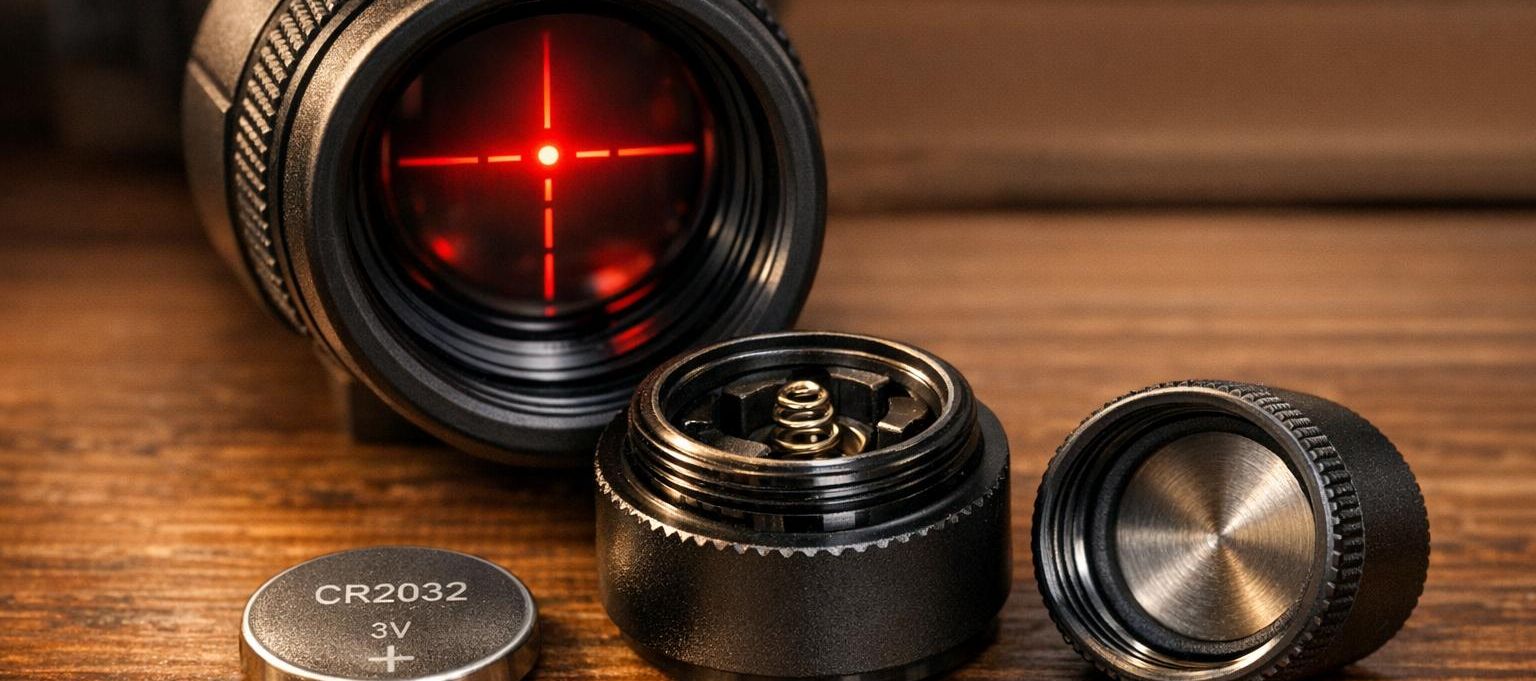
Illuminated reticles in riflescopes are essential for hunting in low light conditions. They require batteries, usually CR2032 button cells, which impress with their high energy density and long lifespan. However, cold temperatures, brightness settings, and storage significantly affect battery performance.
Key Points:
- Battery Types: CR2032 is standard, alternatives include CR2025, CR2016, or SR44.
- Lifespan: Reduced brightness and proper storage extend usage time.
- Replacement: Batteries should be checked regularly and replaced when performance is weak.
- Tips: Carry spare batteries, use automatic shut-off functions, and remove batteries when not in use.
A precise battery replacement and proper care ensure the functionality of the illuminated reticle – a crucial factor for a successful hunt.
Steiner Ranger 8 - How to Change the Battery
sbb-itb-1cfd233
Battery Types for Illuminated Reticles
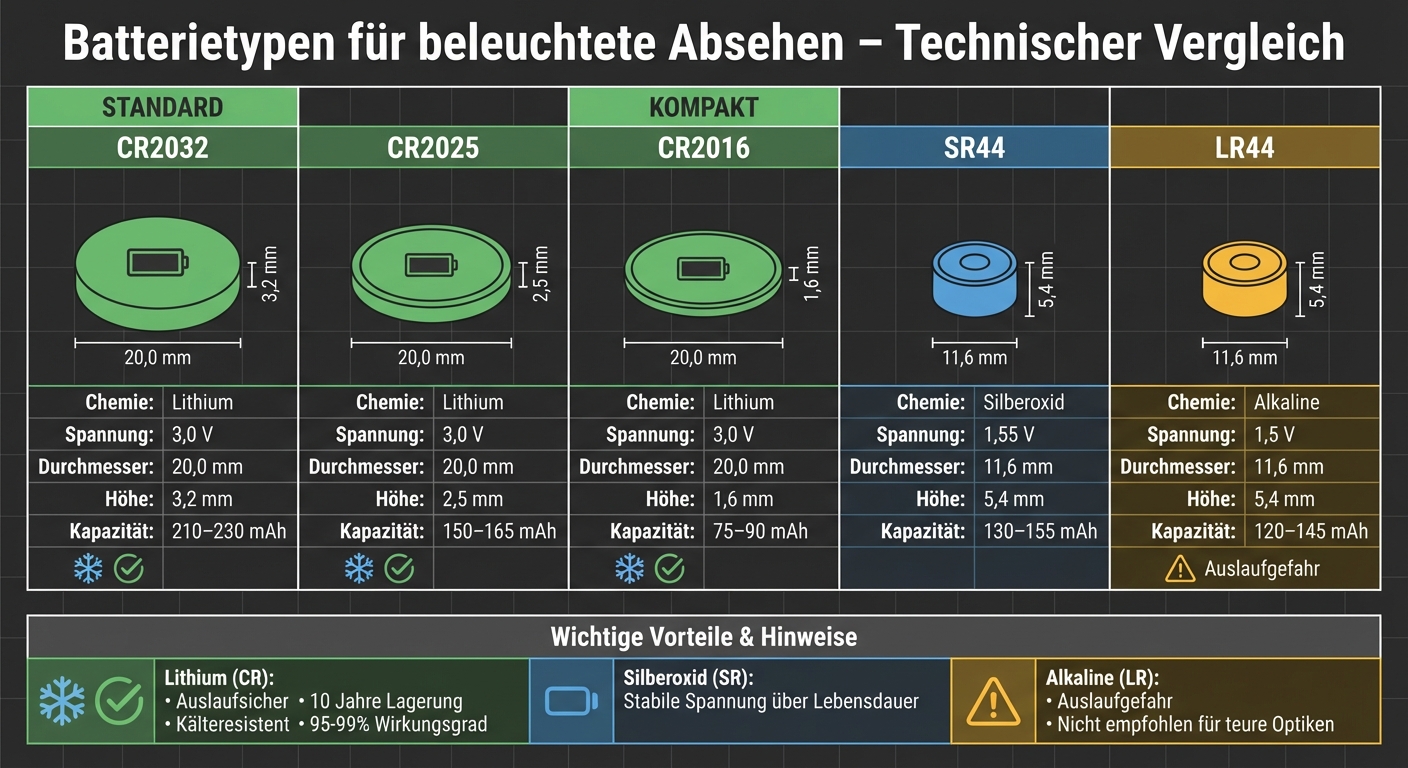
Battery Types for Illuminated Riflescopes Comparison
The CR2032 lithium button cell is the standard for most illuminated riflescopes – all illuminated models from ZEISS rely on this battery [1][6]. The designation "2032" indicates the dimensions: 20 mm diameter and 3.2 mm height [5][6]. With a voltage of 3.0 V and a typical capacity of 210–230 mAh, it provides the constant energy needed for a uniform brightness of the reticle [5][6].
The abbreviation "CR" stands for lithium manganese dioxide chemistry, which is characterized by high energy density and very low self-discharge [5]. Lithium batteries offer efficiencies of 95–99% [7] and operate reliably even at extreme temperatures – a crucial advantage for winter hunting [5]. With a lifespan of up to 10 years, they are ideal for emergency equipment and hunting optics [6].
CR2032 and Button Cell Variants
Compact scopes often use CR2016 or CR2025 batteries. Both utilize the same lithium chemistry but have lower capacities: about 150–165 mAh for the CR2025 and 75–90 mAh for the thinner CR2016 [5]. Older or specialized optics sometimes rely on LR44 (Alkaline, 1.5 V) or SR44 (Silver oxide, 1.55 V). Silver oxide cells provide a more stable voltage throughout their lifespan [5].
Tip: Avoid touching the flat surfaces of button cells with bare fingers, as skin oils can cause leakage currents [5]. The model number is directly engraved on the battery [6].
The following table provides an overview of the key specifications of the various battery types:
Battery Comparison Table
| Battery Type | Chemistry | Voltage | Diameter | Height | Capacity (approx.) |
|---|---|---|---|---|---|
| CR2032 | Lithium | 3.0 V | 20.0 mm | 3.2 mm | 210–230 mAh [5] |
| CR2025 | Lithium | 3.0 V | 20.0 mm | 2.5 mm | 150–165 mAh [5] |
| CR2016 | Lithium | 3.0 V | 20.0 mm | 1.6 mm | 75–90 mAh [5] |
| SR44 | Silver oxide | 1.55 V | 11.6 mm | 5.4 mm | 130–155 mAh [5] |
| LR44 | Alkaline | 1.5 V | 11.6 mm | 5.4 mm | 120–145 mAh [5] |
Lithium cells (CR) are leak-proof and provide a constant 3.0 V. Alkaline cells (LR), on the other hand, have a voltage of only 1.5 V and a higher risk of leaking, which can damage expensive optics [5]. Occasionally, cylindrical batteries such as CR123A or CR2 are also used for tactical sights or compact laser systems [4].
When and how to change batteries
What affects battery life
The battery life strongly depends on the brightness setting. Maximum brightness can reduce the runtime by up to 50%[3]. Therefore, you should always choose the lowest brightness level that is sufficient for the current lighting conditions.
Another important point is temperature. Cold significantly reduces the capacity of the battery, especially in frost. While lithium batteries are more resistant to low temperatures than alkaline cells, they also lose performance in the cold[3]. However, under optimal conditions, some models can achieve impressively long operating times[3].
For replacement: For optics used for self-defense, you should change the battery every six months, regardless of how often it has been used. Recreational and sport shooters can usually manage with an annual change. If you do not use your optic for an extended period, remove the battery to avoid the risk of leaking cells[3][4].
Steps to change the battery
Now that you know what affects battery life, here is a simple guide on how to change the battery safely and efficiently. A correct procedure ensures that your illuminated reticle remains reliable.
- Safety and Preparation: First, check that the weapon is unloaded, the chamber is empty, and the safety is engaged. Turn off the illumination of the reticle and have the necessary tools ready, such as a screwdriver, Allen key, or a coin[4].
- Open Battery Compartment: The battery compartment is often located on the side of the brightness control, at the top of the eyepiece, or directly in the dial. Carefully open the cover.
- Remove Old Battery: Take out the old battery without damaging the sensitive contact springs.
- Observe Polarity: Check the orientation before inserting the new battery. For most button cells, the positive side (+) faces outward, but this can vary by model.
- Insert New Battery and Close Compartment: Insert the new CR2032 battery with the correct orientation and close the battery compartment. Do not tighten it too much to avoid damaging the seal.
- Function Test: Turn on the illumination and test all brightness levels to ensure everything is functioning properly[4].
A regular and careful battery change ensures that your optics remain ready for use at all times. This way, you can rely on your equipment, whether in training or in a serious situation.
Signs That Your Battery Needs to Be Replaced
How to Recognize a Weak Battery
As mentioned regarding battery life, a loss of brightness is a clear sign that it is time for a change. If the reticle becomes dimmer or starts to flicker, the battery is no longer providing enough voltage. This loss of brightness is particularly noticeable in poor lighting conditions or at dusk – exactly when clear visibility is crucial.
Another warning signal is flickering light, which can indicate a weak battery or poor contact. Crate Club explains:
"Flickering can indicate a weak battery or poor contact. Ensure that the battery is properly installed, and try a new battery if the problem persists." [4]
Completely absent illumination or unexpected shutdown during use indicates that the battery is fully discharged. To avoid such situations, you should regularly check the battery status of your optics – ideally once a month, especially with frequent use. It is also wise to always have spare batteries on hand and to test the brightness before each hunting trip.
These tips complement the previously discussed advice on replacement intervals and maintenance, ensuring that you are always optimally prepared.
How to Extend the Battery Life
With these tips, you can extend the battery life of your illuminated reticle and avoid unnecessary energy consumption.
Utilize Power-Saving Features
The brightness setting is the biggest factor affecting battery life. If the illuminated reticle is operated at maximum brightness, the runtime is significantly reduced [3]. Therefore, you should always choose the lowest brightness level that is sufficient for the current lighting conditions. Maximum brightness is only needed in direct sunlight.
Many modern optics offer automatic shut-off features that turn off the device after a certain period of inactivity. Features like "Shake Awake" activate the reticle only when movement is detected [3]. Some models, such as those from Holosun, combine battery operation with solar technology, achieving impressive runtimes of over 50,000 hours [3]. Additionally, some systems automatically adjust the LED intensity to the ambient brightness, further reducing energy consumption [2].
Remember to always turn off the reticle after use – this significantly conserves the battery [3].
In addition to saving energy, proper storage of batteries is also crucial.
Proper Battery Storage
Store spare batteries in a cool, dry place – ideally at temperatures between 15 °C and 25 °C [8]. Extreme temperatures should be avoided: heat increases self-discharge, while frost can damage the battery [8]. Low humidity and good ventilation are also important to prevent corrosion.
If you do not use your illuminated reticle for an extended period, remove the battery. This prevents it from leaking or corroding [3]. In winter, it is advisable to carry spare batteries close to your body. This keeps them warm and maintains their full capacity, as extreme cold significantly slows down the chemical reactions in the battery [3].
Battery Operation vs. Other Illumination Methods
After considering battery operation and maintenance, a comparison with other illumination methods is sensible. Illuminated reticles do not all function the same way. In addition to the classic battery-operated LED systems, there are also fiber optic reticles that either do not require a battery or use it differently.
Fiber Optics vs. LED Systems
LED systems offer precise control over brightness and color. You can choose between red, green, or blue and adjust the intensity manually or automatically – particularly practical in changing light conditions. The downside: The function completely depends on the battery. If it is empty, the illumination fails. Additionally, at very low brightness, the reticle may appear blurry, which can strain the eyes[2].
In contrast, fiber optic reticles use alternative light transmission paths. Models like the Minox ZX 2-10x50 (from approx. €1,199) transmit light through fiber optics and create a bright, precisely dimmable point of light. This technology works excellently in both bright sunlight and twilight. It often allows for finer adjustments than many LED systems. Even though some fiber optic reticles require batteries for the dimming function, their light transmission concept is an interesting alternative[9].
Modern LED systems like the Kahles Helia 3 3-10x50i or the Swarovski Z6i 2-12x50 (both rated 5.0/5 by Gunfinder) compensate for their weaknesses with clever features. Position sensors automatically turn off the illumination when the rifle is not in shooting position, and memory functions remember your preferred brightness setting. This saves energy and makes everyday use significantly more comfortable[9].
Summary
The choice of the right battery significantly affects the reliability of an illuminated reticle. CR2032 button cells provide about 80 hours of illumination, while AA or AAA batteries last around 200 hours, approximately 2.5 times longer. For tactical applications, CR123A batteries are often preferred due to their high energy density[4][10].
In addition to the battery, usage behavior also plays a role: Reduce the brightness of the reticle to the lowest visible level, use optics with position sensors, and regularly check the battery status – especially before hunting[4][9]. A weakening, flickering, or failing reticle is a clear sign that a battery change is necessary[4].
Modern technologies facilitate energy management: Scopes like the Kahles Helia 3 or Swarovski Z6i combine LEDs with intelligent energy-saving features to use batteries efficiently without compromising comfort[9]. Store spare batteries in a cool, dry place and pay attention to the correct polarity when changing[4].
On Gunfinder, you can discover a wide selection of high-quality scopes with illuminated reticles – both new and used. The platform allows you to compare different models and their battery management features directly, so you can find the perfect optic for your needs.
FAQs
Can I replace a CR2032 with a CR2025 or CR2016?
No, you should not do that. The button cells CR2032, CR2025, and CR2016 differ in their voltage and capacity. A replacement could negatively affect the function of the illuminated reticle and even lead to malfunctions.
How can I tell if the flickering of the reticle is due to the battery or the contact?
Check if the flickering occurs at different battery charge levels or when moving the contacts. Often, either a weak battery or a contact problem is the cause. Insert a new battery and thoroughly check the contacts to find the source of the issue.
How do I best store spare batteries for winter hunting?
Store spare batteries for winter hunting in a cool and dry place, away from extreme temperatures and humidity. This helps maintain the performance of the batteries. For illuminated reticles, as commonly found in ZEISS riflescopes, CR 2032 batteries are often used.