SAAMI standards vs. non-standardized ammunition

SAAMI standards guarantee safety and reliability for ammunition, while non-standardized ammunition poses potential risks. SAAMI (Sporting Arms and Ammunition Manufacturers' Institute) has been defining strict standards for firearms and ammunition since 1926. These ensure that ammunition from different manufacturers is safe and compatible with corresponding firearms. Non-standardized ammunition, such as handloads or wildcat cartridges, deviates from these standards and can cause unpredictable pressure spikes as well as damage to firearms.
Overview:
-
SAAMI-compliant ammunition:
- Strict pressure and safety testing
- Compatible with all modern firearms
- Reliable performance and protection against wear
-
Non-standardized ammunition:
- No uniform testing standards
- Risk of firearm damage and accidents
- Examples: handloads, old or improperly stored ammunition
Conclusion: For hunters and sport shooters in Germany, it is crucial to rely on SAAMI or C.I.P. compliant ammunition to avoid risks and ensure safety.
The Significance Of SAAMI
sbb-itb-1cfd233
SAAMI-compliant Ammunition: Safety and Consistency
The principles of SAAMI standards are reflected in the precise and safe manufacturing of ammunition. SAAMI-compliant ammunition undergoes rigorous testing, including pressure measurements with piezoelectric sensors. These sensors provide accurate values in psi (pounds per square inch) and ensure that each batch remains within the specified limits [8]. This consistent pressure and velocity control is crucial for predictable projectile trajectories – an indispensable factor for hunters and sport shooters.
Another advantage of standardization is interchangeability: ammunition from any SAAMI-compliant manufacturer works safely in any firearm designed for the respective caliber [4]. This combination of safety and compatibility is a significant benefit that becomes particularly noticeable when choosing ammunition types.
What SAAMI Standards Cover
SAAMI standards establish, among other things, the Maximum Average Pressure (MAP) limits for each caliber. For example, the MAP for .357 Magnum is 35,000 psi (approximately 2.413 bar) [5]. Older calibers like the 7x57 Mauser are limited to 51,000 psi, while modern calibers like the 7mm-08 Remington can be loaded up to 61,000 psi [4]. These limits take into account the stress limits of various generations of firearms.
In addition to pressure limits, the standards also include cartridge and chamber dimensions, standardized twist rates for stable bullet rotation, and defined velocity ranges [4]. The latest version for centerfire rifle ammunition (SAAMI Z299.4) was updated in 2025 [2]. The Z299.5 standard also includes abuse testing: New firearm designs undergo drop, impact, and rotational tests to ensure their safety under accidental loads [2].
Benefits for Hunters and Sports Shooters
For hunters, SAAMI-compliant ammunition means reliable performance in the field. The consistently high bullet velocity facilitates precise shot calculations over varying distances. Sports shooters benefit from the reproducible accuracy that can only be achieved through standardized manufacturing. Additionally, adherence to pressure limits protects firearms from excessive wear or material fatigue [6].
Another safety aspect is dimensional standardization: cartridges with larger bullet diameters cannot physically be loaded into firearms with smaller barrels [4]. Especially with older firearms, it is important to match the barrel markings with the ammunition designation, as SAAMI-standardized names like “270 Winchester” must match exactly [4].
In the next section, we will take a look at the risks associated with non-standardized ammunition.
Find SAAMI-compliant ammunition at Gunfinder – your go-to source for safe and precise products.
Non-standardized ammunition: Risks and problems
In contrast to SAAMI-compliant ammunition, which is subject to strict and defined testing standards, non-standardized ammunition lacks such clear guidelines. The result? Uncontrolled pressure spikes and potentially catastrophic failures that can endanger not only the firearm but also the shooter and bystanders. Here are some examples of these types of ammunition.
Common types of non-standardized ammunition
- Handloaded cartridges from unreliable sources: Without precise loading data and artisanal precision, they pose significant risks [9].
- “Ruger Only” loads: This ammunition is designed for specially reinforced systems like the Ruger Blackhawk. Standard revolvers can be seriously damaged by the higher pressure levels [10].
- +P ammunition: It is loaded about 10% above standard pressure, while +P+ is merely an undefined marketing term without clear specifications [7].
- Old or improperly stored ammunition: Chemical changes in the propellant can lead to dangerous pressure spikes. An example is certain Chinese 7.62 Tokarev batches, where the breakdown of stabilizers makes the ammunition "sharper" over time [9].
- Surplus ammunition: Mechanical defects such as blocked primer pockets or cracks in the casing material have been documented [9].
Safety concerns
The risks associated with non-standardized ammunition are significant. If the pressure values exceed the recommended limits, serious damage such as burst cylinders or frame breaks can occur [10]. Even modern firearms that can withstand higher pressures are not invulnerable. For example, +P ammunition can lead to accelerated wear and frame stretching in older, unreinforced revolvers [7].
A particularly important point is highlighted by Feuerlinie.at:
The problem is not that the warranty expires, but that it could be interpreted as negligence and one not only endangers oneself but also the man/woman at the neighboring booth if something happens [10].
In addition to the physical dangers, using non-standardized ammunition can void the warranty claim on the weapon. In the event of an accident, legal consequences are also possible [10].
Side-by-Side Comparison: SAAMI vs. Non-standardized Ammunition
SAAMI vs. Non-standardized Ammunition: Safety Comparison
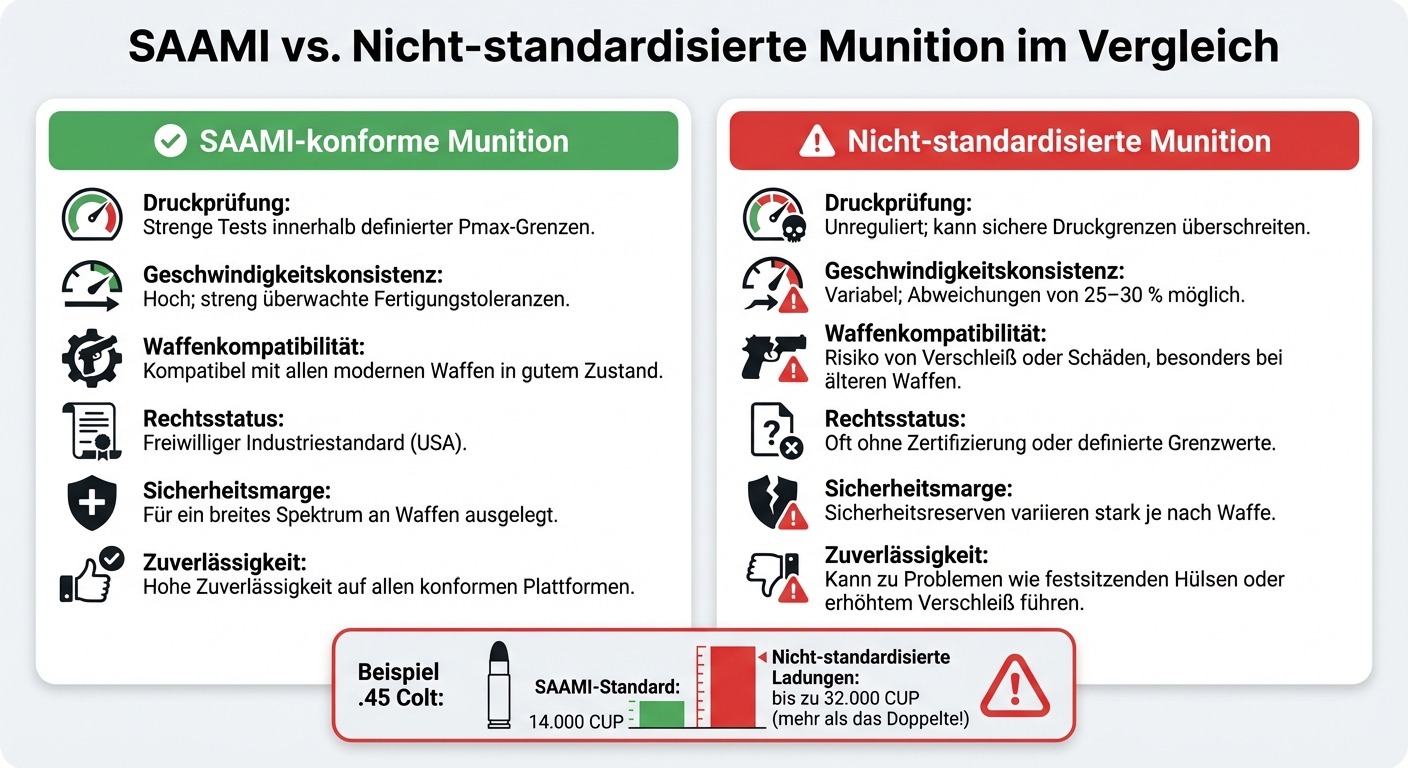
As already described, the main difference between SAAMI-compliant and non-standardized ammunition lies in the safety guaranteed by manufacturing. While SAAMI-compliant ammunition is designed for universal safety and compatibility, non-standardized ammunition often prioritizes maximum performance – sometimes at the expense of safety.
A vivid example is the .45 Colt. The pressure set by SAAMI is 14,000 CUP to protect even older firearms from the 19th century. In contrast, modern non-standardized loads can reach up to 32,000 CUP – more than double. However, these are suitable only for modern firearms like the Ruger Blackhawk [11].
Buffalo Bore, a manufacturer of high-performance ammunition, describes the situation as follows:
Almost all major ammunition manufacturers 'download' or 'water down' their ammunition to stay well below SAAMI pressure specifications... the end customer receives weak ammunition that cannot cause a problem in any firearm [11].
While this practice reduces liability risk, it also leads to lower performance. The following table shows the differences between SAAMI-compliant and non-standardized ammunition in detail.
Comparison Table
| Feature | SAAMI-compliant Ammunition | Non-standardized Ammunition |
|---|---|---|
| Pressure Testing | Strict testing within defined Pmax limits | Unregulated; may exceed safe pressure limits |
| Velocity Consistency | High; strictly monitored manufacturing tolerances | Variable; deviations of 25–30% possible [6] |
| Weapon Compatibility | Compatible with all modern firearms in good condition | Risk of wear or damage, especially with older firearms [7] |
| Legal Status | Voluntary industry standard (USA) | Often without certification or defined limits |
| Safety Margin | Designed for a wide range of firearms [5] | Safety reserves vary greatly depending on the firearm |
| Reliability | High reliability on all compliant platforms [1] | Can lead to issues such as stuck casings or increased wear [11][6] |
An example of the risks of non-standardized ammunition: Defective batches exhibited up to 30% higher muzzle velocities (V0) and stronger recoil [6]. Such fluctuations practically do not occur with SAAMI-compliant ammunition thanks to strict quality controls.
SAAMI vs. C.I.P. Standards for European Firearms
When it comes to the safety assessment of SAAMI-compliant and non-standardized ammunition, the European C.I.P. standards are an important point of comparison. While SAAMI in the USA is merely a voluntary guideline, the C.I.P. standards are legally mandated in its 14 member countries – including Germany, Austria, and France. Without this approval, neither firearms nor ammunition may be sold [12][14].
The technical difference between the two systems lies primarily in pressure measurement. C.I.P. drills a hole in the cartridge case to measure gas pressure directly, while SAAMI captures the pressure through the wall of the case [14][6]. Additionally, different positions of the pressure sensors on the test barrel lead to varying measurement results with identical loads [3].
An example: For the .357 Magnum, the maximum C.I.P. pressure is 3,000 bar (43,511 psi), while SAAMI only specifies 2,413 bar. For the 9mm Luger, C.I.P. sets it at 2,350 bar, compared to SAAMI with 2,412 bar and 2,654 bar (+P) [5][15]. These differences are mainly due to the more cautious calculations of US manufacturers, who want to minimize liability risks and protect older firearms [5][13]. These technical deviations directly affect the safety and compatibility of ammunition in European firearms.
For German hunters and sports shooters, it applies that SAAMI ammunition is generally safe in C.I.P.-tested firearms, as the SAAMI pressures are often lower. Modern European firearms from manufacturers like Heckler & Koch, Walther, or Glock are usually also suitable for SAAMI +P ammunition, as they can withstand pressures up to 2,700 bar [15]. However, when purchasing imported US firearms, you should definitely pay attention to the C.I.P. proof mark. Every firearm sold in Europe must be tested in an official proof house with high-pressure proof cartridges [14][16]. There is no such testing requirement in the USA [13].
If you reload ammunition yourself and use European powders like Reload Swiss or Vihtavuori, you should adhere to C.I.P.-based loading data. Even if these are occasionally displayed as "too high" in US software, they are correct for European firearms [13].
Conclusion: Choosing Safe and Reliable Ammunition
The decision between SAAMI-compliant and non-standardized ammunition is primarily a matter of safety. Ammunition that meets SAAMI standards is rigorously tested and is compatible with one another – a cartridge from Federal works just as reliably in the same firearm as one from Hornady or Winchester [3]. In contrast, non-standardized "wildcat" ammunition carries a higher risk as it can cause dangerous pressure spikes [3].
For hunters and sport shooters in Germany, it is particularly important to pay attention to the C.I.P. proof mark. European firearms should only be used with SAAMI or C.I.P.-compliant ammunition [5]. SAAMI ammunition can be used without hesitation in C.I.P.-tested firearms, as the American pressure values are generally set more conservatively [5].
Be sure to avoid ammunition without clear standards or verified load data. Faulty ammunition can lead to drastic deviations such as up to 30% higher muzzle velocities and dangerous recoil [6].
On Gunfinder, you will find tested ammunition, firearms, and hunting accessories to ensure that you only shoot with ammunition that meets the highest safety requirements. This way, you can rely on your equipment and fully concentrate on your hunt or sport.
FAQs
How can I tell if ammunition is SAAMI or C.I.P. compliant?
SAAMI or C.I.P. compliant ammunition can be identified by the markings on the cartridge case or packaging. With SAAMI ammunition, you will often find a corresponding logo or indication that points to compliance with SAAMI standards. C.I.P.-tested ammunition, on the other hand, has been tested and certified according to C.I.P. guidelines.
It is important to pay attention to these markings to ensure that the ammunition is compatible with your firearm and meets the required safety standards.
What warning signs indicate that ammunition is over-pressured or unsafe?
Over-pressured or unsafe ammunition can become dangerous due to increased gas pressures, as these can damage both the firearm and the ammunition. There are some typical warning signals to watch for:
- Overheating: If the firearm becomes unusually hot, this could indicate excessive pressure.
- Deformations of the casings: Visible changes to the casings, such as bulges or cracks, are a clear warning sign.
- Unexpected wear: A faster than normal wear on the firearm can also be an indication of excessive pressures.
To be truly sure, a precise pressure measurement is essential. Only in this way can overpressure be reliably detected and safety ensured.
Can I use +P or "Ruger Only" loads in my firearm?
Yes, you can use +P loads, but only if your firearm is explicitly designed for it. Check the manufacturer's specifications carefully – this ammunition is specifically designed for modern firearms that are built for higher pressure. Using +P ammunition in older or unsuitable firearms can cause serious damage or even be dangerous.
What are "Ruger Only" loads?
"Ruger Only" loads are types of ammunition specifically developed for particularly robust revolver models, such as those manufactured by Ruger. These loads generate a very high pressure and should never be used in firearms that are not explicitly designed for them. Using them in unsuitable firearms can lead to safety risks. It is therefore essential to carefully check the specifications of both your firearm and the ammunition before using them.