Checklist: Check rimfire and centerfire compatibility

Choosing the right ammunition is crucial for safety and performance. Rimfire and centerfire cartridges differ fundamentally in their ignition mechanics and are not compatible. Errors in ammunition selection can lead to misfires or dangerous situations. Here’s what you need to know:
- Rimfire Ammunition: Ignition occurs at the rim of the case, e.g., .22 LR. Inexpensive, ideal for training and small game hunting.
- Centerfire Ammunition: Ignition through a central primer, e.g., 9 mm Luger. Powerful, reusable cases, preferred for hunting and self-defense.
- Firearm Adaptation: Firing pins and chambers are specifically designed for the cartridge type.
- Legal Requirements in Germany: Firearms ownership card (WBK) required, caliber specifications must match exactly.
Quick Check: Always check caliber specifications on the firearm and ammunition, cartridge dimensions, and ignition system. Consult manufacturer specifications or experts if unsure. Safety first.
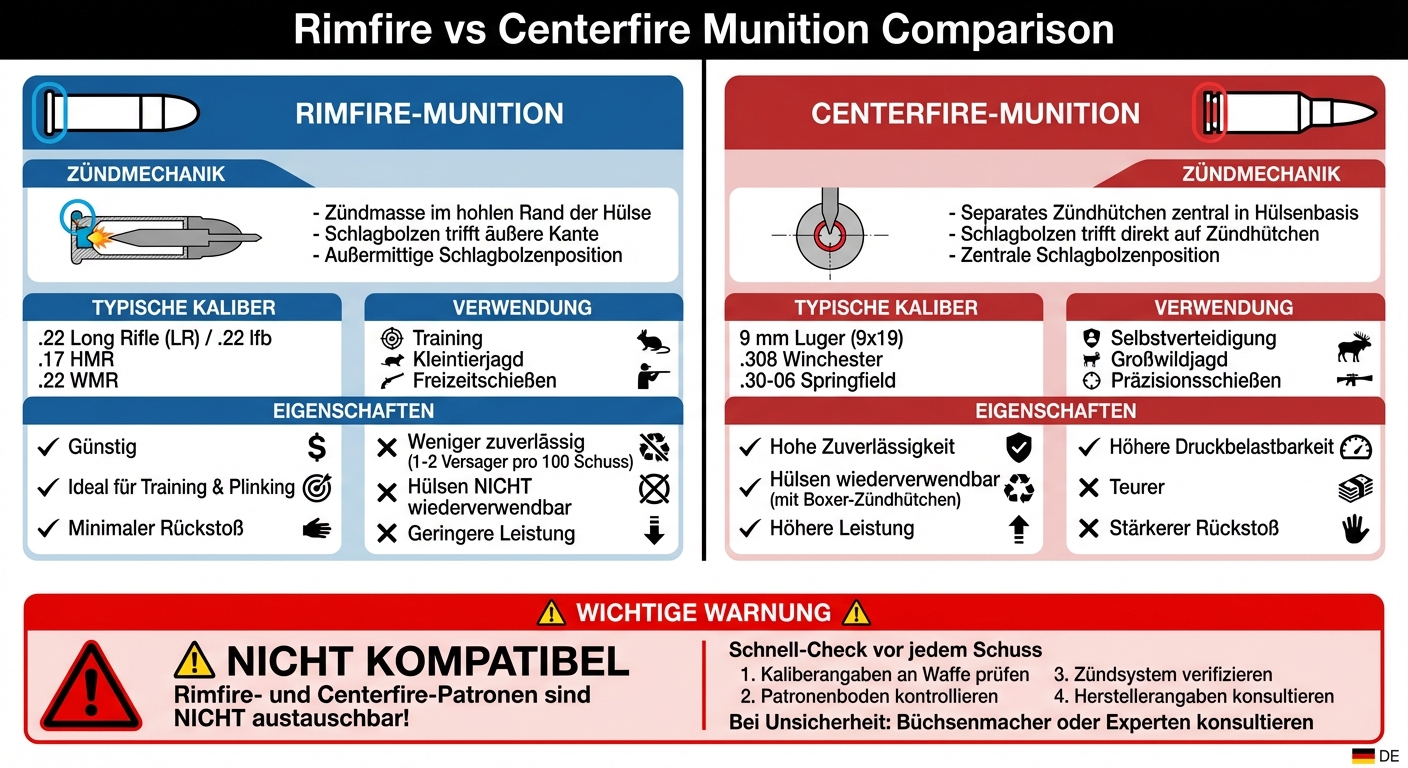
Rimfire vs Centerfire Ammunition: Main Differences and Compatibility
.22LR, .22WMR, .17HMR, .22 Hornet Comparison - BULLET RACES
Rimfire and Centerfire Ammunition: The Basics
Here we take a closer look at the characteristics and differences between the two types of ammunition.
What is Rimfire Ammunition?
In rimfire cartridges, the primer is located directly in the hollow rim of the cartridge case, rather than in a separate primer. The firing pin strikes the outer edge of the case base, compressing the rim and igniting the primer. The .22 Long Rifle (LR) is the most well-known example of rimfire ammunition and is considered the best-selling cartridge worldwide [1]. Other common calibers include .17 HMR and .22 WMR.
What is Centerfire Ammunition?
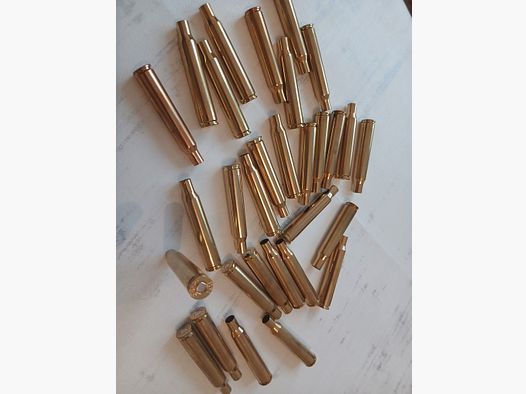
Centerfire cartridges use a separate primer that is centrally located in the case base. The firing pin strikes directly on this primer, allowing for reliable ignition. Due to the thicker and sturdier case walls, these cartridges can withstand higher pressures, allowing for larger powder charges and greater performance. Typical centerfire calibers include 9 mm for pistols as well as larger calibers like .308 Winchester or .30-06. An additional advantage: cases with boxer primers can be reused by replacing the spent primer and reloading the case.
The next section will highlight how these different ignition techniques affect reliability.
Main Differences Between Rimfire and Centerfire
One of the central differences is reliability. Centerfire ammunition is generally more reliable because the primer is concentrated in the primer pocket. In rimfire ammunition, the primer is distributed throughout the rim, which can lead to more frequent misfires. William Lawson from SilencerCo puts it succinctly:
"Even good quality rimfire ammo has more duds than centerfire ammo. It's not unusual to have one or two misfires in a box of 100 rounds."
Another difference lies in price: Rimfire ammunition is significantly cheaper, making it the ideal choice for training and “plinking.” It is also excellent for small game hunting due to minimal recoil. Centerfire ammunition, on the other hand, offers more power and flexibility and is preferred for self-defense, big game hunting, or precision shooting at long distances.
A crucial point is also the reusability of the cases. Rimfire cases are deformed after firing and are not reusable, while centerfire cases can be used multiple times. These differences play an important role in selecting the appropriate ammunition, as explained in the following sections.
Step 1: Determine Firearm Type and Ignition System
Before purchasing ammunition, it is crucial to know whether your firearm is designed for rimfire or centerfire cartridges. This distinction is key to avoiding malfunctions or even dangerous situations.
Check Manufacturer Markings
Examine your firearm closely – you will typically find the caliber directly engraved or stamped on the firearm. Examples of rimfire calibers include .22 LR (often known in Germany as .22 lfb – long for rifle), .17 HMR, .22 WMR, or .22 Short [5]. Centerfire firearms, on the other hand, are marked with calibers such as 9 mm Luger (9x19), .308 Winchester, .30-06 Springfield, .223 Remington, or 5.56x45 NATO [5][6]. After finding the markings, check the mechanical properties of your firearm.
Examine Chamber and Firing Pin
A close look at the mechanical components of your firearm is the next step. The chamber – that is, the area at the rear end of the barrel or in the cylinder of a revolver – is precisely matched to the appropriate type of ammunition [3]. Here, there is a crucial difference between rimfire and centerfire firearms:
- In rimfire firearms, the firing pin is offset to strike the rim of the cartridge.
- In centerfire firearms, the firing pin is central and strikes directly on the primer [5].
Additionally, rimfire firearms often have a flat breech face against which the rim of the cartridge is pressed. Centerfire firearms, on the other hand, have a central opening for the firing pin [5].
Important: Avoid dry firing rimfire firearms without so-called snap caps. This can damage the firing pin or chamber edge, as the pin strikes hard material [5].
Consult the User Manual
A look at your firearm's user manual provides additional clarity. There you will find the exact technical specifications and safety instructions from the manufacturer. The manual contains important information about ammunition specifications and chamber dimensions. It also provides guidance on how to avoid overpressure hazards or mechanical damage. If you are missing the manual, you can visit the manufacturer's website or use forensic expert systems to determine the firearm category and suitable ammunition [7].
Step 2: Match Caliber and Cartridge Dimensions
After identifying your firearm's ignition system, the next crucial step is to ensure the exact compatibility between your firearm and the ammunition. Even small deviations in caliber or cartridge dimensions can be dangerous.
Compare Caliber Specifications
The caliber marking on your firearm must match exactly with the markings on the cartridge base and packaging [3][4]. Precision is essential here: A firearm designed for .22 Long Rifle must not be used with .22 Magnum or .22 Hornet [4][10].
Caution with Synonyms: Some calibers have multiple designations. For example, 9x19 mm Parabellum is also referred to as 9 mm Luger, Pist Pat 41, or Pist Pat 14 [4]. For shotguns, not only the caliber (e.g., 12) is crucial, but also the cartridge length: A 12/76 shotgun (3 inches) can easily fire 12/70 cartridges (2 ¾ inches). However, it is dangerous to load a 12/70 shotgun with 12/76 cartridges [9].
| Firearm Marking | Compatible Ammunition (Examples) | Common Confusion |
|---|---|---|
| .22 Long Rifle (.22 LR) | .22 LR, .22 lfb (long for rifle) | .22 WMR, .22 Short, .22 Hornet |
| 9 mm Luger | 9x19 mm, 9 mm Parabellum, 9 mm NATO | 9x18 mm Makarov, 9x21 mm, 9 mm Short |
| .308 Winchester | .308 Win, 7.62x51 mm NATO | .30-06 Springfield, .300 Win Mag |
| 12/70 (Shotgun) | 12/65, 12/67.5, 12/70 | 12/76 (Magnum), 12/89 (Super Magnum) |
In addition to the caliber marking, you should also check the exact cartridge dimensions to ensure everything fits.
Check Cartridge Dimensions
The chamber of your firearm is precisely designed for a specific caliber [3]. In addition to the bullet diameter, the overall length of the cartridge plays an important role. Although calibers like .22 Hornet, .222 Remington, and .223 Remington have similar numbers, they differ significantly in their dimensions and are not interchangeable [4][10].
“The chamber is always designed according to the caliber (the dimensions) of the cartridge to be used and serves to hold the cartridge in the firearm just before firing.” – Gunfinder Magazine [3]
If you are unsure, you can refer to reloading manuals or manufacturer tables to check bullet diameter and case length [10]. Especially with imported firearms, designations may vary, such as .22 lfb in Germany compared to .22 LR in the USA.
Once you have checked the dimensions, compatibility tables provide an additional safeguard.
Use Compatibility Tables
For safely checking cartridge dimensions and calibers, various resources are available. The CIP dimension tables (TDCC – Tables of Dimensions of Cartridges and Chambers) are considered the international standard and are publicly accessible [11][10]. They contain all important information about cartridge dimensions and the maximum allowable gas pressures.
“The currently valid maximum allowable gas pressures and dimensions are listed online in the CIP dimension tables and are publicly accessible.” – RWS Ammunition [10]
In addition to the CIP dimension tables, you can also use digital tools like the Arsenal App or the Gunfinder firearm measurement converter to check dimensions and compatibility data [4][8][9]. If doubts remain, you can have the compatibility checked by an official proof house like the DEVA [10].
sbb-itb-1cfd233
Step 3: Conduct Mechanical and Safety Checks
Once the caliber and cartridge dimensions have been checked, it is important to test the mechanics of the firearm to ensure safe operation of the ammunition.
Check Firing Pin and Primer Alignment
Start with a visual inspection of the internal components or examine the strike marks of previously fired cartridges [13] [14]. In centerfire ammunition, the firing pin should strike the centrally located primer [12] [14]. For rimfire cartridges, however, the firing pin must strike the outer rim of the case [12] [14]. If you are using a rimfire firearm, ensure that a two-pronged firing pin reaches both sides of the cartridge rim. Always use dummy rounds and avoid dry firing to prevent damage [15].
Once the ignition components are correctly aligned, the next step is to check the magazine.
Test Magazine Fit and Feeding
Ensure that the magazine is specifically designed for the caliber being used, fits cleanly, and has intact feed lips as well as sufficient spring tension [7] [16] [17]. Test functionality by manually feeding dummy rounds. This way, you can detect potential issues such as ammunition hang-ups (e.g., “rim lock”) early [15] [16]. Especially in semi-automatic systems, it is crucial that the feeding works smoothly, as the positioning of the ammunition plays a central role [16] [17].
“The chamber is always designed according to the caliber (the dimensions) of the cartridge to be used and serves to hold the cartridge in the firearm just before firing.” – Gunfinder Magazine [3]
After these mechanical tests, one important aspect remains: avoiding confusion errors.
Avoid Confusion Errors
Confusions between ammunition types can be dangerous. Never use centerfire and rimfire cartridges interchangeably. If a cartridge does not fit exactly into the chamber, this is a clear sign of a compatibility error [3] [15] [16]. Attempting to use an incompatible cartridge can cause mechanical damage or dangerous overpressure situations [15] [16].
Step 4: Legal and Practical Requirements in Germany
After checking the technical compatibility, it is essential to observe the legal requirements in Germany. Without the necessary authorization, such as a firearms ownership card (WBK) or a hunting license, the purchase and possession of rimfire and centerfire ammunition is not permitted. Here’s how to correctly comply with WBK entries, storage regulations, and testing procedures.
Check Firearms Ownership Card (WBK) Entries
In Germany, the purchase and possession of ammunition generally requires a permit, which is usually evidenced by an entry in the WBK [18].
- Sports Shooters: For each caliber they wish to use, sports shooters need a specific entry in the “Ammunition Acquisition Authorization” column of their WBK [18]. Ensure that the caliber designation on the packaging matches exactly with the entry in your WBK.
- Hunters: For long gun ammunition, hunters with a valid hunting license can purchase both rimfire and centerfire cartridges without a specific WBK entry being required. However, for handgun ammunition, they also need a corresponding entry [18].
- Collectors: Collectors need an ammunition acquisition permit (MES) to purchase ammunition.
Since September 1, 2020, dealers must record the NWR IDs (personal ID and E-ID of the permit) of the buyer for the electronic reporting system when selling ammunition [9]. Keep this data ready when making a purchase.
| User Group | Long Gun Ammunition (Rimfire/Centerfire) | Handgun Ammunition |
|---|---|---|
| Sports Shooters | Specific WBK entry required | Specific WBK entry required |
| Hunters | Authorization via valid hunting license | Specific WBK entry required |
| Collectors | Ammunition acquisition permit (MES) required | Ammunition acquisition permit (MES) required |
Observe Storage and Transport Regulations
Once your authorizations are clarified, clear rules apply for the storage and transport of ammunition. Ammunition should be stored in a steel container with a swivel latch lock [21]. It must be stored separately from firearms unless you use a highly resistant gun safe (VdS 2450/EN 1143-1 resistance grade 0 or I) [21].
During transport, firearms and ammunition must always be separate and locked so that they are not ready to fire [19]. Additionally, you should always carry your WBK or hunting license [19].
Special Note for Centerfire Ammunition: Note the magazine limit: Up to 20 rounds for handguns and up to 10 rounds for long guns are allowed [20]. Check the capacity before purchasing to avoid acquiring prohibited magazines.
Conduct Test Shots at Certified Shooting Ranges
The safe practical test is just as important as the authorizations and storage. New ammunition may only be tested at officially approved shooting ranges (§ 27 WaffG) [18]. The shooting range requires a valid operating permit from the responsible authority and must be certified for the respective caliber and bullet energy [18][20].
A shooting range that is only approved for small caliber cartridges (.22 LR) cannot be used for centerfire rifle cartridges, for example. Therefore, clarify the energy limit of the range (measured in joules) and the approved calibers in advance.
Ensure that a qualified supervisor is present who can ensure safety and assist you with the range-specific rules [18]. When transporting ammunition for testing, always carry your WBK and, if applicable, your European Firearms Pass [19].
Common Mistakes and Safety Warnings
After checking the technical and legal requirements, you should also be aware of these common mistakes and safety risks.
Even experienced shooters can make serious mistakes when selecting ammunition. One of the most dangerous misconceptions is the assumption that a cartridge is safe simply because it physically fits in the chamber [2]. Just because it fits does not automatically mean it can be used safely – such a mistake can lead to serious injuries or even fatal accidents.
Always ensure that you check the caliber marking on the barrel, the base stamp of the cartridge, and the original packaging [2]. If you are using a firearm with illegible, painted over, or altered caliber markings, you should have it checked by a gunsmith before using it [2].
Avoid Overpressure Hazards
Using the wrong ammunition can cause dangerous overpressure in the chamber, barrel, or action [2]. In the worst case, this can lead to an explosion of the firearm.
"The discharge of ammunition in a firearm that is not designed to shoot that ammunition can be dangerous and can result in serious injury or death to the user and/or bystanders, as well as damage to the firearm. This unsafe condition is caused by an excessive build-up and/or release of high-pressure gas in a firearm's chamber, barrel and/or action beyond which the firearm is designed to withstand." – Sporting Arms and Ammunition Manufacturer's Institute (SAAMI) [2]
Particular caution is required with seemingly compatible calibers such as .223 Remington and 5.56mm NATO or .38 Special and .357 Magnum [2]. These calibers are not fully interchangeable. Additionally, ammunition that has been affected by moisture or extreme temperature fluctuations can cause unpredictable pressure spikes [9]. Therefore, pay close attention to these details to avoid dangerous situations.
Document Compatibility Tests
Keep a written record of each compatibility test, including date, caliber, manufacturer, batch number, and test results [9]. This documentation serves not only your safety but can also be helpful in legal matters.
If you are using reloaded cartridges or unsafe loads, you should have the gas pressure checked by a recognized proof house or the German Testing and Inspection Institute for Hunting and Sporting Firearms (DEVA) [10]. When starting with new loads, always begin with a powder amount that is about 5% below the specified maximum load and increase it only in small increments – for example, by 0.03 grams for rifle cartridges or 0.005 grams for handgun cartridges [10].
Consult Experts if Unsure
If you are unsure: Do not use the ammunition [2]. Have both the firearm and the ammunition checked by a qualified gunsmith or firearms expert. This is especially true for firearms that have been re-chambered. They may still bear the original factory markings even though the chamber has been altered [2].
In case of uncertainties, also refer to the CIP dimension tables (Commission Internationale Permanente). These tables contain the current maximum gas pressures and cartridge dimensions [10]. They complement your previous checks and provide additional safety. Always remember: Safety is the top priority – when in doubt, ask once too often rather than take an unpredictable risk.
Conclusion: Safe and Proper Use of Ammunition
The right combination of firearm and ammunition is crucial to ensure your safety. Always treat every firearm as if it were loaded and ready to fire[23]. This basic rule is indispensable.
Before each shot, you should check the caliber marking on the barrel and ensure that it matches exactly with the ammunition designation. As mentioned in Step 2, similarly sounding calibers do not mean interchangeability. If the bolt or chamber does not close easily, do not force it – that is a clear warning sign [24].
"If you were able to fire your gun with the wrong cartridge chambered, you can expect either catastrophic weapons failure, injury to the shooter and those around the shooter, or possibly death." – Jack Kennedy, Firearms Safety Range Officer [24]
This urgent warning highlights how important it is to strictly adhere to safety standards. Use the SAAMI or CIP standards to exclude dangerous combinations [22]. Also, check the barrel for possible obstructions such as dirt, ice, or moisture that could cause dangerous pressure spikes before loading [22]. When in doubt, always consult a qualified gunsmith [2].
In addition to safe handling, careful documentation of your tests is essential. Keep a written record of each compatibility test and store these records. Many experienced shooters keep detailed notes on various ammunition brands and loads to analyze failure rates and accuracy over the long term [25]. This practice not only helps identify the most reliable types of ammunition for your firearm but can also be significant in legal matters. Regular and consistent documentation is an important building block for long-term safety and reliability.
FAQs
Why can rimfire and centerfire cartridges not be used interchangeably?
Rimfire and centerfire cartridges are not interchangeable because they are based on completely different ignition mechanisms. In rimfire cartridges, the primer is integrated into the rim of the case. In contrast, the primer in centerfire cartridges is centrally located in the case base.
This difference is not only technical – it also has practical consequences. A firearm specifically designed for one of these types of ammunition cannot be operated safely or reliably with the other. Therefore, it is crucial to always choose the ammunition that exactly matches your firearm. Safety and functionality depend on it.
What requirements apply in Germany for the purchase of ammunition?
In Germany, the purchase of ammunition is subject to strict legal requirements. In principle, you need a firearms ownership card (WBK) or a special permit, depending on what type of ammunition you want to buy and for which firearm it is intended.
The requirements are based on the German Weapons Act (WaffG). Different types of ammunition, such as hunting or sporting ammunition, have their own regulations. It is important that your documents are always complete and up to date to avoid legal consequences.
How do I check if the ammunition fits my firearm?
To ensure that the ammunition is compatible with your firearm, check the caliber marking that is engraved on the barrel or the firearm. Carefully compare this with the caliber designation on the ammunition packaging or the manufacturer information for your firearm.
The specifications must match exactly. If you are unsure, you should have the ammunition checked by a professional or consult an experienced dealer. Safety is always the top priority!