Fire hazard from tracer ammunition: What you need to know

Tracer ammunition, also known as incendiary ammunition, poses significant fire risks. The pyrotechnic charge generates temperatures of up to 1,650 °C, which can ignite easily flammable materials – even after a flight distance of over 900 meters. Examples like the Lake Christine Fire in 2018 demonstrate how dangerous its use can be in dry or windy environments.
In Germany, this ammunition is prohibited for private individuals. Violations of the Weapons Act can lead to imprisonment. For shooters and hunters, there are safe alternatives such as standard or lead-free ammunition that do not pose a fire hazard and can be used legally.
In summary:
- Danger: High temperatures, fire risk upon contact with vegetation.
- Legal situation: Prohibited in Germany, penalties of up to 5 years possible.
- Alternative: Standard and lead-free ammunition for hunting and sport shooting.
Tracer ammunition is therefore not only dangerous but also unnecessary. Modern scopes and approved ammunition offer safe and precise alternatives.
Weapons Law for Advanced Users - Prohibited Tracer and Armor-Piercing Ammunition
sbb-itb-1cfd233
What is Tracer Ammunition and How Does it Work?
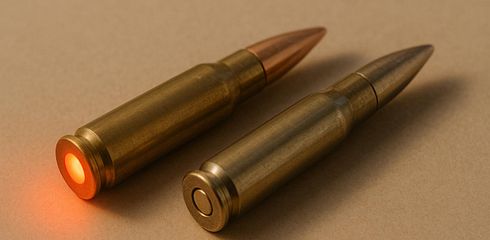
Tracer ammunition differs significantly in its construction from conventional ammunition. While normal projectiles are solid, tracer ammunition has a hollow base filled with a pyrotechnic mixture [1][4]. This mixture consists of a metallic fuel – usually magnesium – and an oxidizer that also determines the color of the glow [1][4].
Magnesium is the preferred fuel because it burns particularly brightly and ensures clear visibility [1]. The color of the tracer is influenced by the oxidizers used: Strontium compounds like strontium nitrate produce red light, while barium salts produce green light [1][4]. NATO forces predominantly use strontium-based mixtures for red traces, while Russian and Chinese ammunition often uses barium for green traces [1][4].
The ignition of the tracer occurs when fired by the burning propellant powder in the cartridge case [1][2]. Additionally, air resistance at speeds over 244 m/s contributes to ignition through the heat generated [3]. During flight, the pyrotechnic mass burns, creating the characteristic glow that allows the shooter to track the projectile's trajectory [1][2].
An example of the composition of such ammunition is the M62 tracer ammunition (7.62×51 mm NATO). It uses the mixture R 284, which consists of 55% strontium nitrate, 28% magnesium powder, and 17% polyvinyl chloride (PVC) [1]. The PVC serves a dual purpose: it cools the flame to ensure color consistency while also extending the burn duration [1][4]. However, this composition increases the fire risk, an aspect that will be examined in more detail later.
Common Uses of Tracer Ammunition
Tracer ammunition is primarily used in the military sector. Machine gunners use it to correct the trajectory of their projectiles in real-time without having to rely solely on optical aiming devices [1][2]. In ammunition belts, tracer ammunition is often loaded in a ratio of 1:4 – one tracer round follows four normal rounds [1][3].
Furthermore, it is used for target marking: squad leaders use tracer ammunition to designate targets for concentrated fire [1][3]. Some shooters also use it as a warning signal by placing tracer rounds at the end of the magazine to indicate that ammunition is running low [1][3]. In anti-aircraft guns, the tracer even has an additional function: it activates a self-destruct mechanism that prevents misfires from falling back to the ground [1]. These versatile properties make tracer ammunition an indispensable tool for precise ballistic corrections and tactical applications.
Why Tracer Ammunition Causes Fire Hazards
The extreme heat generated by tracer ammunition is the main reason it poses a high fire risk. During its flight, the pyrotechnic components burn at temperatures between 760 °C and over 1,650 °C. This heat is sufficient to ignite dry vegetation, grass, or other easily flammable materials – especially when the projectiles ricochet or strike near fuels [6][8].
“Tracer ammunition is primarily military projectiles. They leave the barrel already burning.” – Zach Ellinger, fire protection specialist, Bureau of Land Management [8]
Tracer ammunition ignites directly upon firing and remains active, allowing fires to start after just a few meters of flight [8]. Even after a flight distance of 800 to 900 meters, the burning components are hot enough to ignite their surroundings [3]. A single ricochet into dry grass, onto trees, or buildings can trigger a fire in seconds [6]. For example, in March 2016, a shooter in the Scrivner Road Conservation Area in Missouri caused a fire with tracer ammunition that destroyed about 6 hectares of grassland and forest. The firefighting efforts cost around $2,500, and strong winds reignited the fire the next day [6]. Such scenarios illustrate how dangerous the combination of tracer heat and unfavorable environmental conditions can be.
Environmental Conditions that Increase Fire Risk
Dryness and low humidity are among the critical factors that increase the risk. Even brief contact with the glowing components of the ammunition can ignite dry vegetation [7]. Particularly susceptible are so-called “fine fuels” such as dry grass, dead plant debris, and brush [7].
Strong winds significantly worsen the situation. They spread flames more quickly and can reignite smoldering embers that were thought to be extinguished [6][7]. An example of this occurred in May 2021 in Alaska when recreational shooting sparked a fire that spread across about 3.7 hectares of dry spring grasses [7].
Accident Causes from Tracer Use
In addition to environmental factors, errors in handling tracer ammunition play a central role. One of the most common causes of fires is ricocheting off hard surfaces. When tracer rounds hit rocks, metal signs, or steel targets, they are often deflected in unpredictable directions – frequently directly into flammable vegetation that is out of the shooter's line of sight [6][7]. Even the fragments of the rounds can reach temperatures between 650 °C and 760 °C upon impact, which is sufficient to ignite organic material [8].
The use of unsuitable targets, such as electronic waste or other objects on the ground, further increases the risk. In this case, the kinetic energy of the projectiles is converted into heat, causing hot sparks to fly in all directions [6][8][9]. These dangers highlight the importance of adhering to strict safety precautions.
Legal Situation of Tracer Ammunition in Germany
After explaining the dangers of tracer ammunition, it is important to consider the legal situation in Germany.
In Germany, tracer ammunition is strictly prohibited for private individuals. It falls under Annex 2, Part 1 of the Weapons Act (WaffG) [11]. This specific ammunition was originally developed for military purposes, such as for target correction without sights, for marking targets for comrades, or as an indication of low ammunition levels in machine gun belts [1].
As mentioned earlier, the heat-generating components pose a high fire risk [1]. Therefore, there is no tolerance in Germany for private possession or use. Anyone who illegally imports or sells tracer ammunition faces criminal consequences. Typically, penalties of up to five years of imprisonment are possible, and in particularly severe cases, even up to ten years [11]. These strict regulations reflect the significant dangers associated with this ammunition.
In cases of violations, authorities take strict action: weapons and ammunition are immediately confiscated, and proceedings to revoke the firearms ownership license are initiated. The National Weapons Register (NWR) documents the entire lifecycle of legal weapons and ammunition, facilitating the tracking of violations [12]. The following section will explore possible exceptions and alternative options.
Exceptions and Legal Alternatives
For private use, there are practically no exceptions. The Federal Administrative Office (BVA) can grant exceptions for prohibited items upon request from recognized shooting sports organizations, but these are limited to national or international competitions [10]. Therefore, such permits are not accessible to hobby shooters or hunters.
A legal alternative consists of signal weapons and their ammunition. In Germany, adults may use signal devices and associated ammunition without special permission, provided they bear the “PTB” test mark [11]. This signal ammunition can fulfill similar marking functions without carrying the high fire risks associated with tracer ammunition. To ensure that a specific ammunition is permitted, one should check for the PTB mark or the “F in a pentagon” mark before purchasing. Products without these markings are generally prohibited [11].
Safe Ammunition Options for Hunting and Shooting Sports
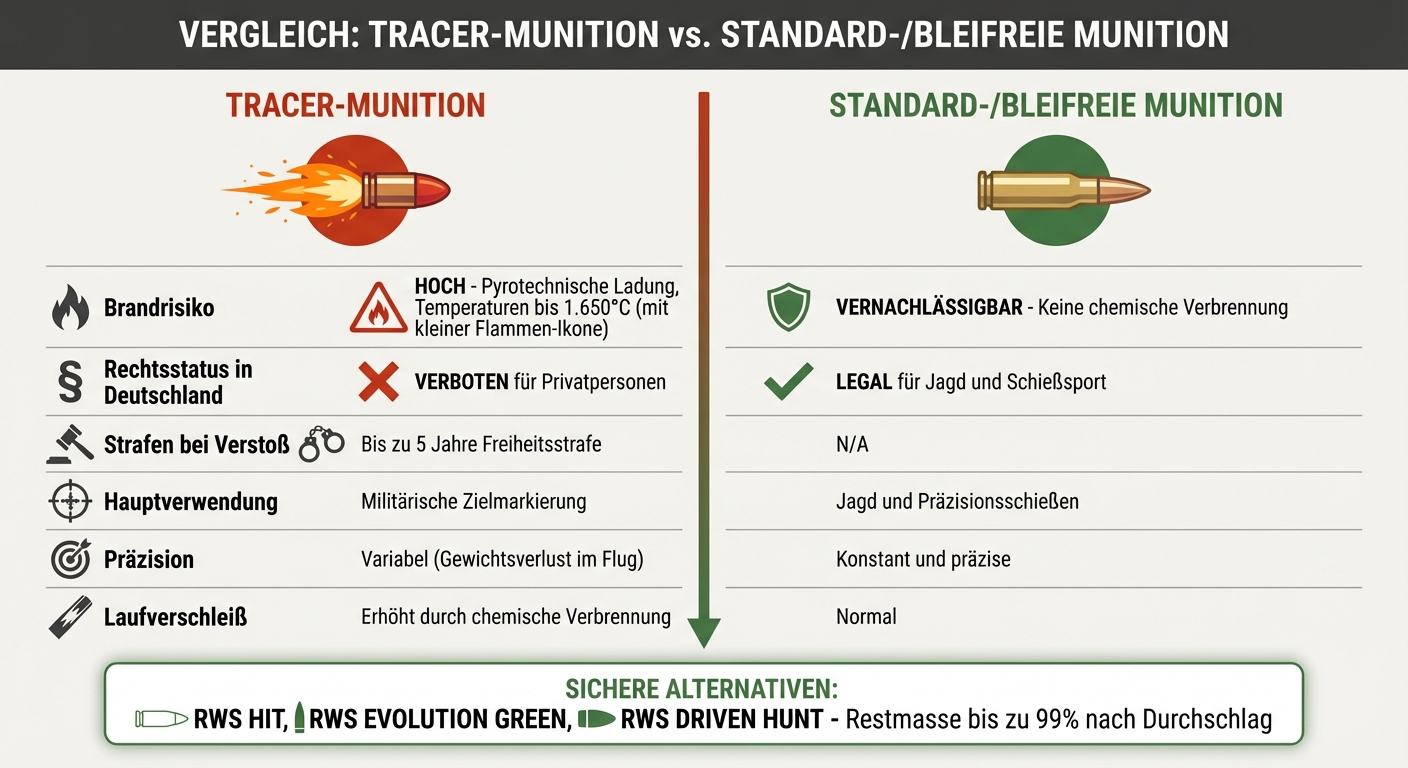
Tracer Ammunition vs. Standard Ammunition: Fire Risk, Legal Situation, and Safety Comparison
Since tracer ammunition is prohibited for private individuals, the question arises about safe and approved alternatives. Tracer ammunition not only poses a high fire risk but is also legally not permissible for civilian use. Instead, other types of ammunition provide a safe and legal solution for hunting and shooting sports. Particularly standard ammunition – whether lead-containing or lead-free – is widely used and considered fire-safe. Modern, lead-free full copper ammunition or copper alloy fulfill ecological requirements as well.
Some proven options include high-performance projectiles such as the RWS HIT (fragment-free deformation projectile made of copper), the RWS EVOLUTION GREEN (a tin-core jacketed bullet suitable for long distances), and the RWS DRIVEN HUNT (a deformation bullet made of copper for short-distance use). These types of ammunition retain up to 99% of their mass even after penetrating bones [14] and leave significantly fewer fragments than lead-containing projectiles [15][16].
“Effective hunting, lead-free shooting – one does not exclude the other.” – RWS Ammunition [14]
For a quick search for fire-safe options, Gunfinder offers a “Lead-Free” filter that allows you to find ammunition from brands like RWS, Barnes, Hornady, or LOS. However, note that full copper or brass projectiles may have a higher likelihood of energetic ricochets due to their harder material structure compared to soft lead [13].
Tracer vs. Non-Tracer Ammunition Comparison
A direct comparison shows why standard ammunition is a safe alternative to tracer ammunition:
| Feature | Tracer Ammunition | Standard/Lead-Free Ammunition |
|---|---|---|
| Fire Risk | High (pyrotechnic phosphorus) | Negligible (no chemical combustion) |
| Legal Status | Prohibited for private individuals | Legal for hunting and shooting sports |
| Main Use | Target marking in the military | Hunting and precision shooting |
| Precision | Variable (weight loss in flight) | Consistent and precise |
| Barrel Wear | Increased (due to chemical combustion) [5] | Normal |
Practical Safety Measures
In addition to the choice of ammunition, simple precautions play an important role. Even with safe ammunition, you should consider the environmental conditions. In extreme dryness, mechanical sparks – such as from projectiles hitting stones – can pose a minimal fire risk. Therefore, it is advisable not to shoot in particularly dry areas during prolonged heat.
Additionally, the search filter on Gunfinder helps find ammunition that optimally fits your weapon. For handguns with suppressors, “Short Rifle” versions are recommended, as they reduce muzzle flash [14].
Safe Handling and Storage – Guidelines
Proper storage of ammunition is not only legally required but also crucial to minimize fire hazards and other risks from improper handling. Careful storage significantly reduces the risk of accidents.
Proper Storage Methods
In Germany, legal requirements must be strictly adhered to when it comes to the storage of ammunition. Licensed ammunition must be kept in locked steel containers, while for unlicensed ammunition, at least a locked container is sufficient. Since July 6, 2017, anyone wishing to store weapons and ammunition together requires safety containers according to DIN/EN 1143-1 with resistance grade 0 or I. It is important that only the license holder has access and that the storage location is not publicly known to prevent misuse [17].
Fire Protection Measures
Regular checks of the ammunition are a must. Look for signs of corrosion or other damage, as such defects can lead to malfunctions or even fire hazards. Always store ammunition in a cool, dry place to ensure its stability and prevent corrosion. If you discover old or unknown ammunition whose condition is uncertain, do not touch it. Secure the area and ensure that children do not have access. In such cases, immediately inform the local police. In the case of a change of ownership, such as through inheritance, a safety container according to DIN/EN 1143-1 is required to meet legal requirements [17].
Conclusion: What You Need to Know About Tracer Ammunition
In Germany, tracer ammunition is strictly prohibited for private individuals, regulated by Annex 2 Part 1 of the Weapons Act [11]. Possession or illegal import can be punished with imprisonment of up to five years [11]. This regulation is sensible, as the pyrotechnic charge burns over long distances and poses a significant fire hazard [1].
For hunters and sport shooters, standard hunting ammunition or lead-free projectiles provide a safe alternative. They deliver the same precision but without the risk of fires [1]. Thanks to modern optics and scopes, visual tracking of projectiles is also easily possible without tracer ammunition [1]. This illustrates why the use of this ammunition in the private sector is unnecessary.
International incidents highlight the risks associated with tracer ammunition [1]. The legal requirements and potential dangers make it clear that responsible handling is essential: use only approved ammunition, rely on high-quality optics, and ensure safe storage. The risk can be effectively minimized with standard ammunition that does not contain pyrotechnic components.
FAQs
How do I recognize tracer ammunition?
Tracer ammunition is characterized by the glowing trail it leaves during flight. This trail is created by a pyrotechnic charge in the rear part of the projectile, which is ignited upon firing, allowing for a visible trajectory.
What should I do if I find tracer ammunition?
Never touch or remove tracer ammunition on your own. Immediately inform the police or the relevant authority and follow their instructions. This ammunition poses a significant danger as it can ignite fires or explode.
How can I shoot as fire-safe as possible in dry conditions?
To minimize the risk of fires when shooting in dry conditions, there are some important precautions you should observe:
- Place targets on earth or gravel: This reduces spark generation that could ignite fires.
- Do not use steel-core ammunition: This can generate sparks and is therefore particularly dangerous.
- Use established shooting ranges: They are specifically designed to minimize risks.
Additionally, you should always have water, a shovel, or a fire extinguisher readily available to respond quickly in case of an emergency. Also, avoid flammable targets, smoking, and parking on dry grass, as hot vehicle parts can easily ignite a fire.
In cases of very high fire risk, a protected shooting range is the safest choice, as it offers optimal safety precautions.