5 common disputes in partial deliveries

Partial deliveries can be practical but can also cause problems. Common conflicts arise from delayed or incomplete deliveries, incorrect quantities or quality, unclear return deadlines, transfer of risk, and legal uncertainties. Buyers should make clear agreements, check each delivery, and adhere to deadlines to secure claims. Sellers are obliged to comply with binding delivery times and offer transparent processes. Careful documentation helps avoid disputes and enforce rights.
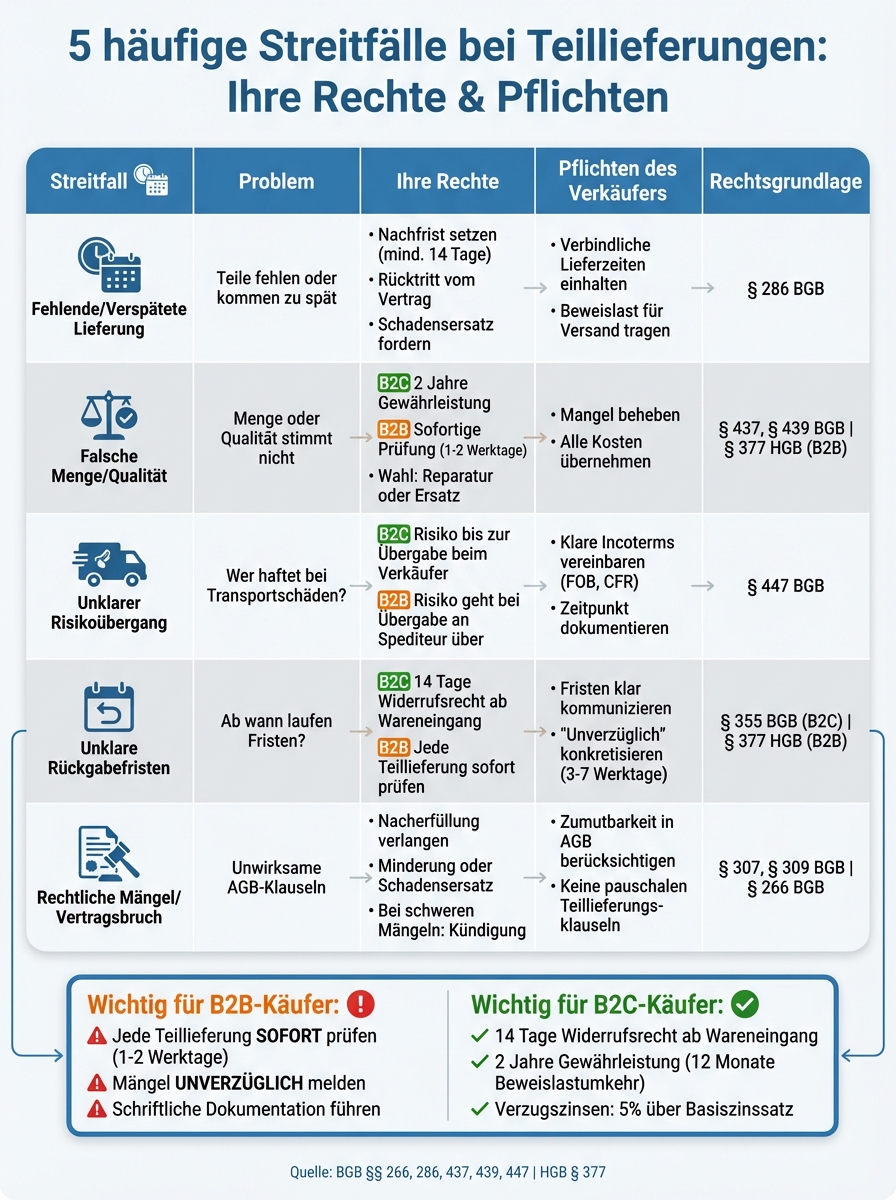
Rights and obligations in partial deliveries: Overview of the 5 most common disputes
AGB clause “Partial deliveries are permitted” is invalid! | In an interview with Dr. Carsten Föhlisch
sbb-itb-1cfd233
1. Missing or delayed partial deliveries
If parts of your order are missing or delivered late, it can quickly lead to frustration. Delayed follow-up deliveries often lead to conflicts. The reasons for this are varied: from bottlenecks and production problems to logistics errors, force majeure, or incorrect address information[4][1]. Such delays not only affect your planning but also your trust in the seller.
A major problem arises when sellers change delivery times retroactively – especially if you have already paid[2]. For buyers, this can mean real disadvantages: Imagine you are urgently waiting for ammunition for a hunting appointment or a scope for a tournament. A court ruling from 1989 shows that sellers cannot simply refer to manufacturer difficulties. The District Court of Tübingen ruled in favor of a couple who sued due to a three-week delay in the delivery of a fitted kitchen. They were awarded around €250 in damages[3]. Such delays thus have not only emotional but also legal consequences.
Legally, online sellers are required to specify and adhere to binding delivery times[2]. If a delivery is missing, you can withdraw from the contract or demand damages after a grace period of at least 14 days[2][3]. The burden of proof for the dispatch of the goods lies with the seller[4].
To better enforce your rights, you should agree on clear delivery dates. Instead of vague time indications like “approx. 2 weeks,” specific calendar weeks or fixed dates in the contract are advisable[3]. Modern tracking systems with real-time monitoring offer additional security: you can check the status of your order at any time, and the seller can prove where your goods are located[1]. Platforms like Gunfinder rely on transparent delivery processes that show you exactly when an item is available and shipped.
“Online sellers must specify the delivery time for each item – and then adhere to the promised date." – Verbraucherzentrale.de[2]
2. Incorrect quantity or quality in partial deliveries
If the delivered quantity or quality does not match your order, it can quickly lead to frustration. Especially with partial deliveries, there is a risk that different batches exhibit different quality standards or that individual deliveries are incomplete[1]. Imagine you order 500 rounds of ammunition, but only 300 pieces arrive in the first delivery – a classic case of potential annoyance.
In the B2B sector, you are required to check each partial delivery immediately. The deadlines are often very short: for standard goods, it is usually one to two business days, while for perishable goods, only a few hours are often available. If you miss this deadline, you lose your warranty rights[6].
A ruling by the Higher Regional Court of Bremen from March 2023 illustrates how strict these requirements are. A buyer complained about defective stainless steel components, but only after 15 days. Although the defects were undoubtedly present, he lost his rights because the defects could have been recognized earlier through the examination of the attached certificates[6].
“Where consecutive and partial deliveries occur, the buyer must, however, check each individual delivery separately." – Advant Beiten[6]
To avoid such conflicts, you should make clear written agreements that precisely specify quantity and quality details[7][8]. Each delivery should be documented: compare it with the delivery note and the order, check the quality as well as the technical documents. Deviations must be reported in writing and without delay.
This approach not only protects your claims but also reduces the risk of future disputes. Modern ERP systems can help automatically capture open quantities and document the status of partial deliveries[1].
3. Unclear transfer of risk in partial deliveries
The transfer of risk is the moment from which you, as the buyer, are responsible for damages or loss of the goods – even if they have not yet arrived at your location. Especially with partial deliveries, this point is often not clearly regulated, which can quickly lead to costly disputes. Many do not know: The risk often passes to you as soon as the goods are handed over to the carrier. This becomes particularly problematic because the regulations in the B2B and B2C sectors differ significantly.
In the B2B sector, § 447 BGB applies: As soon as the seller hands over the goods to the carrier, you bear the risk – even if the delivery is still on its way[11]. In contrast, for consumer purchases (B2C), you are better protected, as the risk only passes to you when the goods actually arrive at your location[11]. These differences often cause confusion in partial deliveries, especially when individual shipments are damaged during transport.
Another problem is the clear allocation of goods. The risk can only pass when it is clear which items specifically belong to your contract. This is determined, for example, by markings or shipping documents[9]. However, with partial deliveries from a large inventory, there is often a lack of precise documentation, which can lead to uncertainties.
To avoid disputes, you should use Incoterms such as FOB or CFR. These establish internationally recognized transfer points[11]. It is also important to document the time of the transfer of risk precisely – for example, “upon handover to the first carrier” or “upon arrival at the warehouse gate.” Each partial delivery should be timestamped. Also, check whether a transport insurance applies from that point[10]. This way, you can better protect yourself in case a shipment is damaged on its way to you.
4. Confusion about return deadlines in partial deliveries
Partial deliveries can quickly lead to uncertainties: When do return and complaint deadlines actually start? Do they begin with the first delivery, each individual one, or only with the last? Such ambiguities carry conflict potential, especially when multiple delivery dates are involved and deadlines can easily be overlooked. The regulations differ significantly between B2C and B2B.
In the B2C sector, the 14-day right of withdrawal and the two-year warranty period start from the time of receipt of the goods[2][8]. In the B2B sector, however, each partial delivery must be checked immediately, and defects must be reported without delay. Otherwise, the goods are considered accepted, and warranty claims are lost[8][13]. Many sellers also define specific reporting deadlines in their terms and conditions, for example, one week after receipt of the respective partial delivery[12].
To avoid misunderstandings, it should be clearly regulated in the purchase contract whether deadlines start from the first, each individual, or the last delivery. Especially in the B2B sector, it is advisable to replace the often vague term “without delay” with concrete time frames such as “3 to 7 business days”[8][12]. Digital tools or precise contractual agreements can help document delivery dates and deadlines seamlessly. Complaints should always be recorded in writing – by email or letter – to prove compliance with deadlines[12].
If partial deliveries arrive late, consumers often have the option to use the 14-day right of withdrawal. This is often quicker and more straightforward than setting a grace period.
5. Legal defects or breaches of contract in partial deliveries
In addition to logistical and quality issues, legal uncertainties can also lead to significant conflicts in partial deliveries.
A common reason for legal problems lies in unclear contractual regulations and ineffective terms and conditions clauses. Particularly problematic is the widely used wording “Partial deliveries and partial invoicing are permitted.” According to case law, this clause is invalid in general terms and conditions, as it unlawfully restricts the customer's right of retention and withdrawal[14]. If such a clause is used, costly warnings under § 4 No. 11 UWG are threatened[14]. For a partial delivery clause to be legally valid, it must necessarily consider the “reasonableness” for the customer[15].
According to § 266 BGB, in principle: Without a deviating agreement, the debtor has no claim to partial performance[15]. Therefore, partial deliveries should always be regulated individually in the purchase contract. It is important to make clear statements regarding type, quantity, quality, delivery intervals, and call-off modalities to avoid misunderstandings and disputes. Vague formulations quickly lead to conflicts over allegedly unfulfilled contractual obligations.
If breaches of contract occur, you have various rights available: You can demand subsequent performance, withdrawal, reduction, or damages. However, before withdrawing, it is necessary to set the seller a written grace period of at least 14 days[2]. Only in cases of serious breaches of duty or repeated defects can the entire framework contract be terminated.
To enforce your claims, thorough documentation is crucial. Keep records of complaints, grace periods, and all communication in writing, whether by email or letter. Especially in the B2B sector, caution is advised: According to § 377 HGB, you lose your warranty rights if you do not check partial deliveries immediately and report defects without delay. An out-of-court settlement is often more cost-effective and preserves the business relationship[5].
| Legal issue | Legal basis | Consequence |
|---|---|---|
| Invalid terms and conditions clause | § 307, § 309 BGB | Clause void; risk of warning |
| Restricted right of retention | § 273, § 320 BGB | Loss of leverage |
| Delayed partial delivery | § 286 BGB | Default; claim for damages |
| Missing B2B inspection | § 377 HGB | Loss of warranty rights |
These legal aspects illustrate how important transparent and precise contractual regulations are to avoid conflicts in partial deliveries.
Comparison table: Rights and obligations in partial deliveries
The following table provides an overview of the central rights and obligations in the most common conflicts related to partial deliveries:
| Dispute | Your rights | Seller's obligations | Legal basis |
|---|---|---|---|
| Missing quantity | Claim for delivery of missing parts; set deadline; withdrawal or reduction possible after deadline | Deliver missing goods; cover all costs for transport and labor | § 434, § 439 BGB [13] |
| Incorrect quality | Choice between repair or replacement delivery; damages if seller is at fault | Remedy defect or deliver defect-free goods; bear all material, labor, and transport costs | § 437, § 439 BGB [8] |
| Delayed delivery | Withdrawal from the contract; claim for damages due to delay (default damage) | Make up for delivery; pay default interest (5% or 9% above the base interest rate) | § 280, § 286 BGB [13] |
| Unclear transfer of risk | B2C: Claim for reimbursement or replacement in case of loss during transport. B2B: Limited rights if risk has passed to the carrier | B2C: Seller bears the risk until delivery to the consumer. B2B: Risk usually passes upon handover to the carrier | § 447 BGB [8] |
| Defect in B2B deliveries | Warranty rights exist if the defect is reported immediately after discovery | Remedy defect, provided the claim is not time-barred | § 377 HGB [6][13] |
Note for B2B transactions: It is important to check each partial delivery immediately. Noticeable defects must be reported without delay, usually within 1–2 business days, to secure warranty rights. A ruling shows that claims can expire if defects are reported late [6].
Burden of proof in consumer purchases: Since 2022, it applies: If defects occur within the first 12 months, it is presumed that they already existed at the time of delivery [16][18]. Warranty rights apply for two years (one year for used goods). Default interest for consumers is 5 percentage points above the base interest rate [13][16][17].
This table helps you understand your rights and effectively enforce claims.
Conclusion
Partial deliveries are not uncommon in trade but can bring five main problems: missing or delayed quantities, defective quality, unclear regulations on the transfer of risk, uncertainties regarding return deadlines, and contractual breaches. Well-crafted contracts and careful documentation are crucial to avoid conflicts.
To prevent disputes, you should make clear agreements when concluding contracts. This includes minimum quantities, tolerance ranges, and binding delivery dates. Also clarify who is responsible for additional costs such as transport and administration – usually, this responsibility lies with the supplier if the partial delivery occurs unexpectedly. Digital tools can help you keep track of open remaining quantities and deadlines.
Each delivery should be carefully checked, documented, and monitored. Deviations should be recorded immediately to secure your claims. While you have more time for consumer purchases, the rule still applies: The faster you react, the better.
For specific transactions, such as in the field of firearms and hunting accessories, Gunfinder offers practical security features. The purchase service and verified seller profiles create transparency and trust. This way, you can not only avoid financial losses but also potential reputational damage that could arise from disputes.
If delays occur, set written grace periods and communicate exclusively through traceable channels. With the right preparation and a thoughtful approach, you maintain control – and that is the key to avoiding conflicts in partial deliveries.
FAQs
How do I set a valid grace period for partial deliveries?
For a grace period to be legally effective, the original delivery date should be documented in writing in the contract. If delays occur, you can notify the seller with a reminder and set a reasonable grace period – usually between 7 and 14 days.
If the delivery is still missing after this period, you have various options:
- You can withdraw from the contract.
- Alternatively, you can demand damages.
If you are no longer interested in the goods, it is also possible to withdraw from the contract directly after the grace period expires.
Who is liable if a partial delivery is damaged during transport?
If a partial delivery is damaged during transport, the carrier is usually liable, if the damage was caused by them. The legal basis for this can be found in the provisions of §§ 425 ff. Commercial Code (HGB).
What documents should you secure for partial deliveries?
Be sure to carefully keep shipping receipts, delivery notes, and payment receipts for partial deliveries. These documents serve as proof of shipping, receipt of goods, and payments made – and can be extremely useful in case of discrepancies or disputes.