Why multi-axis designs carry more weight

In short: I usually carry more load with more axes because the weight is distributed better. This reduces the load per wheel, relieves the frame, and exerts less pressure on the ground per cm². With a 200 kg total load, this can make the difference between a smooth run and sinking or tipping in the forest.
If you want to know if a multi-axle cart is worth it, I look at these points:
- Load per wheel: More wheels = less kg per wheel
- Frame load: Shorter free sections = less deflection
- Ground pressure: More contact area = less sinking
- Stability: Longer support and often wider track = more stability in the terrain
- Limits: Bearings, tires, frame, welds, and brakes set the limit
- Disadvantage: More axes also bring more friction, more parts, and more maintenance
A simple example:
150 kg game + 30 kg equipment + 20 kg cart = 200 kg total load.
These 200 kg already feel full when stationary. In the terrain, bumps, downhill travel, and braking can push the load well over 100% of the stationary load.
For me, the core message is clear: Single-axle carts are often more manageable. Tandem or other multi-axle designs are often more stable and carry more on soft or uneven ground.
| Point | Single-axle | Multi-axle |
|---|---|---|
| Load per wheel | high | lower |
| Ground pressure | higher | lower |
| Tipping safety | lower | higher |
| Agility | higher | lower |
| Maintenance effort | small | higher |
If I often pull heavy loads over wet, soft, or uneven ground, a multi-axle design is usually the better choice. If it’s more about narrow paths and a lot of maneuvering, a single-axle cart often has the advantage.
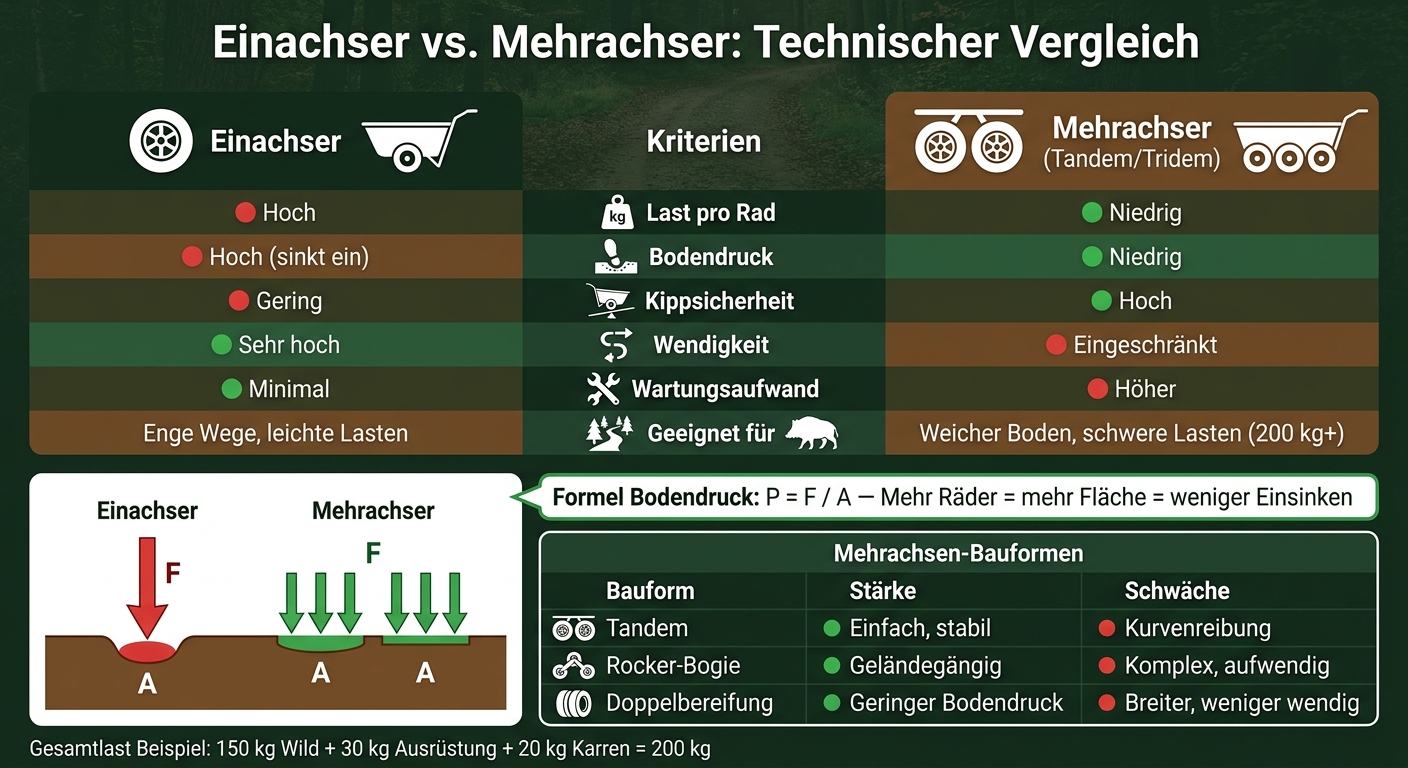
Single-axle vs. Multi-axle: Technical Comparison at a Glance
Load Fundamentals: Contact Points, Frame Load, and Ground Pressure
Now we are talking about the three forces that ultimately determine the load capacity in the cart frame: Normal force, lateral force, and bending moment. So simply put: downward pressure, lateral forces in the frame, and deflection. In a multi-axle design, these loads are distributed over more wheels and more contact points.
Single-axle vs. Multi-axle as Different Load Systems
The crux is how many load paths the frame can actually use to transfer the load to the ground. A single-axle cart has fewer support points. As a result, the frame itself must absorb more load [1].
A multi-axle system distributes the lateral forces across more connection points between the frame and axles. This has a direct effect: The free spans become shorter, and the bending moment decreases [3][5].
Why more wheels reduce ground pressure
Ground pressure follows a simple formula: P = F / A. So force divided by contact area. More wheels provide a larger contact area with the ground. This reduces the pressure per square centimeter [3][6].
This is not just noticeable on paper. Less pressure also means:
- less sinking
- fewer ruts
- lower rolling resistance
Why shorter spans reduce frame bending
Shorter free spans directly reduce deflection [4]. This is one of the major points of having a second axle: it shortens the unsupported sections of the frame. As a result, the bending moment and the risk of deformation under high load decrease measurably.
| Type of Load | Effect on Frame | Effect of Multi-Axle Design |
|---|---|---|
| Normal Force | Weight presses vertically downwards | Distributed across multiple wheels |
| Lateral Force | Tangential stress in the frame cross-section | Distributed across multiple support points |
| Bending Moment | Frame bends under load | Decreases due to shorter spans |
| Ground Pressure | Force on the ground | Reduced by larger total contact area |
sbb-itb-1cfd233
Why multi-axle designs carry more load in practice
Load distribution on wheels, bearings, and tires
In multi-axles, the weight is distributed across more wheels, bearings, and tires. This lowers the load per component. This is particularly helpful in practice: wheels and bearings are subjected to less stress, tires operate more relaxed, and the driving behavior remains calmer under load.
Especially on long forest roads with heavy loads, this makes a noticeable difference. Where a single-axle system is subjected to stronger localized loads, a tandem or tridem chassis distributes the forces better.
Longer contact area and wider track improve stability
Additionally, there is the geometry. A longer contact area and often a wider track provide more rollover safety on uneven ground, in ruts, and during lateral inclination.
This is one of the points that you not only see on paper but also notice directly while driving. When the ground is sloped, soft, or worn, a multi-axle vehicle usually stands more stable.
Rolling resistance: less sinking, but more friction
Less ground pressure usually also means: less sinking on soft ground. This is a clear advantage when the path gives way after rain or the forest floor is loose.
However, the downside is also obvious. Each additional axle brings more bearings, more friction, and more maintenance effort. So, more load capacity does not come for free.
| Criterion | Single axle | Multi-axle (Tandem/Tridem) |
|---|---|---|
| Load per wheel | High | Low [7] |
| Stability | Low | High [1][7] |
| Ground pressure | High (sinks slightly) | Low [3] |
| Maintenance effort | Minimal | Higher (more bearings/tires) [8] |
| Manoeuvrability | Very good | Limited [7] |
How much load is safely carried in the end still depends on the specific design.
Multi-axle configurations and their technical limits
Tandem, Rocker-Bogie and dual wheel comparison
More axles can carry more load. The reason is quite simple: weight, ground pressure, and deformation distribute differently depending on the design. Once it is clear how the load is distributed, the main question is how well the system performs off-road. Which multi-axle design ultimately carries more depends mainly on the ground, stability, and construction effort.
Tandem axles are the simplest solution in this field. Here, two axles sit close together and share the load. This works well for heavy loads on relatively flat or soft ground. The construction is simple, and the stability is high. However, there is a catch in tight curves: resistance increases because the tires are pulled sideways over the ground [11].
Rocker-Bogie systems take a different approach. Here, a pivot beam connects two axles, allowing the wheels to maintain ground contact even over larger obstacles. This keeps the load distributed across the wheels [10]. This is strong in rough terrain, but it requires more effort to build than a simple tandem.
Dual tires increase the contact area per axle. This further reduces ground pressure. This is especially helpful on wet or very soft ground. The downside is obvious: more width and thus less maneuverability on narrow paths.
| Design | Strength | Weakness |
|---|---|---|
| Tandem | Simple construction, high stability | More resistance in curves |
| Rocker-Bogie | Constant ground contact, load distribution over obstacles | Complex mechanics, more construction effort |
| Dual tires | Lower ground pressure | More width, less maneuverable |
The design determines what the system can deliver in operation. However, the upper limit is always set by the part that gives way first.
The weakest component sets the limit
The best geometry is only useful if all components can also bear the load. More axles do not automatically mean more reserve. The load capacity ends where the weakest component lies: at the frame, at the seam, at the bearing, at the bolt, or at the tire [11].
Additionally, there is a point that often matters more in practice than the bare number on paper: dynamical loads. Impacts from unevenness, braking processes, or cornering can clearly exceed the static load [9]. For this reason, components should always be designed with a safety buffer.
Center of gravity, load distribution, and braking on a slope
The load should be low and as much as possible between the axles. If the center of gravity is too far forward or backward, individual axles will be overloaded. Then not only does the axle work harder, but the frame can also be subjected to greater bending stress [9].
On a slope, this becomes even more critical. When braking, the weight shifts forward. The front axles then carry more load, while the rear ones are relieved and may lose braking effectiveness [10]. The higher the load, the more important a proper brake design becomes [2][9].
Thus, it is not only the number of axles that counts. Equally important is how the components are designed for this purpose.
When multi-axle designs make sense: Advantages and disadvantages at a glance
Advantages and disadvantages in direct comparison
After load distribution, bending, and ground pressure, the practical question arises: When is a multi-axle vehicle worth it in everyday life?
The short answer is simple. More axles carry more load, but they also bring more weight, more maintenance, and less maneuverability. Whether it is worth it depends not only on theory but also on the on-site application.
This is no longer just about mechanics, but about the decision in operation:
| Criterion | Single axle | Tandem axle | Rocker-Bogie |
|---|---|---|---|
| Load capacity | Limited | High | Very high |
| Off-road capability | Good on solid paths | Stable on uneven ground | Excellent with obstacles |
| Maneuverability | Very high | Restricted | Low, large turning radius |
| Maintenance effort | Minimal | Medium | High (many moving parts) |
A single axle is often strong when space is tight: narrow paths, sharp turns, a lot of manual maneuvering. Tandem axles show their strengths when the load and ground become harder. A Rocker-Bogie takes it a step further, but it comes at a cost in maintenance and turning radius.
When switching to multi-axles makes sense
The single axle is suitable as long as you are moving light to medium loads, traveling on narrow forest paths, and often maneuvering the vehicle by hand. In such a scenario, it is often the obvious solution: little technology, little ballast, little effort.
However, as soon as you regularly pull heavy loads over soft or uneven ground, the equation changes. Then switching to a multi-axle setup can make sense, as it relieves the load, frame, and ground more effectively.
Conclusion: The three mechanical reasons for more load capacity
From the technical advantages arises the practical question: Does the system fit your terrain and your load?
Multi-axle designs carry more for three clear reasons. First, the load is distributed over more wheels. This means that each individual tire and bearing has to take on less. Second, the bending moments in the frame decrease because the contact points come closer together and the free span becomes shorter. Third, ground pressure decreases because a larger contact area distributes the weight over a greater area.
The point is: More axles alone do not solve the problem. The frame, bearings, tires, and brakes must also be able to support the whole.
FAQs
How many axles are sensible?
The appropriate number of axles primarily depends on the total weight of the load, the legal requirements, and the desired driving behavior.
For simple transport tasks, two axles are often sufficient. Tridem systems with three axles distribute the load more evenly and provide a smoother driving experience. For extreme loads of over 65,000 pounds, four to thirteen or more axles are necessary to better distribute weight, tire pressure, and wear.
When does a multi-axle really pay off?
A multi-axle is especially worthwhile if you want to safely move heavy loads regularly or need more stability and comfort over long distances.
The reason is simple: The extra axle distributes the weight over more wheels. This reduces ground pressure, relieves tires and suspension, and makes the driving behavior feel calmer. Additionally, there is better load distribution and more braking power.
Which parts limit the load capacity?
The load capacity is primarily limited by the frame, suspension, and the axle construction. These components bear the weight up to the axles and must safely withstand bending, torsional, and shear stresses.
Additionally, the design of the trailer itself plays a role. Length, axle spacing, and the position of the load directly affect how evenly the weight is distributed across the axles. If the load is positioned unfavorably, one axle can be subjected to more stress than the other – even if the total weight is still within the permissible range.