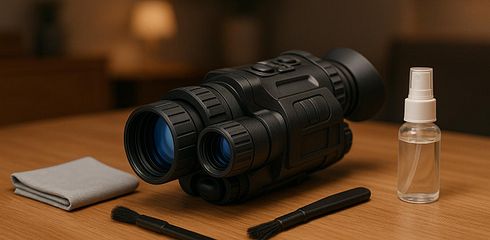
Night vision accessories against dust: 8 products

Dust on the lens costs image quality – often after just a few minutes outside. I would therefore break the topic down into two simple steps: first cover and store, then clean.
When I want to protect night vision or thermal optics against dust, I look at 8 types of accessories:
- Objective lens caps for the front lens
- Eyepiece caps for the rear glass
- Dustproof hard cases for storage and transport
- Padded bags/pouches for the way to the hunting ground
- Complete cleaning kits as a starter solution
- Blowers for loose dust without contact
- Microfiber cloths for fine residues
- Lens pens and fine brushes for edges, seams, and light stains
What I pay attention to:
- Fit above all else: For caps, the outer diameter of the tube counts, not the lens size.
- IP67 does not protect the outer lens: Even with a sealed housing, the glass remains exposed to dust, pollen, and sand.
- Order of cleaning: air first, then cloth or lens pen. This reduces the risk of fine scratches.
- Bag or case? For everyday use, a padded bag is often enough. For storage, shipping, or long trips, I prefer a hard case.
- Price range: simple caps start at around €9.95, flip covers often range from €24.90 to €59.00, bags about €39.00 to €54.00, cleaning kits from €10.00 to €100.00.
In short: If I want to keep my optics clean, I need more than just a cloth. I need a small system of caps, transport protection, and gentle cleaning.

Protect & clean night vision optics: The 3-step system
How to Clean Your Night Vision
Quick Comparison
| Accessory | What I use it for | Important point when buying | Price according to article |
|---|---|---|---|
| Objective lens cap | Protection of the front lens | matching outer diameter, quiet opening | approx. €9.95 to €59.00 |
| Eyepiece cap | Protection of the eyepiece | secure fit, free operation | approx. €9.95 to €59.00 |
| Hard case | Storage, long transports | seal, dust protection, padding | not uniformly specified |
| Padded bag | Hunting ground, vehicle, short transport | padding, compartments, water-repellent cover | approx. €39.00 to €54.00 |
| Cleaning kit | Starter package for care | use only lens-safe products | approx. €10.00 to €100.00 |
| Blower | loose dust without contact | use first, before each wipe | not specified |
| Microfiber cloth | fine residual dirt | store separately clean | partly included |
| Lens pen/brush | edges, joints, light stains | use only clean and without pressure | not specified |
So I summarize the article like this: Protection comes before cleaning, and the right order saves glass and nerves.
1. Objective lens caps and protective covers
The front lens is the most sensitive part of a scope. That’s exactly why a protective cap is worth it: it keeps dust, dirt, and small deposits away before they even land on the lens.
When choosing, the main factor is the intended use. Slip-on caps are simple, light, and quick to mount. Flip covers are often more convenient in the field because they can be opened with one hand. That’s a clear plus when stalking. In hunting, silent opening also counts. At the shooting range, lightning-fast access is usually less important.
Important: The decisive factor is the outer diameter of the tube, not the diameter of the lens. This is often confused. Universal clamp flip covers like the model from Präzise Jagen fit tubes up to Ø 61 mm [4].
Model-specific caps usually fit more precisely and seal better. Universal caps can work well, but only if the clamp fit is tight enough. Otherwise, the cap sits loose or slips at the wrong moment. A safety strap is also useful because it prevents loss when opening.
| Product | Material | Diameter | Price (approx.) | Feature |
|---|---|---|---|---|
| Zeiss Conquest HD replacement cap | Polymer | 42 mm | 9.95 € | With safety strap [5] |
| Hawke flip cover | Aluminum | 42 mm | 24.90–31.90 € | One-hand operation [6] |
| Präzise Jagen flip cover | Robust plastic | up to Ø 61 mm | 28.90 € | Silent, tool-free [4] |
| Tenebraex UAC030-FCR | Robust polymer | 30 mm | 59.00 € | One-hand operation [7] |
The next section is about protection for the eyepiece and what helps against fogging.
2. Eyepiece Caps
If the front lens is protected, the eyepiece shouldn’t be left open. For storage and transport, a secure cover is needed. Eyepiece caps keep dust, dirt, and scratches off the eyepiece.
Aluminum flip covers like those from Hawke often last longer than simple caps made of plastic or rubber. Plus, they have a lockable flap position[6][8]. This is practical for everyday use: flip open, lock in place, keep going. Models with 360° rotation and one-handed operation can also be used quickly without getting in the way when looking through the glass. But fit is crucial. Caps with internal threads or clamping rings must fit the eyepiece exactly.
In use, two things matter most: secure fit and quick access. Differences usually come down to fit, material, and operation.
| Product | Material | Feature | Price (approx.) |
|---|---|---|---|
| Hawke Flip-Cover (42 mm) | Aluminum | Lockable flap position[6][8] | €24.90 |
| Präzise Jagen Flip-Cover (>62 mm) | Durable plastic | Tool-free clamping ring[2] | €28.90 |
| Tenebraex Eyepiece Cap | Robust polymer | Specialized fit[7] | €59.00 |
| Zeiss Conquest HD Eyepiece Cap | Rubber/plastic | Safety strap[5] | €9.95 |
Measure the outer diameter of the eyepiece tube before buying. Even a small millimeter error can cause the cap to wobble or not fit at all. The next section covers dustproof hard cases for storage and transport.
3. Dustproof Hard Cases
For storage and transport, a cap alone isn’t enough. A dustproof hard case protects the entire device. Caps mainly protect the optics, the case secures the whole setup.
The most important point is the seal. A good case should achieve IP67 – meaning fully dustproof and able to withstand short submersion [3][9].
Inside, padding and adjustable dividers matter. This way, the interior can be adapted to different devices [1]. For example, a Hikmicro Habrok Pro HX60LS clearly needs more space than a Steiner Nighthunter C35. You can also see this in the dimensions and the respective space requirements [1].
| Device Type | Example Model | Dimensions (L × W × H) | Recommended Space Requirement |
|---|---|---|---|
| Digital Monocular / Clip-on | Hikmicro Cheetah C32F-N | 18.3 × 7.0 × 8.7 cm | Small/Medium |
| Thermal Clip-on | Steiner Nighthunter C35 | 17.7 × 9.5 × 6.2 cm | Small/Medium |
| Thermal Imaging Binocular | Hikmicro Habrok Pro HX60LS | 23.15 × 15.28 × 8.2 cm | Large/Deep |
| Two-Device Setup | Clip-on + Monocular | variable | approx. 26 × 19 × 16 cm |
In everyday use, it’s not just about the case itself. Dust protection also matters when opening it. Keep the caps on the device while stored in the case. This keeps the optics protected even if you open the case outdoors in the field [2][6].
Compartments in the lid for batteries, cables, and cleaning supplies are also practical. Everything is quickly at hand. If it’s mainly about mobile transport, padded bags are often the lighter option.
4. Padded Transport Bags and Pouches
Padded tech bags are lighter and more compact than hard cases. For a quick trip to the field, they’re often the more practical choice. Unlike hard cases, it’s mainly about speed and mobility here.
What matters? A water-repellent outer shell and adjustable dividers. This keeps dust mostly out, and the device doesn’t rub against accessories. Mesh pockets or flat front pockets are also handy for power banks and cables. The simple advantage: you have to open the main compartment with the optics less often.
The Jagdspezi tech bag measures approx. 26 × 19 × 16 cm, also fits a Hikmicro Habrok, and costs depending on the offer €39.00–54.00 [1].
| Feature | Padded Transport Bag | Dustproof Hard Case |
|---|---|---|
| Main Use | Active field use, vehicle transport | Long-term storage, maximum protection |
| Organization | Adjustable dividers, outer pockets | Foam insert, limited compartments |
| Protection Level | Shock-absorbing, water-repellent | Dustproof, pressure-resistant |
The same applies to a carrying bag: cleaning remains an issue. The next section is about complete sets for optics care.
sbb-itb-1cfd233
5. Complete Optics Cleaning Sets
A cleaning set combines cloth, liquid, and brush in one package. This is practical if you don’t want to gather everything separately.
There are clear price differences: high-quality sets like the OTIS IWCK cost around €100.00, compact sets like the Schmeisser WeaponCare are about €41.99 [11]. Used sets are often available for €10.00 to €30.00 [10].
But beware: not every set is intended only for optics. Some also contain products for metal parts. Such products don’t belong on coated lenses [10]. This is where mistakes happen quickly – something is included in the set, so it gets used even though it’s not meant for glass surfaces.
In the field, one thing counts above all: touch the lens as little as possible directly. For loose dust, a blower is often enough on the go. If dust particles are only loosely resting, use air first and not immediately a cloth. This reduces the risk of fine scratches.
| Set | Price Range | Special Feature |
|---|---|---|
| OTIS IWCK | approx. €100.00 [10] | Comprehensive, incl. housing care |
| Schmeisser WeaponCare | €41.99 [11] | Compact, for optics and mechanics |
| Used Military Set | €10.00–30.00 [10] | Affordable basic equipment |
6. Blower for Loose Dust
After the cleaning set, the blower is the first step against loose dust. It removes loose particles without contact and thus protects the coating. Cleaning accessories are part of the basic equipment of every night vision device.
Here’s how to proceed: Remove the protective cap, hold the blower a little distance in front of the optic, and blow the dust away with a few short bursts. If residues are still visible afterward, next use the microfiber cloth. It’s best to store the blower in a tech pouch with compartments or outer pockets – together with spare batteries and cables.
7. Microfiber Cloths for Lenses
After the blower, there’s often still a fine layer of dirt left. That’s exactly what microfiber cloths are for. They pick up these small particles from coated lenses without damaging the coating.
The Hikmicro Cheetah C32F-N comes with a special cleaning cloth included [3].
A small but useful trick: place the cloth as a protective layer over the optic. This prevents contact scratches if cables or a power bank are in the same compartment. It’s simple but can save you a lot of trouble.
The cloth itself is also important. If it lies loose among other accessories, it quickly collects dust and small particles. And those are exactly what you don’t want on the lens later. So keep it separately in a clean, closed compartment.
For dust in edges and fine deposits, the next section covers lens pens and fine brushes.
8. Lens Pens and Fine Cleaning Brushes
After blower and cloth, small particles often remain in edges, rims, and seams. This is where fine cleaning comes in: the brush loosens dust in hard-to-reach places, the lens pen removes light spots on the glass surface. This complements the rough dust removal effectively.
A fine brush is suitable for dust on edges, mounting rims, and in seams. One thing is especially important: use only clean brushes. Even a small particle can be a problem with high-quality night vision devices. So use the brush only with clean tools and without pressure.
The lens pen is meant for light dirt on the glass surface. It’s best to keep the lens pen and brush dry and separate. This way both stay clean and are ready as a fixed part of your compact cleaning kit when the next use comes up.
How to Compare the Options
After looking at the individual products, the direct comparison often makes things clear. This is where you see which combo suits you best in everyday life.
For protective caps, three things are especially important: quiet access, secure fit, and one-handed operation. Flip covers usually perform best here. They open quickly and generally stay more firmly on the device. Slip caps often cost less but usually don’t fit quite as securely.
For transport, it depends heavily on the use: everyday, travel, or storage. For hunting everyday use and transport in a vehicle, a padded transport bag is usually enough. A hard case is worth it especially if you ship the optic, travel long distances, or want maximum pressure protection.
| Feature | Hard Case | Padded Transport Bag |
|---|---|---|
| Protection | Maximum (shock- and pressure-resistant) | Medium to high (padded) |
| Weight | Heavier and bulkier | Light and compact |
| Flexibility | Low | High |
| Ideal for | Shipping, long trips | Everyday hunting, vehicle transport |
There’s no clear winner when it comes to cleaning either. A complete set is convenient, especially if you’re just starting out and want everything in one place. If you already know exactly what you need, individual tools are often the better choice. Then you proceed step by step: first blower or brush, then lens pen or microfiber cloth.
| Feature | Complete cleaning set | Individual tools |
|---|---|---|
| Scope | Everything included | Targeted for dust or fingerprints |
| Portability | Requires its own space | Fits in jacket or outer pocket |
| Use | Care after use | Quick fixes on the go |
| Recommendation | Good for beginners | Useful for high-end night vision optics |
The basic idea remains the same throughout the article: first protect, then transport, then clean. Which mix fits best depends on your usage profile.
Conclusion
Dust, dirt, and scratches often quickly degrade the image quality of night vision devices. That’s why protection isn’t an extra, but the foundation.
In the end, your usage profile matters most. Dust protection works best as a coordinated system: caps, case, and cleaning accessories work together. The best mix remains cover, transport protected, and clean gently. Those who consistently protect and keep their optics clean ensure they last longer.
You can find suitable accessories on Gunfinder.
FAQs
What cap size do I need?
The right cap size depends on the outer diameter of your lens or the clamping sleeve used. Measure this value precisely before purchase, as these protective caps are designed for fixed dimensions.
Always follow the manufacturer’s specifications. The cap must fit exactly to reliably keep out dust and moisture.
Is a bag enough instead of a case?
Yes, usually a padded bag is sufficient if it protects your night vision device well from shocks. It’s also important that the bag is sturdy and water-resistant.
Models with flexible dividers are especially practical. This way you can neatly store accessories like batteries or cleaning equipment and have everything quickly at hand.
How do I clean the lens properly?
First remove loose dust with compressed air or a blower brush. This prevents small particles from scratching the surface when wiping.
For cleaning, use only soft, lint-free microfiber cloths for optical devices. Avoid abrasive materials like paper towels or clothing. They can quickly damage the surface.
Always apply the lens cleaning solution to the cloth, never directly on the lens. Then wipe gently in circular motions. Finally, dry with a clean microfiber cloth to avoid streaks.