Pyrotechnic mixtures in incendiary ammunition
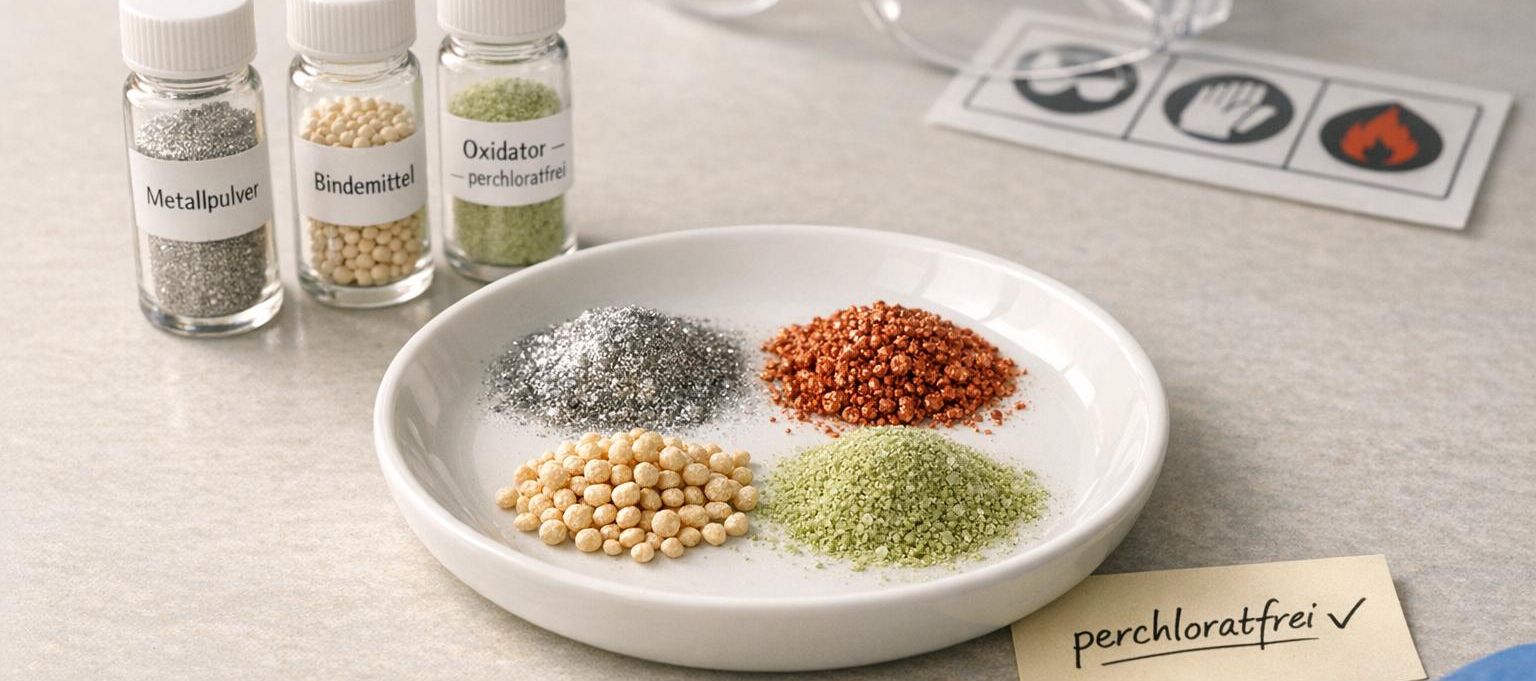
Pyrotechnic mixtures play a central role in incendiary ammunition. They generate extreme heat, light, and energy through chemical reactions, which are utilized in military and technical applications. Typical components include oxidizers such as barium nitrate or perchlorates, combined with fuels like magnesium, aluminum, or magnalium. However, these substances are often highly reactive and must be handled under strict safety precautions. At the same time, there are efforts to develop more environmentally friendly alternatives that avoid toxic heavy metals or perchlorates.
Key Points:
- Heat and Light Yield: Temperatures exceeding 3,000 °C and intense flashes of light.
- Safety Risks: High sensitivity to friction, impact, and electrostatic discharge.
- Environmental Aspects: New formulations increasingly avoid heavy metals and perchlorates.
- Modern Alternatives: Periodate-based mixtures and HTPB binders offer better storage stability and less environmental impact.
The development of these mixtures demonstrates progress in performance and safety while simultaneously reducing environmental burdens.
1. IM-11 (Barium Nitrate and Magnesium-Aluminum Alloy)
IM-11 combines barium nitrate as an oxidizer with a magnesium-aluminum alloy (magnalium) as a fuel. This mixture generates extreme temperatures and intense light effects, making it particularly suitable for incendiary ammunition. The light intensity ($I$) strongly depends on the combustion temperature ($T$), according to the relationship $I \propto T^4$[4]. The following sections will examine the thermal, optical, and safety properties of this composition in more detail.
Heat and Light Yield
The combustion of IM-11 releases high-temperature solid and liquid particles such as barium oxide (BaO) and magnesium oxide (MgO), which emit intense radiation as gray bodies. Interestingly, the addition of 5% BaO increases the light intensity by 25.9%, while 5% MgO results in a 17.8% increase[4]. Magnesium is preferred because it is cost-effective and can be easily ignited. Aluminum, on the other hand, contributes to the effectiveness of the mixture through its high heat output[4].
Stability and Handling Safety
IM-11 is extremely sensitive to friction, impact, heat, and electrostatic discharge. Already 100 to 200 g can transition from a deflagration (combustion) to a detonation (explosion). Therefore, storage in hermetically sealed containers at low humidity is essential. Additionally, consistent measures to protect against electrostatic discharge (ESD) are required[5]. The presence of magnesium increases sensitivity to moisture, which can lead to degradation or even unintended ignition[5].
Toxicity and Environmental Impact
Since barium is a toxic heavy metal, it oxidizes during combustion to a stable, inert oxide. However, unburned residues of the mixture must not enter the environment and must be disposed of properly[1][6].
sbb-itb-1cfd233
2. IM-28 (Potassium Perchlorate, Barium Nitrate, and Magnalium)
After analyzing IM-11, we now take a look at IM-28, which is specifically used in armor-piercing applications.
IM-28 is a pyrotechnic mixture used in .50 caliber incendiary projectiles. Upon impact, it exerts its effect by generating armor-piercing effects. The mixture of potassium perchlorate and barium nitrate as oxidizers, along with magnalium as a metallic fuel, creates a flash upon striking armored targets. This flash ignites volatile fuel vapors and simultaneously marks the impact point [7].
Heat and Light Yield
The mixture is ignited immediately by compression between the copper shell and steel core [7]. Potassium perchlorate provides a high amount of oxygen and offers better thermal stability compared to chlorates [8][5]. Magnalium combines the heat release of aluminum with the rapid ignition capability of magnesium. Additionally, the oxide layer of magnalium provides better corrosion protection than pure magnesium [8].
Stability and Handling Safety
As with IM-11, strict safety measures are also required for IM-28. Although the mixture is more stable than chlorate-based alternatives, it remains sensitive to electrostatic discharge, friction, and impact. The fine metal particles in the mixture are hard enough to cause friction ignitions, and their high conductivity increases susceptibility to static charge compared to other pyrotechnic mixtures [9].
To minimize risks, only non-sparking tools made of wood, aluminum, brass, or lead should be used – steel is off-limits [9]. Machines must be grounded, and it is recommended to wear conductive shoes as well as cotton clothing [9].
Toxicity and Environmental Impact
The annual production of IM-28-based ammunition exposes both personnel and the environment to significant amounts of perchlorate and barium nitrate [7]. Potassium perchlorate is subject to strict environmental regulations as it is difficult to degrade in the environment and poses potential health risks.
In June 2019, the Combat Capabilities Development Command – Armaments Center (CCDC AC) and the Naval Surface Warfare Center (NSWC) successfully presented a perchlorate-free substitute based on sodium metaperiodate at the Lake City Army Ammunition Plant (LCAAP) [7]. Dr. Jared Moretti from U.S. Army RDECOM-ARDEC explained:
"The new technology consists of a replacement nose-fitted incendiary composition based on sodium metaperiodate (SMP), magnesium-aluminum alloy, and calcium stearate... these do not contain perchlorate or heavy metals." [7]
3. Periodate-based Mixtures (NaIO₄ with Magnalium)
Periodate-based mixtures of sodium periodate (NaIO₄) and magnalium produce intense heat and light development and are commonly used in incendiary ammunition.
Applications in incendiary ammunition
Sodium periodate is an extremely reactive oxidizing agent (GHS H271) that significantly accelerates the combustion of other substances [10]. In combination with magnalium, it creates a so-called "pyrolant" – a mixture specifically designed for maximum heat generation [1]. Magnalium burns at extremely high temperatures of several thousand degrees Celsius, releasing enormous amounts of light and heat energy [1]. The rapid and violent reaction between the oxidizing agent and the finely dispersed metal alloy makes this combination particularly powerful [1, 16].
Heat and light yield
Sodium periodate begins to decompose at around 300 °C, releasing sodium oxide and iodine. At the same time, magnalium produces intense "white" light effects and temperatures exceeding 1,500 °C [1][10]. Thanks to this relatively high decomposition temperature, the mixture remains stable during storage but unleashes an explosive reaction upon ignition.
Toxicity and environmental impact
Sodium periodate is highly toxic to aquatic organisms (GHS H410) and can damage skin and internal organs with prolonged exposure [10]. With a water solubility of 91 g/l at 20 °C, it poses a significant risk of environmental contamination [10]. At temperatures above 300 °C, especially in humid environments, iodine or hydrogen iodide may be released [10].
Stability and Handling Safety
Although sodium periodate itself is not flammable, it acts as a strong oxidizer [10]. It is crucial to keep it away from combustible materials to minimize the risk of unwanted reactions [10]. Handling this mixture requires strict safety measures, such as wearing protective clothing and avoiding contact with organic or easily flammable substances [10]. In comparison to perchlorate-based mixtures, however, this combination has advantages as it is free of heavy metals and thus less burdensome for the environment.
4. RU2560386C1 Composition (Barium Nitrate, Al-Mg Alloy, TNT and PETN)
The RU2560386C1 composition consists of 50–80 % PETN (TEN), 7–21 % barium nitrate, 11–25 % aluminum-magnesium alloy, and 2–4 % TNT. Notably, up to 84 % of the total mass is made up of recycled explosives, providing an environmentally friendly solution for the disposal of surplus military explosives [11]. This mixture exemplifies the approach of sustainably reusing military explosives. The following explains how this specific composition is used in incendiary ammunition.
Applications in Incendiary Ammunition
Although PETN is a secondary explosive, it burns layer by layer without a detonator and releases enormous amounts of thermal energy [11]. This property makes the mixture ideal for incendiary ammunition, as it effectively ignites both the main charge of the ammunition and combustible materials in the target area [11]. The aluminum-magnesium alloy prevents the formation of a heat-resistant Al₂O₃ layer that would occur with pure aluminum and could slow down the combustion process. Magnesium ensures a high and stable combustion temperature [11].
Stability and Handling Safety
In addition to functionality, stability is also crucial. Despite the use of explosives, the mixture is designed to be safely used in industrial processing. TNT acts as a plasticizing binder, allowing for the extrusion of long charges that can subsequently be automatically cut [11]. The optimal ratio of TNT to PETN is (0.04–0.05):1 [11]. The aluminum-magnesium alloy is chemically more stable than pure magnesium, as the alloyed magnesium does not react with atmospheric oxygen [11][12]. Furthermore, the ratio of nitrate oxidizer to metallic fuel has been doubled compared to previous standards, increasing sensitivity to thermal impulses and ensuring stable high-temperature combustion [11][12].
Toxicity and Environmental Aspects of the Oxidizer
Barium nitrate decomposes during combustion primarily into barium oxide (BaO) [4]. Although it is used as a more environmentally friendly alternative to perchlorate oxidizers, the search for even more environmentally friendly options remains an active area of research [4]. The high ignition temperature of barium nitrate also contributes to the handling safety of the mixture [4].
Heat and Light Yield
The combination of PETN as a high-energy base and the aluminum-magnesium alloy as fuel generates extremely high temperatures and intense light effects. The high combustion heat of aluminum and the stable combustion temperature of magnesium make this mixture particularly effective for generating fire centers in the target area [11]. These properties are decisive for the performance of the RU2560386C1 composition [11].
5. Thermite Mixtures (Aluminum with Iron Oxide)
Thermite reactions release an impressive amount of heat, making them an important component in incendiary ammunition. The classic mixture of aluminum and iron(III) oxide (Fe₂O₃) is based on an exothermic redox reaction. In this process, aluminum reduces the iron oxide to molten iron, producing aluminum oxide. This reaction reaches temperatures of about 2,400 °C and releases around 850 kJ/mol [13][14]. A major advantage of this mixture is that it does not require external oxygen and thus functions independently of the environment – whether underwater or in sand [13][14]. The following sections will explore the applications, safety aspects, and energetic properties of these mixtures in more detail.
Applications in Incendiary Ammunition
Thermite exerts its destructive effect by generating white-hot, liquid metal. This metal can melt through materials and ignite surrounding objects [13]. As early as the 1940s, the Swiss Army, in collaboration with the Swiss Aluminum Industry Corporation (A.I.A.G.), developed special aluminothermic processes to deliberately render weapon systems inoperable [13][14]. Hans Goldschmidt, the inventor of the thermite process, aptly described the efficiency of the reaction:
“Temperatures of more than 3,000 degrees take operations of 2 to 3 minutes”
After these impressive applications, it is worth looking at the stability and safety in handling thermite.
Stability and Handling Safety
Thermite mixtures are considered safe as they are not explosive and ignition only occurs at very high temperatures – above 1,500 °C – [13][14]. This high activation energy makes them relatively unproblematic when handled correctly. However, to avoid risks such as unintentional ignitions, thermite mixtures and their igniters, such as magnesium rods or barium peroxide starters, should always be stored separately [13][14].
Moisture poses a particular danger. It can release hydrogen, which in turn can lead to steam explosions and explosive gas mixtures [13][14]. Therefore, it is crucial to store thermite under absolutely dry conditions.
Heat and Light Yield
Although thermite reaches temperatures of about 2,400 °C, it has only about 25% of the specific enthalpy of wood [13][14]. This is because the iron oxide, as an oxidizing agent, does not provide any energy itself. It must first be decomposed to release iron and oxygen ions [13]. Nevertheless, Wilhelm Ostwald once described thermite as:
“a blacksmith's fire and a blast furnace in your pocket"
For technical applications, magnetite (Fe₃O₄) is often used instead of hematite (Fe₂O₃). Magnetite provides a less vigorous reaction, which reduces the risk of the mixture boiling over [13].
6. Metal Hydride Mixtures (Titanium or Zirconium Hydride with Perchlorate)
Metal hydrides such as zirconium hydride or titanium subhydride, combined with perchlorates, are among the most powerful pyrotechnic formulations. They significantly outperform classic mixtures like black powder and release their energy in fractions of a millisecond [2]. A well-known example is the Zirconium/Potassium Perchlorate Mixture (ZPP), which is used by NASA as a laser-guided detonator for solid rockets – thanks to its reliability [1][3]. Zirconium hydride decomposes at temperatures above 500 °C, releasing hydrogen and zirconium, which increases its effectiveness in incendiary devices [16]. The combination of highly reactive substances is crucial here. The following sections will examine the energy generation, stability, and applications of these mixtures in more detail.
Heat and Light Yield
These mixtures reach temperatures of several thousand degrees Celsius and produce an intense, silver-white light [1][17]. By combining metal hydrides and perchlorates, the thermal conductivity within the mixture is improved, which increases the speed of the chain reaction [2]. The radiation is so intense that it can cause severe burns even without direct flame contact [18].
Stability and Handling Safety
Perchlorates are thermally more stable and safer to handle than the previously used chlorates [1][3]. Nevertheless, metal hydride mixtures remain sensitive to heat, friction, impact, and electrostatic discharge [1]. Mixing in a mortar should be absolutely avoided, as this can trigger an immediate explosion [18]. Moisture poses another risk, as it can lead to self-ignition in alkaline environments [18]. The addition of boric acid can stabilize the pH and minimize the risk of moisture-induced self-ignition [18].
Applications in Incendiary Ammunition
Zirconium hydride is a strong reducing agent and is often used in military incendiary and illumination compositions [16]. With a density of 5.61 g/cm³, it is nearly insoluble in water [16]. Titanium subhydride/potassium perchlorate mixtures are used in nuclear weapon components and aviation due to their specific burning properties and sensitivity to electrostatic discharge [15]. These mixtures are compatible with modern ignition methods such as laser pulse ignition [15][1].
Toxicity and Environmental Impact
Oxidizing agents such as barium nitrate are toxic – therefore, wearing respiratory masks is essential [18]. Metal fires involving titanium, magnesium, or zirconium must not be extinguished with water, CO₂, or standard powder extinguishers, as this can lead to further explosions [18]. Instead, a large bucket of dry sand should always be on hand to smother such fires [18]. Even though heavy metals are often chemically inert after complete oxidation, unburned pyrotechnic mixtures can burden the environment [3][17].
7. Aluminum-Sulfur Mixtures
Aluminum-sulfur mixtures are among the classic pyrotechnic formulations, where sulfur is used as an oxidizing agent. Interestingly, this role reverses when sulfur is combined with highly electropositive metals such as aluminum, as aluminum has a significantly lower electronegativity [1][3]. Such mixtures are often used in so-called flash mixtures, which are frequently supplemented with barium nitrate to produce booster charges for small bombs [1][3]. The main features and challenges of these mixtures are explained in more detail below.
Heat and Light Yield
The combustion of aluminum generates temperatures of several thousand degrees Celsius and an intense, silver light. In comparison, carbon or iron-based mixtures only produce golden sparks at about 1,500 °C [1][19]. The addition of sulfur has a dual effect: it lowers the ignition temperature and accelerates the reaction [2][19]. The mixture is particularly effective with the use of ultra-fine ground aluminum powder, known as “Dark Pyro Aluminum.” This powder offers a large surface area that further enhances energy release [2][19].
Stability and Handling Safety
Aluminum-sulfur mixtures are extremely sensitive to heat, friction, impact, and electrostatic discharge. Sulfur additionally increases sensitivity to mechanical stress [1][3][2][19]. Moisture poses a particular risk as it can cause clumping and unpredictable reaction changes [2]. For this reason, it is important not to grind or mix these mixtures. They should be stored in stable, non-reactive containers, with mandatory anti-static grounding [1][2].
Applications in pyrotechnics
Flash mixtures consisting of barium nitrate, sulfur, and ultra-fine ground aluminum are often used as explosive charges in military small bombs [1][19]. They are more powerful than classic black powder (consisting of 75% potassium nitrate, 10% sulfur, and 15% charcoal), but do not reach the strength of perchlorate-based variants. Additionally, they are more sensitive to moisture [1][19][2].
Toxicity and environmental impacts
While the aluminum oxide produced during combustion is considered stable, the sulfur content can release sulfur dioxide. Barium nitrate-containing mixtures require special caution, as unburned residues can pose risks to both the environment and health. These residues must therefore be disposed of as hazardous waste and handled by qualified personnel [1][3].
8. Perchlorate-free alternatives (with HTPB binder)
Perchlorate-free HTPB mixtures offer an environmentally friendly option that is gaining importance due to increasing environmental and health concerns. Conventional ammonium perchlorate-based mixtures release over 15% toxic HCl during combustion and contribute to groundwater contamination through perchlorate ions [20][21]. These new formulations represent an advancement that takes environmental and health aspects more into account.
Toxicity of the oxidizer and environmental impact
Compared to traditional AP/HTPB mixtures, TNEF/HTPB formulations perform significantly better. By using chlorine-free oxidizers such as 2,2,2-Trinitroethylformiate (TNEF) in combination with HTPB, the release of hydrochloric acid is practically completely avoided. While AP/HTPB mixtures release over 15% HCl, this value remains at 0% for TNEF/HTPB [20]. Mohamed Abd-Elghany from Ludwig Maximilian University of Munich describes the advantages as follows:
“The results proved that the new oxidizer and its HTPB-based formulation have chlorine-free decomposition products and exhibit higher performance characteristics than traditional propellants."
Additionally, the targeted use of binders in nitrate-based, perchlorate-free mixtures slows down the aging process [21].
Stability and handling safety
TNEF/HTPB mixtures are characterized by higher thermal stability. Their activation energy ranges between 119 and 126 kJ/mol, while AP/HTPB compositions only reach 88 to 97 kJ/mol. The controlled decomposition begins at about 169.5 °C [20]. HTPB impresses as a binder due to its low viscosity, high compatibility with various oxidizers, and its mechanical properties, which ensure the structural stability of the formulations. However, metallic fuels such as magnesium often require special surface treatments to ensure long-term stability [22].
Heat and light yield
TNEF/HTPB mixtures offer specific impulses of 231.5 s and burning rates of 2.86 mm/s, surpassing AP/HTPB (228.2 s and 2.70 mm/s). The characteristic exhaust velocity is 1.425 m/s compared to 1.404 m/s for AP/HTPB. Furthermore, the reaction zone shows more than double the thickness and a more intense brightness [20].
Applications in incendiary ammunition
Perchlorate-free HTPB mixtures are particularly suitable for military applications where reduced toxicity and lower environmental impact are crucial. They produce sound pressure levels of 170 to 185 dB at distances of 1.2 to 2.0 m, making them ideal for flash-bang effects. Furthermore, the addition of manganese dioxide (MnO₂) can increase the burn rate in nitrate-based mixtures by a factor of 14.6, although this also increases the ignition sensitivity [22]. These formulations expand the possibilities of modern incendiary ammunition and demonstrate progress in the development of sustainable pyrotechnic solutions.
9. Binders in pyrotechnic mixtures (TNT, Viton, HTPB)
Binders are just as important in pyrotechnic mixtures as the active components. They stabilize the composition, increase safety, and can additionally provide energy. Some even act as oxidizers [5].
Stability and safety in handling and storage
TNT (2,4,6-Trinitrotoluene) is a binder that is particularly insensitive. Due to its melt-castability, it is excellent for formulations used in decoys. Dr. Ernst-Christian Koch from the NATO Munitions Safety Information Analysis Center emphasizes:
"2,4,6-Trinitrotoluene is an insensitive, high-energy fuel and binder for melt-castable decoy formulations" [25].
In contrast, Viton-based MTV compositions (Magnesium/Teflon/Viton) are significantly more sensitive. They react strongly to static charge, requiring special precautions during manufacturing and processing. These mixtures, which contain between 25% and 90% magnesium, are classified as explosives of category 1.1.2 due to their high reactivity [23][24].
HTPB (Hydroxyl-terminated polybutadiene) is another binder that provides mechanical stability while also delivering energy. It allows for controlled casting and curing, making handling safer compared to pressed powders [1][3]. These properties complement the reactive components and contribute to the optimal performance of incendiary ammunition.
Heat and Light Yield
The choice of binder also affects flame emissivity. The combustion of Viton produces soot, resulting in a high emissivity of the flame – an advantage for efficient infrared radiation [23][24].
Nitrocellulose is used as an energetic binder to produce low-smoke mixtures. Depending on the degree of nitration, it can even burn without additional oxidizers. Synthetic polymer binders like PMMA ensure reliable ignition and stable combustion, even at extremely low temperatures down to –196 °C [5][6].
Applications in Incendiary Ammunition
The specific properties of the binders directly affect the performance in incendiary ammunition. TNT-based formulations are often used for spectrally adapted decoys, as they provide high performance at low sensitivity. The melt-casting process also improves the physical stability of the ammunition compared to pressed powders [25].
Viton-based MTV compositions have been a staple of military infrared countermeasures since the 1950s. Their combustion produces 30 to 65% magnesium fluoride as well as soot and gaseous magnesium [23][24].
HTPB-based binders are versatile and are used in many pyrotechnic and incendiary ammunition formulations. They provide mechanical stability and allow for controlled burn rates [1][3].
Comparison of Common Oxidizers
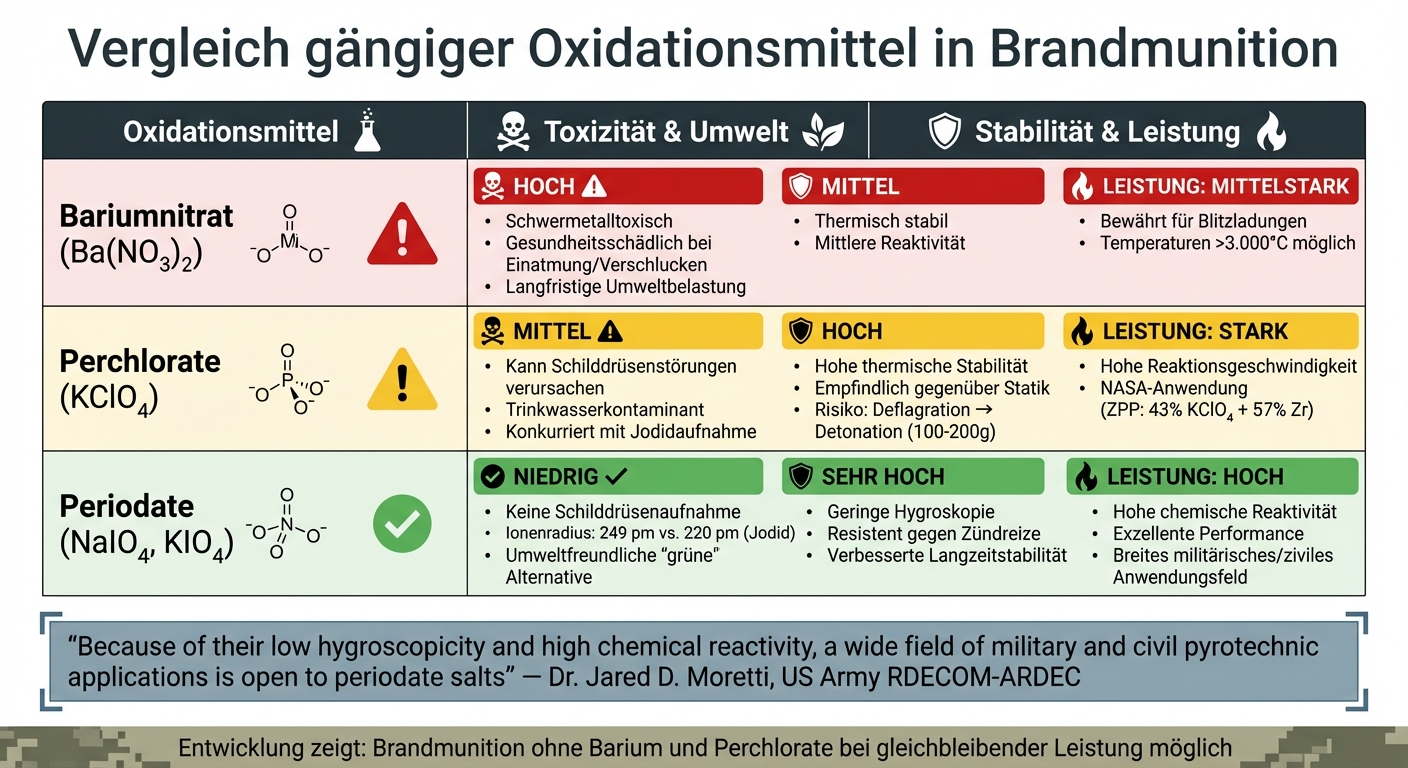
Comparison of oxidizers in pyrotechnic incendiary mixtures: Toxicity, stability, and performance
The choice of oxidizer significantly influences the performance, safety, shelf life, and environmental compatibility of incendiary ammunition. Barium nitrate, perchlorates, and periodates exhibit very different properties.
Barium nitrate is often used in flash and incendiary charges and is considered a reliable oxidizing agent. However, it is criticized for its heavy metal toxicity. It is harmful to health when inhaled or swallowed and leaves long-term environmental burdens [26][27].
Perchlorates, such as potassium perchlorate (KClO₄), are thermally stable and characterized by a high reaction rate. An example of their application is the zirconium/potassium perchlorate initiator (ZPP), which is used by NASA in solid rocket motors. This mixture consists of 43% KClO₄ and 57% Zr [1][6]. However, perchlorates pose risks: they can react sensitively to static discharge and can transition from deflagration to detonation even with small amounts (100 to 200 g). Additionally, they can impair thyroid function as drinking water contaminants because they compete with iodide uptake [26].
Periodates (NaIO₄, KIO₄) offer a promising alternative as they are less hygroscopic and more environmentally friendly. They have been specifically developed as "green" alternatives. Dr. Jared D. Moretti from the US Army RDECOM-ARDEC emphasizes:
"Because of their low hygroscopicity and high chemical reactivity, a wide field of military and civil pyrotechnic applications is open to periodate salts"
Another advantage of periodates is their larger ionic radius (249 pm compared to 220 pm for iodide ions), which means they do not compete with thyroid uptake [26][27]. Their low hygroscopicity also ensures improved long-term stability while providing high pyrotechnic performance [26].
| Oxidizing Agent | Toxicity | Stability | Performance |
|---|---|---|---|
| Barium nitrate | High (heavy metal) [26][27] | Thermally stable, medium reactivity | Moderate, proven for flash charges |
| Perchlorate (KClO₄) | Medium (can cause thyroid disorders) [26] | High thermal stability, sensitive to static | Strong, with high reaction speed |
| Periodate (NaIO₄, KIO₄) | Low (no thyroid uptake) [26][27] | Low hygroscopicity, resistant to ignition stimuli | High chemical reactivity, excellent performance |
The development of periodate-based formulations shows that it is possible to produce propellant without the use of barium and perchlorates – while maintaining consistent performance and better environmental compatibility [26][27]. These advancements highlight how modern pyrotechnic mixtures increasingly focus on safety and environmental aspects.
Conclusion
Pyrotechnic mixtures in propellant have evolved significantly. Classic formulations with perchlorates are increasingly being replaced by more environmentally friendly, perchlorate-free alternatives. These new mixtures offer the same performance but cause significantly less environmental damage.
The choice of mixture strongly depends on the intended use. Thermite mixtures generate temperatures of several thousand degrees Celsius and are ideal for maximum incendiary effect. Metal hydride-based formulations are characterized by high thermal stability, while aluminum-sulfur mixtures represent a cost-effective option for less demanding applications.
A central point remains safety in handling these substances. Pyrotechnic mixtures are extremely sensitive to heat, friction, impact, and electrostatic discharges. Even small amounts can trigger a detonation [1][6]. Although their explosive power is lower than that of high explosives, they still pose significant risks. Safety aspects therefore remain at the forefront of all developments.
A notable example of technical advancements is the WP-1424 project by QinetiQ from July 2010, led by Dr. Trevor Griffiths. It demonstrated that perchlorate-free formulations with a magnesium-aluminum alloy, sodium nitrate, and 4% calcium resin are comparable in terms of flash size and duration to conventional potassium perchlorate mixtures [21]. This proves that performance and environmental awareness can be compatible.
In summary, the future of incendiary ammunition lies in the balance between military effectiveness and ecological responsibility. Modern binders such as HTPB improve mechanical stability and provide additional energy [1]. At the same time, research on nitrogen-rich compounds and heavy metal-free oxidizers lays the foundation for the next generation of pyrotechnic mixtures.
FAQs
What is the most important difference between nitrate, perchlorate, and periodate mixtures?
The central difference lies in the oxidizers used: Nitrate mixtures contain nitrate, Perchlorate mixtures use perchlorate, and Periodate mixtures are based on periodate. These variations affect their chemical properties and reaction behaviors.
Why are many incendiary mixtures so ESD-sensitive, and what can be done about it?
Many incendiary mixtures are sensitive to electrostatic discharge (ESD) because they contain pyrotechnic substances that can be ignited by such a discharge. To minimize the risk of unintended ignition, special protective measures are required. These include grounding, wearing anti-static clothing, and using ESD-safe packaging. These precautions significantly reduce the risk of ignition.
What environmentally friendly alternatives offer similar performance to classic perchlorate formulations?
Chlorine-free pyrotechnic mixtures provide a more environmentally friendly alternative to classic perchlorate formulations. They are less harmful to the environment and significantly reduce the formation of hazardous by-products.