Lost hunting equipment: Rights and claims with airlines

If your hunting equipment is lost, damaged, or delayed while flying, you have clear rights. According to the Montreal Convention, which applies in 131 countries, airlines are liable for damage, loss, and delays of luggage – but only up to a limit of 1,519 Special Drawing Rights (approximately €1,868).
The most important points at a glance:
- Report immediately at the airport: Fill out a Property Irregularity Report (PIR) before leaving the security area.
- Deadlines: Report damages within 7 days, delayed luggage within 21 days in writing.
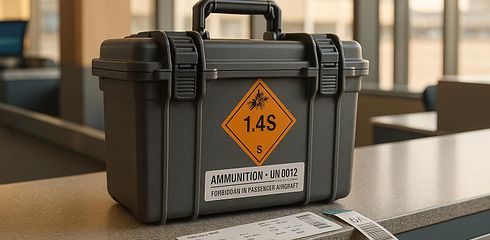
- Packaging: Unload firearms, transport in sturdy hard cases with locks. Ammunition separately and max. 5 kg per person.
- Increased liability: For valuable equipment, you can declare the value at check-in for a fee.
- Secure evidence: Photograph damages, document purchase receipts and replacement costs.
With good preparation and a quick response, you can assert your claims and minimize the damage.
Regulations for Transporting Hunting Equipment on the Plane
Properly Packing Hunting Equipment for the Flight
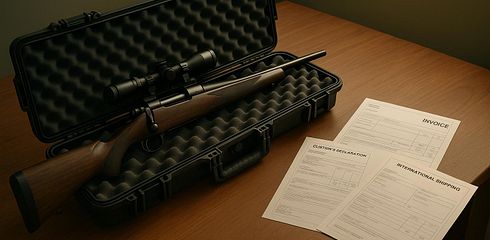
Strict regulations apply when transporting hunting equipment such as firearms and ammunition. Your firearm must be unloaded and stored in a sturdy, locked hard case with a robust lock [4]. Important: Firearms and ammunition must never be transported in the same container. The ammunition belongs in a separate, sturdy container [4].
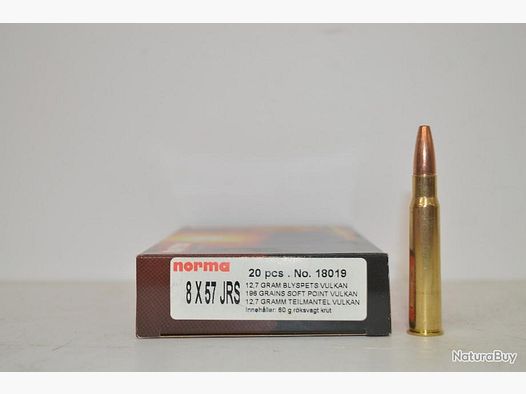
Per person, you may carry a maximum of 5 kg of ammunition (gross weight) for sporting purposes. This amount cannot be combined with that of other travelers [4]. Explosive or flammable projectiles are strictly prohibited [4]. Black powder and harpoon guns (in the cabin) are also on the list of prohibited items.
Policies of Airlines and Security Authorities
Airlines have their own regulations governing the transport of hunting equipment, usually based on the IATA Dangerous Goods Regulations (DGR) [4]. For example, Mavi Gök Airlines (MGA) requires that the transport of firearms and ammunition be registered and approved in writing at least 48 hours before departure [4]. Other airlines may have different deadlines or charge additional fees.
You can find the exact regulations on your airline's website under categories such as “Baggage”, “Special Baggage”, “Sporting Equipment”, or “Prohibited and Restricted Items” [3][4][5]. It is advisable to contact your airline or travel agency early to obtain all necessary approvals. Generally, the transport of firearms and ammunition incurs additional costs, which vary depending on the airline [4].
Early planning helps you avoid inconveniences. In the next section, you will learn what to do if your equipment is lost or damaged.
sbb-itb-1cfd233
What to do if hunting equipment is lost or damaged?
Report at the Airport
If your hunting equipment does not appear on the baggage carousel or is delivered damaged, you must act quickly. Go directly to the lost and found counter before leaving the airport. This is usually located in the security or baggage claim area [2]. There you will receive a Property Irregularity Report (PIR) – an essential document for any claims. Write down the reference number or take a photo of it, as it is important for tracking and possible compensation. Also, keep your flight ticket, boarding pass, and baggage registration number (the check-in sticker) handy.
If the switch is closed, you can also report the incident via the airline's website or app. Pay attention to the deadlines: Damages must be reported in writing within 7 days. For delayed baggage, you have 21 days from delivery to make claims. After this period, the baggage is considered officially lost [2]. Document the incident and all damages as quickly as possible to avoid problems later with the claims process.
“The airlines are the sole contractual partners of the passengers... Passengers should also contact them if their suitcase did not arrive at the destination with them." – Sabine Herling, Head of Association Communication, ADV [2]
Document evidence for the claims process
Secure evidence by photographing all damages to your hunting equipment or transport case directly at the airport [2]. Even better is if you took photos before departure showing the original condition and value of your equipment [2]. Also, keep all original receipts for replacement purchases and create a detailed inventory list of the contents of the case, ideally with proof of purchase.
An additional tip: Use GPS trackers like Apple AirTags or Samsung SmartTags to independently check the location of your hunting cases [2]. This can be extremely helpful in the search for lost baggage.
Liability of Airlines and Compensation Limits
Explanation of Compensation Limits
As already mentioned, improper packaging and missed reporting deadlines can lead to airlines denying their liability. The well-known limit of 1,519 Special Drawing Rights (SDR) – which corresponds to approximately €1,868 – applies per passenger, not per piece of luggage[1][7]. This means that you can claim a maximum of around €1,868 for your entire hunting equipment, regardless of whether it was packed in one or multiple pieces of luggage. If you are traveling with a hunting partner and the equipment is checked in under both names, you can claim up to €3,736 together[8]. Within this limit, the airline is liable without you having to prove any fault[6].
For valuable hunting equipment that exceeds this limit, it is advisable to make a so-called “Special Declaration of Interest” at check-in. This allows you to increase the liability limit for an additional fee[7].
Exclusions and Limitations
However, there are cases in which airlines deny their liability. The most common reason is improper packaging: If your equipment is not properly packed, the airline assumes no responsibility[1]. The same applies to already damaged items, such as a defective gun case[1].
In addition, many airlines exclude certain items such as scopes, electronics, or cameras from liability unless they have been explicitly declared as valuable. This regulation primarily applies to domestic flights. For international flights, however, airlines also assume responsibility for such items without a value declaration[9].
“If a checked baggage item was already damaged or an item checked as baggage was not properly packed, airlines are not liable. In practice, this sometimes occurs with checked sports luggage.” – Europakonsument.at[1]
It is important to be aware of these limitations, as they can vary by airline.
Differences in Airline Policies
The exact liability limits and reporting deadlines often differ from airline to airline. To avoid unpleasant surprises, you should carefully review the General Terms and Conditions of Carriage (ABB) of your airline before booking. This way, you are better prepared and can minimize potential risks.
Claiming Compensation
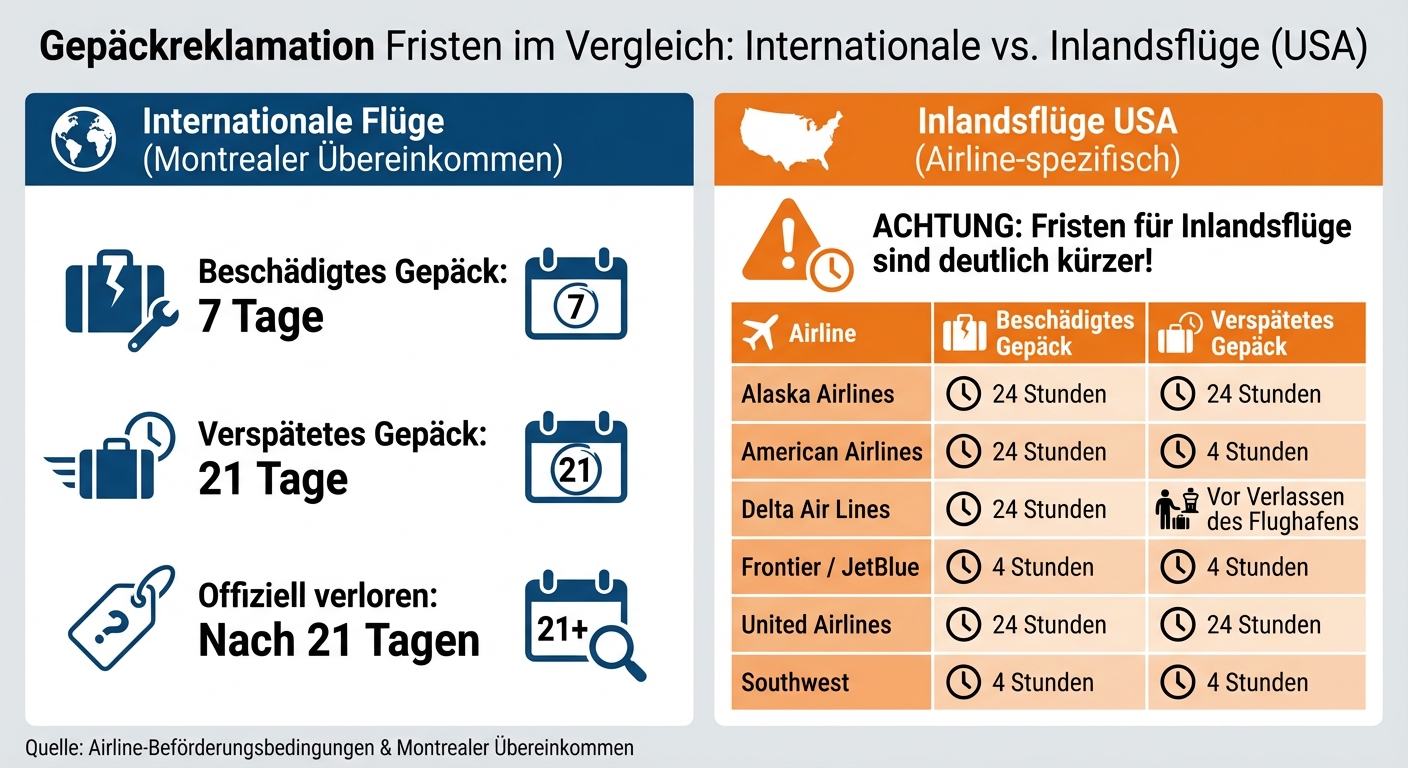
Deadlines for baggage claims with airlines: International vs. Domestic Flights USA
Deadlines and Processes for Filing a Claim
After you have reported the incident and taken the initial steps, it is now time to apply for compensation. Important: Filling out the PIR (Property Irregularity Report) at the airport is not sufficient on its own. Additionally, you must submit a written compensation claim[2].
For international flights, the deadlines of the Montreal Convention apply: You have 7 days to report damaged luggage and 21 days to claim delayed luggage[10][12]. If your luggage is not found within 21 days, it is officially considered lost[2].
For domestic flights, the deadlines are often significantly shorter and vary by airline:
| Airline | Deadline for damaged luggage | Deadline for delayed luggage |
|---|---|---|
| Alaska Airlines | 24 hours | 24 hours |
| American Airlines | 24 hours | 4 hours |
| Delta Air Lines | 24 hours | Before leaving the airport |
| Frontier / JetBlue | 4 hours | 4 hours |
| United Airlines | 24 hours | 24 hours |
| Southwest | 4 hours | 4 hours |
„Passengers do have recourse - airlines must pay up to liability limits and reimburse expenses." – Sara Rathner, travel expert[11]
Required Documents
For your claim, you will need some documents: the PIR with reference number, baggage tags, boarding passes, photos of the damaged items and the suitcase, as well as purchase receipts. Additionally, you should create a detailed list of all lost or damaged items, including brand names, purchase date, and estimated value[10][11][12].
If you had to purchase replacement items during the baggage delay, keep all receipts safe. These expenses can be reimbursed by the airline as long as they are considered reasonable[10][11].
Tracking Your Application
The processing of a compensation claim usually takes between 4 weeks and 3 months[11]. If you do not receive feedback after 4 to 6 weeks, it is advisable to inquire. Always provide the PIR reference number[10][2]. Note: Your contact is exclusively the airline – not the airport or a ground service provider[2].
If the airline remains inactive, you can seek support from passenger rights portals or consumer centers. They can help you enforce your claims[2]. If your luggage is officially considered lost or arrives significantly late (e.g., after 12 to 15 hours), you are also entitled to a refund of the baggage fees[10][9].
Special regulations apply to weapons and ammunition. You will learn more about this in the next section.
Lost or Damaged Weapons: Special Regulations
Liability Restrictions for Weapons
Weapons are among the most sensitive items that can be transported while traveling and are therefore subject to strict regulations. Firearms, such as pistols, rifles, or shotguns, as well as air, spring, and CO2 guns, are strictly prohibited in carry-on luggage[13]. Weapon parts are also not allowed in the cabin – with the exception of scopes[13]. Furthermore, the transport of ammunition and explosives is prohibited in both carry-on and checked baggage according to the EU security regulation (Regulation 2015/1998)[13].
A common problem when traveling by plane with firearms is the limited liability of airlines. According to the terms of carriage, many airlines exclude liability for valuable or sensitive items in checked baggage[2]. Since firearms must be transported in checked baggage, this creates a liability gap – especially with expensive hunting rifles. The maximum compensation amount is approximately 1,865 EUR (1,519 Special Drawing Rights), unless a higher value has been declared in advance. This limit was raised by about 285 EUR as of December 28, 2024[14].
As a hunter, it is your responsibility to make the transport of your firearm as safe as possible.
Responsibility of the Hunter During Transport
To ensure the safe transport of your firearm, you should take some precautions. Carefully pack your firearm in a sturdy gun case and include a note with your name, address, and destination address. This can be helpful in case the outer labels tear off[14]. Also, remove old barcodes and stickers from previous flights to avoid confusion during automatic sorting[14].
The use of GPS trackers such as Apple AirTags or Samsung SmartTags is now officially allowed. These devices allow you to monitor the location of your gun case in real-time[2][14]. Many airlines also offer additional tracking options to simplify the search for lost luggage[2][14]. Additionally, keep purchase receipts for your firearm and the case to prove the value in case of damage[2][14].
Before traveling, you should check whether your destination country has ratified the Montreal Convention. Countries like Turkey or Thailand have not done so, which means that lower liability limits often apply there[14].
These measures help you make the transport of your weapon safer and better assert your rights against the airline.
Conclusion
The numbers speak for themselves: In 2023, 36.1 million pieces of luggage were either damaged or lost worldwide, with 46% of these problems occurring during layovers[2]. As a hunter, you are particularly affected, as your hunting equipment – due to security regulations – usually has to be transported as checked baggage.
Preparation is key: Use GPS trackers like Apple AirTags or Samsung SmartTags to track your luggage in real-time. Keep important documents like your flight ticket, boarding pass, and baggage tag safe. If possible, choose direct flights to minimize the risk of luggage loss or damage during layovers.
Act quickly in case of damage: Report the loss or damage immediately at the airport – either at the lost-and-found counter or through the airline's online form. According to the Montreal Convention, you are entitled to compensation of up to approximately €1,868[1].
Collect all receipts for replacement purchases and submit them to the airline. With good preparation and knowledge of your rights, you can assert your claims and avoid unnecessary hassle.
FAQs
How do I prove the value of my hunting equipment to the airline?
To prove the value of your hunting equipment to the airline, you should have receipts, invoices, or photos of your equipment ready. Also important: Be sure to keep the baggage claim ticket from check-in. This serves as proof that the airline accepted your luggage.
When is a special value declaration worth it at check-in?
It may be worthwhile to make a special value declaration if the value of your equipment exceeds the airline's usual liability amount. This ensures that you receive a higher compensation in the event of loss or damage. Find out in advance about the exact liability limits of the airline to decide whether such a declaration is worthwhile for your equipment.
What should I do if the airline denies my compensation?
If the airline denies your compensation claim, you have several options for how to proceed. You can consider taking legal action or contacting the appropriate arbitration body. This body helps resolve conflicts between you and the airline out of court.