7075 vs. 6061 Aluminium: Which is better for optics?
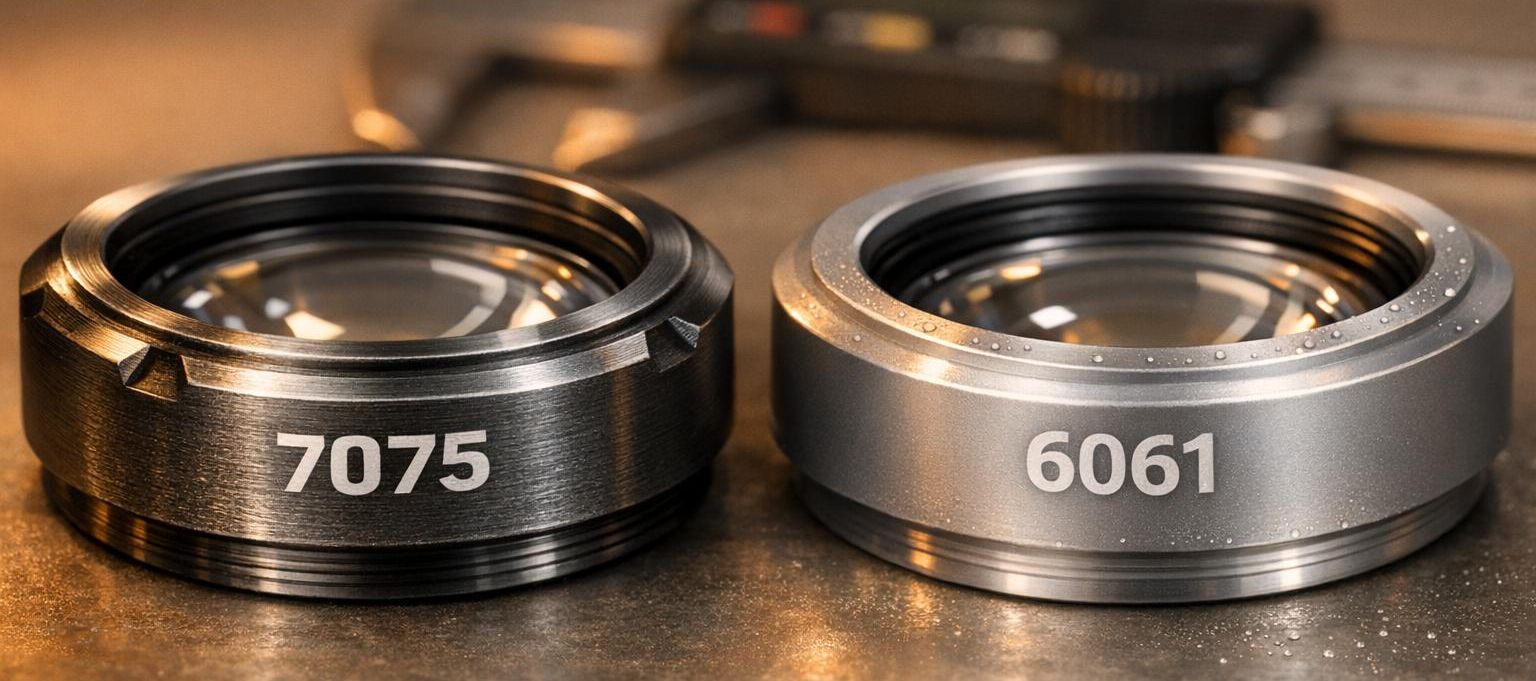
In short: The choice between 7075 and 6061 aluminum depends on your application. 7075 offers nearly double the strength, better hardness, and is ideal for high-stress optics like riflescopes. 6061, on the other hand, excels in corrosion resistance, higher thermal conductivity, and lower costs – perfect for precision optics in humid or hot environments.
To the point:
- 7075-T6: Higher tensile strength (572 MPa), better hardness (150 HB), lower corrosion resistance, more expensive.
- 6061-T6: Cheaper, better machinability, higher thermal conductivity (167 W/m-K), more stable at heat and less prone to corrosion.
Quick comparison:
| Criterion | 6061-T6 | 7075-T6 |
|---|---|---|
| Tensile strength | 310 MPa | 572 MPa |
| Corrosion resistance | Very good | Moderate |
| Thermal conductivity | 167–170 W/m-K | 130 W/m-K |
| Cost | Low | High |
| Machinability | Easy | Difficult |
| Applications | Precision optics, outdoor | High-stress housings, aerospace |
Conclusion: Choose 7075 when strength and load-bearing capacity are critical. Opt for 6061 if you value corrosion protection, thermal conductivity, and cost.
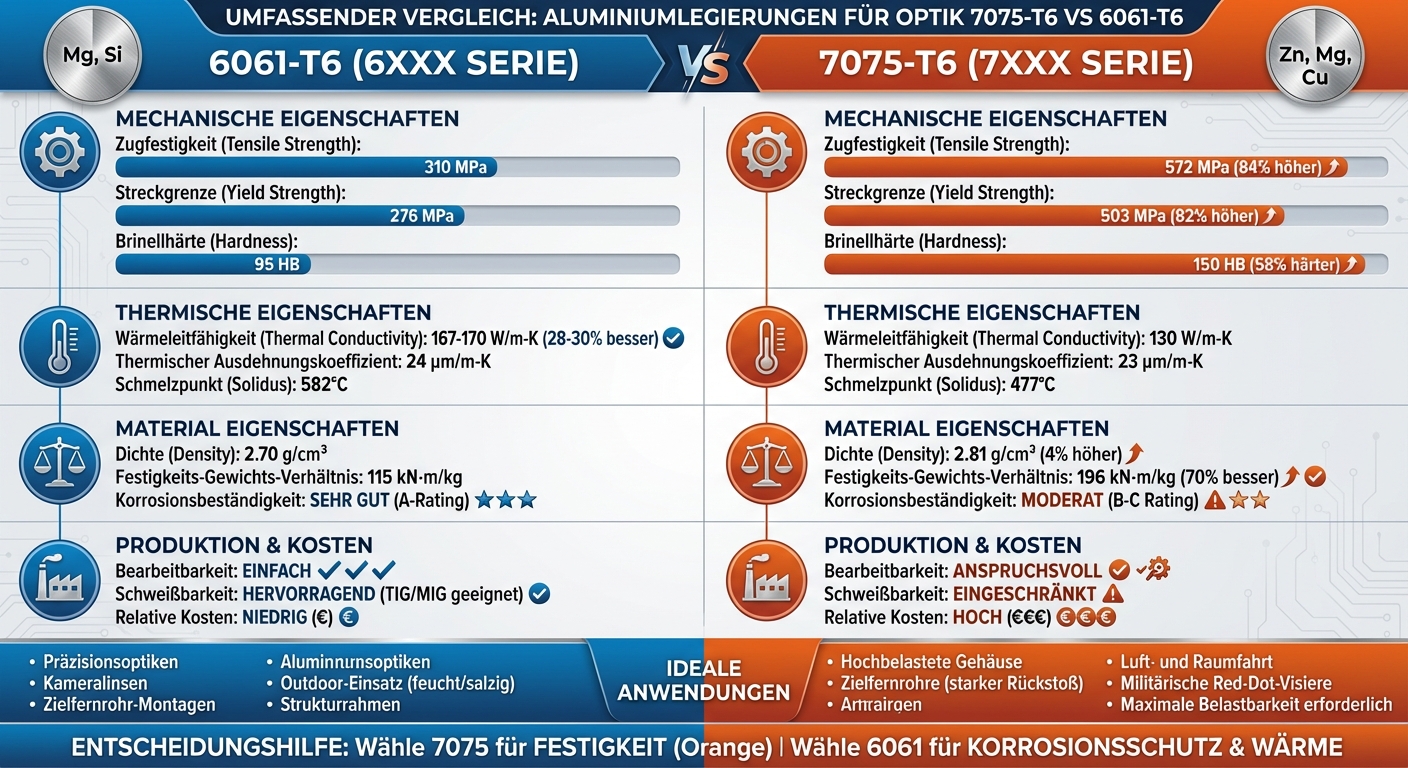
7075-T6 vs 6061-T6 Aluminium Comparison Chart for Optics Applications
CNC Machining Material Guide - Aluminum 6061/7075
sbb-itb-1cfd233
Chemical Composition and Manufacturing
The components of 7075 (Zinc, Magnesium, Copper) and 6061 (Magnesium, Silicon) significantly influence their behavior under loads, temperature fluctuations, and in production. 6061 belongs to the 6XXX series, which is based on magnesium-silicon, while 7075 is part of the 7XXX series, which combines zinc, magnesium, and copper [1] [2].
Both alloys are commonly used in the T6 temper, which includes solution heat treatment and artificial aging. The T651 variant additionally optimizes dimensional stability and minimizes the risk of deformation [5] [8]. These differences in composition form the basis for their mechanical and thermal properties.
7075: Strength from Zinc and Copper
The main components of 7075 are zinc (5.1–6.1 %), magnesium (2.1–2.9 %), and copper (1.2–2.0 %) [5] [8]. This combination provides one of the highest strengths among aluminum alloys. The high zinc content is crucial for strength, while the copper content adds additional stability but also increases susceptibility to corrosion and complicates welding [8]. Due to these properties, 7075 is preferred in areas such as aerospace, where maximum load-bearing capacity is required.
6061: A Balanced Alloy
6061 contains magnesium (0.8–1.2 %) and silicon (0.4–0.8 %), which together form magnesium silicide, creating a balance of strength, corrosion resistance, and weldability [8]. With a copper content of only 0.15–0.4 %, 6061 is significantly more corrosion-resistant [8].
The silicon in 6061 promotes the formation of a uniform oxide layer, which ensures precise and corrosion-resistant components [6] [7]. While 7075 is designed for maximum strength, 6061 offers a balanced combination of properties that will be examined in more detail in the next section.
Mechanical Properties: Strength and Hardness
The mechanical properties of 7075-T6 and 6061-T6 show significant differences that affect their suitability for various applications under demanding conditions.
The tensile strength of 7075-T6 is about 572 MPa, while 6061-T6 only reaches around 310 MPa [5]. A similar ratio is observed in the yield strength: 7075-T6 is at approximately 503 MPa, while 6061-T6 reaches about 276 MPa [5]. Thanks to the higher strength of 7075-T6, thinner wall thicknesses can be used without sacrificing stability.
In terms of hardness, 7075-T6 also performs better: With a Brinell hardness of 150 HB, it surpasses 6061-T6, which is at 95 HB, by 58% [5]. This higher hardness provides better wear resistance and protects the surface more effectively against scratches and dents. Additionally, 7075-T6 produces clean chips and offers superior fatigue strength, while 6061-T6 impresses with its greater flexibility under vibrations [5] [9].
Comparison Table: Mechanical Properties
| Property | 6061-T6 | 7075-T6 |
|---|---|---|
| Tensile Strength | approx. 310 MPa [5] | approx. 572 MPa [5] |
| Yield Strength | approx. 276 MPa [5] | approx. 503 MPa [5] |
| Brinell Hardness | 95 HB [5] | 150 HB [5] |
| Durability | Moderate [5] | Superior [5] |
| Surface Quality | Good (tends to smear) [5] | Excellent (clean chip break) [5] |
These differences in mechanical properties are a crucial factor in the choice of material and lead directly to the analysis of thermal properties.
Thermal Stability and Expansion
After examining the mechanical properties, we now turn to thermal stability – another key factor for the precision of optical systems.
The thermal properties of aluminum are critical, as temperature changes can lead to material expansions. These can affect optical elements, which is particularly problematic in precision optics such as riflescopes. Here, we take a close look at the thermal expansion, thermal conductivity, and behavior at high temperatures of the two alloys.
Thermal Expansion and Conductivity
The thermal conductivity of 6061‑T6 is about 167–170 W/m‑K, while 7075‑T6 only reaches about 130 W/m‑K [11]. This means that 6061 conducts about 28–30 % more heat, effectively reducing hotspots. However, in terms of the thermal expansion coefficient, there is a slight advantage for 7075‑T6: at 23 µm/m‑K, it is more stable than 6061‑T6, which has 24 µm/m‑K [11]. Nevertheless, the higher thermal conductivity and thermal diffusivity of 6061 (68 mm²/s compared to 50 mm²/s) compensates for this slight disadvantage [11].
High Temperature Performance
When it comes to high temperatures, significant differences become apparent. 7075‑T6 noticeably loses strength at temperatures of 120–150 °C, making it less suitable for applications at consistently high temperatures [10]. In comparison, the melting point (solidus) of 7075 is about 477 °C, while 6061 melts at around 582 °C [11]. This difference of over 100 °C clearly shows that 6061 retains its mechanical properties better at high temperatures, while 7075 loses performance more quickly under heat.
Comparison Table: Thermal Properties
| Property | 6061‑T6 | 7075‑T6 |
|---|---|---|
| Thermal Conductivity | 167–170 W/m‑K [11] | 130 W/m‑K [11] |
| Thermal Expansion Coefficient | 24 µm/m‑K [11] | 23 µm/m‑K [11] |
| Thermal Diffusivity | 68 mm²/s [11] | 50 mm²/s [11] |
| Melting Point (Solidus) | 582 °C [11] | 477 °C [11] |
| Strength Loss | More stable at heat | Faster loss from 120–150 °C [10] |
Corrosion Resistance and Density
After thermal properties, the focus now shifts to resistance under demanding environmental conditions. Corrosion protection and weight play a crucial role – especially in optics used outdoors.
6061: Excellent Protection Against Corrosion
6061‑T6 is an excellent choice for environments with high humidity or salty air. The lower copper content (0.15–0.40% compared to 1.2–2.0% in 7075) makes 6061 more resistant to corrosion [4]. Additionally, this alloy forms a stable oxide layer that effectively protects the material from further degradation. In tests, 6061‑T6 receives an "A" rating for rural and industrial outdoor conditions. In contrast, 7075‑T6 is rated only "B" in these scenarios, while it is downgraded to "C" in marine climates [4]. For users like hunters or sport shooters, whose optics are often exposed to rain, fog, or salty sea air, 6061 is therefore the more reliable option.
7075: Higher Density, but Less Corrosion Resistant
The density of 7075 is 2.81 g/cm³ – about 4% higher than the 2.70 g/cm³ of 6061. This allows for more compact constructions, albeit at the expense of corrosion resistance [1]. With a yield strength of 503 MPa, 7075 allows for thinner wall thicknesses, despite the higher density [4]. The strength-to-weight ratio of 7075 is an impressive 196 kN·m/kg, significantly more than the 115 kN·m/kg of 6061 [3].
As Thomasnet explains, 7075 is more susceptible to corrosion in aggressive environments due to its copper content of over 1% and does not share the high resistance of other aluminum alloys [12]. The higher zinc content (5.1–6.1%) further exacerbates this weakness [3]. Those using 7075 for heavily stressed optical components like scope mounts should therefore rely on high-quality anodizations or coatings to enhance corrosion resistance [4]. These aspects are crucial when it comes to choosing the right material for precise optics.
Machinability, Costs, and Applications in Optics
In addition to mechanical and thermal properties, machinability and costs play a central role in the selection of materials for optical applications.
Machinability: 6061 is easier to process
6061 aluminum scores with easy machinability, which shortens production times and reduces costs. However, this results in stickier chips that can affect surface quality [5]. In contrast, 7075 guarantees better surface quality through the formation of clean chips – a clear advantage for precise optical components. The downside: The higher hardness of 7075 (150 HB compared to 95 HB for 6061) leads to greater tool wear and increases cutting tool consumption [5].
Costs: 6061 is cheaper
Costs also play a significant role. 6061 aluminum is generally less expensive than 7075 [5]. Since extreme strength is not required in all projects, 6061 is often preferred due to its lower cost. Additionally, the easier machinability further reduces production costs, as there is less tool wear and shorter manufacturing times.
Applications: Precision or load-bearing capacity?
The intended use significantly influences the choice of material. 6061 is excellent for applications where lightness and thermal stability are paramount, such as in camera lenses or mounts for telescopic sights. Here, heat dissipation and formability are more important than maximum strength [3] [5]. Additionally, the excellent weldability allows for the production of complex assemblies using TIG or MIG welding.
7075, on the other hand, is ideal for high-stress applications, such as housing of telescopic sights with strong recoil or components in aerospace [1] [4]. With nearly double the tensile strength (572 MPa compared to 310 MPa) and better fatigue resistance, 7075 is the right choice for components that must withstand constant loads and vibrations [5]. Due to its limited weldability, 7075 is usually joined by mechanical connections or adhesives [5].
Comparison Table: Machinability, Costs, and Applications
| Property | 6061-T6 | 7075-T6 |
|---|---|---|
| Machinability | Easy (tends to produce sticky chips) | Difficult (clean chips, high tool wear) |
| Relative Costs | Low / Cost-effective | Higher / Premium quality |
| Weldability | Excellent (ideal for TIG/MIG) | Limited (low weldability) |
| Main Applications | Camera lenses, mounts, structural frames | High-stress housings, aerospace |
Conclusion: Which Aluminum is Better for Optics?
The choice of the right aluminum alloy largely depends on the specific application: 7075 excels in applications with high mechanical stress, while 6061 shows its strengths in thermal stability and resistance to environmental influences.
7075-T6 is the preferred choice when extreme mechanical loads are a priority. Thanks to its high tensile strength, it significantly outperforms 6061 and is excellent for heavily used optics. Additionally, the higher hardness of 7075 makes it more resistant to scratches and deformations. However, a high-quality anodizing is necessary to compensate for its lower natural corrosion resistance [6].
6061-T6, on the other hand, offers clear advantages in precision optics that require thermal stability and resistance to environmental influences. Its superior thermal conductivity helps maintain the optical zero point even with temperature fluctuations. Moreover, 6061 scores with better corrosion resistance, easier machinability, and lower material costs [6].
Important Insights
- 7075 is ideal for high-stress applications such as military red dot sights or components in aerospace, where maximum strength is required [3].
- 6061 is better suited for precision optics, especially in hunting applications or where heat management and environmental influences play a role [6].
FAQs
Which anodization is sensible for 7075 in outdoor use?
7075 aluminum, known for its strength and versatility, has an increased susceptibility to corrosion due to its high zinc content. Especially in outdoor areas, where materials are constantly exposed to environmental influences such as moisture and temperature fluctuations, this can be problematic.
A high-quality anodization offers an effective solution. It not only protects the aluminum from corrosion but also significantly extends the lifespan of the alloy. This makes 7075 aluminum a reliable choice even under adverse conditions.
Does 7075 really make my scope lighter than 6061?
7075 aluminum generally makes a scope lighter than 6061. Due to its higher strength, thinner and lighter components can be manufactured. While 6061 offers solid stability, 7075 impresses with its remarkable tensile strength, allowing for less material to be used. This makes it particularly suitable for applications where every gram counts – such as in optics and scopes.
Which alloy withstands temperature changes better?
7075 aluminum is characterized by its high resistance to temperature changes. It is harder and has higher strength compared to 6061 aluminum, making it ideal for use under thermal stress.
A notable difference lies in shear strength: 7075 T6 has about 1.5 times the shear strength of 6061 T6. This makes it the preferred choice for applications requiring high load capacity and thermal stability.
While 6061 aluminum is often used due to its versatility and ease of machining, 7075 aluminum finds its place in more demanding scenarios where extreme conditions prevail.