Ultimate Guide: Understanding Tactical Hunting Backpacks

Tactical hunting backpacks are specifically designed for demanding hunting conditions. They combine robust materials, modular attachment systems, and thoughtful load distribution to safely transport heavy equipment and game. Key features include MOLLE systems, quiet fabrics, and ergonomic carrying systems. Models like the Blaser Ultimate Expedition (approx. €397) or the OnFire Tactical 50+5L (approx. €109) offer features such as rifle holders, game compartments, and adjustable carrying systems. For short hunting trips, smaller backpacks (15–30 liters) are sufficient, while larger models (50–90 liters) are ideal for multi-day tours. Proper care, such as hand washing and waterproofing, extends their lifespan.
Quick Facts:
- Material: Durable Cordura (500D–1000D).
- Volume: Daypacks (15–30 liters) to multi-day backpacks (70–90 liters).
- Carrying System: Padded hip belts, aluminum frames.
- Prices: From approx. €87 (e.g., Wisport Sparrow 16L).
A well-chosen backpack is essential for comfort and efficiency while hunting.
Introduction to the Lynx Backpack from VORN
Core Features of Tactical Hunting Backpacks
The choice of the right material plays a crucial role in the durability of a hunting backpack. Cordura fabric is the standard here, as it is both robust and durable. The material thickness is measured in Denier (D), with 500D offering a balanced combination of lightness and durability. For those needing more robustness, 700D provides an alternative that combines the resilience of 1000D with the lighter weight of 500D [8]. Cheaper models often use 900D polyester with a PU coating. This material is water-repellent but requires an additional rain cover in heavy rain [6].
Materials and Quality of Workmanship
The carrying system of a backpack significantly influences comfort. Aluminum frames provide stability and can be individually adjusted, while plastic frames are lighter but less load-bearing [3]. High-quality backpacks like the TT Modular Pack 30 IRR even meet the strict Bundeswehr standards (TL 8305-0278). Thanks to an IRR treatment (Infrared Reduction), the backpack remains less visible under night vision devices [7].
“CORDURA® in fiber strength 700 den combines the high abrasion and tear resistance of the classic 1000-den fabric with the lightness of the 500-den fabric.” – Tasmanian Tiger [8]
Modular Systems and Attachment Options
Good material is the foundation, but only modular systems make a hunting backpack truly versatile. MOLLE systems (Modular Lightweight Load-carrying Equipment) allow you to customize the backpack to meet the demands of hunting. External MOLLE loops provide space for additional pockets, and modern models often also feature internal Velcro MOLLE areas to securely attach holsters or bags in the main compartment [7]. The Blaser Ultimate Range System takes it a step further: here, a “Backbone” carrying system can be combined with various modules – from rifle holsters to 45-liter backpacks [10]. Compression straps play an important role in stabilizing the load and preventing the center of gravity from shifting during movement [2].
Weight Distribution and Carrying Systems
A well-thought-out hip belt is essential for carrying heavy loads. It shifts the weight from the shoulders to the pelvic area, providing more comfort [2]. Systems like the X1 system from Tasmanian Tiger are specifically designed for loads starting at 20 kg and distribute the weight optimally on the hips [8]. Ergonomic shoulder pads reduce pressure points, while Air-Mesh material ensures better air circulation and minimizes sweating [6]. Adjustable back lengths allow for adaptation to body size, which is particularly important for balance during long marches [3]. An example of this thoughtful construction is the Swarovski BPH 44l. With a load capacity of up to 40 kg and the Deuter Alpine system, it remains stable even in mountainous terrain and ensures a slim center of gravity [5].
Popular Models: Feature Comparison
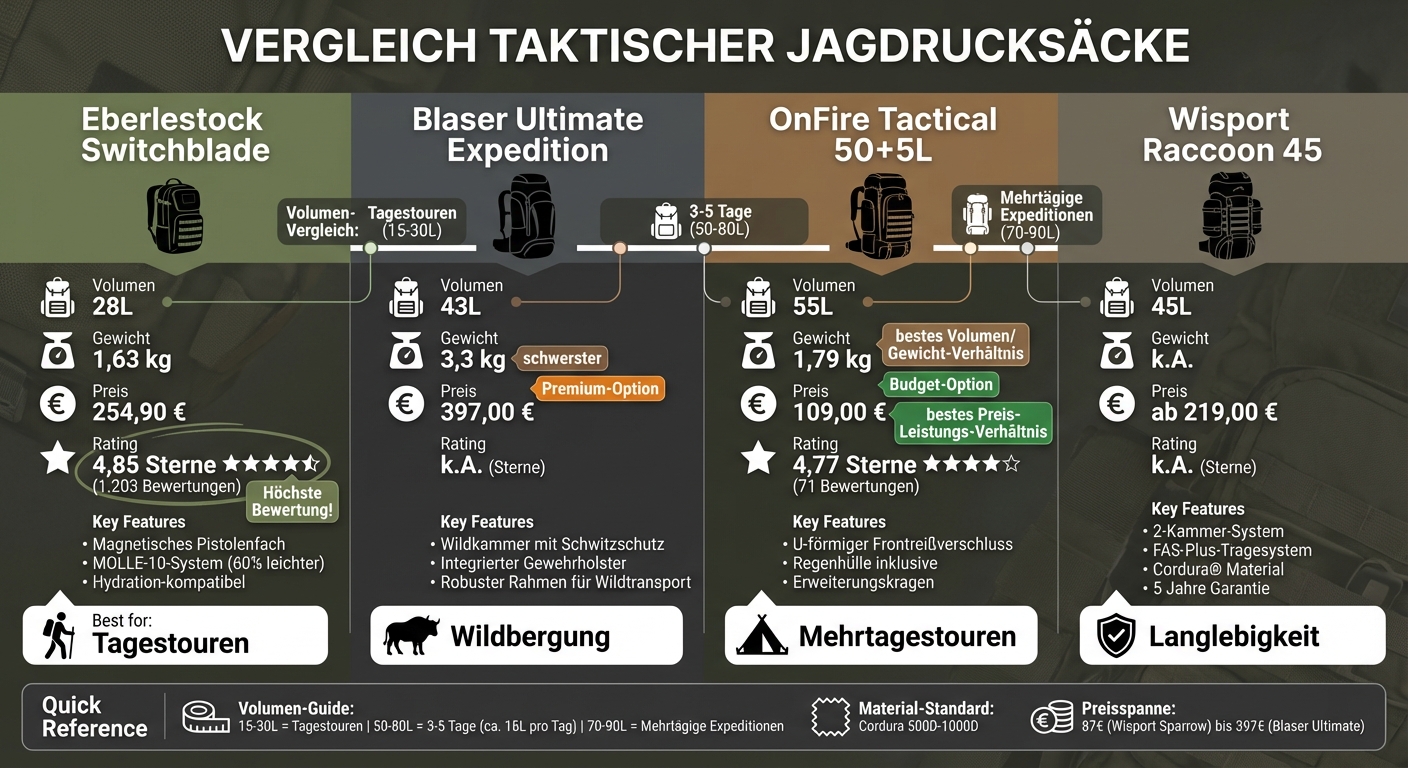
Tactical Hunting Backpacks Comparison: Models, Volume, and Prices
Feature and Specification Table
The choice of the right model strongly depends on the intended use. For short hunting trips, a compact daypack like the Eberlestock Switchblade with 28 liters is suitable. However, if you plan multi-day tours, a more spacious model like the OnFire Tactical 50+5L, which holds 55 liters, is a better choice. The following table summarizes the key features of the models:
| Model | Volume | Weight | Price | Features |
|---|---|---|---|---|
| Eberlestock Switchblade [12] | 28L | 1.63 kg | €254.90 | Magnetic pistol compartment, lightweight MOLLE-10 system, hydration compatible |
| Blaser Ultimate Expedition [4] | 43L | 3.3 kg | €397.00 | Game compartment with sweat protection, integrated rifle holster |
| OnFire Tactical 50+5L [6] | 55L | 1.79 kg | €109.00 | U-shaped front zipper, rain cover, extension collar |
| Wisport Raccoon 45 [1] | 45L | N/A | From €219.00 | 2-chamber system, FAS-Plus carrying system, Cordura®, 5-year warranty |
The Blaser Ultimate Expedition is the heaviest model on the list at 3.3 kg. This weight results from its robust frame, which is specifically designed for transporting game. In contrast, the OnFire Tactical 50+5L impresses with an excellent volume-to-weight ratio – 55 liters at only 1.79 kg.
This table provides a quick overview and serves as a basis for the following evaluation of the models.
Model Ratings
The ratings are based on practical tests and user experiences, showing how the models perform in use:
- Eberlestock Switchblade: With a rating of 4.85 stars (1,203 votes) [13], this model is a favorite among hunters. The MOLLE-10 system, which is 60% lighter than conventional MOLLE matrices, provides flexibility and comfort [12].
- Blaser Ultimate Expedition: This model is specifically designed for game retrieval. The game compartment with sweat protection keeps the main compartment clean, while the integrated rifle holster allows for free hands – a significant advantage in rough terrain.
- OnFire Tactical 50+5L: With a rating of 4.77 stars (71 votes) [6], this backpack scores points for its price-performance ratio. The U-shaped front zipper allows for quick access, and the extension collar provides additional flexibility.
- Wisport Raccoon 45: This model stands for durability and robustness. The durable Cordura® material and the 5-year manufacturer warranty make it a popular choice for demanding applications.
On Gunfinder, you will find a wide selection of tactical hunting backpacks that can help you find the right model for your individual needs.
sbb-itb-1cfd233
How to Pack and Organize Your Backpack
Techniques for Weight Distribution
Proper weight distribution is crucial to staying fit even after long distances. Heavy items like water and ammunition should be stored as close to your back as possible – ideally at shoulder blade height or in the upper part of the main compartment [14][15]. This keeps the center of gravity close to your hips, providing more stability on uneven terrain.
“The shoulder straps are meant to keep the backpack close to the body, not to carry the weight.” – Martin Gebhardt, founder of Survival-Kompass [14]
Light items like sleeping bags should go at the bottom to create a stable base [15]. Important gear like first aid kits should be placed in the outer areas of the main compartment for quick access. Good weight distribution can reduce the perceived effort of a hike by up to 25% [14]. Particularly important: Adjust the carrying system so that the main load rests on your hips – where the strongest muscles of your body work [14][15].
The load-lifter straps help shift the weight from the shoulders to the hips. To properly adjust the carrying system, load your backpack with about 7–11 kg so that the straps and lumbar padding fit perfectly [16]. Once optimally adjusted, you will benefit not only from better weight distribution but also from a thoughtful organization of the compartments.
Effectively Using Compartments
When the weight is well distributed, clever use of compartments ensures quick access and more stability. Frequently needed items like maps, compasses, snacks, or headlamps should go in the lid pocket or external pockets so you can reach them without having to open the entire backpack [14][15]. Ammunition and magazines are best placed in frontal pockets or in modular holders that you can secure with Velcro inside [11].
For first aid equipment, it is advisable to secure it on the outside of the MOLLE system or in the lid pocket so that it is immediately available in an emergency [14][3]. Heavy optics like spotting scopes should be positioned centrally on the back, while tripods or trekking poles can be secured with side compression straps or in external pockets [3][16]. A tip: Roll clothes instead of folding them – this uses space better and prevents your gear from shifting during movement [14].
| Equipment Category | Recommended Position | Access Level |
|---|---|---|
| Heavy (Optics, Water, Ammunition) | Center of back, close to the spine | Medium |
| Light (Spare Clothing, Rain Protection) | Bottom or outer area | Low |
| Essential (First Aid, Map, Knife) | Lid pocket or external pockets | High/Immediate |
| Modular (IFAK, Magazine Pouches) | External MOLLE system | High/Immediate |
| Long Items (Tripod, Rifle) | Side pockets with compression straps | Medium |
Backpacks with a front-loading design offer a significant advantage: The U-shaped zipper allows you to access all your gear like a suitcase without having to unpack everything [1][3]. On Gunfinder, you will find models that excel in both clever weight distribution and practical compartment organization.
Maintenance and Upgrades
Cleaning and Care
Washing machines are a no-go when it comes to cleaning your backpack – they can damage the PU coating and the Cordura fabric. Instead, you should clean the backpack by hand. Use lukewarm water (about 30 °C) and pH-neutral soap or a special cleaner [18][21].
For stubborn stains, such as blood or other organic dirt, a soft brush can help to gently clean the affected areas without damaging the fibers [19][21]. Mud stains should be allowed to dry completely before you brush them off. After that, you can briefly treat organic residues in soapy water [19][21]. To remove sweat and salt crystals, rinse the corresponding areas several times with soapy water [17][18]. A toothbrush is suitable for cleaning the zippers – if necessary, you can use a light lubricant [20].
“Never wash a backpack in the washing machine and do not dry it in the dryer.” – REI Expert Advice [20]
Drying should always be done in the air, away from direct sunlight or other heat sources. Open all zippers and compartments to prevent mold growth [17][18][21]. After cleaning, it is advisable to check the water-repellent coating (DWR): Drop some water on the fabric – if it does not bead up, you should use a waterproofing spray while the backpack is still damp [18][19].
With the right care, your backpack will not only remain in good condition for longer but will also be optimally prepared for accessories and upgrades.
Adding Accessories
In addition to maintenance, well-chosen accessories can significantly enhance the functionality of your backpack. MOLLE-compatible pouches like IFAK pouches, radio pouches, or magazine holders can be easily adjusted and are excellent for specific hunting or outdoor situations [22][3]. For longer missions, hydration systems – either with internal bladders or external hydration pouches – are particularly practical, as they allow you hands-free access to water [22][9][18]. Panels and inserts like MOLLE Velcro panels or smartphone holders help keep ammunition and electronics organized [22][11].
External loops provide space for trekking poles, tripods, carabiners, or compression straps [1][11]. To protect your gear from moisture, rain covers or waterproof dry bags are ideal – these start at €26.90 for 20 liters [18][3]. Additional hip belts or load control straps can improve carrying comfort and better distribute your load [22][3]. Make sure that all accessories are compatible with your backpack model. On Gunfinder, you will find a selection of extensions specifically designed for various tactical systems.
Conclusion: Choosing the Right Tactical Hunting Backpack
The most important criteria for selecting a tactical hunting backpack can be derived from the points discussed above.
Determine Volume: For day trips, a backpack with 15–30 liters is sufficient, while for 3–5 days, a volume of 50–80 liters is sensible – about 16 liters per day [23]. Make sure to choose a carrying system that distributes the weight evenly between hips and back. Or as Josh Kirchner aptly puts it: “A backpack must fit your body – not that of your friend” [23].
Material and Functionality: The right material, such as Cordura (500D–1000D), offers a good balance of lightness and abrasion resistance [1]. For hunters, a game transport function is crucial: the backpack should be able to securely fix meat between the bag and frame [23]. With modular MOLLE systems, you can adapt and expand the backpack to your needs [2].
Recommendations and Purchase Options: On Gunfinder, you will find a large selection of tactical hunting backpacks. Here are some examples:
- Wisport Sparrow 16L – a compact daypack from about €87.
- OnFire Tactical 50+5L – a versatile model for approx. €109.
- Wisport Wildcat 65L – a robust expedition backpack for about €239 [1].
The platform allows you to specifically filter by volume, material, or brands like Wisport, Mystery Ranch, and 5.11 Tactical and compare prices.
A high-quality backpack is a worthwhile investment – especially if you take good care of it and expand it sensibly. With these selection criteria and the offers on Gunfinder, you can make a thoughtful and long-term decision.
FAQs
What advantages does the MOLLE system offer in a tactical hunting backpack?
The MOLLE system (Modular Lightweight Load-carrying Equipment) provides you with a clever way to flexibly and clearly organize your hunting gear. With the sturdy PALS loops, you can securely and individually attach equipment such as first aid kits, knife sheaths, or water bottles to your backpack. This way, you have everything exactly where you need it – even during intense movements or challenging conditions.
A significant advantage: You can adjust your setup at any time. Whether you are preparing for different hunting conditions or need specific equipment for a particular mission – the MOLLE system adapts to your needs and ensures that you are efficient, safe, and well-organized on the go.
How do I properly clean and care for my tactical hunting backpack?
To ensure that your tactical hunting backpack lasts a long time, proper care is essential. Before you start cleaning, remove all equipment and close all zippers and buttons. Use a damp cloth and, if necessary, a mild soapy solution to gently remove dirt and stains. Avoid the washing machine unless the manufacturer explicitly states that it is safe to do so.
After cleaning, you should let the backpack air dry. Choose a well-ventilated place, but avoid direct sunlight to prevent damage to the material. Regularly check the material for wear or minor damage and have these repaired early to ensure that the backpack remains reliable and durable.
How large should a hunting backpack be for multi-day tours?
For multi-day hunting trips, a backpack with a volume of at least 50 liters is ideal. This way, you can easily store all your equipment, food, and everything you need on the go.
It is not only the size that matters, but also the carrying comfort. A well-fitting and comfortable backpack makes a big difference on longer trips and spares your back.