Note:
The item location is abroad. Please note that this may affect delivery conditions, shipping times, and/or the purchasing process.
J-Tac Mosfet for AEPs
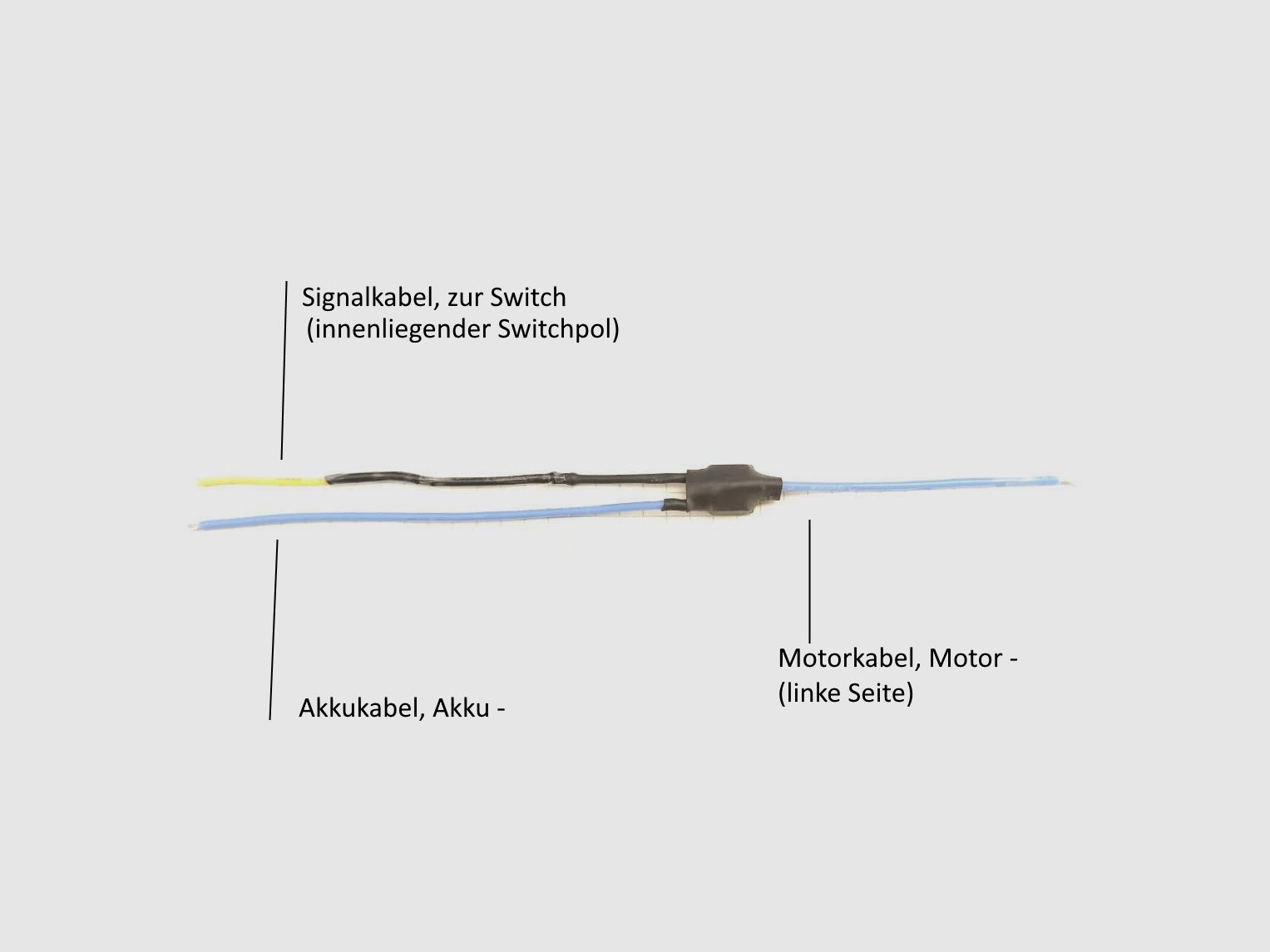
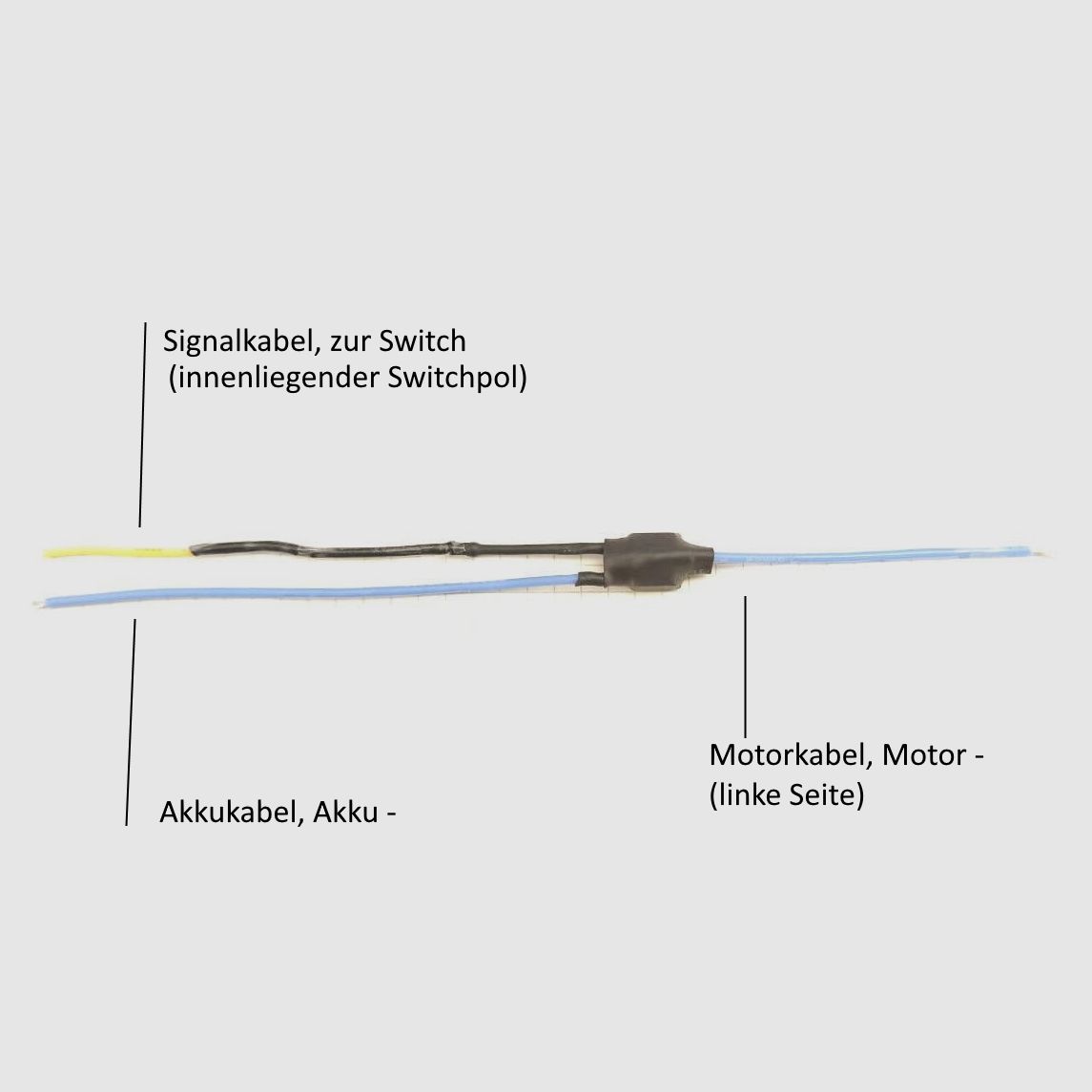
a simple Mosfet, NO "Active Break", with black negative cable pre-soldered. For installation, a soldering iron, solder, heat shrink tubing, the red positive cables, and the necessary expertise are required. The Mosfet is designed to be placed directly in front of the HopUp/trigger block of the AEP and integrated into the existing wiring harness. The motor negative cable is to be connected to the cable coming out from the left side of the pistol (please solder!). The color of the cable on the AEP may vary. The thin signal cable is to be soldered to the inner contact on the switch, and the remaining battery negative cable to the battery connector. On the other side of the switch, there is already a cable coming from the motor in the pistol, and here the battery positive cable (not included) must be connected.
Depending on what type of AEP you own (normal or S-Line), the wiring harness may need to be modified accordingly. For "normal" AEPs, remove the holder for the old NiMH battery by loosening the corresponding screw, so that the Mosfet fits in its place. For S-Line AEPs, you can almost copy the wiring harness 1:1.
These Mosfets are made from high-quality tested components, made in Germany, and of course also 11.1V LiPo-ready. Even though the Mosfet itself can theoretically withstand very high amperage, we still ask that only the battery packs commonly used for airsoft be used. The design of a Mosfet for the airsoft sector, and especially its positioning, rarely allows for sufficient cooling to fully exploit the actual performance limits of the FET. For AEPs, we recommend using only 7.4V batteries! However, we do have batteries with extremely high C ratings that we warmly recommend to every user.
If a Mosfet is needed for a different model or at a different positioning than intended, please purchase and contact our support.
All our J-Tac Mosfets have been functionally tested before delivery.
FAQ: Metal-Oxide Semiconductor Field-Effect Transistor (short: MOSFET, even shorter: what-the-hell..?):
When operating an airsoft gun with high currents, the switch is heavily loaded (sparking, etc.) and gradually deteriorates, or starts to malfunction because deposits form. The Mosfet, on the other hand, only allows a low control voltage to run through this switch and then switches to full power to supply the motor with juice. This reduces resistances, and the motor can respond faster. Additionally, the full power reaches the motor directly. In addition to installing the Mosfet, cleaning the motor (especially with softer motor brushes that wear out quickly) is recommended, and if possible, soldering the contacts to the motor where feasible (for all guns with motor cages) - to further reduce resistances. Dean-T connectors are also highly recommended.
TLDR: A Mosfet is good for response behavior, protects the switch, and reduces power consumption.
Where to install a Mosfet? If we have a "standard" airsoft gun (i.e., without pre-installed electronic systems (ETU, EFCS, ASCU, SSS) that is operated with strong batteries, e.g., 11.1V, the switch should be protected with a Mosfet if at all possible. Due to the other advantages of a Mosfet, the only reason for us NOT to install a Mosfet is if the space within the airsoft gun does not allow it.
Are jams impossible with a Mosfet? No. Jams can occur with the best guns. The reasons for jams are manifold and must be determined individually, e.g., the system can overspin, the motor can be too strong or too weak, the system can be poorly shimmed, or the motor play may not be adjusted...
A Mosfet, depending on how it is installed, often makes it easier to resolve a gearbox jam. ---> More about this in our Anti-Jam Guide.
(Show description in original language)
J-Tac Mosfet für AEP´s
ein einfaches Mosfet, KEIN "Active Break", mit schwarzem minus-Kabel vorverlötet. Zum Einbau werden Lötkolben, Lötzinn, Schrumpfschlauch, die roten plus-Kabel und die nötigen Fachkenntnisse benötigt. Das Mosfet ist dafür vorgesehen direkt vor dem HopUp/Triggerblock der AEP platziert zu werden und in den bestehenden kabelbaum eingefügt zu werden. Das Motor-Minus-Kabel wird mit dem vom Schützen aus an der linken Seite der Pistole herauskommenden Kabel verbunden (verlötet bitte!). Die Farbe des Kabels an der AEP kann abweichen. Das dünne Signalkabel wird auf den weiter innen liegenden Kontakt auf die Switch gelötet, das übrige Akku-Minus-Kabel an den Akkustecker. Auf der anderen Seite der Switch liegt bereits ein Kabel, dass aus der Pistole vom Motor kommt und hier muss das Akku-Plus-Kabel (nicht enthaltend) aufgebracht werden.
je nachdem was für eine AEP sie besitzen (normal oder S-Line) muss ggfs der Kabelbaum anders verändert werden. Bei "normalen" AEP´s entfernen sie die Aufnahme für den alten NiMH-Akku indem sie die dazugehörige Schruabe lösen, sodass an dessen Stelle das Mosfet passt. bei S-Line AEP´s können sie nahezu 1:1 den Kabelbaum kopieren.
Diese Mosfets sind aus hochwertigen geprüften Teilen, made in Germany und selbstverständlich auch 11,1V LiPo-ready. Auch wenn das Mosfet selbst theoretisch sehr hohe Ampereströme aushalten kann, bitten wir darum dennoch nur die für Airsoft üblichen Akkupacks zu verwenden. Die Bauweise eines Mosfets für den Airsoftbereich und vor allem seine Positionierung lässt selten eine ausreichende Kühlung zu, um die tatsächlichen Leistungsgrenzen des Fets auszureizen. Für AEP´s empfehlen wir nur 7,4V Akkus zu benutzen! Wir haben allerdings Akkus mit extrem hohen C-Werten, die wir an dieser Stelle jedem nutzer wärmstens empfehlen.
Sollte ein Mosfet für ein anderes Modell oder an eine andere andere als die vorgesehene Positionierung benötigt werden, kaufen Sie bitte und setzen Sie sich mit unserem in Verbindung.
Alle unsere J-Tac Mosfets sind selbstverständlich vor Auslieferung auf Funktion überprüft worden.
FAQ: Metal-Oxide Semiconductor Field-Effect Transistor (kurz: MOSFET, noch kürzer: was-zur-Hölle..?):
Beim Betrieb einer Airsoftwaffe mit starken Strömen wird die Switch stark belastet (Funkenflug, usw.) und dabei wird diese langsam schlechter, bzw. beginnt nicht mehr ordentlich zu funktionieren weil sich Ablagerungen bilden. Das Mosfet lässt dagegen nur eine geringe Steuerspannung über diese Switch laufen und schaltet dann auf Durchzug um dem Motor voll mit Saft zu versorgen. Dabei werden Widerstände verringert und der Motor kann schneller ansprechen. Auch kommt direkt die volle Leistung beim Motor an. Zusätzlich zum Einbau des Mosfets empfiehlt sich die Säuberung des Motors (vor allem bei weicheren Motorkohlen die schnell abnutzen) und wenn möglich das Anlöten der Kontakte an den Motor sofern das geht (Bei allen Waffen mit Motorkäfig) - um Widerstände noch weiter zu verringern. Auch Dean-T-Stecker sind wärmstens zu empfehlen.
TLDR: Ein Mosfet ist gut für Ansprechverhalten, schont die Switch und reduziert den Stromverbrauch.
Wo ein Mosfet verbauen? Haben wir eine "standard"-Airsoftwaffe (also ohne bereits vorverbaute elektronische Systeme (ETU, EFCS, ASCU, SSS) die mit starken Akkus, z.B. mit 11,1V betrieben wird, sollte wenn irgend möglich die Switch mit einem Mosfet geschützt werden. Aufgrund der anderen Vorteile eines Mosfets ist für uns der einzige Grund KEIN Mosfet zu verbauen, wenn der Platz innerhalb der Airsoftwaffe dies nicht zulässt.
Werden Jams mit einem Mosfet unmöglich? Nein. Jams können bei den besten Waffen auftreten. Die Gründe für Jams sind manigfaltig und müssen individuell ermittelt werden, z.B. kann das System überdrehen, der Motor zu stark oder zu schwach sein, das System schlecht geshimmt, das Motorspiel nicht eingestellt sein... Ein Mosfet erleichtert aber je nachdem wie es verbaut wurde oft das Lösen eines Gearboxjams. ---> Mehr dazu in unserem Anti-Jam-Guide.






 A-TEC
A-TEC
 AEA Airguns
 AKAH
AKAH
 ASG
ASG
 Aimpoint
 Alpen Optics
 Alpha Industries
 Anschütz
 Antonio Zoli
 Ares
Ares
 B&T Schalldämpfer
 Baikal
 Ballistol
 Balzer
 Barbour
 Barnes
 Barnett
 Benelli
 Beretta
 Bergara
 Blaser
 Brandit
 Bremer Tresor
 Brenneke



 Classified ad