Checklist: Apply for hunting license for foreigners in the USA
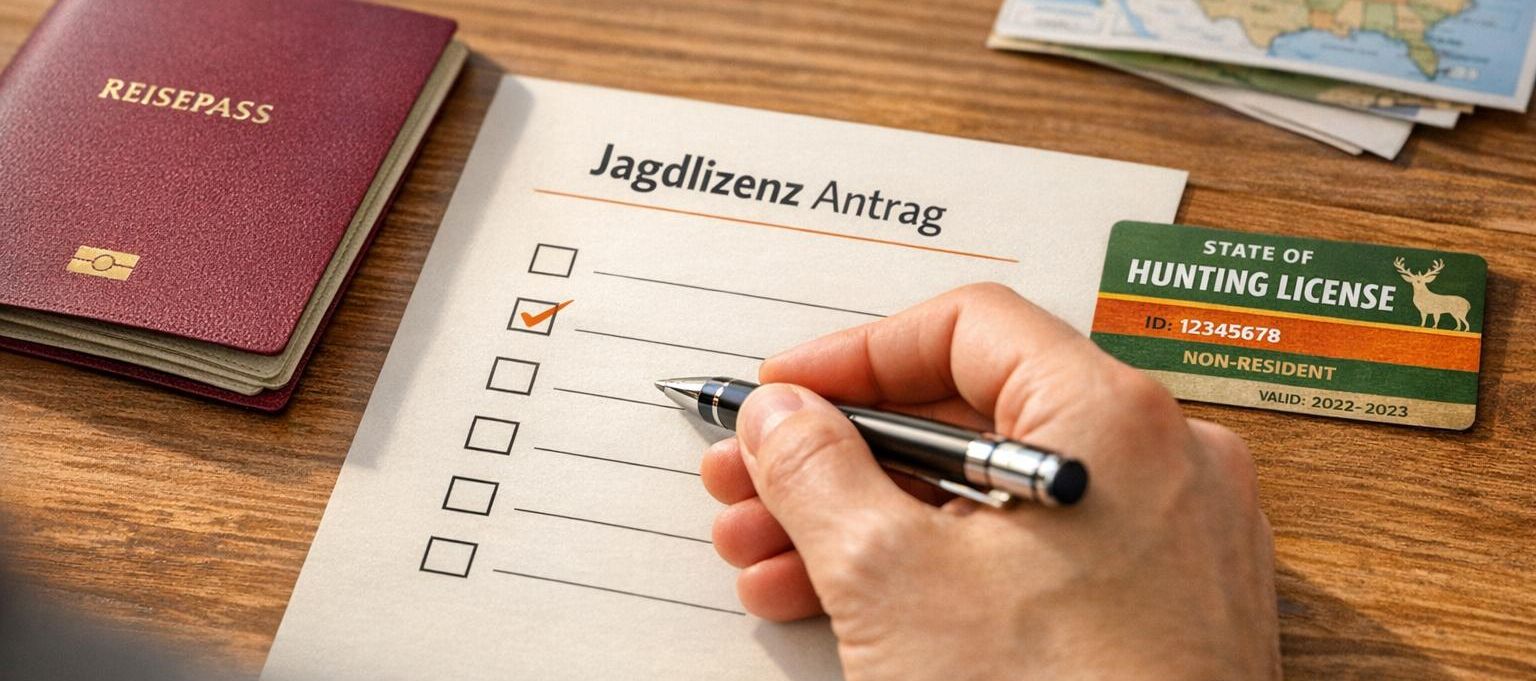
If you want to hunt in the USA as a German, you need a state-issued hunting license. It not only allows you to hunt but also enables you to legally handle firearms – despite strict US gun laws. Important: Without a valid license, the possession and transport of firearms is generally prohibited for foreigners with a non-immigrant visa.
The most important steps:
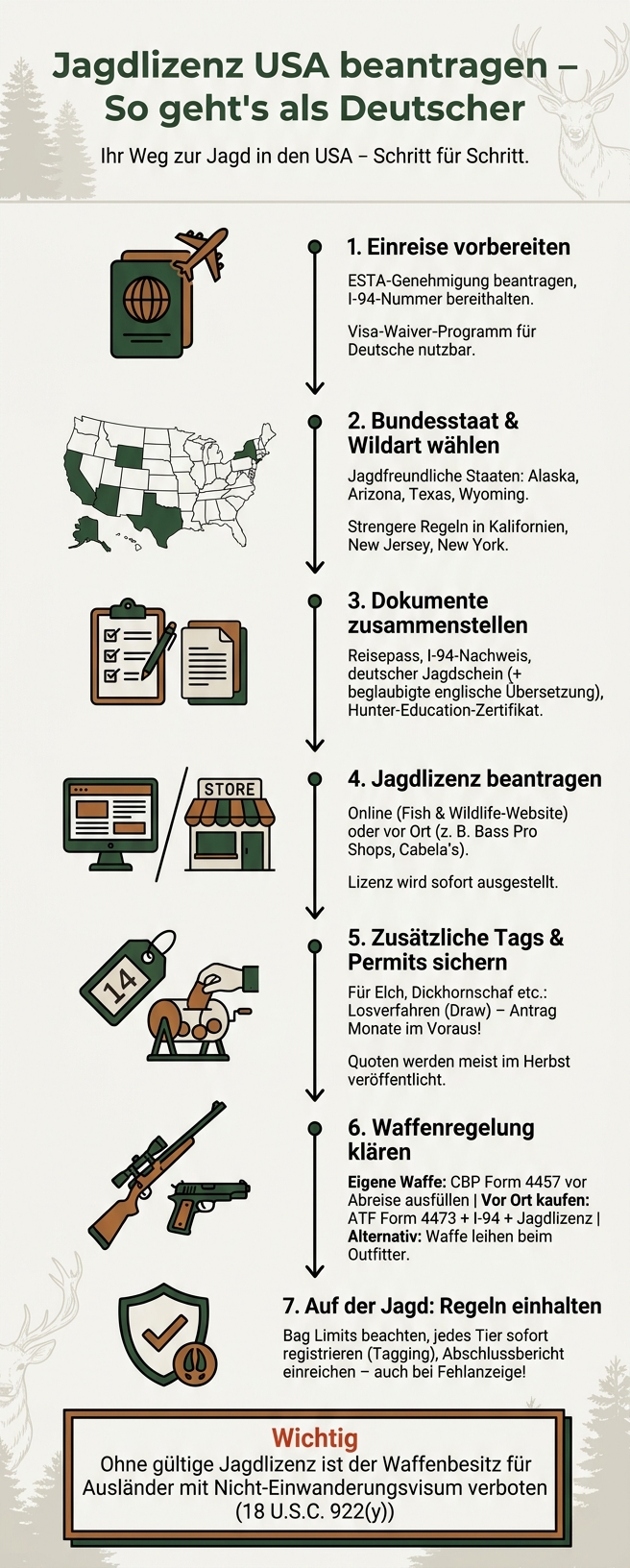
- Travel preparation: Apply for ESTA, select a state (e.g., Texas or Alaska), and plan your budget.
- Documents: Passport, I-94 entry record, German hunting license (with translation), and proof of hunting training.
- Apply for a license: Online or in person at the state wildlife agency.
- Additional permits: Special tags or permits are required for certain wildlife species, which are often allocated by lottery.
- Firearm regulations: Personal firearms must be declared in advance (CBP Form 4457), alternatively, you can rent or buy on-site.
Important notes:
- Each hunting license is state-dependent. Inform yourself about the specific regulations of your target state.
- Adhere to all hunting laws, e.g., bag limits and reporting requirements.
- Plan early, as applications for sought-after hunting tags often need to be submitted months in advance.
With careful preparation, nothing stands in the way of your legal hunting adventure in the USA.
Hunting License USA for Germans: Step-by-Step Guide
Preparations Before the Trip
Check Visa and Entry Status
For a hunting trip to the USA, you can use the Visa Waiver Program as a German, which eliminates the need for a traditional visa. Instead, you need an ESTA authorization (Electronic System for Travel Authorization), which you should apply for before your trip. Additionally, it is important to have your I-94 entry/departure record number ready. This is often required when you purchase or document firearms in the USA [2] [4].
Once you have clarified your entry status, you can focus on selecting the appropriate state and wildlife species.
Choose State and Game Species
In the USA, hunting regulations are set by individual states. Therefore, choosing the right state is a central step. States like Alaska, Arizona, Texas, and Wyoming are particularly straightforward for non-residents regarding firearm and hunting regulations [2]. In contrast, states like California, New Jersey, or New York have significantly stricter regulations.
Visit the website of the relevant wildlife agency of the respective state – for example, Texas Parks and Wildlife or Florida Fish and Wildlife – to learn about the requirements for non-residents. There you will also find out which game species may be hunted in the planned season [2] [1]. For particularly sought-after species like moose or bighorn sheep, hunting tags are often allocated through a lottery system, with applications frequently needing to be submitted several months in advance [1].
Plan Budget
In addition to the legal aspects, you should also carefully plan your budget. As a non-resident, you typically incur higher fees than resident hunters. Typical costs include:
| Cost Item | Description |
|---|---|
| Hunting License (Non-Resident) | Basic license that must be renewed annually; prices vary by state. |
| Species-Specific Tags | Required for each animal to be hunted; costs depend on the rarity of the species. |
| Area Fees | Some states (e.g., California) charge additional fees for certain hunting areas [1]. |
| Lottery Fees | Advance costs for participating in lotteries for rare game species like bighorn sheep [1]. |
| ATF Import Permit | This permit for the import of firearms should be applied for at least 6 weeks before travel [4]. |
To realistically calculate your budget, it is worthwhile to research the current prices for non-residents on the online portals of the respective states – for example, on gooutdoorsflorida.com for Florida [2]. Remember to convert the amounts into euros to get an accurate overview of your total costs.
sbb-itb-1cfd233
Personal and Legal Requirements
Hunting Education and Age Limits
In most US states, you must provide proof of your hunting education when applying for a hunting license for the first time [5]. The focus is primarily on firearm safety and hunting ethics. If you already hold a German hunting license, you should check whether it is recognized in the respective state through "Reciprocity." The relevant wildlife agency provides information on its website [5]. If your German qualification is not recognized, you often have the option to complete an online safety course [5]. In Texas, even a one-day safety course is sufficient [1].
The age limits for the hunting license vary by state. In New York, it is required from the age of 12, while in California, a minimum age of 16 applies [5].
In the next section, you will learn which documents and proofs you need for the application.
Identification Documents and Proof of Residence
For your license application, you need a valid passport as well as the I-94 entry record number [2]. In some states, proof of a US address is also required. This can be provided, for example, by a hotel bill or a booking confirmation [2]. Make sure that your name is correctly stated in all documents [5].
Bring German Hunting Documents
In addition to the required identification documents, you should also carry your German hunting documents. These include:
- Your hunting license in original
- Your hunter examination certificate as proof of training
- An officially certified English translation of these documents to avoid delays in the application process [3]
If you want to bring your own firearm, you must also present the corresponding firearm possession documents. As a non-immigrant, you are generally prohibited from firearm possession under US federal law (18 U.S.C. 922(y)). However, a valid US hunting license constitutes a legal exception that allows you to handle firearms and ammunition [2].
These requirements form the basis for the further application process. Clarify these points carefully before proceeding with the next steps.
How to Legally Purchase a Firearm in the USA as a Foreigner
How to Apply for a Hunting License
In the USA, hunting licenses are not issued at the federal level, but by individual states [7]. This means that you need a specific license for each state where you wish to hunt. Each state has its own authorities and portals.
Apply Online
The most convenient way to apply is through the official website of the relevant Fish & Wildlife agency of the state. The U.S. Fish & Wildlife Service provides a handy directory of all 50 state agencies, so you can easily find the right contact [7]. There, you can create an account, upload your required documents – such as passport, I-94 number, and hunting education certificate – and pay the license fee directly online. After payment, the temporary license is immediately available for download. This is especially helpful if you want to start hunting on short notice.
If you prefer personal contact, there are also options to apply for the license in person.
Apply In Person
For those who prefer a more personal touch: You can apply for your license directly at the wildlife agency or at authorized outdoor retailers like Bass Pro Shops or Cabela's [6]. Bring your passport, a certified hunting license translated into English, and your entry proof – the same documents required for the online application. The advantage: The license is usually issued immediately.
Additional Permits and Draws
For some wildlife species, a general hunting license is not sufficient. You will need additional permits, known as tags or special permits. These are often strictly limited and are awarded in many cases through a lottery (Draw) [1]. State agencies usually publish the quotas for such permits in the fall before the respective hunting season [1].
For more common wildlife species like white-tailed deer or turkey, you can often purchase the licenses directly without having to participate in a lottery. It is advisable to register early for draws and to properly document all hunting results to avoid potential bans in the following years [1].
Firearms and Ammunition in the USA
Bringing Your Own Firearms
Without a valid U.S. hunting license, foreigners with a non-immigrant visa are prohibited from possessing or transporting firearms [2]. Therefore, it is crucial to apply for the license in advance before carrying a weapon.
If you want to bring your own firearm, you must fill out the CBP Form 4457 before departing from Germany. This form confirms that the firearm was in your possession before your entry and protects you from additional customs fees upon your return.
"This form [CBP Form 4457] allows a CBP officer to verify that the traveler has that property in their possession while they're exiting the United States." – Steve Ehrlich, Branch Chief of CBP's Travel and Tourism Initiative [8]
Note that shotguns with a minimum barrel length of 45.7 cm and scopes fall under the regulations of the U.S. Department of Commerce, while rifles with shorter barrels are subject to the Department of State. Make sure to find out in advance which authority is responsible for your firearm.
If you do not want to bring your own firearm, there are other options available locally.
Renting or buying firearms locally
If you do not want to bring your own firearm, you can rent one from an outfitter or at a shooting range. This option is often the easiest, especially if it is a one-time hunting trip.
If you prefer to buy a firearm locally, you will need the following documents: your hunting license, proof of residence (e.g., hotel bill or rental agreement), and your I-94 number. At the dealer, you will fill out the ATF Form 4473, entering the I-94 number in question 20 and attaching a copy of your hunting license for question 26d [2]. Plan for a waiting period of three days for this.
Ammunition, on the other hand, is usually easier to acquire. Proof of age, such as a photo ID, is generally sufficient.
If you are looking for additional hunting gear, you can use platforms like Gunfinder, which offer a wide selection of equipment, optics, ammunition, and more.
Transporting firearms to the hunting area
If you have legally acquired or brought the firearm, specific regulations apply when transporting it to the hunting area. Non-immigrants are allowed to transport firearms only directly to the hunting area or shooting range [2]. Unnecessary detours can have legal consequences.
The firearm should be transported in a locked case, while the ammunition is stored separately. In states with stricter regulations, such as California or New York, additional safety measures are required, such as gun locks or locked containers [2].
Don't forget to always carry your hunting license and travel documents while transporting.
Legal Rules and Safety in Hunting
Complying with Hunting Laws
In the USA, hunting is subject to strict regulations that are governed at both federal and state levels. Each state has its own rules regarding bag limits (Bag Limits), season dates, and tagging requirements (Tagging), which are consistently monitored. It is mandatory to register each animal harvested immediately. Those who hunt without the required tags or fail to report at the end of the season face hefty fines, loss of their hunting license, or even criminal consequences[1].
Some states also require an end-of-year report, even if no game was taken. Failing to submit this report may result in no new license being issued in the following year[1]. You can find information on this at the relevant State Game Bureau or on the official website of the respective state.
In addition to hunting laws, it is equally important to observe the regulations for transporting firearms outside of hunting.
Firearms Outside of Hunting
Possessing a hunting license does not automatically allow you as a non-immigrant to carry firearms freely outside of hunting. The legal requirements are clear:
“Only on the direct way to the shooting range or while hunting is carrying the weapon on your person permitted." – Kanzlei Mount Bonnell[2]
After the hunting is finished, this right expires. Particularly strict regulations apply in states like California, Massachusetts, New Jersey, and New York. In contrast, the laws in Alaska, Arizona, Texas, and Wyoming are less restrictive[2]. Therefore, make sure to thoroughly inform yourself about the specific regulations of your destination state in advance.
Emergency Planning
It is advisable to have the contact details of the nearest hospital, local ranger station, and the German consulate in the respective state readily available. Use the knowledge from your Hunter Education course – such as first aid, survival techniques, and terrain knowledge – to act quickly and correctly in emergencies[1].
Checklist: All Required Documents at a Glance
Before you set off for the hunt, make sure that all necessary papers are complete and readily available. Missing documents can cause not only delays but also legal issues. Here is a compact overview of the most important documents that have already been described in the previous sections:
| Document Category | Required Documents |
|---|---|
| Identity | Valid passport |
| Proof of Residence | Rental agreement or current utility bill |
| Entry Status | I-94 entry record, non-immigrant visa (e.g., L- or E-visa) |
| Qualification | Hunter education certificate, German hunting license |
| Hunting License | State hunting license of the respective state |
| Species-Specific Permits | Species tags (e.g., Deer Tag, Bear Tag) and Federal Duck Stamp for waterfowl |
Important: Always carry the original documents with you. Digital copies are generally not accepted [5].
Additionally, it should be noted that a general hunting license is not sufficient in many states. For hunting big game such as deer, elk, or bear, as well as for migratory birds, special tags and stamps are required. These often need to be applied for months in advance [1][5].
If you want to buy a firearm in the USA, you will need a copy of your hunting license in addition to the I-94 record to fill out the ATF Form 4473 [2].
Conclusion: The Most Important Steps for a Successful Hunting Trip
A successful hunting trip to the USA requires thorough preparation on legal, organizational, and practical levels. Especially as a foreign hunter, you should start planning early. Many of the coveted hunting tags, such as for elk or bighorn sheep, are allocated through a lottery system. These applications often need to be submitted months before the hunting season begins – missed deadlines cannot be corrected afterwards [1]. Therefore, it is crucial to complete all steps in a timely manner.
After the hunt, you must not forget to submit your final report to the responsible office – even if you did not take any game. Failing to submit this report can result in fines and exclude you from obtaining a hunting license in the following year[1]. You should also keep a close eye on the validity periods of your license.
Since hunting licenses are generally only valid for one year, it is particularly important to check the respective regulations when traveling through multiple states. Gaps in the validity of the license can quickly lead to unexpected additional costs[1].
For the right equipment – whether optics, ammunition, or clothing – Gunfinder (https://gunfinder.de) offers you support. This way, you are not only legally but also practically well prepared for your hunting adventure.
FAQs
What hunting license do I need in which US state?
The requirements for a hunting license vary by US state, as each state has its own regulations. In most cases, you need a valid hunting license, which often requires proof of completed hunter education as well as a corresponding certificate. Such licenses are generally valid for one year. Therefore, it is advisable to inform yourself in advance about the specific requirements of the respective state.
How early should I apply for tags/permits for the lottery?
You should apply for your tags or permits for the lottery as early as possible – preferably before the hunting season begins. This gives you enough time to ensure that all required documents are available on time. Since a hunting license is only valid for one year in most US states, you should also think about the renewal in a timely manner to avoid possible delays.
What rules apply to gun ownership and transport with ESTA?
Foreigners without a Green Card are generally not allowed to possess firearms in the USA. An exception exists only if they have a valid hunting license or permit issued for legal hunting or sporting purposes. The transport of firearms is only permitted on a direct route to a hunting location or shooting range. Any carrying or handling of firearms outside of these specific purposes is subject to strict regulations.