6.5 Creedmoor vs .308 Win: Ballistics Comparison
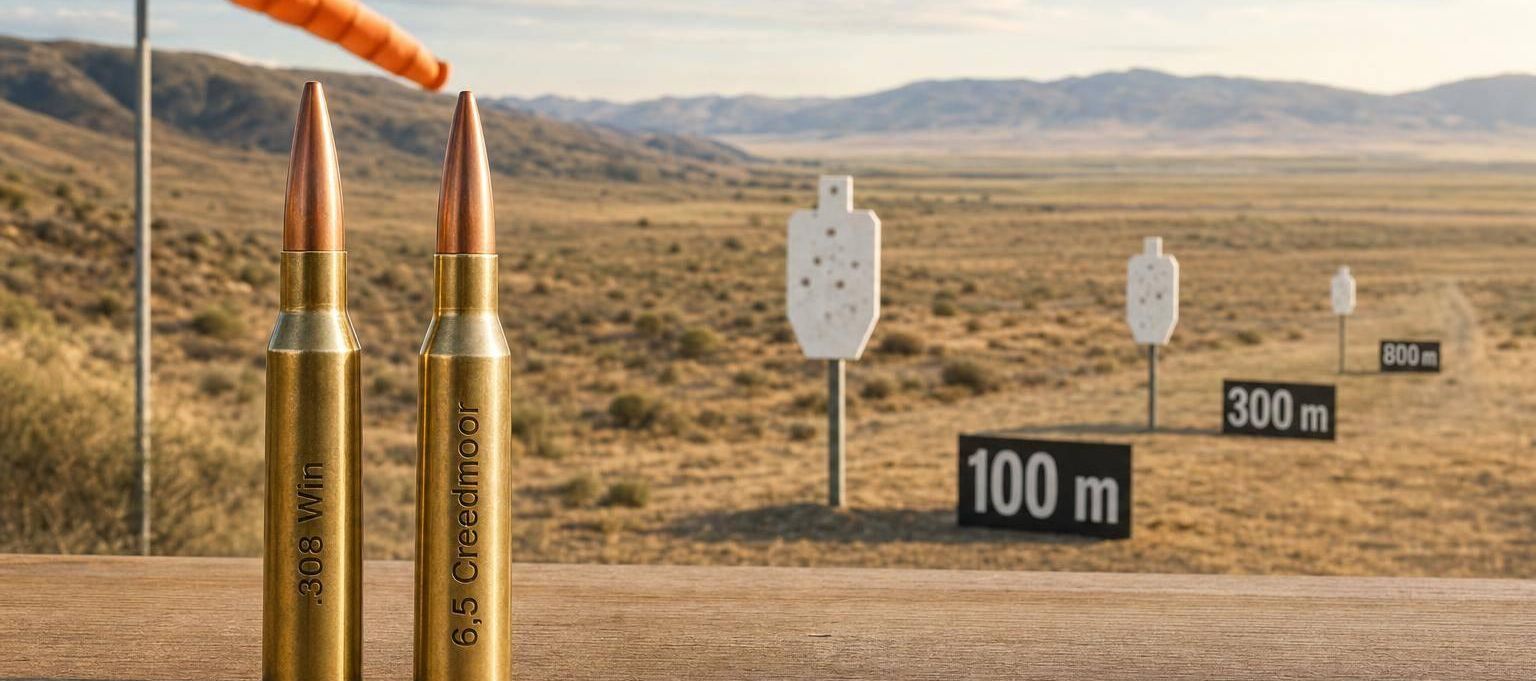
In short: Up to 300 m, the .308 Win is the obvious choice for many hunters. From 300 m on, the 6.5 Creedmoor usually has the edge in trajectory, wind drift, and velocity at distance.
I see the core of the comparison like this: .308 Win delivers a lot of substance at short to medium range, is widespread, and is well established for hunting from roe deer to red deer. 6.5 Creedmoor plays to its strengths where shots get longer and crosswind becomes a factor. With a 100-m zero, the 6.5 CM at 300 m is often around −20 to −22 cm, while the .308 is more like −25 to −30 cm. At 4.5 m/s crosswind, the 6.5 CM drifts about 30 to 35 cm at 400 m, while the .308 drifts more like 40 to 50 cm.
If you just want the result, here it is:
- 0 to 300 m: .308 Win often fits very well
- 300 to 500 m: 6.5 Creedmoor is usually ballistically ahead
- Over 500 m: 6.5 Creedmoor generally retains velocity and energy better
- The main factors in the comparison are:
- velocity
- residual energy
- bullet drop
- wind drift
Quick Comparison
| Point | 6.5 Creedmoor | .308 Winchester |
|---|---|---|
| Bullet diameter | 6.72 mm | 7.62 mm |
| Typical hunting weights | 120 to 147 gr | usually heavier than 6.5 CM |
| Trajectory from 300 m | flatter | steeper drop |
| Wind drift from 300 m | less | more |
| Short to medium range | strong | very strong |
| Long range | advantage | loses ground |
My conclusion upfront: If you mostly hunt in the woods, on short clearings, or up to about 200 to 250 m, the .308 Win is often more than enough. If you often hunt in fields or mountains and want to place shots cleanly beyond 300 m, ballistically the 6.5 Creedmoor is the better choice.
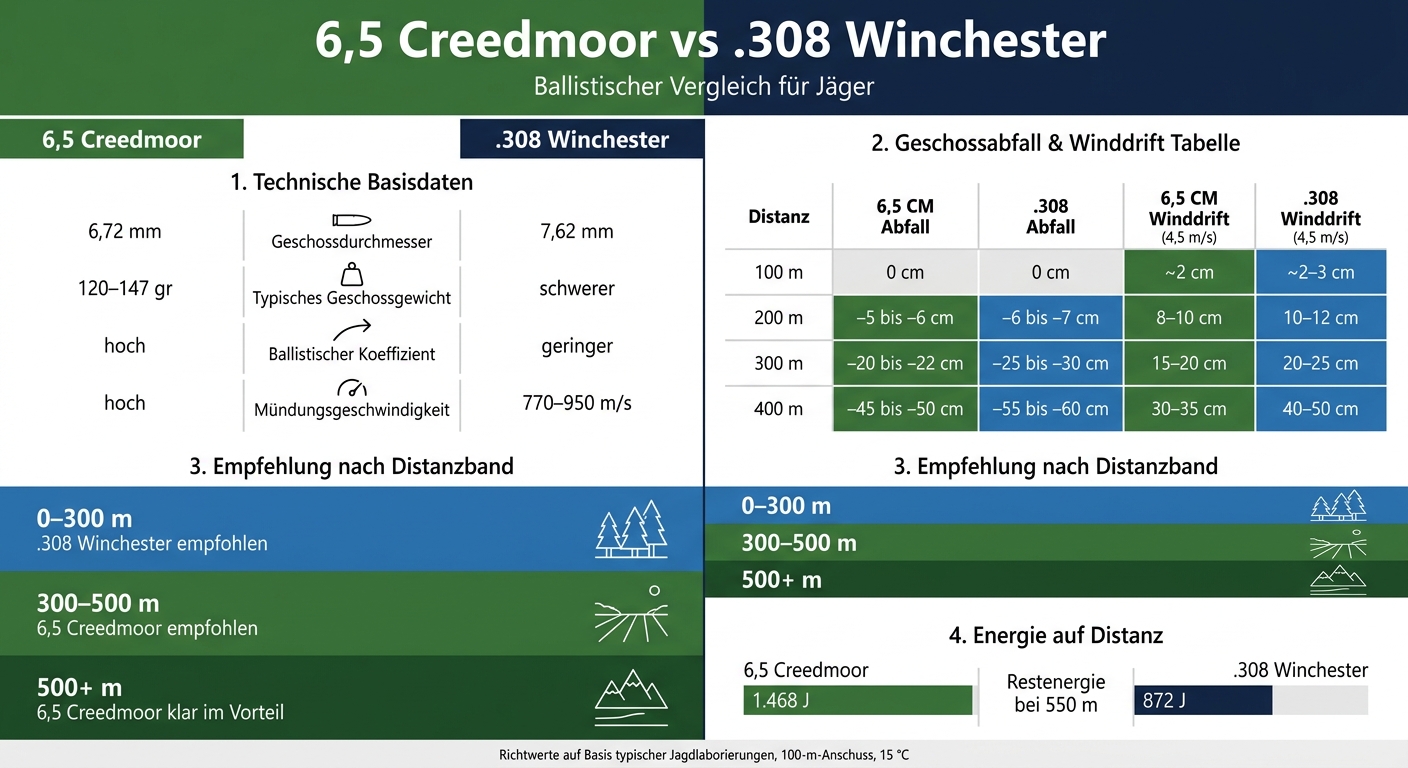
6,5 Creedmoor vs .308 Winchester: Ballistics Comparison at a Glance
Technical Basics of Both Cartridges
Bullet Diameter and Typical Hunting Bullet Weights
The 6.5 Creedmoor fires bullets with a 6.72 mm diameter [1]. The .308 Winchester is at 7.62 mm [3][2].
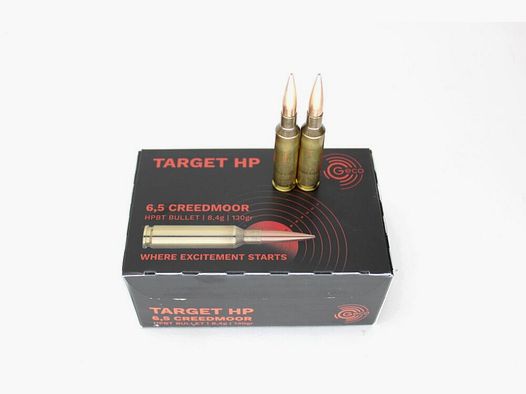
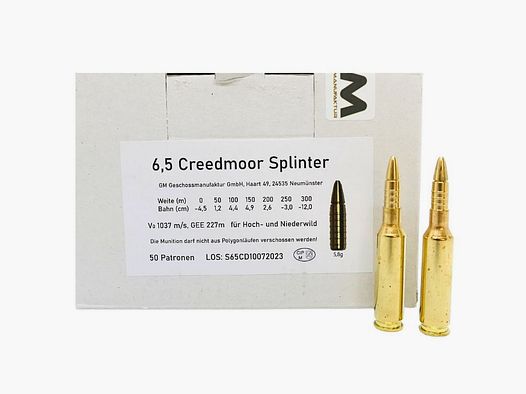
There is also a clear difference in hunting bullet weights: The 6.5 Creedmoor usually ranges between 120 to 147 grain or about 7.8 to 9.5 g [1]. These basic data play a big role later. They affect how quickly both cartridges lose velocity and energy and how stable they remain in flight over longer distances.
Muzzle Velocity and Ballistic Coefficient
The .308 Winchester has a muzzle velocity depending on the load of 770 to 950 m/s [3]. The 6.5 Creedmoor often scores with the higher ballistic coefficient, or BC, of its slim 6.5 mm bullets [1].
What does this mean in practice? A high BC slows a bullet down less in the air. This means it retains its velocity better and drifts less in crosswinds. This is exactly the big advantage of the 6.5 Creedmoor over longer distances, especially from about 150 m and beyond [1][3].
| Feature | 6.5 Creedmoor | .308 Winchester |
|---|---|---|
| Bullet Diameter | 6.72 mm [1] | 7.62 mm [3][2] |
| Typical Hunting Bullet Weight | 120–147 gr (approx. 7.8–9.5 g) [1] | – |
| Muzzle Velocity | high [1] | 770–950 m/s [3] |
| Ballistic Coefficient | high [1] | lower than 6.5 Creedmoor |
Now it gets exciting: These exact differences later result in deviations in velocity, energy, and trajectory over distance.
sbb-itb-1cfd233
Is 6.5 Creedmoor Really Better Than .308?
Velocity and Energy at Distance
Looking at muzzle velocity and BC, it quickly becomes clear: Both cartridges lose velocity over distance, but not at the same rate.
Compared here are a 6.5 Creedmoor with a 140-gr hunting bullet and a .308 Winchester with a 165-gr hunting bullet. The values are example calculations. They can vary depending on manufacturer, bullet design, and load.
A manufacturer datasheet for the 6.5 Creedmoor lists 800 m/s at the muzzle, 746 m/s at 100 m, 695 m/s at 200 m, 645 m/s at 300 m, and 598 m/s at 400 m. The energy drops from 2,944 J to 1,644 J.[6]
For the .308 Winchester, the velocity loss over distance is greater. Listed are 570 m/s at 274 m and 438 m/s at 457 m. The 6.5 Creedmoor in the same comparison is at 755 m/s and 650 m/s respectively.[4]
Velocity and Energy up to 300 m
Up to 300 m, the differences are not huge yet. Both cartridges remain very effective for hunting in this range. The .308 Winchester shows its strengths mainly at short and medium distances, and up to about 300 m the practical difference is often small.
Velocity and Energy beyond 300 m
From this point, the gap widens a bit. Beyond about 300 m, the 6.5 Creedmoor retains velocity and energy better. A comparative analysis lists 1,468 J for the 6.5 Creedmoor at 550 m, and about 872 J for the .308 Winchester.[5]
Energy in joules is only part of the picture. Impact velocity, bullet construction, and whether the bullet reliably expands also matter.
Trajectory and Wind Drift
Besides residual energy, two factors often decide in the field: trajectory and wind drift.
Bullet Drop at Hunting Distances
When zeroed at 100 m, it becomes quite clear how the trajectory of both cartridges develops over distance. The basis is the hunting loads mentioned above.
The 6.5 Creedmoor stays noticeably flatter with increasing distance. Especially from 300 m on, the difference becomes clearer. The .308 Winchester is about 25–30 cm below the sight line there, the 6.5 Creedmoor about 20 cm. At 400 m, the .308 drops to around 55–60 cm, the 6.5 Creedmoor to about 45–50 cm.
Why is this important for hunting? Simply: At 300 to 400 m, even small errors in range estimation can greatly affect the shot.
| Distance (m) | 6.5 CM Bullet Drop (cm) | 6.5 CM Wind Drift at 4.5 m/s (cm) | .308 Win Bullet Drop (cm) | .308 Win Wind Drift at 4.5 m/s (cm) |
|---|---|---|---|---|
| 100 | 0 | approx. 2 | 0 | approx. 2–3 |
| 200 | approx. −5 to −6 | approx. 8–10 | approx. −6 to −7 | approx. 10–12 |
| 300 | approx. −20 to −22 | approx. 15–20 | approx. −25 to −30 | approx. 20–25 |
| 400 | approx. −45 to −50 | approx. 30–35 | approx. −55 to −60 | approx. 40–50 |
Reference values based on typical hunting loadings, 100-m zero, sight height 4–5 cm, temperature approx. 15 °C.
The difference becomes even clearer with crosswind.
Wind Drift and Hit Probability
Wind drift is often underestimated in everyday hunting. This is especially true in open terrain, clearings, and mountain hunting. From about 300 m, it plays a major role in the shooting decision.
At 4.5 m/s crosswind – about 15 km/h – a typical .308 hunting bullet drifts 20–25 cm at 300 m. The 6.5 Creedmoor is around 15–20 cm under the same conditions. At 400 m, the gap widens further: The .308 reaches about 40–50 cm, the 6.5 Creedmoor about 30–35 cm. Around 20 cm wind drift at 300 m corresponds roughly to half a chest width on roe deer.[8]
The problem in the field: Wind can rarely be measured exactly. Shooting with a cartridge that allows a bit more margin for small wind errors provides a measurable safety advantage at distance. Especially from 300 m, wind drift can ultimately decide the shot.
Hunting Conclusion by Distance
When you combine energy retention, trajectory, and wind drift, the picture is quite clear.
Up to 300 m: .308 Win as a Solid Standard
Up to 300 m, the .308 Winchester is often the pragmatic choice. There is plenty of ammunition, including good availability of lead-free hunting loadings, and the hold point remains manageable up to about 200 to 250 m.[10]
From 300 m: 6.5 Creedmoor with clear advantage
From 300 m, the 6.5 Creedmoor has more going for it. At the latest from around 460 m, it shows a clearer advantage in external ballistics.[9] For roe and fallow deer, it often maintains the minimum energy up to about 460 to 500 m, while the .308 Winchester drops below this mark somewhat earlier depending on the load.[7]
The following overview sums up the result:
| Distance range | Stronger cartridge | Main argument |
|---|---|---|
| 0–300 m | .308 Winchester | More initial energy, wide bullet selection, easy handling |
| 300–500 m | 6.5 Creedmoor | Better energy retention, flatter trajectory, less wind drift |
| Over 500 m | 6.5 Creedmoor | Significantly better external ballistics in all categories |
Rifle, optics and ammunition can be found on Gunfinder.
FAQs
Which cartridge forgives wind errors better?
In wind, the 6.5 Creedmoor usually has the edge. The reason is simple: its bullet shape and high ballistic coefficient help it to be less pushed sideways at medium and long distances.
The .308 Winchester reacts more noticeably to crosswind. At 10 m/s, the lateral deflection at 300 m can reach up to 50 cm. Using heavier bullets can reduce this effect somewhat for both calibers.
Which load was compared?
No fixed load was directly compared. The sources therefore do not provide a specific combination of bullet type, powder charge, and primer.
Instead, the calibers are compared on a general level. For the 6.5 Creedmoor, typical bullet weights of 120 to 147 Grain are considered. For the .308 Winchester, the focus is mainly on basic ballistic characteristics, i.e. velocity, energy retention, and trajectory.
From when is 6.5 Creedmoor really worth it?
The 6.5 Creedmoor is especially a good choice for you if you value a flat trajectory, high precision, and low wind drift – and don’t want a harsh recoil.
It really shows its strengths at long range. This applies especially to long-range disciplines and hunting light to medium game at medium and long distances up to 1,000 meters.