Hunting bullet for handguns: hollow point or hard cast

To put it simply: For the finishing shot with a handgun, hard cast is usually the safer choice for wild boar, hard bones, and angled shots. Hollow point fits better for light game, broadside shots, and enough velocity. In Germany, I also have to consider the minimum energy of 200 joules and sometimes lead-free regulations in the federal state.
For me, the choice boils down to four points:
- Game type: light game or heavy animal
- Shooting angle: clean broadside or unfavorable/frontal
- Barrel length: short barrel often costs velocity
- Bullet effect: early expansion or deep penetration
The core difference is simple:
Hollow point releases energy early and often creates a wide, but not always deep wound channel. Hard cast penetrates deeper, stays stable in shape, and often produces an exit wound. This can make tracking easier but also carries a higher risk of overpenetration.
What I look at first:
- For roe deer and close finishing shots, hollow point can work well
- For large wild boar, I prefer hard cast
- With short barrels, hollow point often becomes trickier
- If lead-free is mandatory, deformation bullets often come into play
In short: I don’t choose by feel, but by angle, game weight, barrel length, and local laws.
The Differences Between Full Metal Jacket, Hollow Point, Zombie Max, and S&W 500 - Let's Shoot #104
sbb-itb-1cfd233
Quick Comparison
| Criterion | Hollow Point | Hard Cast |
|---|---|---|
| Effect | early expansion | deep penetration |
| Penetration | medium to limited | high |
| Bone performance | can stop early | usually good |
| Exit wound | not always certain | often likely |
| Short barrel | sometimes tricky | usually more predictable |
| Game meat | more tissue effect possible | often less, depending on hit |
| Risk | too little depth | overpenetration |
| More suitable for | light game, broadside | wild boar, hard angles |
I see it this way: There is no universally better bullet. I take what makes the shot safe and clean under my conditions.
How Handgun Bullets Work: Penetration and Expansion
That’s exactly why it’s worth looking at the effect inside the game animal: penetration and energy transfer decide hunting success. For handgun bullets, it’s mainly about the interplay of these two factors.
The Conflict Between Penetration and Expansion
In German close-range hunting with handguns, this conflict plays a big role. Expanding bullets transfer their energy early in the tissue. That can be good, but it also slows the bullet down faster.
And that’s exactly the problem: handguns usually reach lower muzzle velocities than rifles. If a bullet expands too early, it might not even reach the organs in a heavy game animal.
If a hollow point bullet hits the shoulder blade or other hard structures, it can stop before reaching the chest cavity. Hard cast bullets, on the other hand, more often reach the organs even from unfavorable angles. This is a point you shouldn’t underestimate in practice.
What Test Media Show – and What They Don’t
Lab values help with classification, but they don’t replace real hunting practice. Ballistic gelatin shows penetration depth and expansion under standard conditions. What it doesn’t show is the real mix of hide, muscle, and bone.
That’s why it’s not just about the gel on the test table. What really matters is the resistance the bullet actually encounters inside the game animal.
“If the bullet hits too little resistance and therefore doesn’t expand sufficiently and doesn’t transfer enough energy, it may initially leave too little effect inside the game animal.” - Gunfinder Magazin [4]
For hunting practice, the real shooting situation always counts in the end. That’s why the next step is a direct comparison of hollow point and hard cast bullets.
Hollow Point and Hard Cast in Hunting Practice: Strengths and Limits
In the field, it’s not lab tests that count, but what the bullet actually does inside the game animal.
Hollow Point Bullets: Fast Expansion, Limited Penetration
Hollow point bullets show their strengths especially on light game and a clean broadside shot. They transfer energy quickly and create a wide wound channel. This can work very well as long as the conditions are right.
With heavy game or unfavorable angles, it often looks different. If the bullet hits hard structures, it can stop too early. Another point is that with short barrels, the risk increases that hollow points don’t expand properly [5].
Hard cast bullets: deep penetration, stable shape
Hard cast bullets stand for deep penetration while remaining shape-stable. This is often a big plus in hunting practice. Due to the high likelihood of an exit wound, tracking is often easier [2][4][1][5].
The downside is obvious: Overpenetration is a real risk.
Which bullet fits which game and angle
Decisive are mainly game size and shooting angle. In other words: Not every bullet fits every situation.
| Situation | Recommendation |
|---|---|
| Wild boar, heavy game | Hard cast |
| Oblique or unfavorable shooting angle | Hard cast |
| Light game, broadside | Hollow point |
| Short barrel, unknown impact velocity | Hard cast or hollow point for low velocity |
At short range and with little resistance, hollow points can work very well. For wild boar and hard bones, hard cast is usually the more robust choice. This determines which loading fits better in the hunting area.
Direct comparison: Hollow point vs. Hard cast in handgun hunting
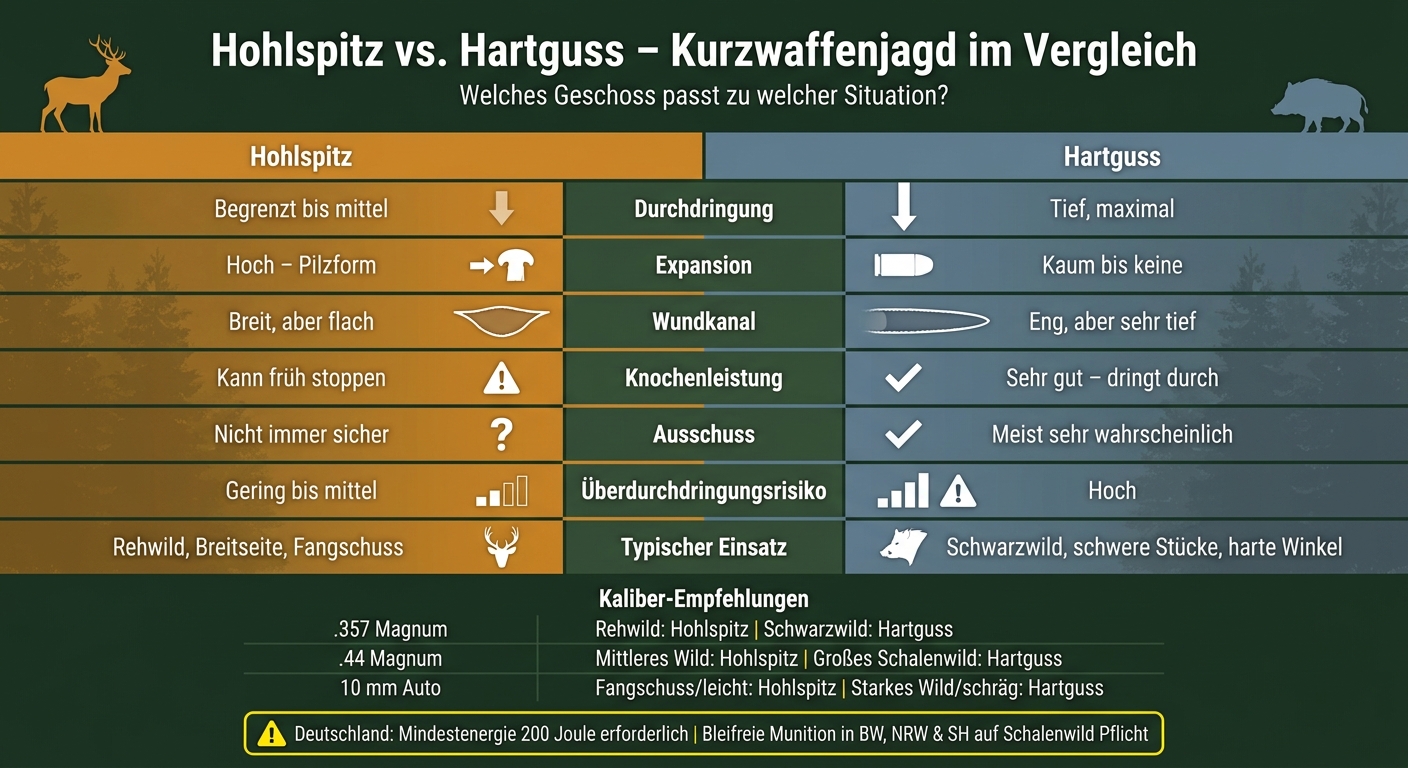
Hollow point vs. Hard cast: Handgun ammunition in hunting comparison
After the basics, a direct look at practice is worthwhile. Hollow point and Hard cast are not just two variants for the same purpose. They solve different tasks in the hunting area. In the end, three points count above all: Expansion, penetration depth, and exit wound.
Performance comparison by hunting criteria
| Criterion | Hollow point | Hard cast |
|---|---|---|
| Penetration | Limited to medium | Deep, maximum |
| Expansion | High (mushroom shape) | Little to none |
| Wound channel | Wide, but potentially shallow | Narrow, but very deep |
| Game meat damage | Moderate; hematomas may increase with bone hits | Usually less, but hit-dependent |
| Bone performance | May cause early expansion or stoppage on hard hits | Very good; also penetrates heavy bones |
| Exit wound | Not always certain on large game | Usually very likely due to mass stability |
| Typical application | Roe deer, coup de grâce | Wild boar, heavy game |
Especially in handgun hunting, the difference quickly becomes visible. Hollow point works through expansion and energy transfer. Hard cast relies more on a straight, deep path through the target. That’s why barrel length, game weight, and shooting angle play a big role. A short barrel can cost speed with hollow points. And it’s often this speed that the bullet needs to work properly.
Pros and Cons in Common Handgun Setups
Hollow point depends heavily on residual velocity. Hard cast is much less dependent on that.
| Feature | Hollow Point | Hard Cast |
|---|---|---|
| Short Barrel Suitability | Depends on residual velocity | Independent of expansion |
| Availability in Germany | Usually well available | More often as specialty load |
| Recoil | Normal | Tends to be higher, often due to heavier projectiles |
| Overpenetration Risk | Low to medium | High |
This is not a minor detail but often the crucial point in use. A hollow point bullet can behave quite differently from a short revolver or pistol barrel than from a longer barrel. Hard cast is often more predictable here because it doesn’t need to expand first to fulfill its purpose.
There’s also a point that must be considered immediately in Germany: In several federal states, such as Baden-Württemberg, NRW, and Schleswig-Holstein, lead-free ammunition is mandatory. Lead-free deforming bullets functionally follow the same effect logic as hollow points.
Which load fits best is usually decided by the interplay of caliber and barrel length.
Caliber Guide: .357 Magnum, .44 Magnum, and 10 mm Auto
The choice of caliber directly follows the effect principle. Should the bullet expand or penetrate as deeply as possible? That’s exactly what determines which load makes sense.
With the .357 Magnum, hollow point is a good choice for roe deer and the coup de grâce. For strong wild boar, heavy hard cast loads are usually the better option because they are designed for deep penetration.
The .44 Magnum works well with both bullet types. Hollow point delivers a lot of energy on medium-sized game. For the largest European hoofed game, hard cast is considered suitable because it provides maximum depth.
The 10 mm Auto lies between these two extremes. Hollow point fits well for coup de grâce and lighter game. Those hunting strong game or expecting difficult angles tend to choose hard cast because the deeper penetration offers more reserve.
Finding the right load for your setup
Simple decision path for German hunters
After comparing hollow point and solid copper, it’s now about the load that fits your setup. Pay special attention to game weight, shooting angle, barrel length, and the effect you need. Hollow point stands for rapid expansion. Solid copper plays to its strengths with reliable penetration. Especially with short barrels, there’s often a catch: expansion doesn’t always work reliably. Solid copper usually reacts much more calmly to this.
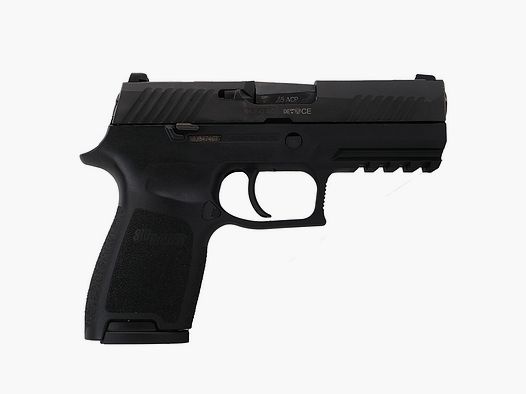
Once the basic direction is set, first check the legal situation, the energy, and your barrel length. In Germany, handguns may only be used for the killing shot as well as in burrow, trap, and catch hunting. Before you decide, measure with a chronograph whether you reach 200 J with your barrel length.[3][9]
Find the right load and tune it to your firearm
Before buying, it’s worth checking your federal state’s regulations on lead-free ammunition. Several federal states have banned lead-containing ammunition for hoofed game.[6][7][8] In Baden-Württemberg, lead-containing ammunition is generally prohibited for hoofed game. The killing shot is exempted there; however, in state-owned hunting districts, only lead-free ammunition may be carried.[6][7][8] If you have to hunt lead-free or want to do so deliberately, lead-free expanding bullets with controlled expansion are usually the obvious choice.
On Gunfinder you can specifically filter for handgun ammunition, for example by caliber and bullet type. Once you’ve found a load, the practical test at the shooting range follows. There you’ll see if the point of impact fits and if the ammunition runs cleanly in your firearm. Both must be right before the cartridge goes into the field.
In the end, the ratio of expansion and penetration in the specific use counts for the selection
In the end, it’s not hollow point or hard cast alone that matters. What’s crucial is the interplay of game species, caliber, and the use you have ahead of you. That’s why the final check always belongs on the range: point of impact and function must fit.
FAQs
When is hard cast the better choice?
Hard cast is the better choice if you want as uniform an effect as possible in the game body with a handgun shot, without the bullet breaking into many pieces.
Deforming or monolithic bullets mushroom in a controlled way and retain most of their weight. This usually ensures deep effect in the target, good energy transfer, and rather an exit wound – provided there is enough resistance in the game body for the bullet to mushroom cleanly.
When does hollow point work reliably?
Hollow point bullets work reliably when the impact velocity is high enough and the target offers enough resistance. In this case, the desired mushroom-shaped deformation occurs on impact.
At long distances, they are often less suitable than other bullet types due to the usually higher air resistance at the open tip.
What applies legally in Germany?
In Germany, there are clear rules for hunting. For the killing shot with handguns, § 19 of the Federal Hunting Law requires at least 200 joules of muzzle energy, measured at a 150 mm barrel length.
That sounds clear at first. In practice, however, there is a catch: Many hunting revolvers have shorter barrels. As a result, the actual energy is often lower than the measured value the regulation refers to.
That’s exactly why calibers like the 7.65 mm Browning are not recommended for this purpose. There is also another fixed point: Incendiary bullets are fundamentally prohibited.