Tracer vs. Brandmunition: Differences explained

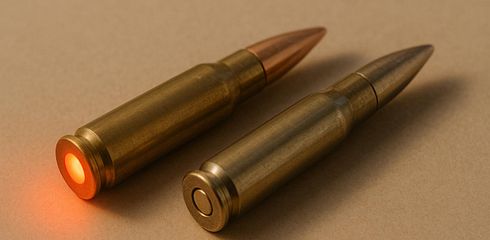
Tracer and incendiary ammunition clearly differ in function and application. Tracer (tracer ammunition) shows the trajectory of a projectile through a glowing trail, while incendiary ammunition is specifically designed to ignite targets such as fuel depots or ammunition storage facilities.
Main Differences:
- Tracer: Pyrotechnic charge at the base of the projectile, visible during flight, used for target correction.
- Brandmunition: Chemical incendiary charge in the core, ignites upon impact, intentionally causes fires.
Important: In Germany, the possession of both types of ammunition is prohibited for private individuals. However, they are used militarily, depending on tactical requirements.
Quick Comparison
| Feature | Tracer (tracer) | Incendiary Ammunition |
|---|---|---|
| Function | Visible trajectory | Ignition upon impact |
| Construction | Pyrotechnic charge | Chemical incendiary charge |
| Visibility | High (during flight) | Low (only upon impact) |
| Flammability | Secondary (unintentional) | Primary (intentional) |
| Application Area | Target correction, training | Destruction of flammable targets |
Tracer ammunition provides visual support but carries risks such as revealing the shooter's position. Incendiary ammunition is more destructive but requires careful handling due to its high fire potential.
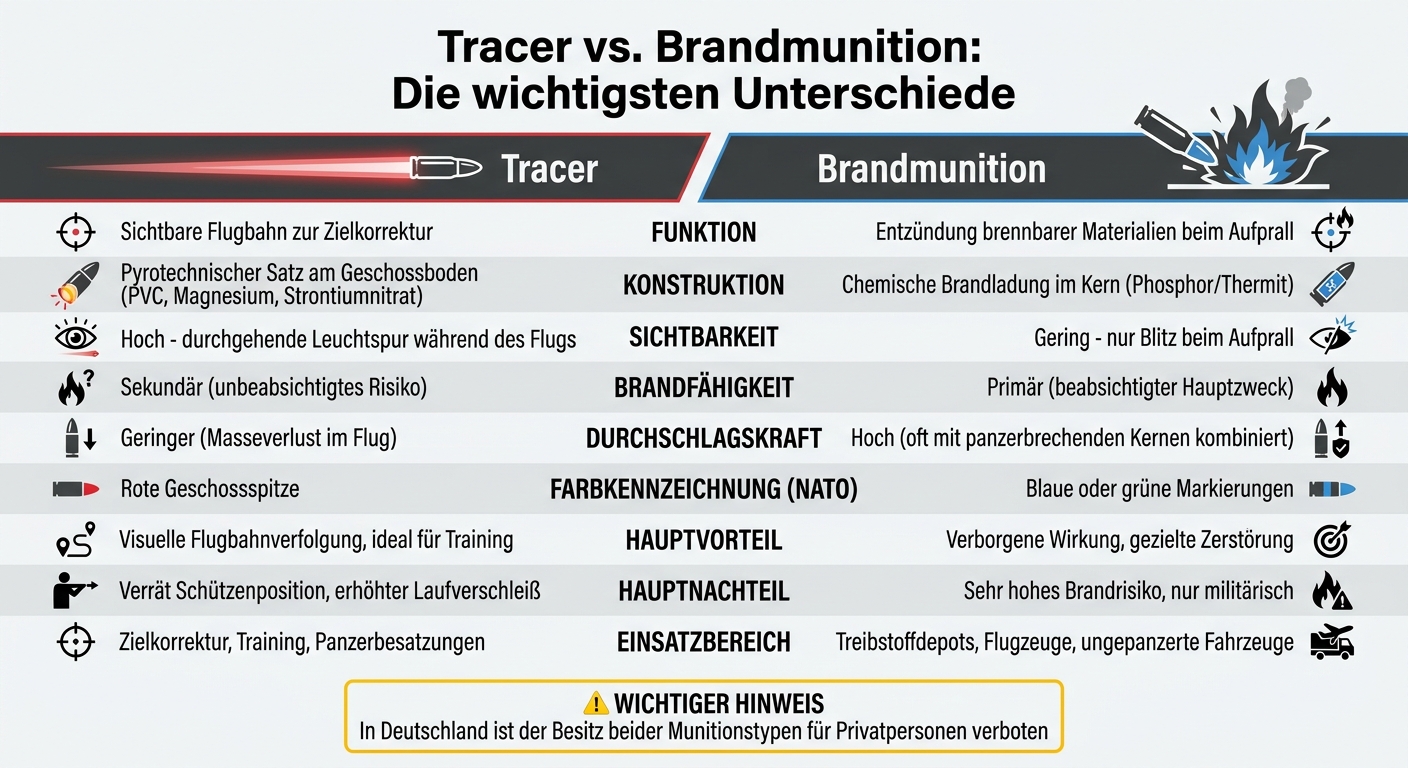
Tracer vs Incendiary Ammunition: Comparison of Main Features and Differences
Tracer ammunition
sbb-itb-1cfd233
Tracer ammunition: Function and Structure
Tracer projectiles have a hollow base filled with a special pyrotechnic mixture[1][4]. When fired, this mixture is ignited by the propellant powder, creating a luminous flight path[1][4]. The chemical composition typically consists of a metallic fuel such as magnesium or aluminum, an oxidizer like strontium nitrate or barium salts, and an organic binder such as polyvinyl chloride (PVC)[4].
Pyrotechnic Composition
The exact chemical mixture varies depending on the type of ammunition. For example, type R 321 (.30-06) contains 16% PVC, 26% magnesium powder, and 52% strontium nitrate. Type R 284 (M62/M196) consists of 17% PVC, 28% magnesium powder, and 55% strontium nitrate[4].
PVC plays a special role: it acts as a chlorine donor and cools the flame, improving color saturation[4]. Without PVC, magnesium would produce a bright white flame that detracts from the desired color saturation[4]. NATO-standard tracer ammunition uses strontium compounds for red traces, while ammunition from Russia and China often employs barium salts for green traces[1][4].
This chemical composition is crucial for the various applications and effects that tracer ammunition offers.
Military and shooting sports applications
Thanks to their special composition, tracer ammunition is used in various ways. Its main function is to facilitate target correction without the need for sighting devices[4]. For example, tank crews use it to detect external influences on the trajectory that cannot be captured by sensors[1].
There are three main types of tracer ammunition:
- Bright Tracer: This ignites immediately upon leaving the barrel and is instantly visible.
- Subdued Tracer: Here, ignition occurs only after about 90 meters to conceal the shooter's position.
- Dim Tracer: These are primarily visible through night vision devices[4].
However, the pyrotechnic charge also poses risks: it can unintentionally ignite dry vegetation or other flammable materials. Additionally, residues from magnesium and strontium lead to faster wear of the rifle barrel compared to conventional ammunition[1].
Incendiary ammunition: Function and structure
After examining tracer ammunition, it becomes clear how different incendiary ammunition is in its function and structure.
Incendiary ammunition aims to destroy both flammable materials and technical equipment[6]. Unlike tracer ammunition, which glows visibly during its flight, incendiary ammunition only takes effect upon impact: it ignites only when it reaches the target[5].
Inside, there is an incendiary charge made of highly flammable substances. Modern variants often use phosphorus fillings or thermite mixtures that can generate extreme temperatures: thermite can reach up to 2,500 °C, while white phosphorus burns at about 1,300 °C[5].
Chemical Incendiary Charge
The ignition occurs in different ways. Usually, a percussion primer is used, which triggers a chemical or pyrotechnic reaction upon impact[5]. White phosphorus ignites spontaneously as soon as the projectile casing breaks and the incendiary charge comes into contact with oxygen[5]. Thermite charges require a starter reaction to initiate the chemical reaction[5]. Some projectiles use a casing made of electron, a magnesium alloy that ignites due to the heat of the internal charge and produces additional effects at around 1,300 °C[5].
Anti-Material Applications
The high reactivity of these charges makes them suitable for special operations.
Incendiary ammunition is specifically used against various targets. It is suitable for both soft targets like fuel depots or unarmored vehicles and harder targets like aircraft[5]. A historical example is February 21, 1916, when explosive incendiary ammunition was successfully used against the Zeppelin LZ 47[3]. Modern explosive incendiary ammunition combines explosive and incendiary effects: first, an explosive charge penetrates the outer shell of the target – for example, a fuel tank or an aircraft fuselage – and then the incendiary charge ignites the leaking fuel[3]. This combination leads to secondary explosions and fires that would not be possible by impact alone[5].
Main Differences Between Tracer Ammunition and Incendiary Ammunition
Tracer ammunition and incendiary ammunition have different tasks and areas of application. Tracer ammunition is used to make the trajectory of a projectile visible. For this purpose, it contains a pyrotechnic charge at the base of the projectile, which ignites upon firing and produces a highly visible trace during flight[1]. Incendiary ammunition, on the other hand, is specifically designed to cause fire upon impact. It is primarily used to destroy flammable materials such as fuel tanks or aircraft structures[7].
While tracer ammunition can reveal the shooter's position due to its continuous trace, incendiary ammunition only unfolds its effect upon impact, often accompanied by a visible flash[1][7]. Additionally, tracer ammunition loses mass due to the combustion of the pyrotechnic charge, which reduces its penetration power. Incendiary ammunition, on the other hand, is often equipped with armor-piercing cores that ignite after penetrating the target[1][7]. The following table summarizes these differences clearly.
Function and Construction Comparison
| Feature | Tracer Ammunition | Incendiary Ammunition |
|---|---|---|
| Primary Function | Visible trajectory and target correction[1] | Ignition of flammable materials[7] |
| Construction Feature | Pyrotechnic charge at the projectile base[1] | Chemical incendiary charge in the core[7] |
| Visibility | High (continuous trace)[1] | Low (only flash upon impact)[7] |
| Flammability | Secondary (accident risk)[1] | Main purpose[7] |
| Penetration Power | Lower, due to mass loss in flight[1] | High, often combined with AP cores[7] |
| Risk Factors | Reveals shooter position[1] | High destructive power against electronics/fuel[7] |
The differences are not only functional but also visually recognizable.
Color Coding and Identification
According to NATO standards, tracer ammunition is typically marked by a red projectile tip[1]. Incendiary ammunition, on the other hand, usually has blue or green markings. Historically, phosphorus incendiary rounds often left a blue smoke trail[7]. However, these color codes vary depending on the manufacturer and country of origin. Russian and Chinese tracer ammunition, for example, uses green tips with barium salts[4]. Therefore, it is important to check the specific manufacturer markings to ensure safe identification.
Advantages and Disadvantages of Different Types of Ammunition
Both types of ammunition have specific advantages and disadvantages. Tracer ammunition has the advantage of allowing visual tracking of the flight path, which is particularly useful in training situations. In the Bundeswehr, for example, a ratio of 3:2 (three regular rounds, two tracer rounds) is used in shooting exercises to train shooters efficiently [1][2]. However, the glowing trail can reveal the shooter's position, especially when observers are positioned to the side, above, or below [1].
Incendiary ammunition, on the other hand, offers a concealed effect, as its ignition becomes visible only upon impact. This allows for more tactically flexible use in combat. However, it carries an extremely high fire risk, as it is specifically designed to ignite targets.
Both types of ammunition also have an increased risk of starting fires. The burning pyrotechnic charge of tracer ammunition can unintentionally cause forest or field fires [1][2], while incendiary ammunition intentionally creates this effect.
Another disadvantage of tracer ammunition is the increased maintenance effort. Its pyrotechnic composition – consisting of PVC, magnesium powder, and strontium nitrate – leaves residues that accelerate barrel wear [1][2].
Advantages and Disadvantages in Comparison
| Feature | Tracer Ammunition | Incendiary Ammunition |
|---|---|---|
| Main Advantage | Visible trajectory tracking and more effective shooter training [1][2] | Concealed effect until impact; targeted ignition upon impact |
| Main Disadvantage | Reveals the shooter's position; trajectory can deviate due to mass loss [1] | Very high fire risk; classified as military material |
| Maintenance Effort | High – residues accelerate barrel wear [1][2] | Varies depending on construction |
| Legal Situation (Germany) | Possession is punishable for civilians [1] | Possession is punishable for civilians |
| Fire Risk | High – unintended fires possible [1][2] | Very high – ignition is intentional |
| Availability | Military or with special permission for collectors [1] | Exclusively military |
The table clearly shows that both types of ammunition have specific applications and limitations. While tracer ammunition is particularly helpful in training, the use of incendiary ammunition requires careful consideration due to its high risk potential.
Conclusion: Choosing the Right Ammunition
The differences in function and application of the two types of ammunition are crucial for the choice. Tracer ammunition is suitable for correcting the trajectory, while incendiary ammunition is intended for targeted ignitions.
For private individuals in Germany, the possession of both types of ammunition is strictly prohibited – regardless of their intended use. This legal regulation is clear and binding.
In the military context, additional considerations come into play. Tracer ammunition can reveal one's position due to its visible trail, and the mass loss during flight can affect precision. Furthermore, it leads to faster wear of the weapon's barrel. Incendiary ammunition, on the other hand, poses a significant risk of uncontrolled fires and therefore requires careful planning and safe application.
The previously presented comparison tables provide a good basis for weighing the advantages and disadvantages of each type of ammunition. Ultimately, the choice should always consider environmental conditions, tactical requirements, and available safety precautions.
FAQs
How can you safely identify tracer and incendiary ammunition from the outside?
You can identify tracer ammunition by a small pyrotechnic charge at the end of the projectile. This creates a bright signal when fired, making the trajectory visible – often in red or orange. Incendiary ammunition, on the other hand, is specifically designed to ignite targets. It differs by special shapes, sizes, or markings that can vary depending on the type. It is important to pay attention to these visual characteristics to safely avoid confusion.
How much does tracer ammunition affect precision and barrel wear?
Tracer ammunition has a noticeable impact on precision and barrel wear. The pyrotechnic charge generates temperatures of up to 1,650 °C, which can cause the barrel to wear out faster. Nevertheless, precision generally remains intact as long as the rifling of the barrel is undamaged. However, with frequent use, regular maintenance or replacement of the barrel is necessary to keep shooting accuracy at a high level.
What risks arise from tracer and incendiary ammunition in the field?
The greatest danger of tracer and incendiary ammunition in the field lies in the high fire risk. Tracer ammunition contains pyrotechnic components that glow brightly when fired. In dry and vegetation-rich areas, these can easily trigger fires. Additionally, the visible tracer trails make the shooter's position recognizable, which poses a safety risk, especially in uncontrolled use or in sensitive areas.