Light hunting shoes vs. heavy boots
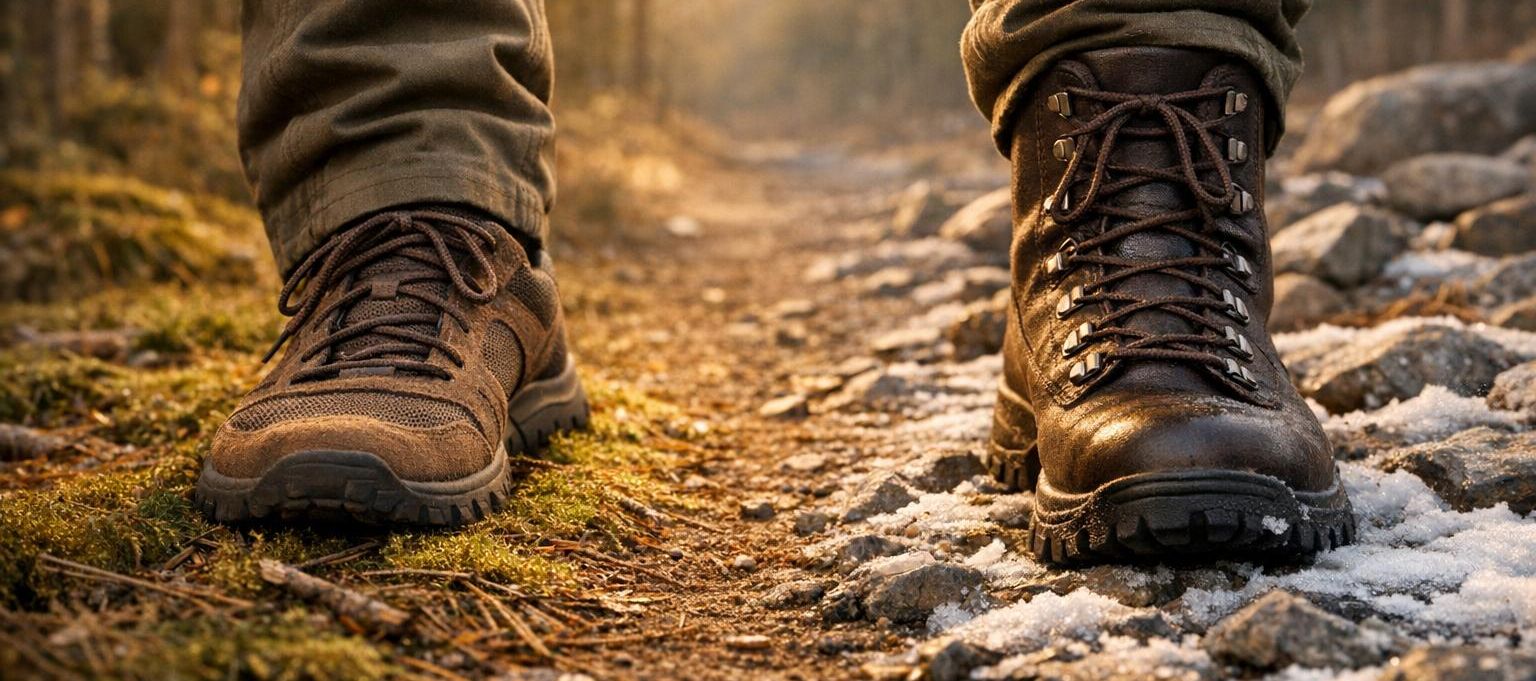
Which shoes are the right choice for hunting? It depends on terrain, weather, and duration of the hunt. Light hunting shoes offer comfort and mobility, while heavy boots provide stability and protection in difficult terrain. Here are the main differences:
- Light Hunting Shoes: Ideal for flat, dry terrain and warmer temperatures. They are flexible, breathable, and make long distances easier.
- Heavy Boots: Perfect for steep, wet, or rocky terrain as well as cold conditions. They offer stability, better grip, and weather protection.
Quick Comparison
| Criterion | Light Hunting Shoes | Heavy Boots |
|---|---|---|
| Terrain | Flat, dry | Steep, wet, rocky |
| Comfort | High freedom of movement, less weight | Stability, protection from injuries |
| Weather | Warm and dry | Cold, wet, wintry |
| Durability | Shorter, less robust | Longer, durable |
| Examples | Härkila Forest Hunter GTX | Meindl Island Lady MFS Active |
The choice depends on your needs and conditions. For active hunts, light shoes are recommended, while sturdy boots are indispensable for demanding tasks.
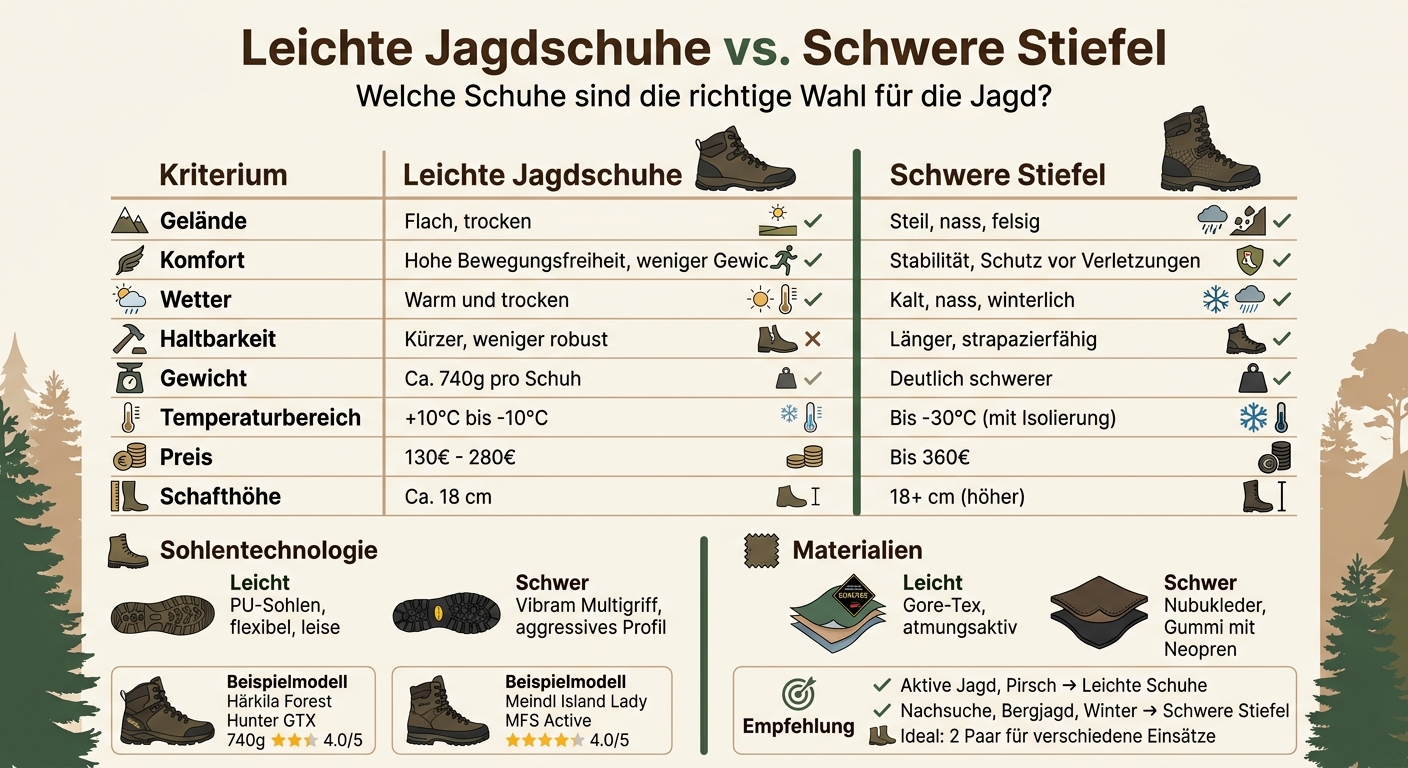
Light Hunting Shoes vs. Heavy Boots: Comparison by Terrain, Weather, and Use
Weight and Comfort Comparison
Weight Differences
On long marches, every gram counts – and this is where light hunting shoes excel. They reduce the strain and help you endure longer without your legs tiring. Especially on extended tours, the lower weight is noticeably beneficial.
Heavy boots, on the other hand, have their strengths in difficult terrain. They provide better protection against thorns and dense underbrush. Their robust, slip-resistant soles ensure secure footing, especially in mountainous regions with gravel or ice[2]. In steep, rocky areas, the extra weight is a price many hunters are willing to pay for more safety. Even though they are heavier, their protective function can increase comfort during longer hunts.
Comfort on Long Hunts
Comfort is not just a matter of weight, but above all of fit. Even the best boot is of no use if it pinches or rubs. High-quality hunting shoes are often equipped with shock-absorbing properties and ergonomic soles that prevent fatigue. Heavy boots additionally provide stability through their high shaft, which protects the ankle and prevents rolling.
Leather boots are extremely durable, but require a break-in period[2]. Lightweight shoes, on the other hand, are comfortable right away, offer more freedom of movement, and are excellent for a quiet stalk. Their breathability keeps feet dry and prevents blisters on warm days. While lightweight shoes impress with flexibility and comfort, heavy boots shine with stability and protection – a matter of priorities and intended use.
sbb-itb-1cfd233
Performance on Different Terrain Types
Flat and Dry Terrain
On flat, dry paths, lightweight hunting shoes are the best choice. They are specifically designed for flat terrain and warmer climates, offering significantly more flexibility than heavy boots. Polyurethane soles (PU) provide excellent cushioning, making them ideal for longer marches. Especially during active hunting or stalking in open terrain, mobility is crucial. Flexible soles allow for a more natural and quieter gait. An example is the Hart Trakai, which is equipped with a dual-layer sole. This improves ground feel and ensures good breathability – perfect for warm days. Heavy boots, on the other hand, often feel bulky on flat paths and can restrict freedom of movement [3][1].
However, while lightweight shoes excel on flat terrain, they are less suitable in more challenging environments.
Difficult and Wet Terrain
In challenging terrain, such as steep slopes, wet forests, or rocky ground, heavy boots are unbeatable. Their robust rubber soles, often featuring a Vibram multi-grip profile, provide secure footing even on slippery and uneven surfaces. With shafts that are about 18 cm high, they stabilize the ankle and reduce the risk of twisting. In extreme conditions – whether mud, rubble, or ice – aggressive sole profiles are indispensable. Tracking boots like the HAIX Nature Trace GTX have been specifically designed for such challenges. While rubber soles provide the necessary traction in these situations, PU soles in lighter shoes often do not offer the required grip. Here, the clear safety advantage of the heavier models is evident [1][3].
The Best Hunting Shoe for YOU 🥾 Points to Consider | Part 2
Materials and Weather Protection
The choice of materials and protection against weather influences are central criteria when deciding between lightweight hunting shoes and robust boots. These factors significantly determine how well the footwear withstands the respective conditions.
Breathability vs. Waterproofing
Lightweight hunting shoes equipped with technologies such as Gore-Tex and the HAIX Climate System ensure effective sweat management through a special pumping action – ideal at temperatures above 5 °C [1]. These features make them perfect for active movement hunts. However, they do not provide complete protection against prolonged wetness, such as during persistent heavy rain.
Heavy boots made of thick nubuck leather or rubber with neoprene lining, on the other hand, offer complete protection against water. Leather boots require regular maintenance, such as conditioning, to preserve their insulating properties. When leather gets wet, it cools the feet faster [2]. While rubber boots are maintenance-free, they have weaknesses in moisture regulation. Especially during long marches, this can lead to excessive sweating and unpleasant odors [2].
In addition to moisture regulation, temperature insulation plays an equally important role.
Temperature Range and Insulation
Light hunting boots are designed for temperatures above 5 °C. They rely on quick evaporation of sweat rather than heat retention. An example is the Härkila Forest Hunter GTX, which weighs only about 740 g per shoe despite its robust leather construction and is suitable for temperatures between +10 °C and -10 °C [1].
For extreme cold, winter boots with thermal insulation or NEOTANE inserts are essential. These withstand temperatures down to -30 °C [4]. NEOTANE boots offer insulation down to -20 °C and are about 40% lighter than conventional PVC or rubber boots [5]. Especially during sit-and-wait hunting in winter, thickly padded boots are essential, as blood circulation in the feet significantly decreases at temperatures around freezing [2]. It is advisable to choose winter boots one size larger to allow room for thick socks and not to impede blood circulation [4].
Sole Construction and Grip
In addition to weight and weather resistance, grip plays a crucial role – depending on the area of use, you can choose between flexible and aggressive profiles. The sole significantly influences how quietly and safely you move in the terrain.
Quiet Soles vs. Aggressive Profiles
Flexible soles provide precise ground feel and reduce disturbing noises like cracking branches. An example of this is the Härkila Stalking sneaker GTX (€279.95), which was specifically developed for controlled, quiet movements [7]. The technical team from Jihua 3515 describes the approach behind it as follows:
"The core principle is energy saving. By exchanging the extreme stiffness and weight of traditional boots for modern materials, you save a small amount of energy with every step." [6]
For rough terrain or challenging conditions, such as those encountered during driven hunts in winter, heavy boots with stiff, aggressive outsoles are ideal. Models like the Meindl Island Lady MFS utilize Vibram® technology Meindl Multigriff®, which provides maximum grip even on frozen ground or steep slopes [1]. This construction also prevents the sole from bending under heavier loads over 22.5 kg [6].
Another advantage of heavy boots is the ability to replace the soles. This not only extends their lifespan but also ensures consistent grip – an option often missing in lighter, synthetic models [6]. For extremely muddy conditions, there are special variants like the 3515 Spiked Camouflage Boots, which provide additional grip with integrated spikes in the rubber sole [6].
The choice of sole therefore heavily depends on the area of use: Flexible soles are ideal for long distances on dry ground, while aggressive profiles excel on rocky, steep, or icy terrain. Material and construction ultimately determine whether you are safe and efficient on the move.
Ankle Support and Durability
A clear advantage of heavy boots is the stabilization of the ankle. Their high shaft prevents rolling, especially in rough or narrow terrain, thus providing protection against injuries [2].
The Memory Foam System (MFS) from Meindl elevates comfort to a new level. It adapts individually to the ankle and shaft through body heat. The Meindl Island Lady MFS Active is an example of this technology and has a rating of 4.0/5 on Gunfinder – particularly appreciated is the adaptability of the system [1].
Lightweight shoes with a shaft height of about 18 cm combine freedom of movement with additional protection. Nevertheless, material quality plays a crucial role when it comes to durability.
For daily use, such as stalking in fields and forests, robust leather boots with a medium to high shaft are ideal. They offer a balanced mix of comfort and the necessary stability for the joints [2].
Heavy boots particularly excel in their durability. Abrasion-resistant linings and robust outer materials like nubuck leather ensure they last a long time. Brands like Meindl also focus on sustainability and offer repair services that significantly extend the lifespan of the boots [1].
In extreme operations, such as tracking, heavy boots with a high shaft are indispensable. They impress with their hard, slip-resistant sole that withstands mechanical stress. In combination with gaiters, they provide additional protection against thorns and moisture, keeping the lower leg dry and secure [2].
While lightweight shoes focus on flexibility and mobility, heavy boots offer not only stability but also a significantly longer lifespan.
Conclusion: The right choice in hunting footwear
As already described, the choice of suitable hunting footwear heavily depends on individual requirements and the conditions of use. Whether light or heavy – the terrain, weather conditions, and type of hunting play a decisive role.
For stalking in fields and forests, lightweight, flexible shoes are recommended. They allow for quiet movement and are easier on the feet over longer distances. In mountain hunting or tracking in difficult terrain, however, heavy boots with a high shaft and slip-resistant soles, such as Vibram Multigriff, are indispensable. These not only provide stability but also protect against potential injuries.
In colder months, waterproof and insulated boots are essential to keep the feet warm and dry. At higher temperatures, breathable membranes like GORE-TEX ensure a pleasant foot climate. For driven hunts, which are often associated with long waiting times on slippery ground, boots should be chosen that provide both warmth and secure grip.
Price also plays a role in the selection. Lightweight tactical models start at around €130 to €180, while premium boots can cost up to €360. An example of modern leather boots is the Härkila Forest Hunter GTX, which, at only 740 g per shoe, is surprisingly light without losing robustness. Such differences in material and technology are reflected not only in the price but also in performance in the field.
On Gunfinder, you can discover a variety of hunting shoes – from new items to classifieds. With the help of intelligent filters, you can specifically search for certain criteria such as type of hunting, season, or special requirements. This allows you to directly compare models like the HAIX Nature One GTX (4.0/5) or the Meindl Gomera GTX (4.0/5) to make the ideal choice for your needs.
Since no footwear can cover all requirements, it is often sensible to own two pairs of shoes: one for movement-intensive hunts and a robust model for demanding operations.
FAQs
How do I find the right shoe size with thick socks?
To determine the appropriate shoe size for thick socks, you should measure your feet while standing, as they become slightly larger under load. Consider both the length and width of your foot. It is advisable to choose half to a full size larger. Also, use the size charts of the respective manufacturer to ensure that the shoes fit comfortably with the thicker socks.
When does a second pair of hunting boots really pay off?
A second pair of hunting boots can be a worthwhile investment if your current boots are reaching their limits – whether due to different areas of use or heavy wear. For hunting in alpine terrain, sturdy, heavy boots are suitable, while in flat, warm regions, lighter models are the better choice. Different boots also provide more comfort, better protection, and higher weather resistance in changing weather conditions or on longer tours.
Which sole is suitable for my hunting ground?
The choice of the right sole depends heavily on the ground conditions. Hard, slip-resistant soles are perfect when you are moving on uneven, icy, or stony terrain – they provide secure grip and stability. For flat and soft ground, however, a softer sole offers more comfort and flexibility.
Light boots are excellent for simple, flat paths, while heavier models provide additional protection and stability in difficult terrain. So think carefully about the requirements of your hunting ground and choose the sole accordingly.