Pyrotechnic compositions in incendiary ammunition: New substances

In short: More reactivity often brings more effect - and almost always more risk. I see five groups of materials that differ significantly in terms of ignition, heat, and storage. Legally, this is clear in Germany: incendiary ammunition is prohibited for civilians, and phosphorus and thermite ammunition are partially subject to the War Weapons Control Act.
If you just want to quickly categorize the text, here are the key points:
- Mg/Al nitrate compositions are the simple basic form: a lot of light, a lot of heat, but sensitive to moisture
- Thermite delivers the highest peak temperature at about 2,200 to 3,000 °C, but ignites only at a high threshold
- White phosphorus ignites at about 30 to 40 °C and is therefore particularly risky in storage
- Metal hydrides often ignite earlier than pure metal powders, but react sensitively to water and humidity
- Nano and hybrid compositions can lower the ignition temperature and release energy in a very short time, but are often more sensitive to friction, impact, and ESD
The pattern is clear:
easy ignition = more storage and handling risk
difficult ignition = usually more control before ignition
In practice, it’s not just about chemistry. I focus primarily on three questions:
- How easily does the composition ignite?
- How concentrated or widespread is the heat effect?
- How much does the mixture suffer from moisture, aging, or improper storage?
Quick Comparison
| Material Group | Ignition | Heat/Effect | Storage | Summary |
|---|---|---|---|---|
| Mg/Al Nitrate | medium | bright, hot, light-intensive | medium | simple basic type with moisture problem |
| Thermite | difficult | very hot, strongly concentrated | high | very high temperature, but high ignition threshold |
| Phosphorus | very easy | widespread, long-lasting | very low | easily igniting near use, tricky in storage |
| Metal Hydride | rather easy | light-intensive, energy-rich | low | early ignition, water contact problematic |
| Nano/Hybrid | rather easy to medium | short, strong heat pulse | medium | high reactivity, tight tolerances in storage |
A few numbers make the difference immediately visible: White phosphorus can burn in air at 30–46 °C, while thermite often ignites only at 600–900 °C or more. Nano-thermite can ignite significantly earlier than coarse mixtures, depending on the system. And in Mg/Nitrate systems, moisture can contribute to critical self-heating already in the range of 70 to 135 °C.
I do not interpret the material comparison as "new versus old." For me, the text shows something simpler: New formulations only shift the conflict between performance, ignition behavior, and stability. This is exactly what the rest of the article is about.
sbb-itb-1cfd233
1. Classic Magnesium/Aluminum Nitrate Formulations
Structure
These formulations consist of a metallic fuel – magnesium, aluminum, or magnalium – and a nitrate as an oxidizer. Typical oxidizers include KNO₃, NaNO₃, barium nitrate, and strontium nitrate. KNO₃/Mg systems react strongly exothermically. The mixing ratio is adjusted depending on the desired effect.
In practice, ratios between 60:40 and 50:50 (oxidizer:fuel) are common [4]. In military magnalium/nitrate pyrotechnic mixtures, the magnalium content is often 25–50 wt-%, and the nitrate content is 15–40 wt-% [6][7]. This simple metal/nitrate principle makes these formulations the basic form of many pyrotechnic compositions.
Ignition Behavior
Magnesium lowers the ignition threshold. Aluminum provides more energy density and often longer burn duration, but requires a stronger initial ignition. Nitrates act as oxidizers less aggressively than chlorates or perchlorates. Therefore, a separate igniter is often necessary.
However, this also has a clear advantage in a good sense: Compared to more reactive oxidizer systems, the ignition behavior remains more manageable. This is a plus for handling.
Heat Release
The effect is achieved through high flame temperatures and strong radiant heat. Depending on the formulation, melting metal particles also play a role, continuing to burn after release. One can imagine this like an effect with glowing: The mixture is not "finished" with the first ignition.
For Mg/nitrate illuminants, luminous values of 2–7 kcd·s·g⁻¹ are reported for green barium nitrate formulations up to 15–50 kcd·s·g⁻¹ for sodium-based white light illuminants [10]. These values refer to the luminous effect, not to the pure heat release.
Storage Stability
Classic Mg/Al nitrate formulations are more stable in storage than chlorate-based mixtures but are noticeably affected by moisture. Especially Al/NaNO₃ systems can become critical in the presence of water: They exhibit a low-temperature exotherm between 70 and 135 °C, which can lead to self-heating.
KNO₃ is less hygroscopic than NaNO₃ and therefore more favorable for storage [4][11]. Additives such as boric acid and calcium resin also help. For calcium resin, 2–4 % is mentioned. Aging tests at 50 °C and 65 % relative humidity show that such additives keep the performance data stable over a longer period [11].
In comparison, thermitic compositions work at significantly higher reaction temperatures but exhibit a different ignition and stability profile.
2. Thermitic Compositions
Following the nitrate-based compositions, here comes the thermitic counterpart.
Structure
Thermite does not work with an oxidizer salt but with a metal oxide as the oxygen source. The classic mixture consists by mass of 75 % iron(III) oxide and 25 % aluminum powder [13][9]. In this process, aluminum reduces the iron oxide. What remains is liquid iron and aluminum oxide as slag.
For incendiary ammunition, pressed pellets or cast forms are often used. Binders such as phenolic resins or fluoropolymers hold the form together and give the composition more strength. In addition to iron oxide, copper oxides, molybdenum oxides, or other metal oxides can also be used. This allows for targeted changes in burning temperature and slag behavior.
The particle size also plays a significant role. Finer particles make the composition more reactive and simultaneously more sensitive. Coarser particles dampen both.
Ignition Behavior
Classic iron-aluminum thermite is difficult to ignite. The crux is the high ignition temperature and the low sensitivity to an initiator. The self-ignition temperature is above 999 °C [13]. This is significantly higher than for many magnesium-based compositions. A mere impact is therefore not sufficient.
In practice, thermite therefore requires an initiator. Often, Mg nitrate or boron potassium nitrate compositions are used for this purpose because they provide the necessary ignition energy.
With nanoscale particles, the behavior changes noticeably. Al/Fe₂O₃ with nanoscale iron oxide ignites at about 605 °C, while the same mixture with micrometer-sized oxide only responds at around 615 °C [20]. The difference is even more pronounced with Al/MoO₃: The system with 100-nm particles ignites already at 458 °C, whereas the micro variant only ignites at 955 °C [20]. Nanothermite ignites more easily, but it also reacts more sensitively to impact, friction, and electrostatic discharge.
Heat Release
The reaction releases about 859 kJ/mol or 3.9 kJ/g [19][9]. The adiabatic combustion temperature for a stoichiometric mixture is about 2,862 °C [2]. Because thermite brings its own oxygen, it continues to burn even without air supply [18].
Compared to magnesium nitrate compositions, thermite usually produces less open flame. Instead, thermite provides a strongly focused high-temperature effect through the molten metal. This is precisely what makes such compositions effective against steel structures, engine blocks, or ammunition depots. There, localized, sustained heat often matters more than a broad flame front.
Storage Stability
Macroscale thermite is very stable when stored dry. Iron(III) oxide and aluminum do not react with each other at room temperature, are considered to be less sensitive to impact and friction, and remain stable when stored dry for decades [12][15][9]. This is a clear advantage over magnesium and nitrate-containing systems, which react more strongly to moisture.
In the case of Nanothermite, it is different. Studies on Al/Fe₂O₃-Nanothermite show that humidity can trigger significant aging and measurable heat release decreases. Nickel-doped systems age more slowly as a countermeasure [14]. As a countermeasure, superhydrophobic Nanothermite coatings have been developed that reduce water absorption and long-term degradation [16]. In practice, the storage stability of thermitic compositions strongly depends on particle size and binder system.
3. Phosphor-based compositions
Structure
In contrast to thermite, phosphorus ignites more easily but is trickier to store. The most important substance in this group is white phosphorus (WP). It exists as a highly reactive P₄ molecule. In practice, WP is usually used as an encapsulated filling in metal casings and finely distributed after disassembly.[27][31]
Some designs additionally mix WP with Hexamethylenetetramine (HMTA) to enhance the incendiary effect.[25] The focus is therefore less on high ignition thresholds and extreme peak temperatures, but more on self-ignition and the associated storage effort.
Red phosphorus (RP) plays only a minor role. It is more commonly found in pressed compositions or coatings, together with oxidizers and binders.[32] RP ignites only at about 260 °C and therefore requires a hot initiator. In use, it reacts less spontaneously than WP, but is significantly less tricky to store.
Ignition behavior
WP is pyrophoric. After release, it can burn without a separate igniter. In humid air, the self-ignition occurs at 30–34 °C, in dry air at 35–46 °C.[33][24][26] This makes WP ammunition reliable in use, but at the same time safety-critical.
Heat Release
The combustion primarily proceeds according to P₄ + 5 O₂ → P₄O₁₀ and reaches flame temperatures of over 1,300 °C.[23][30] This is sufficient to ignite textiles, fuels, and wood safely. At the same time, dense white smoke clouds of phosphorus oxides are formed, which react with humidity to produce phosphoric acids.[27][30]
A critical point remains the residual activity. Charred residues can still contain up to 15 % active WP and can even reignite weeks after use if they break apart or come into contact with air again.[28]
Storage Stability
In contact with air, WP is poorly stable for storage. It oxidizes slowly, can form phosphoric acids, and thereby attack metal casings. Storage becomes critical at temperatures around 30 °C. Additionally, there is the low melting point of only 44.1 °C.[23][21][26][29]
Therefore, storage under water or inert conditions is common, along with regular checks for corrosion and leaks.[21][26][28] Red Phosphorus is significantly more stable but also requires dry, cool storage and protection against dust formation.[32] Compared to thermitic compositions, the storage effort for phosphorus-based systems remains higher overall.
4. Metal Hydride-Based Compositions
After thermite and phosphorus, we now turn to compositions designed for very high light output, which can be tricky to store.
Structure
Metal hydride-based pyrotechnic compositions use compounds such as Titanium hydride (TiH₂), Zirconium hydride (ZrH₂) or Magnesium hydride (MgH₂) as fuel. Strong oxidizers such as Potassium perchlorate (KClO₄), potassium chlorate (KClO₃), barium nitrate (Ba(NO₃)₂) or strontium nitrate (Sr(NO₃)₂) are also used.[34][36][38][42]
Compared to classical metal compositions, the fuel content here can rise to 70–80 wt.-%. This can increase the light output. The reason is quite simple: The hydrogen bound in the hydride is released during combustion and further drives the oxidation.[34][39]
Ignition Behavior
Metal hydrides usually ignite more easily and at lower temperatures than pure metal powders.[34][36][39] This makes a significant difference in practice.
Hydrated magnesium with KClO₄ ignites at about 480 °C. That is about 200 °C less than non-hydrated magnesium. For TiH₂, the ignition temperature with KClO₃ is about 472 °C, with Ba(NO₃)₂ it is about 570 °C.[36]
Even with boron additives, the same effect is evident. Hydrides such as LiH, TiH₂, and ZrH₂ clearly shorten the ignition delay. In a study, LiH reduced it by about 34 % – from approximately 132 ms to 87 ms.[39]
Heat Release
Metal hydride compositions usually achieve slightly lower flame temperatures than pure metal burns. However, they often provide more light and a more intense flame.[43][38] This makes them particularly interesting for illumination applications.
ZrH₂ produces a very bright, white light during combustion – the so-called zircon light. Therefore, it is used in military illumination and pyrotechnic compositions.[35] A patented MgH₂/Sr(NO₃)₂ composition shows lower burning rates while simultaneously achieving higher light output. This is well-suited for illumination compositions and tracer ammunition.[38]
The topic also arises in the field of solid propellants: AlH₃ can increase the specific impulse by about 20 s.[37]
Storage Stability
The catch clearly lies in storage stability. Many metal hydrides are sensitive to moisture and can be self-igniting.[40][41][42] So, you get a lot of performance, but also take on more risk.
Aluminum hydride (AlH₃) is particularly critical. It is considered unstable, decomposes under moisture influence, and reacts dangerously with water.[42] ZrH₂ is not self-igniting, but is classified as a flammable solid (Category 1). Contact with water can produce flammable gases, and hydride fires should not be extinguished with water.[35][40]
Instead, suitable options are:
Another problem arises: Industrial fire incidents show that hydride fires can reignite after apparently being extinguished.[40] Therefore, dry storage, antistatic handling, and tightly sealed packaging are mandatory.[40][41][42]
This marks the transition to perchlorate-free nano and hybrid formulations, where reactivity and stability are weighed even more closely against each other.
5. Perchlorate-free Nano and Hybrid Formulations
Structure
It is no longer just a question of which oxidizer is used. The focus is now on particle size, surface reaction, and the way the mixture is structured. Perchlorate-free nano and hybrid formulations replace potassium perchlorate with nitrates, periodates, or metal oxides. Nanoparticles smaller than 100 nm significantly increase the effective surface area and thus the reactivity. This is where the conflict of goals lies: more performance on one side, more challenging storage stability on the other.
Typical systems are based on aluminum nanoparticles and metal oxides such as CuO, Fe₂O₃, MoO₃, or WO₃. Often, fluoropolymers like PTFE or Viton as well as organic binders are used. Such mixtures are also referred to as metastable intermolecular composites (MICs) or superthermites.[50][47] Hybrid formulations combine thermitic reactions with gas-releasing components or fluoropolymers to specifically control ignition temperature and flame dynamics.[51]
Ignition Behavior
Nanoscale structures noticeably shorten the ignition delay time. With laser ignition, less than 15 ms can be achieved, and an Al/Oxide ratio of about 1.2 is considered favorable.[44] In graphene oxide-modified nanothermites, the ignition temperature dropped from around 545 °C to 509 °C. At the same time, the heat of combustion increased by about 200%.[48]
The downside is obvious: the high reactivity also makes these formulations more susceptible to friction, impact, and electrostatic discharge.[45][52] Nano-Al/WO₃-thermite shows a significantly higher sensitivity to friction and a much higher combustion rate after the transition from micro- to nanoparticles.[52]
Heat Release
More reactivity primarily means: faster burn rate. The total energy does not automatically increase as a result. Nanoscale thermites react more completely and in a shorter time, leading to a strong thermal pulse. Hybrid systems can be tuned to provide either a short peak pulse or a more uniform heat release.
Chlorine-free oxidizers significantly reduce residues and HCl emissions. In TNEF/HTPB, they are close to 0% instead of over 15% as with AP/HTPB.[1][49]
Storage Stability
Storage stability remains the bottleneck. The large surface area helps with performance but also accelerates oxidation, moisture absorption, and agglomeration.[45] In accelerated aging tests at 70 °C over 87 days, the ignition temperatures remained stable, and no decomposition products were found.[46]
In the end, much depends on very practical points: clean packaging, consistent moisture exclusion, and tight manufacturing tolerances in particle size distribution.
These differences provide the basis for the subsequent technical comparison.
Technical Comparison: Ignition Behavior, Heat Release, and Storage Stability
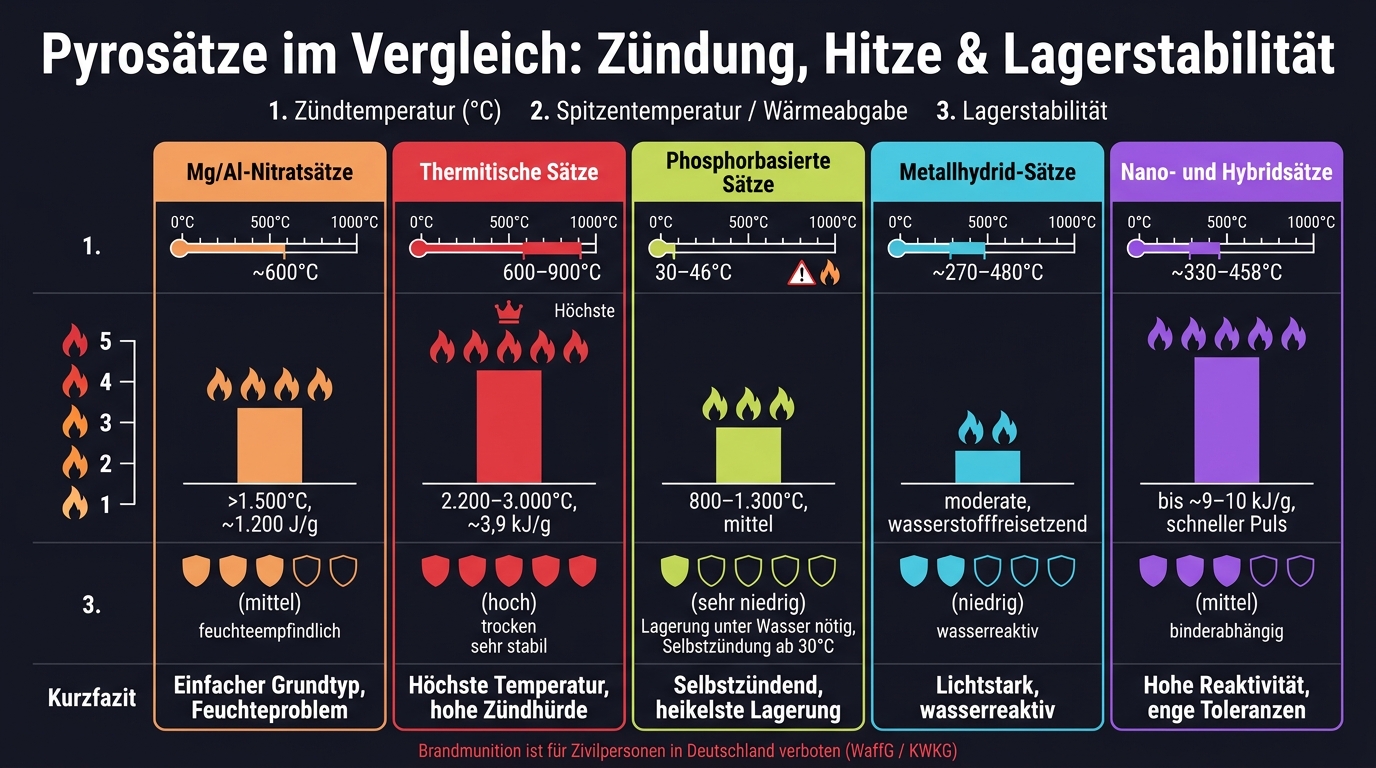
Pyrotechnic compositions compared: Ignition, Heat & Storage Stability
The five families of substances differ significantly in ignition, heat release, and storage. This comparison quickly clarifies why some systems are easier to use in practice, while others are much more delicate.
Ignition Behavior
White phosphorus ignites the earliest, thermite the latest. Metal hydrides are in between.
In other words: The ignition threshold clearly increases from phosphorus to hydrides and nitrates up to thermite. This is a significant difference because a low ignition temperature facilitates the start of the reaction, but often makes handling more delicate.
| Substance Family | Ignition Temperature (approx.) | Sensitivity (Friction/Impact) | Typical Ignition Source |
|---|---|---|---|
| Mg/Al Nitrate Compositions | approx. 600 °C; moisture-sensitive [56][5] | medium to high | Igniter, flame, hot particles |
| Thermitic Compositions | 600–900 °C [55][8] | low | Booster, ignition chain |
| Phosphorus-based Compositions | 30–40 °C [53][26][23] | low; ignition mainly through heat/air contact | Heat, air contact |
| Metal Hydride Compositions | approx. 270 °C (ZrH₂) [58] | medium to high | Igniter, friction |
| Nano and Hybrid Compositions | approx. 330 °C [8] | high | Initiator, ignition chain |
However, it is not only crucial when a substance ignites. Equally important is how strongly the heat is released and how long the reaction lasts.
Heat Release
Thermitic compositions deliver the highest peak temperatures and concentrate energy strongly in a small area. [8] This makes them interesting where localized, very hot effects are required.
Magnalium-barium nitrate compositions reach flame temperatures of over 1,500 °C and produce an intense white light. [1][57] White phosphorus is clearly below this with 800–1,300 °C, but burns longer and more diffusely. [27][23]
| Material Family | Peak Temperature (approx.) | Released Energy | Burning Behavior |
|---|---|---|---|
| Mg/Al Nitrate Compositions | >1,500 °C [1][57] | ~1,200 J/g [54] | bright, fast, light-intensive |
| Thermitic Compositions | 2,200–3,000 °C [8] | high, volume-related | localized, slag-forming |
| Phosphorus-based Compositions | 800–1,300 °C [27][23] | medium | long-lasting, diffuse |
| Metal Hydride Compositions | lower than classical metal-containing systems [43] | significant | moderate, hydrogen-releasing |
| Nano and Hybrid Compositions | comparable to Thermite [8] | up to ~9–10 kJ/g [8] | fast pulse, high energy density |
Here a familiar pattern emerges: More performance often also means stricter requirements for storage and handling.
Storage Stability
Thermite compositions are the most stable. Phosphorus and metal hydride compositions are the most sensitive. This makes storage stability one of the most important points for practical usability.
| Substance Family | Moisture Sensitivity | Main Aging Mechanism | Storage Stability |
|---|---|---|---|
| Mg/Al Nitrate Compositions | high | Oxidizer migration, low-temperature exotherm [5] | medium |
| Thermite Compositions | low | Agglomeration, binder degradation [8] | high |
| Phosphorus-Based Compositions | very high | Surface oxidation, acid formation [53][22] | very low |
| Metal Hydride Compositions | very high | Hydrolysis, dehydration [43] | low |
| Nano and Hybrid Compositions | high | Sintering, nanostructure loss [8] | medium (binder-dependent) |
These technical differences also shape the legal and practical classification.
Law, Practical Relevance, and Advantages and Disadvantages
Technically, these substance groups are clearly distinct from one another. In the civilian sector, however, this plays hardly any role legally in Germany, as the situation is clear: incendiary ammunition is prohibited. Phosphorus and thermite ammunition are also classified as war weapons under No. 50 of the War Weapons List.[3][61][63][65] For hunters and sport shooters, there are no special pathways. Possession, trade, or import can be punished with up to five years of imprisonment.[3]
The Weapons Act (WaffG) distinguishes between permissible pyrotechnic ammunition on one side and incendiary and tracer ammunition on the other. Pyrotechnic ammunition may be allowed if it serves as signal ammunition or for similar safety purposes. Incendiary and tracer ammunition, on the other hand – unless already classified as a weapon of war – are considered prohibited ammunition.[17][62][64]
Even with new pyrotechnic sets, there is no leeway based on feeling. A BAM approval is required before placing them on the market. Additionally, the applicable regulations for hazardous goods and labeling must be followed.[59][60][68][69]
For legal hunting and sporting ammunition, the approval is ultimately what counts. Incendiary ammunition does not belong in the civilian sector.[63][66][67][70] Those looking for approved hunting or sporting ammunition can find a marketplace for compliant ammunition, optics, and equipment on Gunfinder.
In practice, therefore, three points are particularly important: Approval, storage, and safety risk. Because on paper, a set may seem interesting. In everyday life, however, the questions are: Is it allowed? Can it be stored safely? And what happens if moisture, heat, or a firing error come into play?
| Substance Family | Advantages | Disadvantages | Main Risks | Legal Status in Germany |
|---|---|---|---|---|
| Mg/Al nitrate sets | Reliable ignition, high light yield | Moisture sensitive, risk of corrosion | Intense combustion, fire transfer | Prohibited as incendiary ammunition; possible as signal-oriented pyrotechnic ammunition with BAM approval [17][60] |
| Thermitic sets | Extremely high temperatures, low impact sensitivity | Difficult to ignite, uncontrollable fire effect | Localized extreme heat, hard to extinguish | War weapon according to KWKG; prohibited for private individuals [3] |
| Phosphorus-based sets | Self-igniting, long burn duration | Highly toxic, extremely difficult to handle | Spontaneous ignition, toxicity, environmental damage | War weapon according to KWKG; prohibited for private individuals [3] |
| Metal hydride sets | High energy density, adjustable ignition profile | Water reactive, unstable storage | Reactions with moisture, uncontrolled release | Civil pyrotechnic use only permitted; prohibited as incendiary ammunition. |
| Nano and hybrid sets | Chlorate-free, high energy density | Increased sensitivity, complex safety assessment | Nanomaterial risks, elaborate approval | Only permitted as signal ammunition with BAM approval; prohibited as incendiary ammunition. |
Conclusion
Newer pyrotechnic sets can be superior to classic magnesium/aluminum nitrate systems in certain aspects – but not universally. Especially chlorate-free nano and hybrid systems appear promising, as they reduce residues and can be controlled more precisely during ignition.
On the other hand, there are thermite and hydrides: maximum energy, but less control. Thermite reaches the highest peak temperature, but is hardly controllable after ignition. Metal hydride sets remain powerful but are sensitive to moisture. New does not automatically mean safer.
For storage stability, not only reactivity matters. Binders, particle size, and contamination often play a larger role. This is precisely where the bottleneck lies: It is not peak performance that sets the limit, but stability.
In terms of construction, ignition, heat release, and storage stability, the same pattern always emerges: More reactivity brings more performance - but also more risk.
Technically, there are clear differences, legally not: Incendiary ammunition remains prohibited for civilians; phosphorus and thermite sets additionally fall under the War Weapons Control Act. Thus, the text remains a material comparison, not a guide.[3][17]
FAQs
Why do some pyrotechnic compositions ignite significantly easier than others?
Primarily due to their chemical composition and physical properties. Substances like magnesium ignite particularly easily.
Mixtures with fine metal particles often react more sensitively to friction, impact, or electrostatic discharge. The oxidizing agent also plays a significant role: chlorates often react strongly, while potassium perchlorate is thermally more stable.
Which group of substances is the most risky during storage?
In the storage of incendiary ammunition, magnesium-containing mixtures are considered particularly risky. Magnesium makes such substances more susceptible to moisture. This can degrade the mixture or, in the worst case, even trigger an unwanted ignition.
Mixtures with fine metal particles are also critical. Due to their high conductivity, the risk of static charge increases significantly. Therefore, hermetically sealed containers, low humidity, and protection against electrostatic discharges are necessary.
Why are nano and hybrid compositions so sensitive despite their advantages?
Nano and hybrid compositions are so sensitive because their mixture is extremely reactive. Even friction, impact, heat, or electrostatic discharges can trigger a reaction.
It becomes particularly critical with finely distributed, conductive metal particles in combination with highly reactive oxidizing agents. This specific combination of substances makes the compositions vulnerable. If they are mishandled or stored incorrectly, it can quickly lead to degradation or even an unwanted ignition.