Checklist: Buy helmet mount for night vision devices

A helmet mount for night vision devices is essential when you're out at night and want to keep both hands free. The right mount ensures stability, comfort, and a perfect fit between helmet, mount, and device. Here are the key points to consider when making a purchase:
- Check compatibility: Pay attention to the connection interface of your night vision device (Dovetail or Bayonet) and choose a suitable mount.
- Ergonomics and adjustability: Features like height adjustment, eye relief, and tilt angle are crucial for comfortable use.
- Material choice: Aluminum mounts are sturdier and more durable than polymer alternatives.
- Weight distribution: Counterweights or battery packs prevent neck pain, especially with heavier devices.
- Safety systems: High-quality mounts offer breakaway mechanisms to avoid injuries during impacts.
Whether you're hunting, training, or planning tactical operations – the right helmet mount makes a difference. Read on for detailed tips and to find the right mount for your needs.
Night Vision Devices Part 1
Device Compatibility
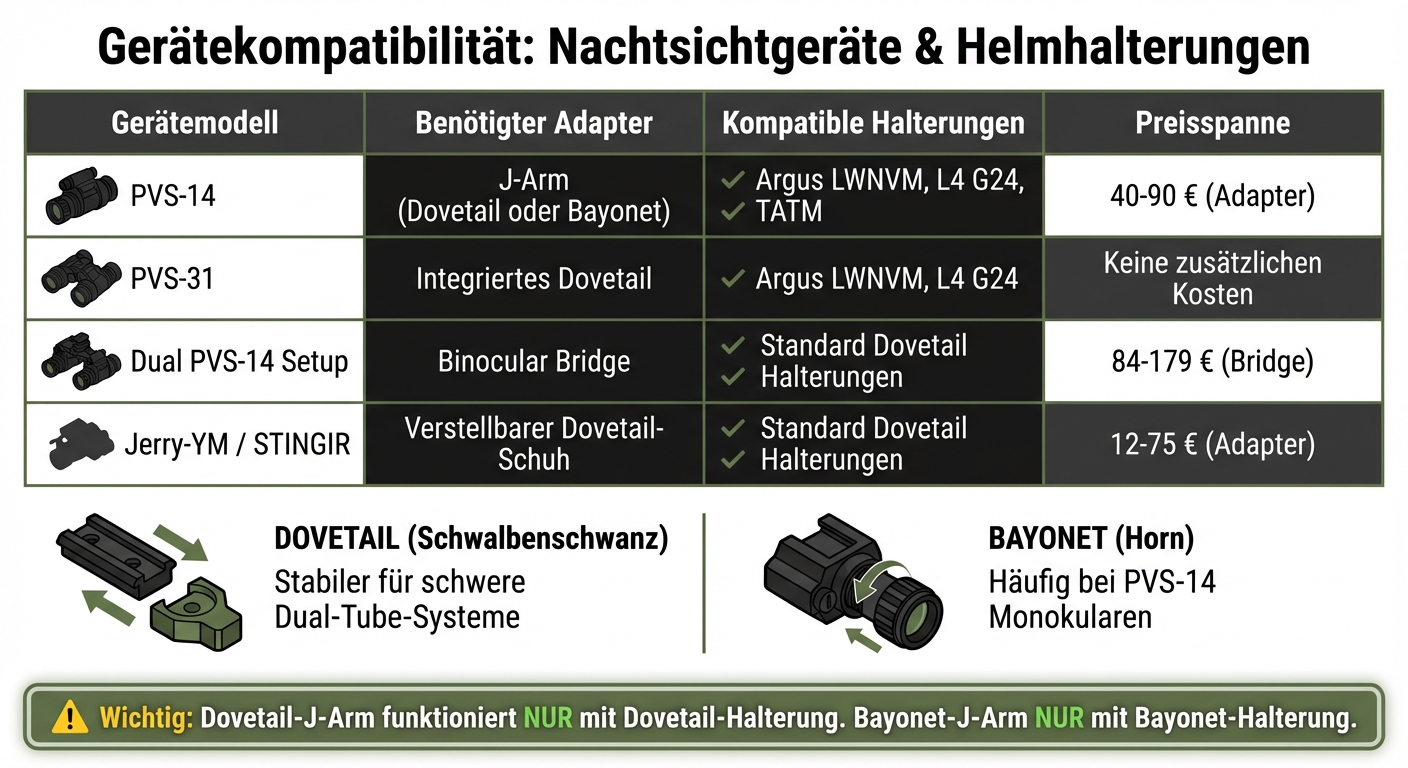
Night Vision Device Helmet Mount Compatibility Overview: Device Models, Adapters, and Mounts
For your night vision device to be securely and stably attached to a helmet mount, it must use the correct connection interface. The most common systems are Dovetail and Bayonet. To ensure compatibility, you should first determine the interface of your night vision device. More details on models, adapters, and interfaces can be found in the following sections.
Check Your Device Model
Some night vision devices require specific adapters to connect to helmet mounts. For example, monoculars like the PVS-14 need a J-Arm that serves as an intermediary. This is attached to the device with a thumb screw and then locks into the mount. Binocular devices like the PVS-31 often have an integrated dovetail connection that allows for direct mounting.
If you want to use two monoculars simultaneously, you will need a Bridge to attach both devices to a single mount. These bridges typically range in price from €84 to €179.
"Arms typically use a thumb screw to attach to the night vision device and a dovetail or bayonet interface to connect to the mount." – Ethan L, Gear Expert, Optics Planet [1]
| Device Model | Required Adapter | Compatible Mounts |
|---|---|---|
| PVS-14 | J-Arm (Dovetail or Bayonet) | Argus LWNVM, L4 G24, TATM |
| PVS-31 | Integrated Dovetail | Argus LWNVM, L4 G24 |
| Dual PVS-14 Setup | Binocular Bridge | Standard Dovetail Mounts |
| Jerry-YM / STINGIR | Adjustable Dovetail Shoe | Standard Dovetail Mounts |
When You Need Adapters
In addition to checking your device, you should ensure whether it already came with a standard J-Arm. Many night vision devices include this in the original packaging. If not, you will need to purchase a suitable adapter separately.
- A Dovetail J-Arm works exclusively with a dovetail mount.
- A Bayonet J-Arm is only compatible with a bayonet mount.
The cost of J-Arms ranges from €40 to €90, while adapter plates can cost between €12 and €75. Thermal devices often require special adapters that must also be purchased separately.
Adjustment Options and Ergonomics
For a helmet mount to remain comfortable over the long term, it must be individually adjustable. Particularly important are the height adjustment, eye relief, and tilt angle. These three factors determine whether you receive a clear and stable image. Let's take a look at which features really make a difference.
Main Adjustment Functions
The height adjustment is crucial for aligning the optical axis of the night vision device with the pupil height. The eye relief (Fore/Aft) regulates how close the device sits to the face – particularly useful for glasses wearers or to avoid unwanted contact. With the tilt adjustment, you can balance the helmet position and prevent tilted or distorted images.
Mounts like the Wilcox L4 G24 (from $400) are considered the benchmark as they allow precise adjustments on all three axes [2]. A more affordable alternative is the Argus LWNVM (approx. €145), which also offers solid adjustment options and is particularly lightweight at only 140 g [4]. Important: All adjustments should be able to be made one-handed [4].
Flip-Up Mechanism
A flip-up mechanism is ideal for quickly switching between night vision and natural sight. High-quality models fold the device tightly against the helmet shell, bringing the center of gravity closer to the head and preventing neck pain [4]. A positive locking mechanism ensures that the device does not accidentally detach during movement [2].
Before purchasing, check if the mechanism can be easily operated with gloves and locks securely in both positions. Models made from aircraft aluminum with steel fittings offer significantly more stability than polymer variants [2]. For demanding operations, a mount with a breakaway function is recommended: This detaches from the helmet under heavy load and helps prevent neck injuries [5][4].
Build Quality and Materials
The material of your helmet mount plays a crucial role in its stability and lifespan. Aircraft aluminum combined with steel fittings is considered the standard for professional mounts [2][4]. This material choice not only provides a stable platform but also reduces wobbling, which often occurs with cheaper alternatives [2].
Polymer mounts, on the other hand, score with low weight but often prove to be less robust [2]. Under repeated stress or the weight of heavy night vision devices, they can quickly give way. If you use your equipment regularly and under demanding conditions, aluminum is the better choice.
Weather Protection
High-quality aluminum mounts impress with special coatings that not only protect against corrosion but also minimize reflections [4][2]. These properties are particularly important when you are operating under adverse weather conditions or extreme temperatures. Such low-visibility coatings are a real advantage in tactical situations.
Material Comparison
A good example of a lightweight yet stable mount is the Argus LWNVM made of aircraft aluminum. It weighs only 140 g and is priced at around €145 [4]. In comparison is the Wilcox L4 G24, which is considered the gold standard in the military sector and is available from $400 [2]. Both models use aluminum but differ in manufacturing precision. CNC-milled variants offer more precise adjustment options than cast models [5].
For airsoft players or occasional use, a polymer mount may suffice. However, those who rely on reliability and safety should invest in an aluminum mount. This decision not only affects stability but also the safety of your entire equipment.
sbb-itb-1cfd233
Mounting System and Safety
The mounting system ensures that your night vision device remains securely and stably attached to the helmet. Modern helmets typically use a three-hole system, while older models often only utilize a one-hole system. The so-called shroud forms the basis for the mounting. But which options provide the best protection and highest safety? Here’s an overview.
Mounting Systems
High-quality mounts generally offer two operating modes:
- Breakaway Mode: Here, the mount detaches upon impact to minimize injuries and damage to the device.
- Secure-Locking Mode: This mode ensures maximum stability and safety, especially in demanding situations.
For the interface between helmet and night vision device, there are two common systems: the Bayonet System, which is often used with PVS-14 monoculars, and the Dovetail System, which is preferred for heavier dual-tube systems due to its stability [5][2].
"If your night vision device falls off its mount, the lanyard will save it from being lost." – Ethan L, Gear Expert, OpticsPlanet
A lanyard system can additionally secure your night vision device in case it accidentally detaches from the mount. To ensure everything is secure, the so-called wiggle test is recommended: Modern quick-release systems make an audible click when the mount is correctly locked in [1][7].
The choice of the right helmet also plays a crucial role in safety and comfort.
Helmet Type Compatibility
Modern tactical helmets from brands like Ops-Core, Team Wendy, Galvion, or Crye Precision are already equipped with universal shrouds. These helmets provide a solid base for mounting your night vision device.
- Ballistic Helmets: Models like the MICH, ACH, or the Crye Precision AirFrame ATX (approx. $991) protect against shrapnel and small caliber weapons. They weigh between 1.4 and 1.6 kg and are ideal for dangerous operations.
- Bump Helmets: Lighter alternatives like the Team Wendy Exfil LTP (approx. $303) weigh only about 725 g and offer excellent ventilation. These are particularly suitable for hunting or training situations where there is no ballistic threat [1].
A crucial note: Never drill holes in a ballistic helmet to mount a shroud – this would irreparably compromise the helmet's protective function. Instead, ensure that the helmet is already factory-equipped with the appropriate mounting points.
Additionally, the helmet should be equipped with a four-point retention system that includes a nape strap. This ensures that the helmet does not tilt forward, even when a heavy night vision device is mounted [1].
Weight Distribution and Comfort
A night vision device mounted on a helmet can tilt the helmet forward due to its leverage effect, unnecessarily straining the neck. The solution? Systems that optimally distribute weight, combined with high-quality padding for added comfort.
Weight Distribution Systems
Instead of simply using static lead weights, modern solutions utilize functional counterweights like ergonomically shaped external battery packs. These serve a dual purpose: they extend battery life while also shifting weight, as they are precisely attached to the back of the helmet [6][2]. Lightweight mounts also help stabilize the center of gravity by keeping the night vision device close to the helmet when folded. This reduces leverage and relieves the neck [4].
High-quality systems additionally offer adjustment options in multiple axes. This allows you to precisely adjust tilt, eye relief, and interpupillary distance, minimizing unnatural head positions and resulting fatigue [2].
"Dual-tube night vision is heavier and can be a literal pain in the neck if you don't choose the right suspension." – Bill Blowers [3]
Dual-tube systems are noticeably heavier than monoculars and make a counterweight system almost indispensable, especially during longer operations. However, in addition to weight distribution, padding also plays a crucial role in comfort.
Padding and Fit
The padding of a helmet is crucial for wearing comfort. Memory foam and gel pads not only offer good breathability but also conform perfectly to the head shape, preventing pressure points [3]. Particularly effective are dual-layer, adjustable foam pads that can be individually tailored to your head size [3].
Textile materials like 3D mesh ensure good air circulation, absorb little moisture, and also prevent pressure points [8]. Thanks to integrated tension systems, you can adjust the fit of the helmet to the millimeter, even during use [3].
Another important point is the nape strap system. Unlike older chin strap designs, a modern nape or neck strap ensures that the helmet remains stable and does not wobble. This distributes the load evenly, even when a heavy night vision device is mounted at the front. Additionally, a helmet-integrated hearing protection can not only increase stability but also reduce perceived weight [3].
Conclusion
The key points at a glance: The technical coordination between your helmet, the mount, and the device is crucial. Ensure that the helmet shroud (one or three holes) and the interface (dovetail or bayonet) are directly compatible to ensure a stable and reliable connection [2][1].
Mounts made of aircraft aluminum, like the Wilcox L4 G24 (from $400+), provide the necessary robustness for demanding operations. Polymer alternatives are lighter but often do not achieve the same durability. An unstable mount can not only cause blurry images but also lead to your expensive device being damaged or lost [2].
An often underestimated factor is wearing comfort, which becomes crucial during longer operations. Without a well-thought-out weight distribution system – such as counterweights or high-quality nape straps – the helmet tends to tilt forward, unnecessarily straining the neck [1][3].
Before purchasing, you should clearly define your specific requirements. Whether hunting, tactical operations, or terrain navigation – each application places different demands on weight, adjustability, and protection. A minimalist setup can reduce fatigue and is perfectly adequate for many applications [1][3]. A high-quality mount is a crucial factor that improves and makes your entire system more reliable [2]. Consider these aspects to find the right mount for your needs.
FAQs
How do I find the right helmet mount for my night vision device?
The choice of the right helmet mount depends on several important factors: Does the mount fit the connection standard of your night vision device (e.g., 30 mm tube)? Is it compatible with your helmet's rail system? And does it have a reliable quick-release mechanism so you can quickly remove the device when needed? Also, ensure that the mount is robustly constructed and offers high wearing comfort – especially if you plan to use it for extended periods.
At Gunfinder, you will find a carefully selected range of high-quality helmet mounts that meet these requirements and can be optimally tailored to your equipment.
How does the material of the helmet mount affect stability and durability?
The material of a helmet mount has a significant impact on its durability and reliability. Materials like aluminum or steel are known for their high load-bearing capacity and resilience. Plastic options, on the other hand, often score with lower weight but may be less robust in some cases.
It is important that the material matches your intended use and the requirements of your night vision device. For example, if you are moving in demanding environments, a metal mount is a wise choice as it is better equipped to handle impacts and other stresses.
Why is balanced weight distribution important for night vision devices?
Even weight distribution is crucial for your night vision device to sit comfortably on the helmet without causing uneven strain. If the device is too heavy or positioned too far forward, the helmet can tilt forward, which not only strains the neck but also restricts visibility.
A counterweight, such as a battery pack or a specially designed additional weight attached to the back of the helmet, provides balance. The result? Your night vision device remains stable in your field of view, allowing you to focus entirely on your surroundings. Many modern helmet mounts also allow for precise adjustment of weight distribution, further improving comfort and ergonomics.
Are you looking for accessories like counterweights or special helmet mounts? On Gunfinder, you will find a wide selection of products perfectly tailored to the needs of hunters and night vision enthusiasts.