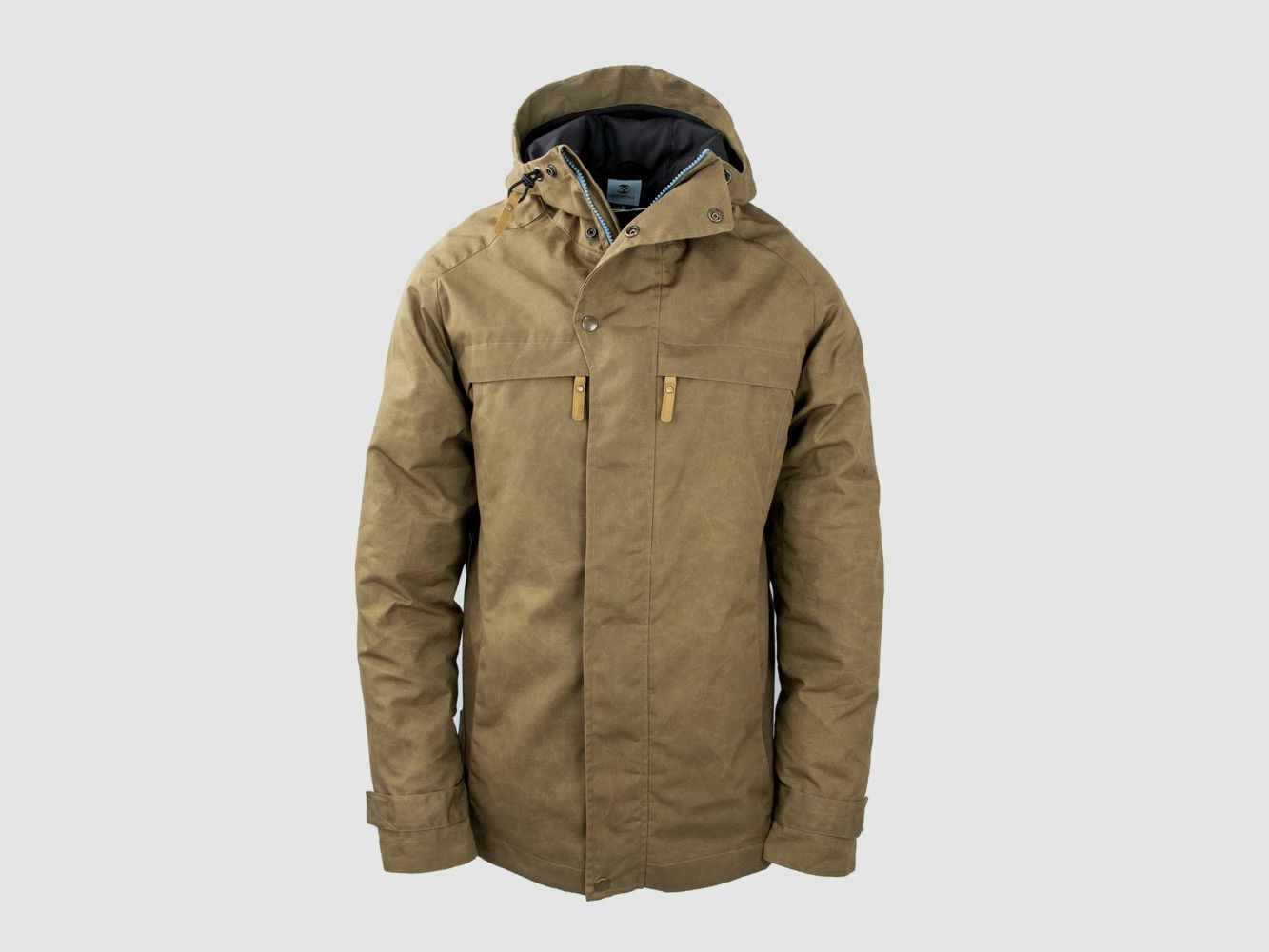
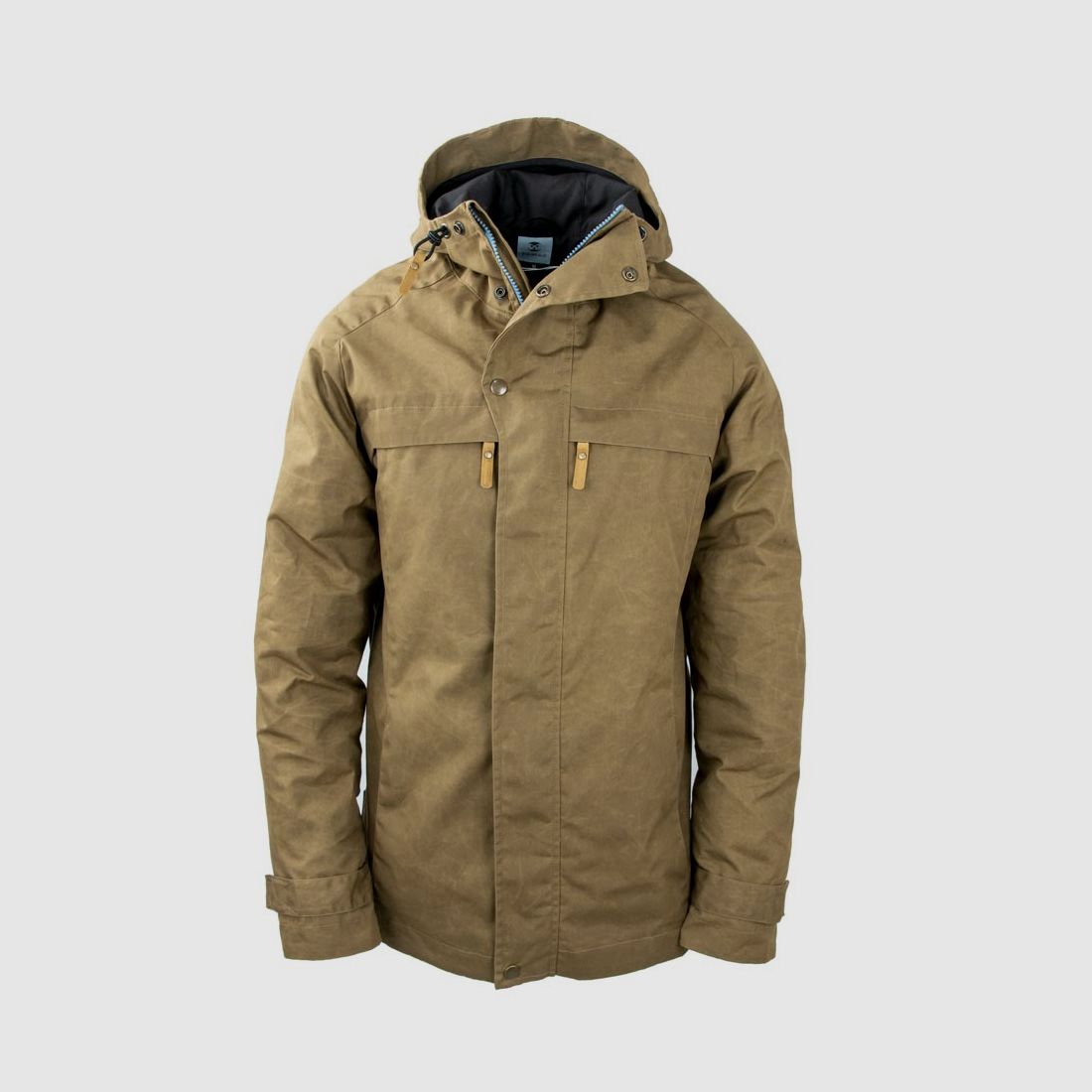
Outdoor jacket made of waxed polycotton
(We are currently producing missing sizes - expected to be available again from mid-November 2025 - Pre-orders are welcome at post@waldkauz.net)
- Lightly padded inside
- Hood adjustable over 2 axes
- 4 outer pockets and 2 inner pockets
- Adjustable windproof inner cuffs in sleeves and hem
- Under and overflap at the main zipper
- Practical 2-way zipper
- Adjustable sleeve cuffs with Velcro
- Handy zipper pulls made of genuine leather
- PFC-free and biodegradable wax-based impregnation
- Renewable at any time
- Weight: approx. 1000g (size L)
- Sizes: S - 3XL
Material composition:Outer material: Waxed polycotton made from recycled polyester and organic cotton (65% polyester, 35% cotton)
Lining: Polycotton (65% polyester, 35% cotton)
Contains non-textile parts of animal origin (leather)
A Cut, Two Jackets: REGENSEGEN and WINDFANG
At STEINKAUZ, there are two jackets that are based on the same cut: While the REGENSEGEN represents the "Heavy Duty" variant, the WINDFANG is the lighter all-rounder. During the development of our new jacket model, we found that there are two camps regarding the material, both of which had their arguments and to which we could adhere in both cases. The advocates of the Heritage camp favored the heavy and heavily waxed Waxed Cotton made from 100% cotton in British style (by the way, that's where ours comes from too). The representatives of the more modern direction preferred another outdoor fabric, which has long been considered a classic – polycotton, the widely used outdoor fabric, in our case made from recycled polyester and organic cotton. Classic Waxcotton, as a pure cotton fabric, is capable of absorbing much more wax than a blended fabric. This makes it very rainproof but comparatively quite heavy. Polycotton, on the other hand, is not only lighter but also somewhat cheaper to produce (and in wax consumption).
So what to do? Which of the two alternatives should we choose? Normally, at this point, especially as a smaller manufacturer, one has to make a decision. We did that too, and it was rather unusual: We decided to simply make both jackets! Both fabrics have their charm and their enthusiasts, and we believe our customers should decide which model resonates more with them. So now there is the outdoor jacket REGENSEGEN made from 100% waxed cotton and the outdoor jacket WINDFANG made from polycotton.
Light Touring Companion: Outdoor Jacket "Windfang" Made of Waxed Polycotton
The STEINKAUZ outdoor jacket "Windfang" is a stylish and material-wise perfect complement to our loden jackets, hoodies, and our gear. Where the bad weather properties of loden reach their limits, waxed cotton forms the necessary outer layer to keep rain out and maintain a good climate inside. With lightweight clothing, the material has a cooling effect. However, with a layer of loden or a warm wool sweater underneath, it retains heat very well inside.
The surface of the wax cotton changes quite quickly with use and soon acquires a beautiful vintage effect. If the waxing diminishes over time, the jacket can be rewaxed as many times as desired.
What to Expect from Waxed Fabrics
There is a lot of half-knowledge and some misunderstandings about waxed fabrics, also known as Waxed Cotton, Waxcotton, or Waxed Polycotton. We explain what the fabrics can do in more detail in our .
The small details that one learns to appreciate
The interior of the "Windfang" is lined with a thin pocket lining made of polycotton, so that the waxed outer fabric does not come into direct contact with the rest of the clothing. The hood can be adjusted to the shape of the head with an internal drawstring over two axes and can be worn loosely or snugly. Four outer pockets, two on the chest and two with side access in the hip area, are all equipped with zippers and additionally feature a flap made of wax cotton that is designed to make it more difficult for raindrops to penetrate. Inside, there is also an additional inner pocket with a zipper and side access on each side in the chest area. The main zipper is made of blued metal and is equipped with two flaps that slow down wind and rain from below and above the zipper. Wind cuffs are built into the inner sleeve cuffs and the hem of the torso. These are fabric cuffs that can be tightened with a drawstring to prevent cold wind from entering, thus providing additional protection for the jacket in sensitive areas. Furthermore, the sleeve cuffs can also be tightened with an external Velcro strap.
Made from sustainable materials
The synthetic fiber content for the polycotton used in this product is made from recycled polyester, while the natural fiber content is made from organic cotton. The wax impregnation is free from environmentally harmful PFCs and can easily be renewed at home whenever the impregnation eventually wears off. However, one of the most important arguments regarding sustainability is quite different: Our products are not bought to be worn a few times, but because one is investing in a new favorite piece that will be worn for as long as it serves its purpose. And nothing is more sustainable than keeping your belongings in use for a long time!
Size Chart
Explanation of whether worn with or without thick undercoat.
Size |
Clothing size |
Chest Jacket / Chest Body |
Waist Jacket / Waist Body |
Sleeve Length* |
Back Length |
S |
46 |
108/98 cm |
104/96 cm |
82 cm |
78 cm |
M |
48-50 |
116/106 cm |
110/102 cm |
84 cm |
81 cm |
L |
52 |
124/114 cm |
120/112 cm |
85 cm |
83 cm |
XL |
54-56 |
132/122 cm |
128/118 cm |
86 cm |
86 cm |
XXL |
58 |
140/130 cm |
134/126 cm |
87 cm |
88 cm |
3XL |
60 |
148/138 cm |
142/134 cm |
89 cm |
90 cm |
Explanations for the Size Chart
The measurements represent the average size. This means there is some leeway in both directions before you enter the range of the next size.
What do I wear underneath?When choosing the right size, please consider whether you will be wearing the jacket more in summer, with light clothing underneath, or in winter with a thick fleece jacket or sweater. This consideration is particularly important if you are exactly between two sizes!
Regarding the individual measurementsSome relevant measurements are given in pairs (e.g., 116/106). The first value refers to the circumference of the garment, while the second refers to your body measurement. This way, you can either measure yourself or compare it with your favorite jacket. The difference between body measurement and garment is usually 8-10 cm.
Chest:The chest measurement describes the chest circumference of the jacket, as well as the chest circumference measured on the body. The chest circumference is the most important measurement. If the chest is too tight, the rest usually doesn't fit well either.
Waist:The waist measurement describes the waist circumference of the jacket, as well as the waist circumference measured on the body. If your waist is narrower, this usually matters less than the chest circumference.
Arm Length:Since this is a raglan sleeve that does not have a classic shoulder seam, please measure the arm length including the shoulder in this case. To do this, place the measuring tape at the apex between the neck and shoulder (where the collar would sit) and measure down to the point where the hem of the sleeve cuff should be.
Back Length:The back length is measured from the seam of the collar's lower edge to the lower edge of the waist hem on the torso.




 A-TEC
A-TEC
 AEA Airguns
 AKAH
AKAH
 ASG
ASG
 Aimpoint
 Alpen Optics
 Alpha Industries
 Anschütz
 Antonio Zoli
 Ares
Ares
 B&T Schalldämpfer
 Baikal
 Ballistol
 Balzer
 Barbour
 Barnes
 Barnett
 Benelli
 Beretta
 Bergara
 Blaser
 Brandit
 Bremer Tresor
 Brenneke



 Classified ad