Note:
The item location is abroad. Please note that this may affect delivery conditions, shipping times, and/or the purchasing process.
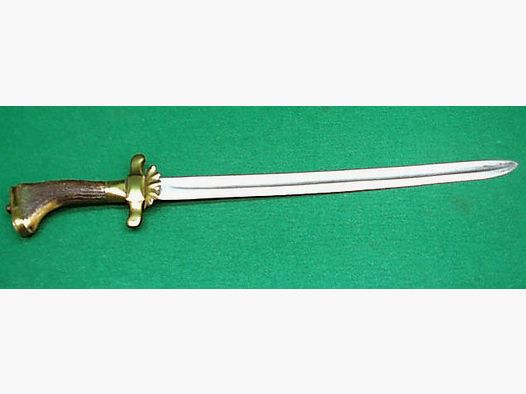
Very beautiful saber for hussar officers around 1810 - perhaps even earlier, gilded and decorated hilt, fittings of the scabbard, bone grip, strongly curved blade, length from the end of the hilt to the tip of the scabbard 86 cm INFO FROM THE AUCTION HOUSE: regarding these cavalry sabers, "a la Mamelukke", the following can be said: it was a great fashion among wealthy officers throughout Europe, starting from France with a focus in Germany, to have such a curved saber made. Hence the nickname "a la Mamelukke". However, it was mostly the Prussian hussar officers who wore such a saber. This fashion prevailed from 1800 to around 1820. The manufacturers were various. But always very high-quality edged weapon smiths. The more or less ornate equipment of the saber was limited solely by the financial status of the client. Rarely did these sabers have manufacturers...
(Show description in original language)
Sehr schöner Säbel für Husarenoffiziere ca. 1810 - vielleicht auch früher, vergoldetes und verzierten Gefäß, Beschläge der Scheide, Beingriff, stark gebogene Klinge,, Länge vom Gefässende bis zur Scheidenspitze 86 cm INFO VOM AUKTIONSHAUS: zu diesen Kavalleriesäbeln, a la Mamelukke, gibt es folgendes zu sagen: es war in ganz Europa, ausgehend von Frankreich mit Schwerpunkt in Deutschland große Mode bei wohlhabenden Offizieren, sich so einen gebogenen Säbel machen zu lassen. Daher auch der Spitzname a la Mamelukke. Meist waren es jedoch die preußischen Husarenoffiziere die einen solchen trugen. Diese Mode hat sich durchgesetzt ab 1800 bis ca. 1820. Die Hersteller waren verschiedene. Aber immer sehr hochwertige Blankwaffenschmiede. Die mehr-oder weniger prunkvolle Ausstattung des Säbels war alleine von finanziellen Status des Auftraggebers begrenzt. Selten haben diese Säbel Herstell...








 A-TEC
A-TEC
 AEA Airguns
 AKAH
AKAH
 ASG
ASG
 Aimpoint
 Alpen Optics
 Alpha Industries
 Anschütz
 Antonio Zoli
 Ares
Ares
 B&T Schalldämpfer
 Baikal
 Ballistol
 Balzer
 Barbour
 Barnes
 Barnett
 Benelli
 Beretta
 Bergara
 Blaser
 Brandit
 Bremer Tresor
 Brenneke





 Classified ad