Why every hunter needs a PLB
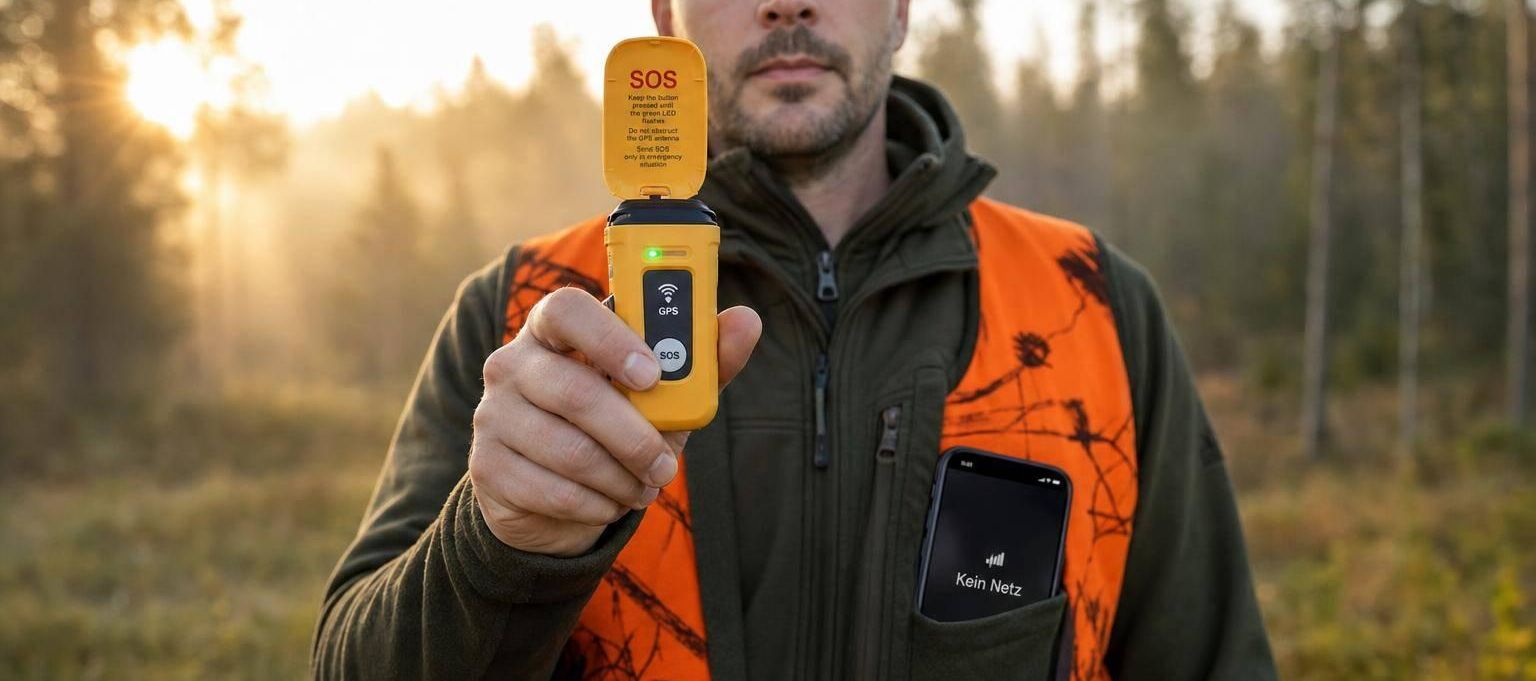
When I hunt alone, a PLB is my direct emergency call without mobile service. That's exactly what it's about: fall, heart attack, cold, dead zone - and still call for help. A PLB transmits via 406 MHz through Cospas-Sarsat, operates even at −20 °C for more than 24 hours, and requires no subscription. The battery often lasts up to 7 years in standby.
For me, the matter is simple:
- Smartphone can fail without a network.
- Radio only helps within range.
- Return agreements often start the search only after 24 to 36 hours.
- Whistle or signaling device only help if someone is close enough.
- PLB sends an emergency call with location even where nothing else works.
A few points are important when buying and using:
- 406 MHz + 121.5 MHz
- GPS/GNSS
- IPX7
- Operating range from −20 °C to +55 °C
- preferably under 150 g
- carry on the body, not just in the backpack
- check test mode and battery before the hunt
- for Germany register correctly and pay attention to the correct country code
| Means | Needs Network/Radio | Sends Emergency Call Itself | Location | Useful Alone in the Field |
|---|---|---|---|---|
| Smartphone | Yes | No | Good if reception is available | No |
| Handheld Radio | Partially | No | No automatic location | Only to some extent |
| Return Agreement | No | No | Last known location | No |
| Whistle/Signaling Device | No | No | Only in sight/hearing range | No |
| PLB | No | Yes | Very accurate | Yes |
In short: I do not see a PLB as an extra, but as an essential part of my hunting gear. It fills the gap between accident and rescue - especially when the phone is no longer useful.
Personal Locator Beacon PLB Are They Worth It? (4k UHD) #greenland
sbb-itb-1cfd233
The Problem: Risks Off the Roads and Mobile Service
Even well-prepared hunters can find themselves in trouble in the field. And often it happens exactly where help is hardest to reach.
Typical Emergencies in the Field
In the field, several problems often come together at once: injury, poor reception, and difficult terrain. A fall, a sprain, a fracture, or an injury in a ditch or hollow can cause a hunter to be unable to move from one second to the next.
In addition, there are medical emergencies such as heart attacks, fainting, or circulatory failure. Hypothermia and exhaustion due to sudden weather changes, cold, or rain are also not marginal issues, but very real risks.
Why dead zones worsen emergencies
Wooded valleys, hilly terrain, and remote regions often have weak mobile reception or none at all. This can quickly turn a serious incident into a precarious situation.
Moreover, smartphones are not invulnerable outdoors. Cold, moisture, or a hard fall can quickly damage the device. Exactly at the moment when one needs to call for help, it may fail.
Why every minute counts in rescue
The greatest risk is often the time until a person is found. Camouflage clothing and dense underbrush make it difficult to see a person even from a short distance. Without an exact location, the search can stretch over large areas.
In cases of hypothermia, shock, or heart attack, this is a serious problem. Every minute counts.
That is precisely why the usual aids alone are not sufficient.
Where common emergency aids fail in the field
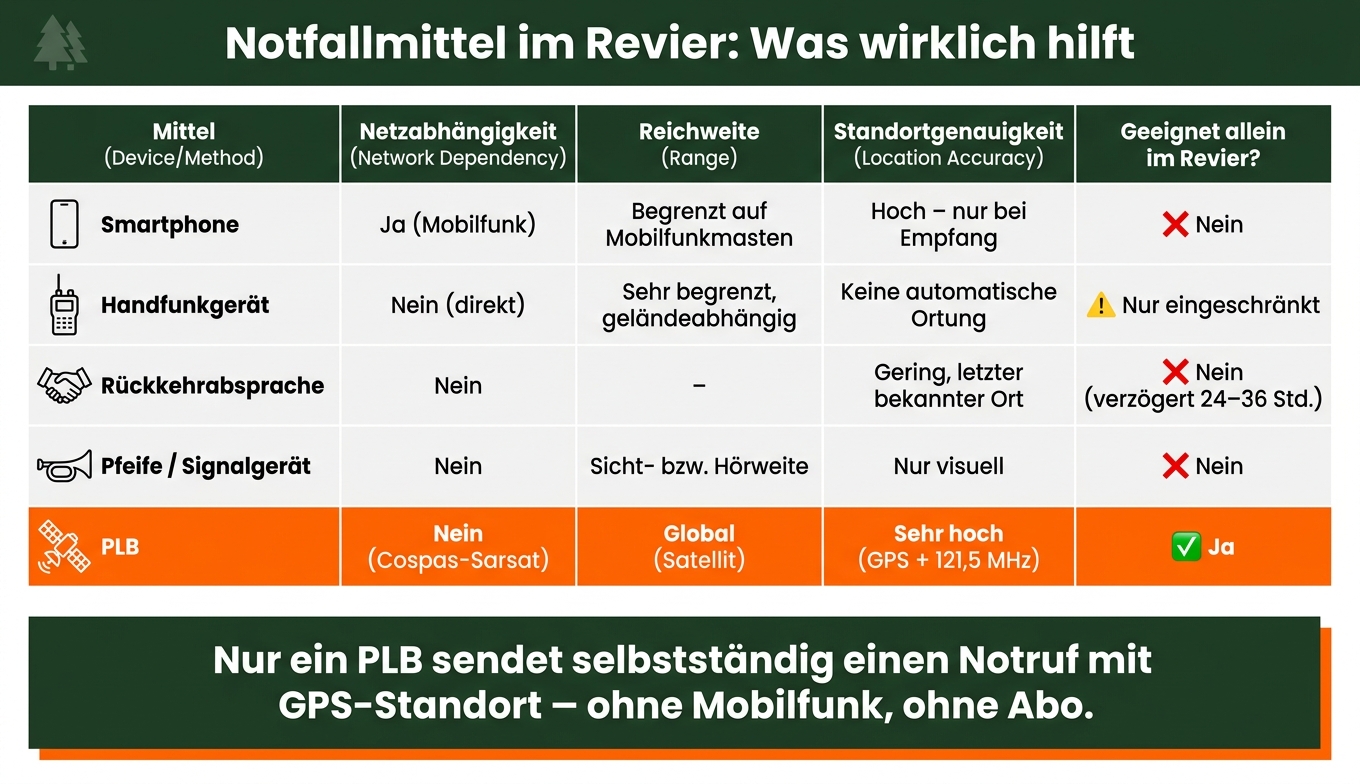
PLB vs. other emergency aids in hunting – The direct comparison
Smartphones, radios, agreements, and signaling devices
If something goes wrong in the field and help is not immediately available, many common aids quickly reach their limits. While smartphones, radios, return times, and whistles are part of the standard equipment for many, they share a common problem in an emergency: None of them can independently send an emergency call. This is where a PLB comes into play.
What these aids cannot do in an emergency
Each of these aids has a clear drawback:
- Smartphone: It is useless without mobile reception. Additionally, in cold weather, battery performance often drops significantly [2].
- Handheld radio: It only helps if there is radio range.
- Return agreement: It often only ensures that a search begins after 24 to 36 hours [5].
- Whistle/signal device: This only works if someone is within hearing or sight distance.
The core problem is simple: None of these aids can independently send an emergency call with location. A PLB fills exactly this gap.
| Aid | Dependent on network/radio | Range | Location accuracy | Suitable alone in the field |
|---|---|---|---|---|
| Smartphone | Yes (mobile network) | Limited to mobile towers | High, if reception is available | No |
| Handheld radio | No (direct) | Very limited, terrain-dependent | None, voice only | Only limited |
| Return agreement | No | – | Low, last known location | No, delayed response |
| Whistle/signal device | No | Visual or audible range | Visual only | No |
| PLB | No (Cospas-Sarsat) | Global (Satellite) | Very high (GPS + 121.5 MHz location) [2][7] | Yes |
The solution: What a PLB does for hunters
A PLB is intended for the moment when no other distress call goes through. When mobile reception is absent, the battery is weak, or the weather makes everything more difficult, it can turn a distress transmitter into a direct line to rescue.
How a PLB works
As soon as you activate the PLB, it sends a 406 MHz signal directly to the satellite system Cospas-Sarsat. From there, the signal goes to the responsible rescue coordination center. Modern satellite systems usually detect the distress call within a short time [2].
Additionally, a PLB transmits on 121.5 MHz. This locating signal helps rescue teams find you on-site, even in the woods, in fog, or at night [2][6].
It is important to note: A PLB is only for genuine emergencies. If there is a false activation, it must be reported immediately [4].
Why a PLB is better suited for hunting than other devices
Especially in the field, one thing counts above all: that a device works when it matters. This is where a PLB shows its strength. It is robust, waterproof, and built for cold. At low temperatures, it operates more reliably than a smartphone [2][6]. The operation is simple: Extend antenna, press button.
Another point: Many satellite messengers only operate with a subscription. A PLB does not. You buy the device once, register it, and then it is ready for use for up to 7 years [3][6].
| Feature | PLB | Satellite Messenger | Smartphone (Sat-SOS) |
|---|---|---|---|
| Main Purpose | Pure emergency call system | Communication & SOS | General / Backup-SOS |
| Network Dependency | Cospas-Sarsat (governmental) | Commercial (Iridium/Globalstar) | Commercial (Globalstar) |
| Subscription Costs | None | Monthly/annually | Often included (time-limited) |
| Operation | Simple (one button) | Medium (menu/tapping) | Complex (alignment needed) |
Registration and Legal Requirements in Germany
To avoid wasting time in an emergency, the device must be registered correctly. In Germany, a PLB must be properly recorded – with your emergency contacts and your data. Registration is done through the international 406-MHz Beacon Database (IBRD) at 406registration.com [4].
The advantage is clear: Rescue services can access your contact details and important medical information even before they arrive.
When purchasing, you should also check that the device is programmed with the correct country code for Germany. An incorrect country code can delay rescue [4].
How to Choose and Carry a PLB While Hunting
What to Look for When Buying: Signal, Battery, Protection Class, and Operation
Once it is clear why a PLB is so important in an emergency, the next question arises: Which device is suitable for hunting?
When purchasing, four things are especially important: a robust construction, an easy activation, a location system you can rely on, and a device that won't fail in the field. The additional 121.5-MHz signal assists rescue teams in precise location – for example, in the woods, in fog, or at night [2][6]. This is where the wheat is separated from the chaff.
For hunting use, the PLB should be cold-resistant, waterproof to IPX7, and shockproof. The operation also plays a significant role. In an emergency, you don't have time for fiddling. Therefore, the device should be operable with one hand, preferably with a protective cover over the activation button. This way, you can safely activate it even while wearing gloves [6].
However, even the best device is of little use if you have to search for it for a long time.
| Feature | Minimum requirement for hunting |
|---|---|
| Satellite network | Cospas-Sarsat (406 MHz) |
| Location signal | 121.5 MHz |
| Operating temperature | −20 °C to +55 °C |
| Waterproofing | IPX7 |
| Weight | Under 150 g |
| GPS/GNSS | Fast location in the field |
Where you carry the PLB and how to check it before the hunt
Carry the PLB on your body – for example, on your belt, on your jacket, or on the shoulder strap. This is not a small detail, but it can change everything in an emergency. After a fall, the backpack may be out of reach. Then the device must be immediately accessible. If you carry it on your body, it remains reachable after a fall and is also kept warmer [5][8].
Before each hunt, you should briefly check the test mode for the battery and GPS. It doesn't take long and can make a big difference later. Also, check the expiration date of the battery. In standby, it typically lasts 7 years, after which it must be replaced by a professional service [6].
Also tell your hunting partners where the PLB is located and how it is activated. If you can no longer act, every second counts [5].
Build a complete safety package
A PLB should not be thought of alone. It complements your first aid kit, a rescue blanket, and a headlamp. Bright clothing also helps, as it can make location easier [9].
In the end, it's not a big additional effort. It's more like a silent Plan B that you hopefully never need – but it should be there when things get tough.
Conclusion: A PLB fills a real gap in hunting safety
A PLB fills exactly the gap that smartphones, radios, and check-in plans leave open. Because hunting often takes place where there is no mobile signal. And it is precisely in such moments that these means fail in an emergency.
A PLB, on the other hand, sends a 406-MHz signal directly to the Cospas-Sarsat satellite system [2].
How important this is is clearly shown by an incident from March 2026: After a heart attack in the field, a PLB immediately triggered an emergency call despite the lack of mobile signal. The hunter was subsequently rescued by helicopter [1]. That's the point. A PLB is not just an extra that you might have. It is part of the safety standard.
And one more thing: A PLB is not a luxury item for extreme sports enthusiasts. It is a serious safety tool with no ongoing costs [3]. Anyone hunting alone or far off the beaten path should therefore have one with them in every hunting area.
FAQs
When can I activate a PLB?
You may only activate your PLB in life-threatening emergencies. This includes, for example, serious injuries, sudden medical emergencies, an avalanche burial, or situations where you simply have no way out.
The device sends a formal distress signal directly to government rescue services. It is intended for cases where immediate professional help can determine life or death.
How do I properly register a PLB in Germany?
In Germany, you may not register an emergency transmitter personally identifiable with a national authority. Therefore, the registration for your PLB often takes place in practice through the British Coastguard, where you can register the device online.
It is important that you keep the information up to date. If your contact details change, you should adjust the registration immediately. This way, rescue control centers have immediate access to your data in an emergency.
What does a PLB do when you are unconscious?
Even if you are unconscious, a PLB can save your life. People nearby can often activate it with little effort and request help.
After activation, the device sends your exact GPS coordinates via the COSPAS-SARSAT satellite network directly to the rescue control centers. It does not require any two-way communication. Authorities can locate the emergency and dispatch rescue teams accordingly.