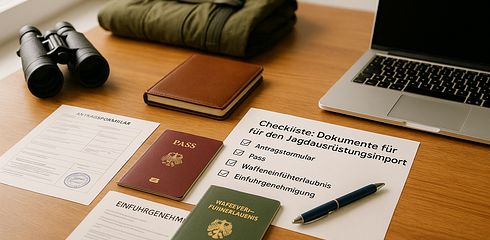
Importing hunting equipment: regulations by country
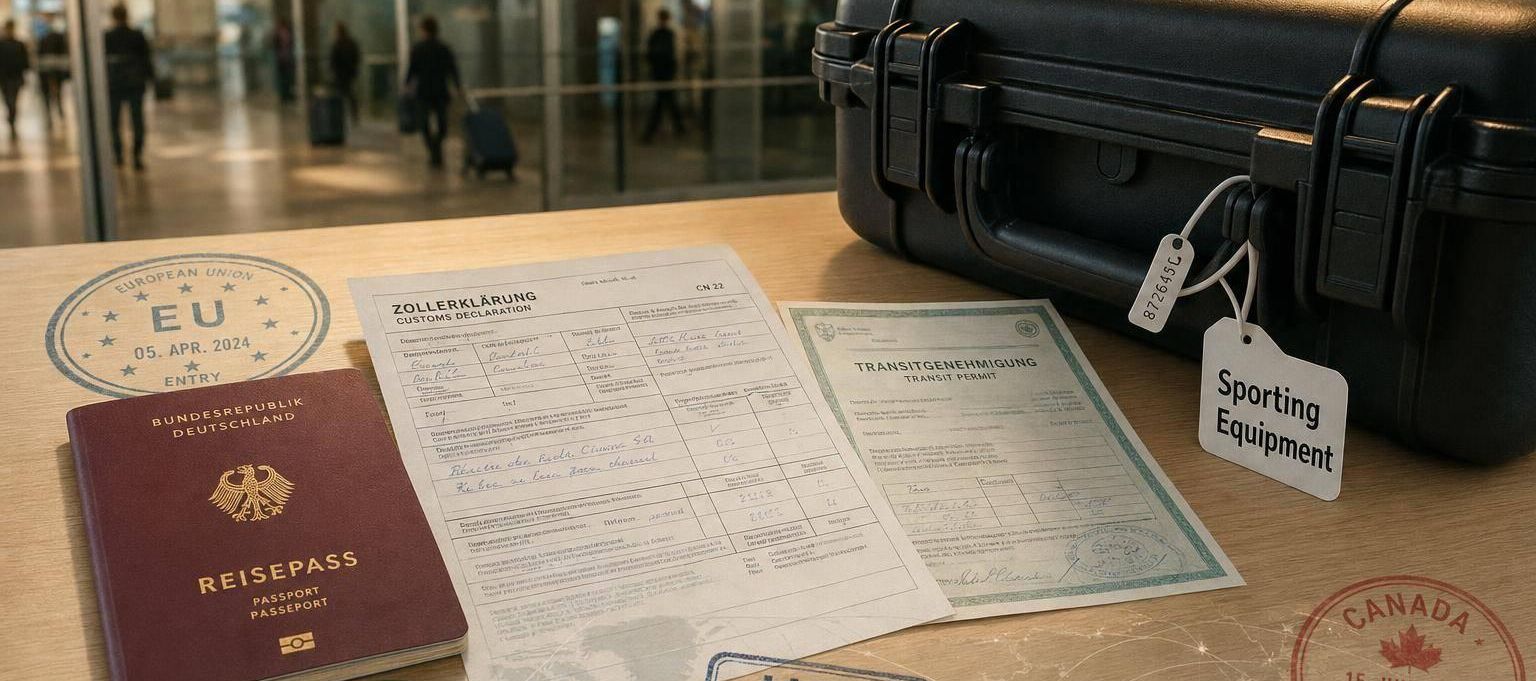
When I take hunting equipment across borders, I always check three points first: firearms law, customs, and species protection. Many trips fail because of this - not because of the weapon itself, but due to missing papers, incorrect declarations, or overlooked transit rules.
For me, the core of the topic is quite simple:
- Temporary transport is different from permanent import
- For hunting trips, the European Firearms Pass or a country-specific form like ATF Form 6NIA, SAP 520, or the Canadian Firearm Declaration often applies
- When purchasing abroad, I usually need two permits: export from the country of origin and import to Germany
- Ammunition, silencers, trophies, and game meat often cause problems
- On the return trip to Germany, I must actively declare, usually through the red channel
- A small typo in the serial number can already lead to confiscation
- For hunters, the text mentions up to 800 rounds as a guideline for temporary export from Germany
- In Switzerland, the duty-free limit was lowered to 150 CHF per person per day as of 01.01.2025
My brief conclusion: If I check WBK, EFP, invitation, proof of return goods, and destination country permit thoroughly before departure, the risk of trouble at the airport or customs decreases significantly. Especially for trips to the USA, Canada, South Africa, Namibia, and Austria, the details of the forms matter.
| Country | What I usually need first | Important Point |
|---|---|---|
| Germany | WBK / proof of return goods | Declare return properly |
| Austria | EFP, hunting invitation, sometimes permit | Check categories B and C separately |
| USA | ATF Form 6NIA | Entry without form can fail |
| Canada | Non-resident Firearm Declaration | Extra license for ammunition purchase |
| South Africa | SAP 520 | Sign only on-site |
| Namibia | Written invitation | Pistols and automatic weapons prohibited |
If I break the topic down to one sentence, it would be this: It's not the packing that is the problem - but whether my documents, serial numbers, and import rules match exactly.
Preparation Steps Before Departure: The Most Important Import Rules
Documents from Germany and for the Destination Country
When temporarily transporting, one thing counts above all: You must be able to prove the later return in compliance with customs and firearms law.
Before departure, you therefore need both German export documents and the entry documents of the destination country. For leaving Germany, you need the Waffenbesitzkarte (WBK) and the Europäischen Feuerwaffenpass (EFP) if you are traveling within the EU or the Schengen area [5][3].
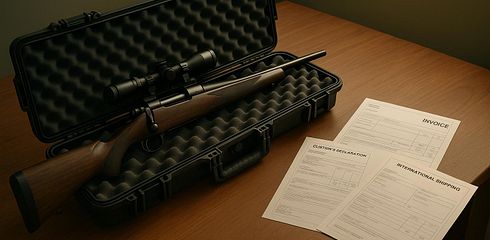
If the trip is to a third country, you also need the INF3 (Nämlichkeitsbescheinigung) from German customs. This document lists equipment and serial numbers and serves as proof for later re-import [6].
For the destination country itself, you usually also need a hunting invitation or an outfitter contract as well as a valid local hunting license [5][4]. Some countries have stricter checks here. For example, Austria requires a travel permit for non-residents, which must be applied for in advance through an embassy or consulate [4].
Only a few types of equipment are particularly sensitive. This is where most mistakes occur in practice.
Equipment categories with the highest legal risk
| Category | Risk Level | Most Important Requirement |
|---|---|---|
| Hunting rifles | High | EFP (Schengen) or BAFA export permit for third countries |
| Handguns | Very high | Stricter permits; often problematic for hunting trips |
| Ammunition | High | Max. 800 rounds for hunters during temporary export; must match the weapon [5] |
| Trophies of protected species | Very high | CITES documents and possibly taxidermy evidence required [3] |
Especially with handguns, ammunition, and trophies, you should always check the rules of the destination country separately before packing. What is acceptable in one country may cause trouble at the airport or customs in the next.
Transport, customs declaration, and preparation for the return trip
Now it gets practical: These documents only work together smoothly when transport and the return trip are also prepared.
For transport, the rule is: Always pack firearms and ammunition separately. It sounds simple, but it is a point that airlines often impose their own rules on. Therefore, it is worth checking the transport conditions before booking [3].
If you want to bring back trophies or game meat, it gets even stricter. Then veterinary and species protection controls also come into play. Game meat from third countries is usually not allowed to be imported privately into the EU. For trophies of protected species, you need CITES documents and sometimes additional taxidermy evidence [3].
With these documents, you can now specifically check the rules of the respective destination country.
sbb-itb-1cfd233
Legal import of weapons and accessories from the USA
Country rules: Germany, Austria, USA, Canada, South Africa, and Namibia
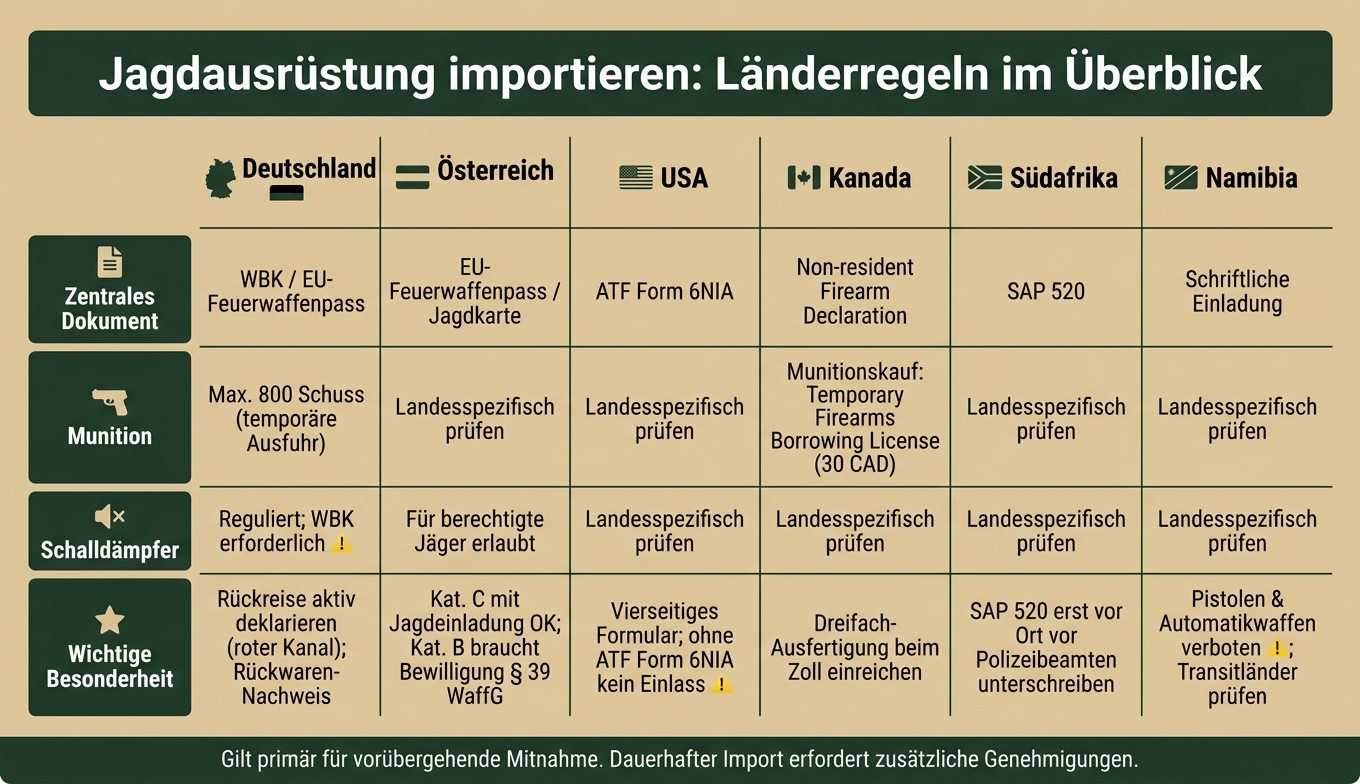
Importing hunting equipment: Overview of country rules
The groundwork is important. At the border, airport, or customs, the documents that must be immediately presented are what counts. The overview below focuses precisely on these points. It is primarily about temporary transport. For permanent import, additional permits are required.
| Country | Central Document | Ammunition Limit | Silencer | Special Feature |
|---|---|---|---|---|
| Germany (Return trip) | WBK / EU Firearms Pass [2][5] | 800 rounds for temporary export [5] | Regulated; WBK required [2] | Return trip only with clean proof of return goods; declare weapons and ammunition separately. |
| Austria | EU Firearms Pass / Hunting Card [4][8] | check regionally | Allowed for authorized hunters [8] | Category C with hunting invitation without prior approval; Category B requires permission according to § 39 WaffG [4][8] |
| USA | ATF Form 6NIA [7] | check regionally | check regionally | Four-page ATF form for non-immigrants [7] |
| Canada | Non-resident Firearm Declaration [7] | check country-specific | check country-specific | Triple copy at customs; ammunition purchase requires Temporary Firearms Borrowing License (30 CAD) [7] |
| South Africa | SAP 520 [7] | check country-specific | check country-specific | WBK + invitation required; form must be signed only in front of police officers [7] |
| Namibia | Written invitation [7] | check country-specific | check country-specific | Invitation from the farm owner, tenant, or conservancy committee required; automatic weapons and pistols are prohibited [7] |
Germany and Austria: EU Travel, Return, and Temporary Import
When returning to Germany from a non-EU country, no additional documents are required for firearms law, if a valid WBK is available [2]. The tricky point is often not the weapon itself, but the proof that it is a return item. This is where mistakes often happen. For the return journey, a clean return goods proof is needed, and firearms and ammunition must be declared separately. Those who overlook this risk prosecution and confiscation of the equipment [2].
In Austria, much depends on the weapon category. Different rules apply for non-residents regarding Category C and Category B. Long guns of Category C may be imported with a hunting invitation without prior approval [4]. For Category B, this is not sufficient: here, a permit according to § 39 WaffG is required, which must be applied for in advance through an Austrian representative authority [4][8]. Sound suppressors are permitted for authorized hunters [8].
USA and Canada: Entry Declarations and Ammunition Rules
Outside of Europe, it often becomes more formal. The forms are longer, and the scrutiny is usually stricter.
For the USA, foreign hunters must fill out the four-page ATF form for non-immigrants: ATF Form 6NIA [7]. Without this paper, things can quickly become unpleasant.
Canada requires a Non-resident Firearm Declaration in triplicate, which must be submitted at customs upon crossing the border [7]. The form must be fully completed there. Anyone wishing to buy ammunition in Canada also needs a Temporary Firearms Borrowing License. This costs 30 Canadian dollars [7]. So-called “Prohibited Firearms" may not be imported.
South Africa and Namibia: Safari Permits and Transit Risks
When it comes to safari trips, much depends on forms, invitations, and the route. Not only the destination country matters, but also every transit country in between.
For South Africa, SAP 520 is the central form. It is only signed on-site and in front of the police officer. Passport, flight ticket, WBK, and the contact of the outfitter should be readily available [7]. This saves time and often nerves.
In Namibia, a written invitation from the farm owner, tenant, or the conservancy committee is sufficient as a basis for import [7]. Automatic weapons and pistols are prohibited [7]. Additionally, there is a point that is easily overlooked: The transit rules of the transit country must be checked in advance [3][8].
Prohibited Items, Common Mistakes, and Checklists
According to the respective country rules, two things often remain as control risks: individual pieces of equipment and errors in declaration. This is often where issues arise in practice. Even if your permits are correct, there can be trouble at the border if prohibited items are in your luggage or if information has not been provided correctly.
Items That Frequently Cause Problems at the Border
Particularly often, silencers, night vision and thermal imaging optics, magazines with certain capacities, and knives with problematic blade shapes or lengths lead to issues[2][4].
Mistakes You Should Avoid at Customs, at the Airport, and During Wildlife and Species Protection Checks
You should always declare weapons and ammunition without being asked. When entering Germany, this specifically means: use the red channel. Those who do not do this risk criminal consequences[2].
Typical mistakes also include:
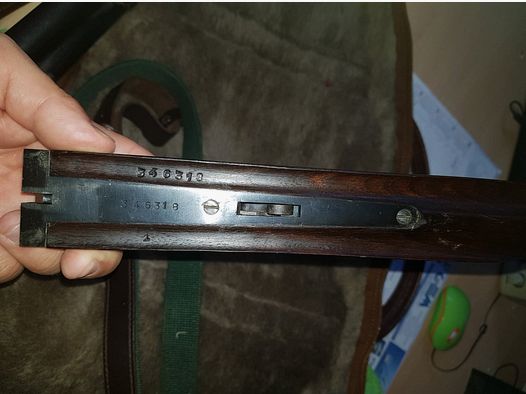
- Discrepancies in serial numbers between the weapon, WBK, and European Firearms Pass. This often leads to delays or even confiscation[1].
- No written proof for the hunting purpose, such as no hunting invitation.
- The assumption that airline rules also cover the import rules of the destination country. They do not.
- Forgotten transit countries. Anyone traveling through a third country must also check its weapon regulations[1].
The following points summarize the most important checks before departure, upon entry, and on the return journey.
Checklists for Departure, Arrival, and Return Journey
Before Departure
- WBK and European Firearms Pass fully completed; serial numbers matched with the physical weapons[1][9]
- Hunting invitation available in writing[9]
- INF 3 obtained from German customs[2]
- Weapon and ammunition packed separately and securely; airline requirements checked[9]
Upon Entry
- Declare immediately and without being asked
- Present the import permit of the destination country
On the Return Journey to Germany
- Declare weapons and ammunition actively again[2]
- Keep the original WBK ready as proof of return goods[2]
- Carry digital and paper copies of all documents
Conclusion: Importing Hunting Equipment Legally and Without Unnecessary Delays
Transporting and transferring are not the same. They involve different permits, different customs procedures, and sometimes differing rules for the return journey. In many cases, temporary transport is significantly easier than permanent import.
Next, take a close look at the requirements in the destination country. Check the information from the embassy, customs, and national firearms authority before traveling. In many countries, the import permit of the destination country is required first, followed by the export permit of the country of origin [1].
It is almost always strict with firearms, ammunition, and species protection. Ammunition, silencers, and trophies often require their own documentation and approvals. This also applies if the firearm itself can be imported without major hurdles. For trophies of protected species, CITES documentation is mandatory [3].
Complete documentation can save you a lot of trouble at the counter if in doubt. They help avoid seizures, inquiries, and long waiting times. In the end, it comes down to three points: check early, document everything properly, and declare correctly.
If you are missing something for the trip, you can supplement your equipment in advance. On Gunfinder, you will find hunting equipment – from optics to ammunition to clothing and accessories.
FAQs
When do I need INF3 instead of EFP?
The information provided does not mention a document called INF3.
For the import of hunting equipment into Germany, other documents are important instead. These primarily include the customs declaration form 0350 for personal property from non-EU countries, as well as firearms-related documentation such as WBK, export permits, and import permits.
When importing from non-EU countries, it may also be necessary to have certified translations for documents such as foreign firearms ownership cards. These translations usually need to be done by sworn translators.
What applies during transit through third countries?
When transporting hunting equipment through Germany, the process is considered transporting in the sense of the firearms law. A permit is absolutely required for this.
You need both the import permit of the destination country and the permission of the sending country. The rules may vary depending on the transit country. Therefore, inform yourself early with the relevant authorities.
Which documents do customs officers check first?
Customs officers first check the documents related to your identity, your authorization to carry the equipment, and your customs status.
Especially important are hunting license, firearms ownership card, or the European Firearms Pass. For imports from non-EU countries, the customs declaration 0350, a commercial or pro forma invoice, and, if necessary, CITES papers are usually required. For foreign firearms ownership cards, a sworn translation into German may also be required.