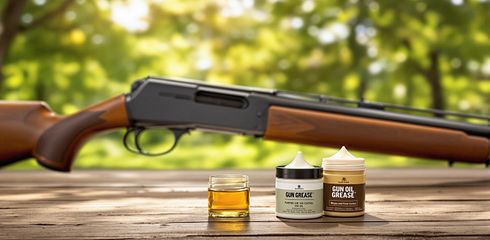
Gun care: Oil or grease?
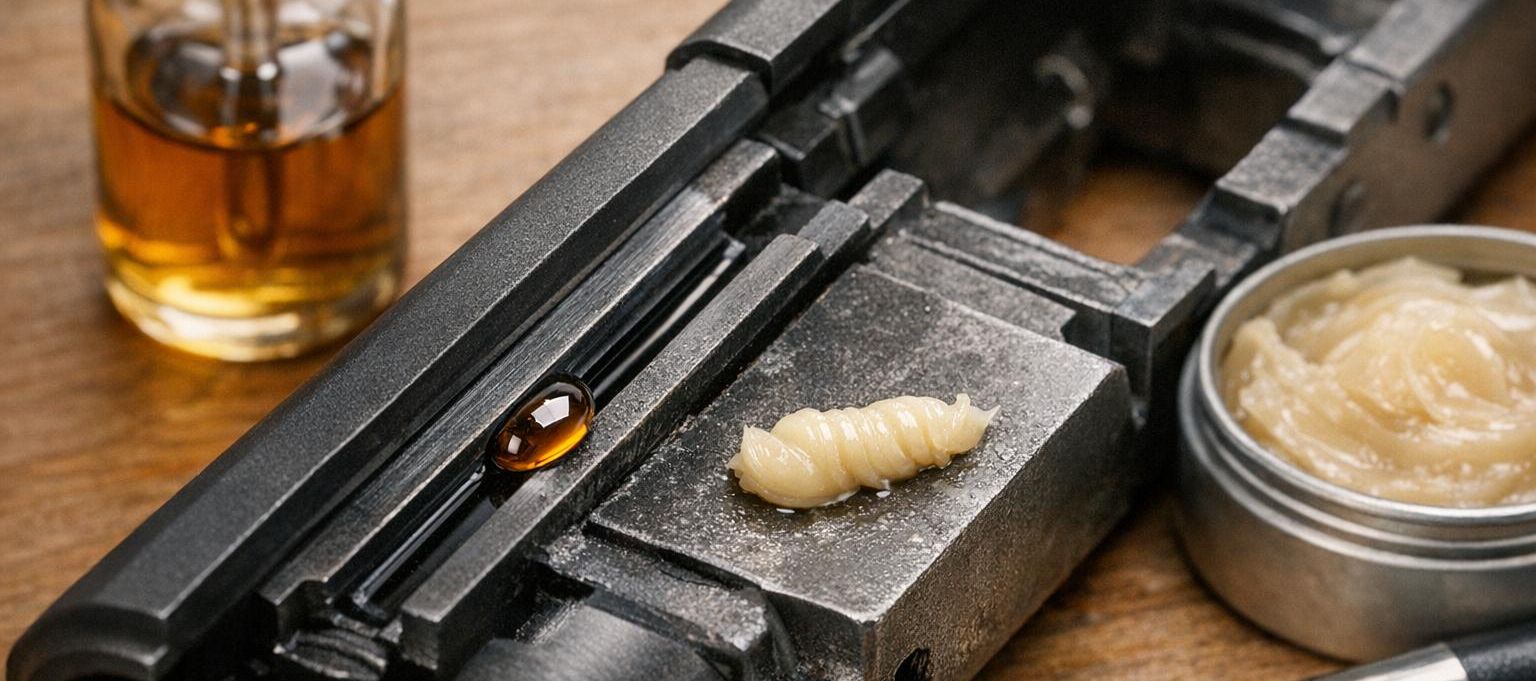
Gun maintenance is crucial to ensure the function and longevity of your firearm. The choice between gun oil and gun grease depends on the application:
- Gun Oil: Ideal for tight fits and hard-to-reach areas. It provides a thin lubrication and protects against corrosion. However, it runs off faster and requires more frequent reapplication.
- Gun Grease: Perfect for open, pressure-loaded surfaces like slide rails or threads. It adheres longer, offers better protection, and reduces wear. However, grease is not suitable for tight gaps.
Brief Comparison
| Criterion | Gun Oil | Gun Grease |
|---|---|---|
| Lubrication | Suitable for tight tolerances | For open, pressure-loaded systems |
| Rust Protection | Good, but short-term | Long-lasting and reliable |
| Temperature Range | Up to –50 °C / +250 °C | Up to –50 °C / +250 °C (with ceramic up to 1,200 °C) |
| Application | Precision mechanisms | Threads, chokes, slide rails |
Conclusion: For optimal maintenance, a combination of both products is recommended. Use oil for internal mechanisms and grease for heavily used, open areas.
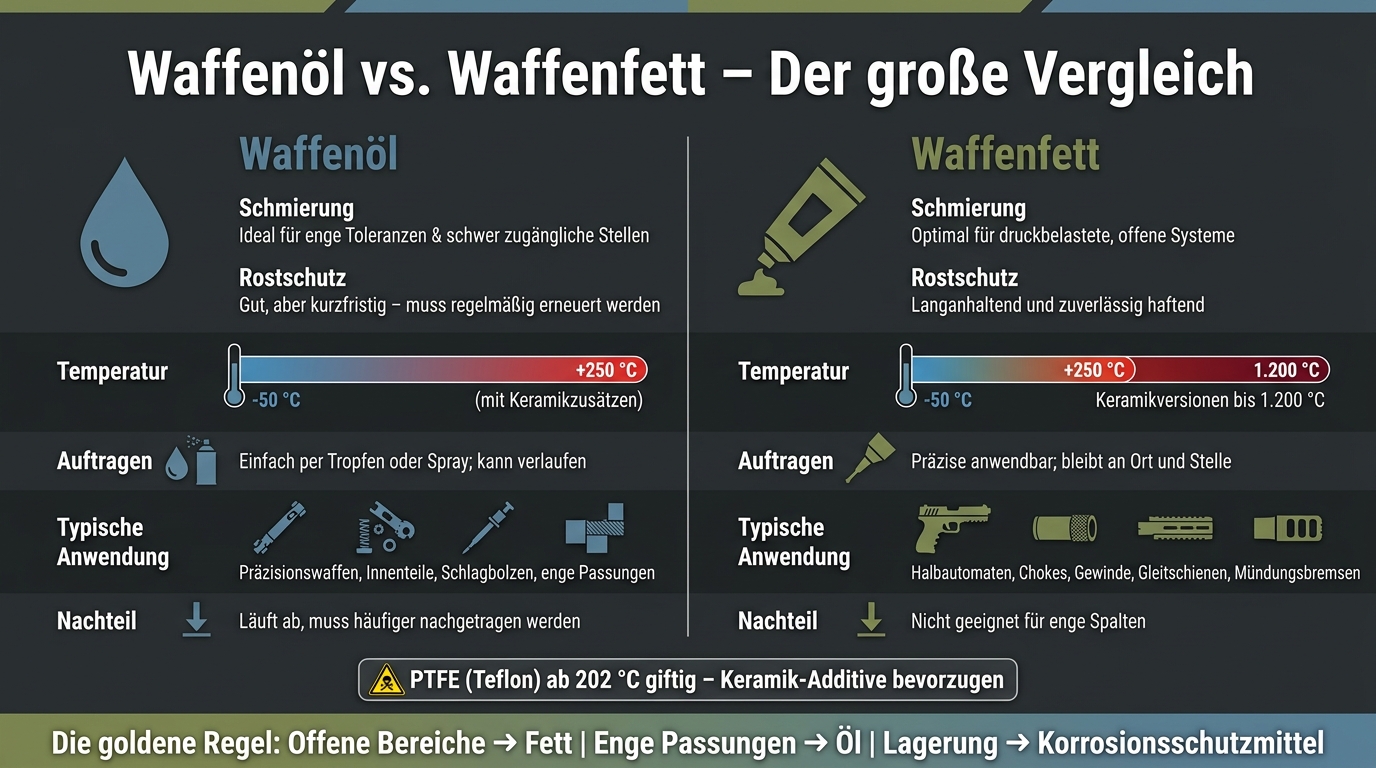
Gun Oil vs. Gun Grease: The Great Comparison
1. Gun Oil
Lubrication
Gun oil provides a thin protective film between moving parts, preventing direct metal-to-metal contact. It penetrates even the smallest gaps where grease often cannot reach. Therefore, oil is particularly well-suited for sporting firearms and other systems with very tight fits [1][3].
An important point: Universal Gun Oils often contain solvents like isopropanol. While these are practical for cleaning, they impair the lubrication effect. Under load, the lubrication film breaks down faster than with a pure lubricant [3].
Rust Protection
Gun oil provides protection against moisture and corrosion, but it has the disadvantage of running down over time [1]. When stored vertically, it can run out of the barrel or enter the firing pin channel. There, it can harden in the worst case and lead to malfunctions [3]. Therefore, oil should be reapplied more frequently than grease. For long-term storage, a special corrosion protection agent is recommended.
Temperature resistance is also a crucial factor when it comes to choosing the right oil.
Temperature Resistance
High-quality gun oil remains operational at temperatures from -50 °C to +250 °C [2]. Especially in extreme cold, the oil must remain liquid to ensure the weapon's functionality – which requires a complex chemical composition.
„Only through highly complex ingredients and processes have we managed to keep our lubricants liquid down to -50°C, ensuring reliable use of your weapon even in the deepest winter." – Adrian Ostermayer, Ostermayer Jagd [2]
At high temperatures, such as those generated by intense shooting, the carrier fluid can evaporate. In such cases, solid lubricant additives like ceramic particles provide stability up to 1,200 °C and ensure emergency operation [2]. PTFE (Teflon), on the other hand, is less suitable, as it can release toxic fumes starting at around 202 °C [2].
Application
Oil is primarily used in closed systems and with closely fitted components. For open and heavily loaded surfaces, such as guide rails under high pressure, grease is the better choice [3]. When stored standing, oil should be reapplied regularly to maintain protection.
sbb-itb-1cfd233
2. Gun Grease
Lubrication
Grease provides a lasting adhesion and thus ensures reliable protection. Thanks to its higher viscosity, it serves as a buffer between mechanical parts, significantly reducing wear[3].
“In principle, the rule is: Open systems are lubricated with grease, closed systems like an automobile engine or a gearbox with oil. This is solely related to adhesion." – Adrian Ostermayer, Ostermayer Jagd[1]
For semi-automatic firearms and heavily stressed threaded connections such as chokes, muzzle brakes, or suppressor threads, grease is the best choice. While oil can splash during rapid reloading and penetrate sensitive areas like the barrel, trigger group, or optics, grease reliably stays in place[1]. However, in particularly tight fits, oil is preferable.
In the following, we will take a look at the rust protection and temperature resistance of gun grease.
Rust Protection
Grease also provides effective protection against corrosion during long storage, especially at sensitive points like the muzzle or the inner wall of the barrel[3]. High-quality gun grease also resists oxidation and hardening, making it stable over long periods. It is important that the grease is material-neutral so that wood, plastic, and paints – for example, on the stock or coatings – are not damaged[2].
Temperature Resistance
Good gun grease withstands temperatures from –50 °C to +250 °C. Variants with ceramic additives even offer emergency running properties up to 1,200 °C, as the ceramic particles continue to lubricate even after the carrier medium has burned away. Silicone-based lubricants, on the other hand, are usually only temperature resistant up to about 180 °C and therefore less suitable for heavily stressed systems[2].
Application
Grease is particularly suitable for open systems with large, pressure-loaded surfaces such as guide rails, bolt tracks, chokes, and threaded connections. Since it adheres longer than oil, maintenance intervals can be extended. For tight, closed systems, however, oil is recommended, as grease cannot reach all gaps[1].
Gun oil, lubricant or gun grease? The right lubrication for firearms explained simply
Advantages and disadvantages at a glance
Here are the central properties of gun oil and gun grease in comparison:
Gun oil impresses with its high creep ability. It reaches tight gaps that are inaccessible to grease and is easy to apply. However, it tends to run off, which means it needs to be renewed more frequently. In semi-automatics, it can also enter the barrel or optics.
Gun grease, on the other hand, adheres permanently and offers long-lasting protection. It is particularly well-suited for pressure-loaded areas such as chokes or suppressor threads. However, its thick consistency can lead to increased resistance in tight fittings and, in the worst case, cause malfunctions [1].
The following table provides a direct comparison of the advantages and disadvantages:
| Criterion | Gun oil | Gun grease |
|---|---|---|
| Lubrication | Excellent for tight tolerances and hard-to-reach places | Optimal for pressure-loaded, open systems |
| Rust protection | Good, but requires regular renewal | Long-lasting and reliably adherent |
| Temperature resistance | Usable down to –50 °C; with ceramic additives up to +250 °C | Heat stable; ceramic versions up to 1,200 °C |
| Application | Easy to apply by drop or spray; can run off | Precisely applicable; stays in place |
| Typical application | Precision firearms, internal parts, tight fittings | Semi-automatics, chokes, threads, guide rails |
Important notes on additives
The choice of additives is crucial: lubricants with PTFE (Teflon) can release highly toxic fumes at around 202 °C [2]. A safe alternative is ceramic-based products, as the ceramic particles continue to lubricate even when the carrier medium has burned away.
“Especially for shotgun chokes, muzzle brakes, suppressor threads... we strongly recommend using our grease. It holds significantly better and longer than oil." – Ostermayer Jagd [1]
On Gunfinder, you will find a wide selection of care products – both oils and greases from various manufacturers. This way, you can directly select the suitable lubricant for your firearm.
Conclusion
The rule is simple: Lubricate open areas with grease, tight fits with oil. For most firearms, this means using both. Grease is suitable for threads, chokes, muzzle brakes, and suppressor threads. Oil, on the other hand, belongs on internal mechanisms, firing pins, and hard-to-reach spots. When storing, remove the lubricating oil and instead use a special corrosion protection agent, as oil can run off during storage and cause damage [1][3]. You can find suitable care accessories directly on Gunfinder.
For additional safety, ceramic-based lubricants are recommended. These are functional down to –50 °C, withstand temperatures up to +250 °C, and provide emergency running properties thanks to ceramic particles, even when the carrier medium has already burned away [2]. Particularly practical for winter hunting or intensive shooting operations.
On Gunfinder, you can conveniently compare gun oils, gun greases, and corrosion protection agents from various manufacturers and select the right product for your firearm.
FAQs
How much oil or grease is too much?
Too much oil or grease can negatively affect the performance of your firearm. Excess lubricant acts like a magnet for dirt and deposits, which can restrict the mobility of the mechanics. Therefore, only use the amount that is truly necessary to prevent rust and ensure smooth operation. Be sure to adjust the lubrication to the specific needs of your firearm.
Which areas should I never grease or oil?
Open weapon systems should never be lubricated with grease, as grease stays in place and does not run off. Instead, grease is unsuitable for closed systems, such as automotive engines. Here, oil is used because it flows off more easily and is therefore more effective.
How often should I lubricate depending on usage?
How often lubrication is needed depends on how frequently the firearm is used: If it is used frequently, it should be lubricated every few shots or daily. For infrequent use, lubricating every few weeks is sufficient. Regular maintenance is important to prevent rust and wear.