Care of hunting clothing: cleaning and storage

The proper care of your hunting clothing is crucial to maintain its functionality and lifespan. From cleaning to storage – here are the key points:
- Cleaning: Use odorless detergents without fragrances or fabric softeners. Follow the care instructions and avoid high temperatures.
- Stain Treatment: Dab blood stains and gently brush off dried dirt to protect sensitive materials.
- Drying: Air drying is ideal. Avoid high heat to prevent damage to membranes and coatings.
- Impregnation: Refresh the water-repellent layer after about five washes or heavy rain showers.
- Storage: Store clothing dry and protected, e.g., in airtight boxes. Avoid damp basements and significant temperature fluctuations.
With these measures, your hunting clothing will remain ready for use and durable.
Inspection and Preparation Before Cleaning
Once you understand the importance of proper care, the next step is a thorough inspection before cleaning. Before putting your hunting clothing in the washing machine, you should examine it closely. Careful preparation can prevent damage and significantly extend the lifespan of your gear. Small issues that are not addressed before washing can worsen. With the following steps, you are well prepared.
Check for Damage
Examine your clothing closely and look for tears, loose seams, or broken zippers. Test zippers gently without stressing the fabric[1]. If a zipper is not functioning properly, you should repair it before washing.
"For the care and long lifespan of zippers, it is advisable to lubricate them regularly." – Northern Hunting[1]
For clothing with membranes like ADDVENTEX™, you should check the level of soiling. Light dirt can often be removed manually with cold water – this protects the membrane and extends its lifespan[1]. Also, check the water-repellent DWR coating: Is water still beading off, or is the fabric already absorbing moisture?
Empty All Pockets
Don't forget to thoroughly empty all pockets – including small inner pockets and zippered compartments. Cartridges, knives, granola bars, or tissues can damage both your clothing and the washing machine. Turn the pockets inside out to ensure nothing is left behind.
Treating Stains
Let mud and dirt dry completely before gently brushing it off. Residues can be removed with a damp cloth[3]. Grease and oil stains on Loden fabrics should be treated by dabbing the area with absorbent paper – avoid using water[3]. For suede, you can generously sprinkle baking soda on the stain, let it sit overnight, and then brush it off[4].
Blood stains should be treated immediately: Dab fresh blood with an absorbent cloth without rubbing – rubbing could push the stain deeper into the fabric[3]. For stubborn stains on suede, mix water with a few drops of mild dish soap or a 1:1 solution of water and white vinegar. Dab the area with a damp sponge, but avoid vigorous scrubbing[4].
sbb-itb-1cfd233
Cleaning Process Step by Step
The proper care of your hunting clothing is crucial to maintaining its lifespan and functionality. Here you will learn how to optimally clean your gear.
Choosing the Right Detergent
For hunting clothing, the choice of detergent is particularly important. Use only detergents without fragrances and optical brighteners. Perfume can attract animals to you, while optical brighteners make your clothing more visible to them[5].
For membrane clothing like Gore-Tex or ADDVENTEX™, you should only use liquid detergents, as powder residues can clog the pores[5]. Special technical detergents like Grangers Performance Wash are ideal for maintaining the functionality of membranes[1]. For wool clothing, a wool detergent like Grangers Merino Wash is recommended, as wool has self-cleaning properties and should only be washed when necessary[5][1].
Wash according to fabric type
Always pay attention to the care instructions on the labels. A horizontal line under the temperature symbol indicates that a gentle wash cycle with reduced spin speed is necessary[5].
- Membrane clothing: Wash at low temperature and low spin speed.
- Loden and wool: Often, airing them for 24 hours in fresh air is enough to remove odors[3][1]. If necessary, use the wool program at a maximum of 30°C.
- Cotton products: Wash according to the label instructions, but it is better to air dry them instead of using a dryer[5][7].
- Synthetic blends (polyester/nylon): These are durable but tend to develop odors. Therefore, odor-neutral detergents are particularly important here[6].
Avoid these common mistakes
Some mistakes can significantly impair the functionality of your hunting clothing:
- Do not use fabric softener: It can destroy technical properties such as the breathability of membranes and odor control layers[5][1].
- Separate laundry: Wash hunting clothing separately to avoid odor transfer[5].
- Do not wash too often: Frequent washing damages membrane clothing. The water-repellent DWR coating loses its effectiveness after about five washes or ten heavy rain showers[1].
- Treat gently: Avoid high spin speeds and strong rubbing, especially with delicate materials like wool and loden, as this can damage the fibers[7][3].
With these tips, your hunting clothing will remain functional and durable.
Drying and Aftercare
After washing, the right drying method determines whether your hunting clothing retains its functionality.
Air dry or use low heat
The safest method to dry hunting clothing is air drying. Shake the clothing well to reduce wrinkles and shorten drying time. For heavier garments like insulated jackets, it is advisable to lay them flat on a towel instead of hanging them up. This keeps the fabric in shape [8].
Avoid drying the clothing in places with strong odors, as these can settle into the fibers. A well-ventilated room or using a fan helps improve air circulation and prevent unpleasant odors [8][9].
"Wool has self-cleaning properties; usually, airing it out for 24 hours is enough to remove odors." – Northern Hunting [1]
Once the clothing is completely dry, you should take care of restoring the impregnation.
Restore Impregnation
The water-repellent DWR coating (Durable Water Repellent) of your hunting clothing typically lasts about five washes or ten heavy rain showers before it needs to be renewed [1]. The ideal time to refresh the impregnation is right after drying. Use products like Grangers Performance Repel Plus or Grangers Wash + Repel. Apply the impregnation while the clothing is still slightly damp (about 5% residual moisture) to allow the active ingredients to penetrate the fibers better [1]. Repeat this process four to five times to maintain the water-repellent properties in the long term.
For garments with a wax finish, you should use a wax-based impregnation. Also, don't forget to regularly maintain the zippers. A little lubricant will keep them smooth and prevent them from sticking [1].
Tips for Off-Season Storage
After drying, proper storage is the next crucial step to keep your gear in good condition. As with cleaning, care pays off here as well. Proper storage not only preserves the functionality of your clothing but also extends its lifespan.
Only completely dry clothing should be stored. Even the slightest residual moisture can cause mold in closed containers [10][12].
"Even though it may be tempting to quickly pack your cold weather gear away in the basement and forget about it, it is worth taking the time for proper care and storage." – UF PRO [12]
Storage in Secure Containers
Use sturdy plastic boxes with tightly closing lids to protect your clothing from moisture, dust, and pests [10][12]. For insulated jackets or down, do not use vacuum bags, as the fibers can be damaged by prolonged compression, reducing thermal performance [12]. Wool clothing is best stored in breathable fabric bags that allow good air circulation [11]. Place the containers on shelves or pallets and not directly on the floor to avoid moisture damage [12].
Create Suitable Storage Conditions
The storage location should be cool, dry, and shady. Rooms like indoor closets or climate-controlled storage areas are excellent [11][12]. Avoid damp basements, as they often promote mold growth and unpleasant odors [10][12]. Attics are also not a good choice, as strong temperature fluctuations can damage technical materials and membranes [12].
Natural Remedies Against Pests and Odors
Cedar wood, lavender sachets, or rosemary are natural options to keep moths away and prevent musty odors [10][11][12]. Renew these repellents regularly to maintain their effectiveness [12]. Additionally, it makes organization easier if you label the containers and create a digital inventory with photos [12].
With these measures, your gear will remain in excellent condition – ready for the next season.
Common Mistakes and How to Avoid Them
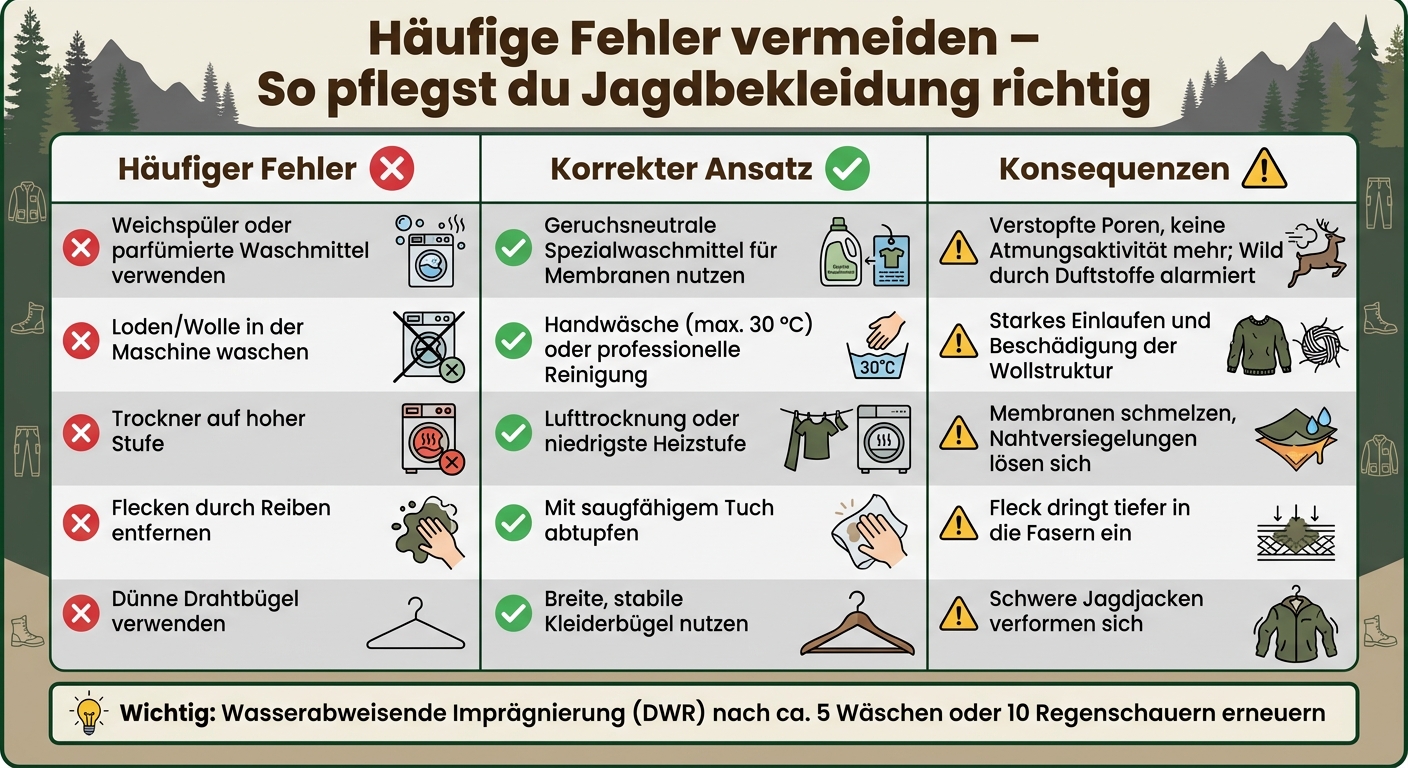
Common mistakes in hunting clothing care and correct methods
After you have cleaned and properly dried your hunting clothing, there are some common mistakes you should definitely avoid. Even experienced hunters sometimes make mistakes that can affect the lifespan and functionality of their gear.
A typical problem is the use of fabric softeners or scented detergents. These can clog the pores of membranes, causing loss of breathability and water repellency [2]. Another mistake is washing at too high temperatures, which can damage membranes or cause wool to shrink [2] [3]. When removing stains, people often rub instead of blot, which causes the stain to penetrate deeper into the fibers [3].
The following table shows you the most common mistakes and how to avoid them. This way, you ensure that your care and cleaning routine works optimally.
Correct Methods vs. Common Mistakes
| Common Mistake | Correct Approach | Consequences |
|---|---|---|
| Use fabric softener or scented detergents | Use odor-neutral special detergents for membranes | Clogged pores, no breathability; game is alerted by fragrances [2] [13] |
| Wash Loden/wool in the machine | Hand wash (max. 30 °C) or professional cleaning | Severe shrinkage and damage to the wool structure [3] |
| Dryer on high setting | Air dry or lowest heat setting | Membranes melt, seam seals come undone [2] [3] |
| Remove stains by rubbing | Blot with an absorbent cloth | Stain penetrates deeper into the fibers [3] |
| Use thin wire hangers | Use wide, sturdy hangers | Heavy hunting jackets become misshapen [3] |
Additionally, you should remember that water-repellent coatings (DWR) do not last permanently. After about five washes or ten intense rain showers, it is advisable to renew the coating [2]. Many hunters overlook this step and later wonder why their jacket suddenly absorbs water.
Conclusion
Caring for your hunting clothing is crucial to maintaining its lifespan and functionality. By following the described steps, you protect your investment and are optimally prepared for future hunting experiences.
What is especially important is a consistent routine: Regular cleaning with odor-neutral special detergents, renewing the water-repellent coating after about five washes or ten intense rain showers [1], as well as proper storage in airtight containers. Always pay attention to the care instructions from the manufacturers to avoid jeopardizing warranty claims [1]. Additionally, odor control plays a central role, as game has an extremely sensitive sense of smell [9].
With the right care, you not only save money in the long run but also help conserve resources. High-quality hunting clothing can last many years – perhaps even a lifetime – with careful treatment [1]. This way, you are well-prepared for the next hunting season, with equipment that reliably performs its duty while being breathable, waterproof, and odor-neutral.
FAQs
How can I tell if my impregnation is still effective?
You can tell that your impregnation is still intact if water beads on the surface of your clothing and it remains dry. However, once the water penetrates the fabric and it absorbs moisture, the impregnation is no longer effective.
How do I remove odors from hunting clothing without washing it?
Sometimes you don't have the time or opportunity to wash clothing, but the odor still needs to go. Here are a few simple and effective methods that can help:
- Air it out: Hang the clothing in a well-ventilated area, preferably outside or near a window. Fresh air often helps to dispel unpleasant odors.
- Use home remedies: Sprinkle some baking soda on the affected areas, let it sit for a few hours, and then shake it out. Alternatively, you can mix vinegar and water (ratio 1:3) in a spray bottle and lightly spray it on the clothing. The vinegar neutralizes odors and dissipates after a short time.
- Use steam: Use a steam iron or a handheld steamer to treat the clothing. The hot steam can help lift odors and refresh the fibers.
These methods are perfect when you need to act quickly and want the clothing to smell fresh again.
What to do if the membrane no longer "breathes" after washing?
If the membrane loses its breathability after washing, it's time to refresh the impregnation. This will restore the functionality of the membrane. Use a suitable DWR impregnation agent (Durable Water Repellent) and apply it as soon as the garment is dry. To further activate the water-repellent properties, you can put the clothing in the dryer on a low temperature.