Reliability of biometric systems: What hunters need to know

Biometric systems have now also made their way into hunting equipment. Whether fingerprint scanners, facial recognition, or iris scanners – they offer practical advantages by replacing keys and codes. But how reliable are these technologies under harsh conditions? Here are the key points:
- Fingerprint Scanners: Compact and affordable, but susceptible to dirt, moisture, and injuries.
- Facial Recognition: Performs poorly in low light conditions, facial expressions, or beard growth.
- Iris Scanners: Very precise, but sensitive to reflections and changes in light.
The systems must withstand extreme weather conditions, temperature fluctuations, and mechanical stress. Regular maintenance and combining with backup options like PIN codes or keys enhance security. Modern developments rely on AI to improve recognition and protection. Biometry offers security and convenience but requires robust technology and care.
Main Biometric Technologies: Strengths and Weaknesses
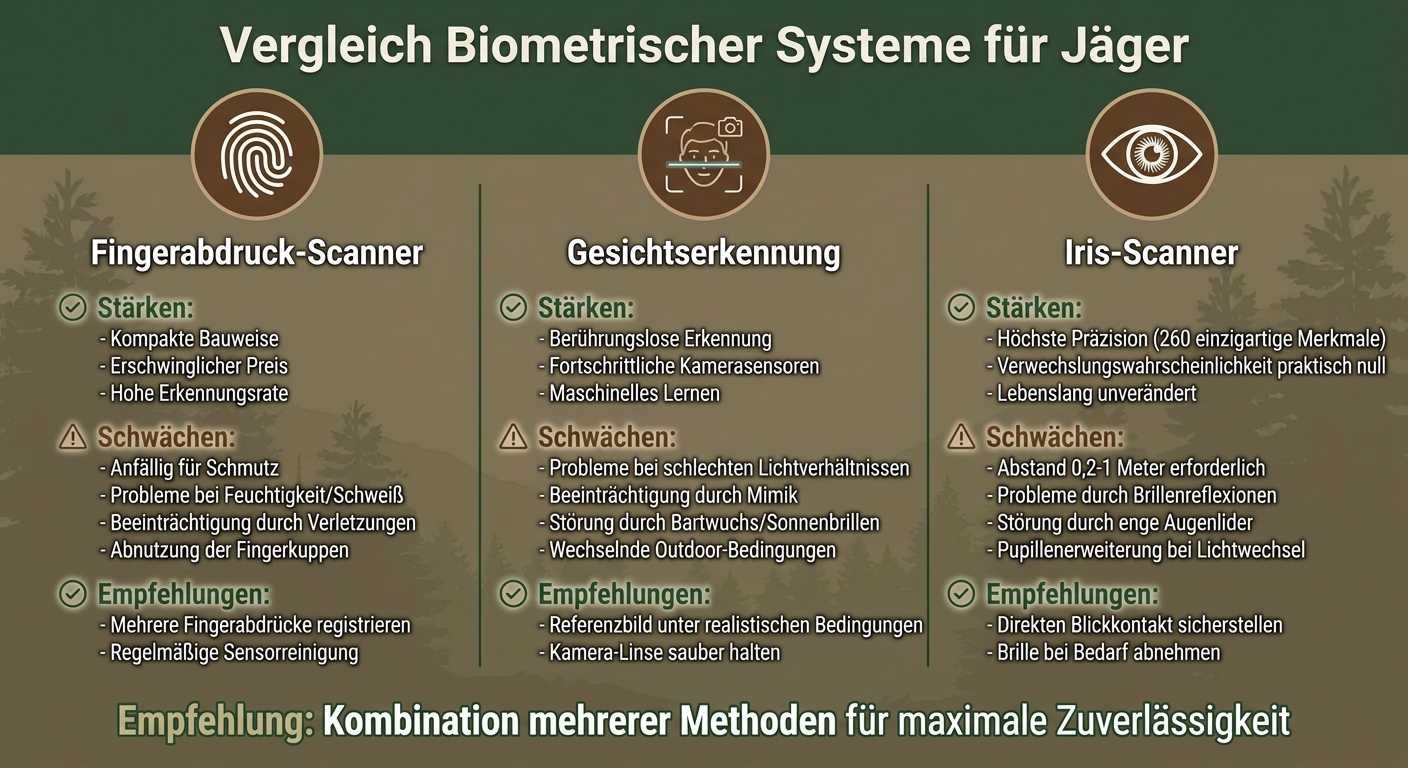
Comparison of biometric systems for hunters: fingerprint, facial recognition, and iris scanner
Fingerprint Scanners: Performance and Challenges
Fingerprint scanners are among the most widely used biometric systems. They score points for their compact design, affordable price, and high recognition rate. However, especially in hunting applications, they can reach their limits. Dirt, moisture, or sweat impair the sensors and lead to misreads [1]. After a heavy rain shower or with dirty hands, recognition can even fail completely. Injuries or wear on the fingertips – for example, from intensive outdoor work – also reduce reliability. To prevent these issues, it is advisable to register multiple fingerprints and regularly clean the sensor. Next, we move on to the challenges of facial recognition.
Facial Recognition: Environmental Factors and Accuracy
Facial recognition shows some weaknesses in real-world conditions. As heise online aptly describes:
"With faces, expressions, aging, sunglasses, beard growth, unfavorable perspectives, and inhomogeneous lighting conditions complicate the matching..." [1]
The changing light conditions outdoors, from dawn to complete darkness, present a particular challenge. A moonless night, for example, provides completely different conditions than a snow-covered landscape under a full moon [2]. High-quality systems rely on advanced camera sensors and machine learning to partially compensate for these weaknesses [1]. Nevertheless, there are significant quality differences between manufacturers. To improve recognition accuracy, the reference image should be taken under realistic conditions, and the camera lens should always be kept clean. In comparison, iris recognition brings a different dynamic.
Iris Scanners: Accuracy and Field Use
Iris scanners offer the most precise recognition among biometric technologies – the probability of confusion is practically zero [3]. The approximately 260 unique features of the iris develop in the first months of life and remain nearly unchanged throughout a lifetime [3]. However, there are practical limitations in hunting applications. The scanner requires a direct view at a distance of 0.2 to 1 meter [3]. Problems can arise from reflections on glasses, narrow eyelids, or strong pupil dilation under changing light conditions [3]. As early as 2017, it was demonstrated that the iris scanner of the Samsung Galaxy S8 could be tricked with relatively simple means [3].
sbb-itb-1cfd233
What Influences the Reliability of Biometric Systems
How Weather and Outdoor Conditions Affect the Sensors
Hunting equipment must withstand extreme conditions, and biometric systems are no exception. Weather conditions such as heavy rain and high humidity take a toll on the devices. To meet these challenges, such systems must be waterproof and continue to function even after immersion[4]. They are designed to withstand temperatures from -40 °C to +50 °C. However, sudden temperature changes, such as moving from the warm interior of a hut to the icy cold, can stress the electronics and materials[4]. ZEISS Jagd puts it succinctly:
"Hunting optics are not scientific instruments, but tools that must function at all times in harsh hunting conditions."[4]
Other factors such as hand sweat, salt spray, or cosmetics can attack unprotected sensors and cause corrosion. Therefore, resistance to corrosion is often tested through procedures such as a 24-hour salt spray exposure[4]. Mechanical stresses also play a role: prolonged vibrations, for example on uneven forest paths, and extreme g-forces of up to 1,500g – comparable to the recoil of a .460 Weatherby Magnum – can affect the sensitive electronics[4]. Here, polymer housings have proven to be particularly resistant to moisture and dirt, making them a better choice compared to conventional materials[5]. These extreme conditions require not only robust technology but also regular maintenance of the systems, as explained in the next section.
Technical Challenges and System Maintenance
In addition to the obvious environmental influences, mechanical stresses and natural wear affect sensor performance over time. Scratches, deposits, and other environmental damage can limit functionality. While software updates can improve detection accuracy, the quality of the hardware remains crucial. After impacts or other shocks in the field, a test shot should always be conducted to ensure that the system continues to operate reliably[4].
Security Risks: Spoofing and Data Protection
In addition to physical challenges, biometric systems must also be protected against digital attacks. Although they are considered more secure than passwords or security cards, as physical characteristics are unique and difficult to replicate, vulnerabilities remain[6]. Simple 2D face scanners, for example, can be tricked by videos or photos[6]. Therefore, modern systems rely on 3D live video and infrared technology to prevent such attacks[6].
An example of advancements in this area is the cooperation between IDnow and Trustfull, announced in March 2026. The goal of this collaboration is to ensure end-to-end fraud prevention and to detect even sophisticated spoofing attacks[6]. Nevertheless, the risk remains: In April 2026, German authorities were able to recover stolen hunting weapons after a burglary – a clear indication that robust security measures are still indispensable[2].
Practical Tips for Hunters
Maintenance of Biometric Devices in the Field
Biometric systems in gun cases and security equipment require regular maintenance to function reliably under the often harsh conditions of hunting. Keep the sensors free from direct contact with rain, snow, or dust [7]. For longer transports, sturdy hard cases made of plastic or aluminum are suitable, while lighter nylon cases are a good choice when protection is not a priority. Carefully clean the sensor surfaces with a soft brush or cloth, avoiding aggressive cleaning agents that could damage the surface. Store your equipment in a cool, dry place, away from direct sunlight, and regularly check for wear, damage, or moisture that could impair the functionality of the locking mechanism [7]. It also doesn't hurt to consider alternative security methods to be prepared for any eventuality.
Combination of Multiple Security Methods
In addition to maintaining biometric systems, it makes sense to combine multiple security methods to optimally protect your equipment. Do not rely solely on biometric technology. The combination of different security levels ensures that you have access to your equipment even under difficult conditions. Many modern gun safes offer backup options such as PIN codes or physical keys in addition to fingerprint scanners. This multi-authentication is particularly useful when environmental factors such as moisture, extreme temperatures, or dirty fingers impair the functionality of the sensors [8]. Such additional measures increase security and give you peace of mind that your equipment is protected at all times.
Find Reliable Equipment on Gunfinder

Gunfinder offers a wide selection of certified security solutions with biometric technology in the category of gun safes. When purchasing, make sure that the security requirements according to §36 WaffG are met – this way you can ensure that your equipment complies with the legal requirements for safe storage [9][10]. With the "Commerçant" filter, you can find providers that offer professional guarantees and technical support – a crucial advantage with complex biometric systems [11]. Since the sensitivity of sensors can decrease over time, it is advisable to purchase devices in "new" condition to benefit from the latest security standards. Brands like Bremer Tresor, known for their certified gun safes, are also a reliable choice [11].
Future Developments in Biometric Systems
Systems with Multiple Biometric Methods
The next generation of biometric security solutions focuses on the use of multiple biometric technologies simultaneously. A notable example is the 9-mm Smart Gun from Biofire Technologies from Denver, which was introduced in April 2023 under the leadership of CEO Kai Kloepfer. This weapon combines a fingerprint sensor in the grip with a 3D infrared facial recognition system on the back. Priced at around $1,499, it offers quick and reliable unlocking – even with dirty hands or poor lighting conditions [13]. Kai Kloepfer describes the challenge as follows:
"Fingerprint technology can be unreliable when a person's hands are wet or dirty."
The combination of different technologies in one system ensures higher reliability [13].
Similar approaches are being pursued in other areas, such as gun safes. At the "Jagd & Hund" trade fair in Dortmund, Hartmann Tresore and Rheinmetall Dermalog SensorTec presented the first gun safe with AI-supported facial recognition in January 2025. This system uses two cameras for stereo depth estimation to create a 3D profile of the user [12]. Thanks to this redundancy, authentication remains reliable even under external influences such as dirt or moisture [13]. Such multimodal approaches further drive the integration of AI in biometric systems.
How AI Improves Biometric Systems
Artificial intelligence plays a central role in the advancement of biometric technologies. One example is the so-called Liveness Detection. This technology detects whether the person being verified is actually a real human being, thus protecting against deception attempts using photos, videos, or masks [12]. Machine learning algorithms analyze 3D facial structures and combine RGB with infrared images. Spartanat describes the process as follows:
"The evaluation of the facial profile and the analysis of RGB and infrared images are based on machine learning" [12].
Another advancement is the use of edge AI technology, where data processing occurs directly on the device. This not only ensures privacy protection but also provides reliable functionality in remote areas, such as during hunting [12][13]. Modern systems recognize authorized users upon touch and unlock immediately, without requiring additional input [13]. These advancements make biometric security solutions particularly practical for everyday use, even under challenging conditions.
Conclusion
Modern biometric systems rely on deep learning algorithms that can reliably recognize features even under changing conditions – for example, with external changes such as beard growth or natural aging [14].
Despite these advances, there are still limitations. Even a highly developed system like the “Easypass” project achieves only a success rate of about 94%. This means that there are false rejections in 6% of cases and false acceptances in 0.1% [14].
In addition to technology, practical application is also crucial. By combining various biometric systems, reliability can be significantly increased under extreme conditions. That is precisely why multimodal and well-maintained systems are indispensable when it comes to your safety.
In addition, Gunfinder offers verified solutions. On this platform, you can specifically search for gun cabinets and security solutions. Thanks to the AI-based identity verification for sellers and the available reviews, you can find trustworthy dealers. This way, you can be sure that you are obtaining high-quality biometric systems from reliable sources [15][16].
The further development of biometric technologies, such as AI-supported Liveness Detection against deception attempts and even more precise recognition algorithms, promises an exciting future. For you as a hunter, these advances mean more security, faster access, and reliable functionality – even under the toughest conditions in the field. Take advantage of these opportunities to protect your equipment as best as possible and always be ready for action.
FAQs
Which biometrics are the most robust for hunting applications?
Facial recognition based on neural networks is considered one of the most reliable technologies for use in the hunting field. Even in challenges such as low light or partially obscured facial areas, it remains precise and effective.
How can I recognize spoofing-resistant biometrics?
Spoofing-resistant systems rely on a combination of various security features such as 3D facial recognition, Liveness Detection, and multi-factor authentication.
The Liveness Detection is particularly important. It checks whether the biometric features actually come from a living person. This is done, for example, by analyzing movements or eye reactions.
To further complicate attempts at manipulation, modern systems often integrate multiple biometric features. These include, among others, face, iris, and fingerprint. This multilayering ensures a significantly higher level of security.
What backup options are sensible?
Biometric systems such as fingerprint or iris recognition offer a high level of security. However, they can be affected by external influences such as dirt, moisture, or technical malfunctions. Therefore, it is sensible to have alternative access options available. These include, for example, PIN codes, mechanical locks, or electronic emergency unlocks.
A particularly reliable option is multi-factor authentication. This combines biometric recognition with additional methods. This way, your hunting equipment remains accessible even if one method fails. It is important to adjust the available options so that they optimally fit your requirements.