Checklist: DIY tools for wild processing
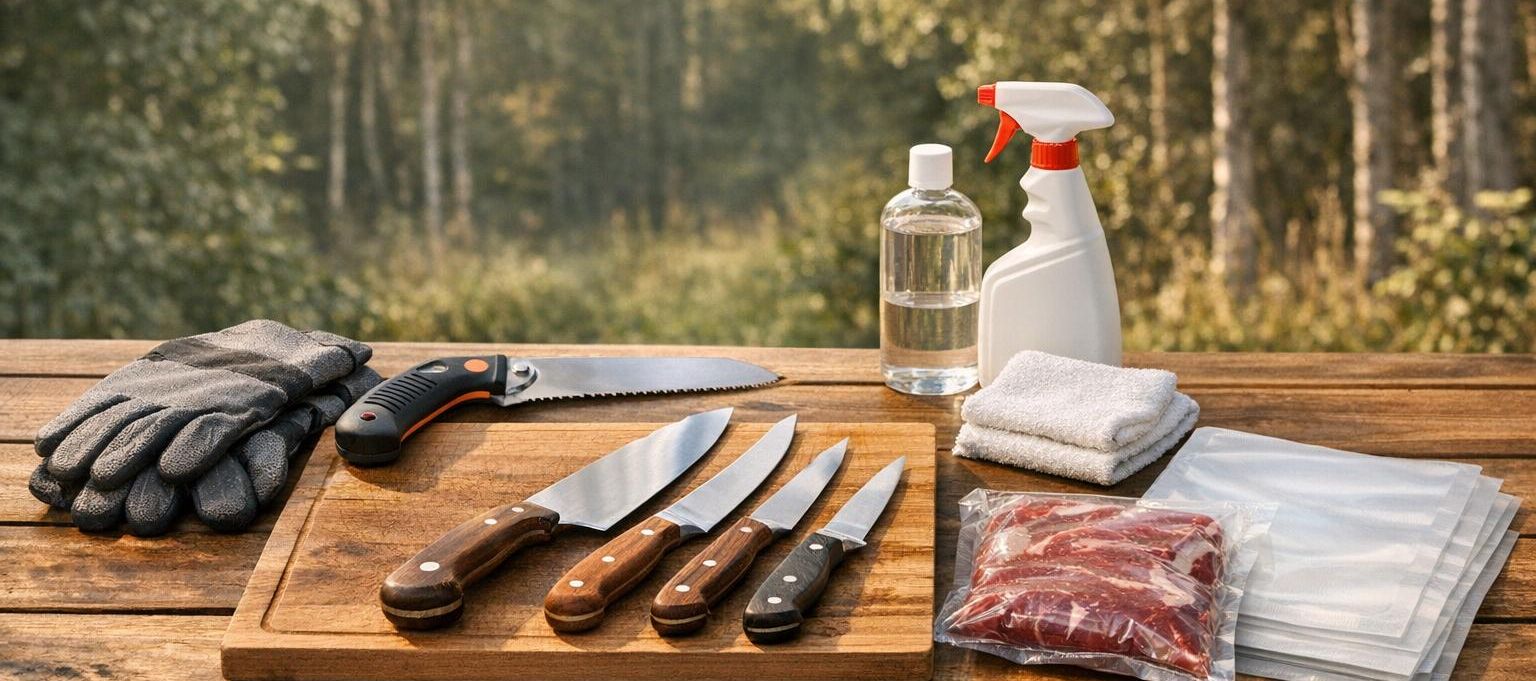
Processing game yourself saves money, guarantees the highest quality, and provides maximum control over the meat. With the right equipment, it is possible to work efficiently and safely, whether at home or on the go. Here you will find the most important tools and materials you need:
- Knife: A 6-inch boning knife for deer, an 8-inch slaughter knife for large game, and a filleting knife for precise work.
- Bone saw: For cutting through bones.
- Meat grinder: Saves time and delivers consistent results.
- Protective gear: Cut-resistant gloves, disposable nitrile gloves, and safety glasses.
- Cleaning: Warm soapy water for tools and hands, vinegar or citric acid solutions against insects.
- Storage: Airtight packaging, e.g., with a vacuum sealer, to avoid freezer burn.
- Additional tools: Rib spreaders, hanging devices, and headlamps for better efficiency.
For about €125, you can purchase a starter set that includes knives, a cutting board, and a sharpener. Invest in high-quality tools to save time and money in the long run.
Game Hygiene: Tools and Requirements for Game Processing
Basic Tools for Game Processing
Knives are an indispensable tool in game processing. A 6-inch boning knife with a stiff blade is excellent for breaking down. For more precise tasks, such as removing backstraps or silver skin, narrow, curved knives are ideal. For large game like moose, an 8-inch slaughter knife is the best choice, while a 6-inch knife is sufficient for deer. Josh Smith, a knife maker and founder of the Montana Knife Company, describes it this way:
“The best boning knife for deer is big enough for breaking down but small enough for skinning without puncturing.”
A filleting knife with a flexible blade is perfect for scraping meat very close to the bone – also ideal for processing waterfowl. A skinning knife with a curved blade is optimal for removing the hide. For cutting through wings, legs, and smaller bones, a heavy kitchen shears is indispensable. David Draper puts it succinctly:
“Strong, sharp, and durable blades are a DIY butcher's best friend.”
For cutting bones, a bone saw with a T-shaped handle and blunt hook tip is necessary to avoid puncturing when breaking down. A boning hook with a T-handle ensures that your fingers stay safely away from the blade. Draper says:
“A good boning hook is like an extension of your hand. Try it once and you'll wonder how you ever butchered without it.”
A rib spreader significantly facilitates cooling and cleaning the game chamber.
As a cutting board, a plastic board is recommended. It is hygienic, non-porous, and easy to disinfect. Wood should be avoided as it absorbs blood and bacteria. Light-colored boards also provide better visibility. Professional processing sets that include cutting boards, knives, and sharpeners are available for about €125.00.
To sharpen your knives, draw the blade 8 to 10 times per side at a 20-degree angle over a honing steel (the back of the knife about 6 mm tilted outward). Handles made of poly or G10 provide a secure grip even with wet or bloody hands and are easy to clean. Stainless steel has the advantage of rusting less, while carbon steel holds its sharpness longer.
With these tools, you are well-equipped to process game safely and efficiently.
Hygiene and Safety Materials
The right choice of tools is important, but cleanliness and safety are essential in game processing.
Gloves and Protective Gear
Cut-resistant gloves are an indispensable aid for hunters in 2025. They provide protection against injuries when breaking down and processing. In addition, disposable nitrile gloves are ideal for avoiding cross-contamination – simply change them after each work step.
A pair of safety glasses should also not be missing, especially when sawing or working with sharp tools. They protect the eyes from splinters and splashes. Models with anti-fog coating ensure clear visibility even with intensive use.
Cleaning Solutions
For cleaning hands, knives, and cutting boards, warm soapy water is the best choice. Pamela Schmutz, a food safety expert, explains:
“Wash your knife, your hands, and your cutting board often with warm soapy water.”
In the field, clean water and paper towels are sufficient to remove excess blood. Water should be used sparingly, as moist meat spoils faster. Grass or snow are unsuitable as they can introduce germs.
To keep insects away, a 50/50 mixture of vinegar and water or a citric acid solution (2 ounces of citric acid per liter of water) is recommended. PJ DelHomme from the Crazy Canyon Journal reports:
“The Alaska Department of Fish and Game recommends spraying the meat with a citric acid solution. They recommend two ounces of citric acid for every liter of water.”
The solution should be applied generously until it drips from the meat. This creates a protective crust that prevents insects from laying eggs.
After cleaning, the safe storage of leftovers is crucial.
Storage and Disposal
A two-bag system has proven effective: a small bag for fat and silver skin and a large one for bones. Brady Miller from GOHUNT describes his method:
“I completely cover the work surface with construction film to make cleaning easier. If I didn't do that, there would be meat and stains everywhere.”
Fresh game meat should be stored in the refrigerator at 1 °C to 3 °C and will last there for a maximum of 2 to 3 days if wrapped in moisture-proof plastic wrap. For long-term storage, freeze the meat at -18 °C or colder – it will remain good for up to 8 months. Seasoned or cured meat is only suitable for 4 months. To avoid freezer burn, package the meat airtight. If butcher paper is used, the meat should be wrapped in plastic wrap beforehand. Label the packages with the date and contents to keep track.
sbb-itb-1cfd233
Additional Equipment for More Efficiency
Once your basic equipment and safety precautions are in place, you can make your work even more efficient with the right additional equipment.
Ropes and Hanging Devices
Hanging a game carcass greatly facilitates processing, as gravity helps when breaking down the legs and separating the parts. T-shaped meat hooks are an indispensable aid in this regard. They act like an extension of the hand and ensure that your fingers stay safely away from the blade. David Draper, an expert in game processing, aptly describes it:
“A good boning hook is like an extension of your hand, keeping fingers away from sharp blades. Try it once and you'll wonder how you ever butchered without it.”
The processing time required depends heavily on the type of game: while a black bear takes about 6 hours, breaking down a moose can take at least 12 hours. A stable hanging system, such as made from paracord or with special game winches, saves valuable time. Equally important is reliable lighting to work efficiently even in poor light conditions.
Lighting Solutions
Since processing often lasts into the night, good lighting is essential. Headlamps, such as the Lupine Penta Pro, offer the advantage of keeping both hands free while ensuring optimal illumination. Make sure the lamp emits warm white LED light with a maximum of 3,000 Kelvin. This color temperature attracts significantly fewer insects than cool white or UV-containing light. Research by Prof. Dr. Gerhard Eisenbeis shows that warm white LEDs attract significantly fewer moths and other insects.
Care Products for Blades
Dull knives are not only inefficient but also dangerous. A honing steel and care oil are therefore part of the basic equipment to keep your knives sharp over the long term. Particularly durable are blades made of high-carbon steel or 420J2 stainless steel, which have proven themselves over many uses. To prevent corrosion and maintain sharpness in the long term, care oils like Ballistol are excellent.
Comparison Table: Advantages and Disadvantages of Common DIY Tools
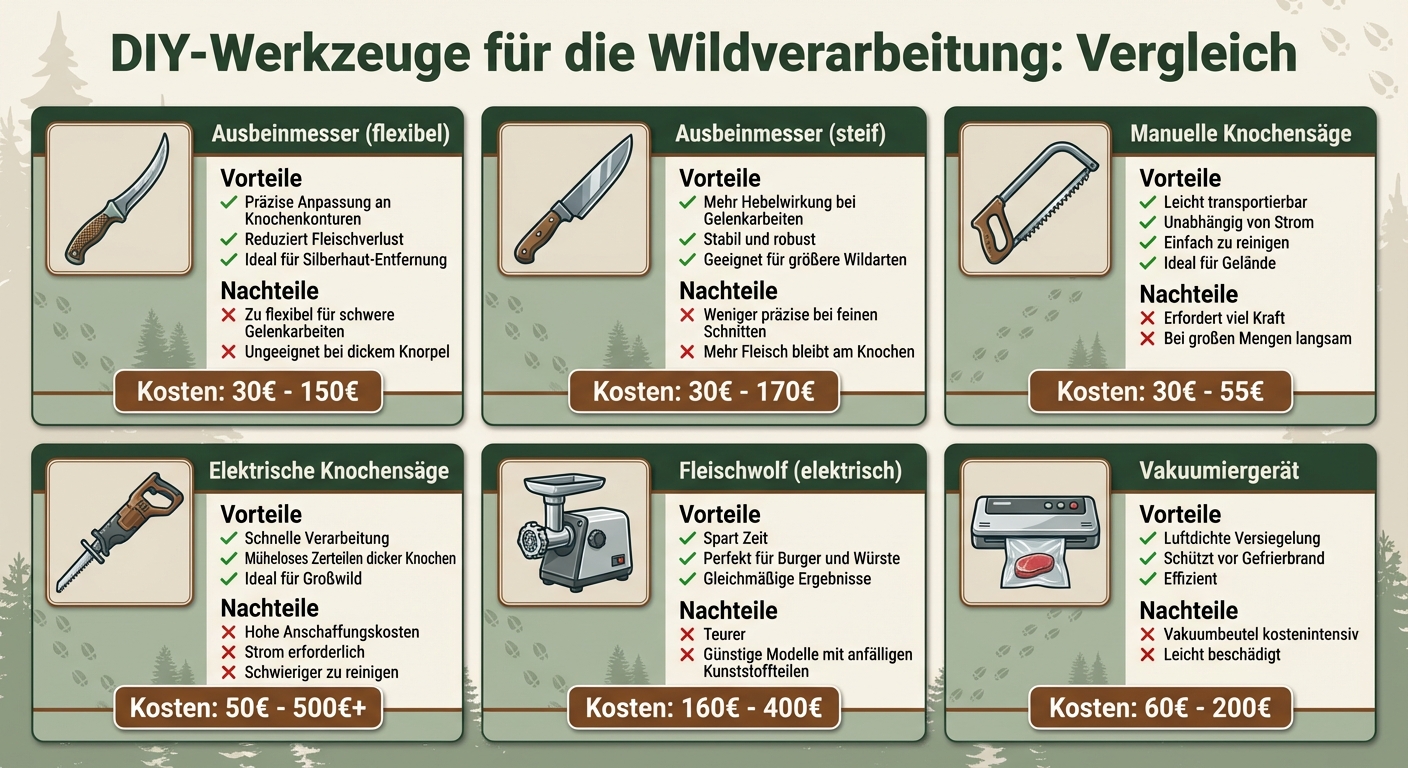
DIY Tools for Game Processing: Advantages and Disadvantages in Comparison
The following table summarizes the advantages and disadvantages of the discussed tools, along with their respective price ranges. This way, you can choose the right tools based on your budget, frequency of use, and type of game.
| Tool | Advantages | Disadvantages | Cost |
|---|---|---|---|
| Boning knife (flexible) | Precise adaptation to bone contours; reduces meat loss; ideal for removing silver skin | Too flexible for heavy joint work; unsuitable for thick cartilage | €30 – €150 |
| Boning knife (stiff) | Offers more leverage for joint work; stable and robust; suitable for larger game species | Less precise for fine cuts; more meat remains on the bone | €30 – €170 |
| Manual bone saw | Lightweight and portable; independent of electricity; easy to clean; ideal for use in the field | Requires a lot of force; slow for large quantities | €30 – €55 |
| Electric bone saw | Fast processing; effortless cutting of thick bones; ideal for large game | High acquisition costs; requires electricity; harder to clean (motor vents) | €50 – €500+ |
| Meat grinder (electric) | Saves time; perfect for burgers and sausages; delivers consistent results | More expensive to purchase; cheap models often have vulnerable plastic parts | €160 – €400 |
| Vacuum sealer | Ensures airtight sealing; protects against freezer burn; efficient | Vacuum bags are costly and can be easily damaged | €60 – €200 |
This overview helps you find the right tool for your needs. For beginners, a two-knife system combined with a manual bone saw is often sufficient. Those who regularly process larger quantities should consider electric tools, as they prove their worth in the long run through their performance and durability. Complement these tools with your existing safety and basic equipment to optimize your workflow.
Conclusion and Practical Tips
The choice and storage of the right tools, for example in a sturdy hard-shell case, significantly contribute to efficiency and safety. Before storing your tools, you should clean and sharpen them thoroughly. Dull blades not only require more force but also increase the risk of accidents due to slipping.
To protect the workspace, heavy construction film bags are suitable, which you can secure with tape. For better organization, it is advisable to provide separate containers for meat, fat, or silver skin as well as bones. Be sure not to let vacuum-sealed bags come into contact with other frozen items to avoid damage.
In addition to organization, it is important to observe legal regulations. According to §42a WaffG, carrying certain knives in public is prohibited. This includes fixed blades longer than 12 cm and one-handed locking blades. Therefore, always transport your tools in closed containers and carry your hunting license to comply with legal requirements.
“Weapons must be transported unloaded and in closed containers.” – Gunfinder Magazine
For anyone who regularly processes larger quantities, investing in an electric meat grinder is worthwhile, as it significantly eases the work. Professional sets with 12 pieces, including a hard-shell case, are already available from about €125.00 – a sensible investment to store tools safely and neatly.
FAQs
Which knives do you need for game processing?
For processing game, there are four types of knives that are particularly helpful, as they are each designed for specific tasks. A skinning knife with a wide and sturdy blade (about 10–12 cm) is ideal for skinning and removing larger pieces of meat. For trimming and bleeding directly in the field, a shorter knife (about 8–10 cm) with a curved blade is particularly suitable. A flexible boning knife with a length of about 12–15 cm allows for precise cutting around bones while retaining as much meat as possible. Additionally, sturdy kitchen shears are extremely practical for cutting tendons or opening packages.
At Gunfinder, you will find a wide selection of high-quality hunting and processing knives, so you are well-prepared for every step of game processing.
How do I ensure hygiene in game processing?
To ensure hygiene in game processing, you should pay attention to clean working conditions in the field. Wear disposable gloves to avoid direct contact with potentially infectious tissues such as brain, spinal cord, spleen, and lymph nodes. These areas may contain pathogens. Only use tools specifically designed for game processing and no kitchen utensils to avoid cross-contamination. After gutting, it is important to thoroughly clean and disinfect all tools. A proven method is a solution of 5 ml bleach per 1 liter of water. Soak knives for at least 1 hour in this solution to effectively kill germs.
Once you are home, the meat should be cooled to a temperature of 0–4 °C within 2 hours after the shot. A well-ventilated refrigerator or cooler is suitable for this. Make sure to work on a clean and disinfected work surface. Keep raw meat strictly separate from other foods and use separate cutting boards. Knives, saw blades, and hands should be regularly cleaned and disinfected. With specially assembled hygiene kits and tools available at Gunfinder, these standards can be easily maintained. This way, your game meat remains safe and tasty.
Which tools make game processing more efficient and safer?
To make game processing faster, cleaner, and safer, there are some tools that significantly ease the process. A sturdy game gambrel made of stainless steel ensures safe hanging of the game and reduces the risk of injury. Opening aids, such as special levers, make opening the chest cavity easier, while S- or turning hooks with rings make removing the entrails more efficient. Additionally, protective gloves provide protection against cuts and cold.
For breaking down the game, a high-quality boning knife and sturdy kitchen shears are indispensable for easily cutting tendons and skin. A meat thermometer helps to accurately monitor the core temperature of the meat, and a vacuum sealer ensures longer shelf life through airtight packaging.
With these aids, you can process your game hygienically, safely, and with significantly less effort.