Note:
The item location is abroad. Please note that this may affect delivery conditions, shipping times, and/or the purchasing process.
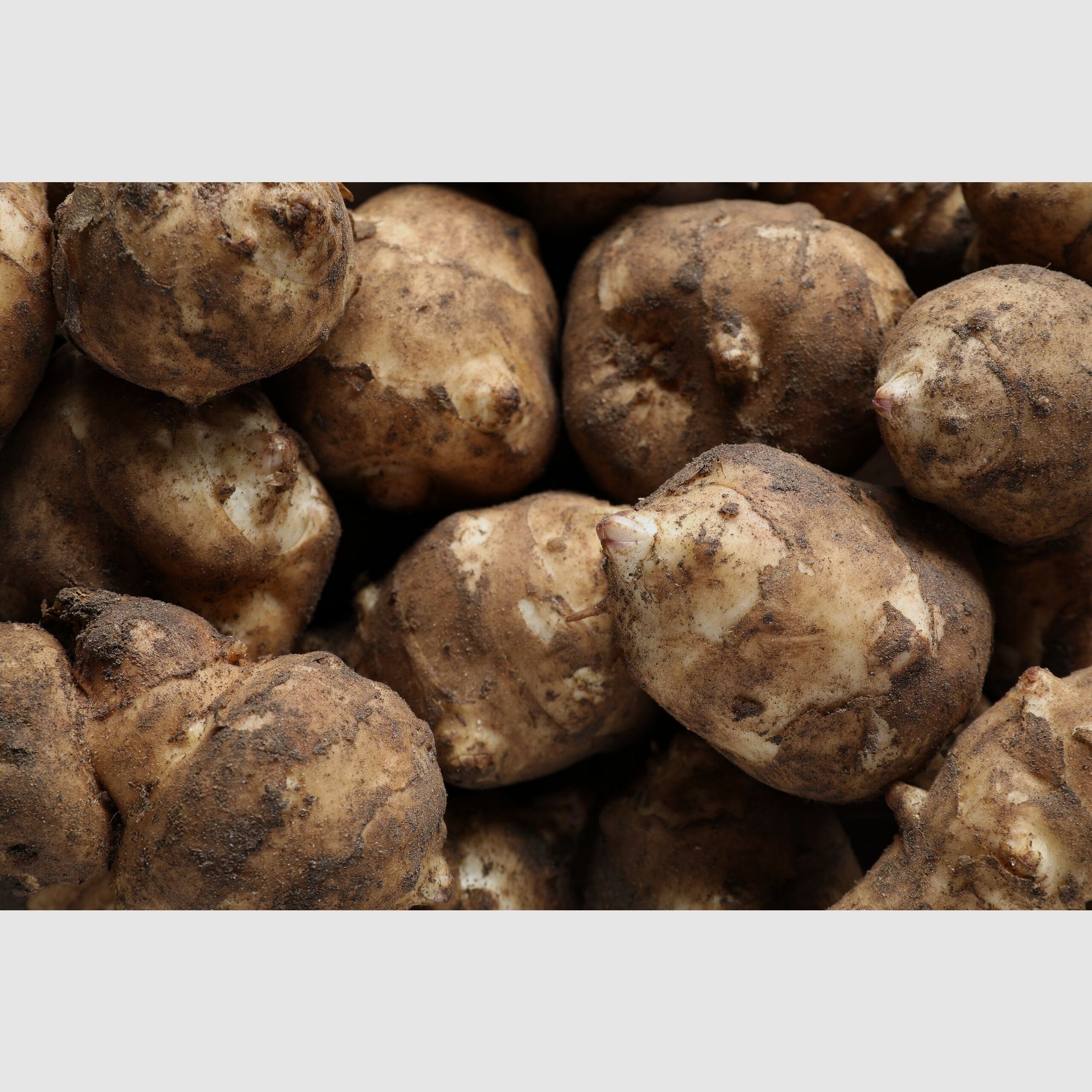
The topinambur tubers of the variety Wilda have proven themselves for years in the wild field area for both low and high game and are characterized by a round shape as well as the 2 to 3 m high foliage. The energy-rich tubers are particularly attractive to wild boar and red deer. The fresh foliage is browsed by small game, and the yellow flowers attract various insects. For the wild field, topinambur has a threefold benefit: The foliage provides forage until autumn and cover until spring. The frost-resistant tubers offer tasty forage from autumn to spring (leave the foliage over winter, the game will free the tubers themselves). Once planted, topinambur will sprout again by itself for several years. Planting can be done on the prepared area using a spade or with a potato planting machine. Planting time is from February to April (immediately after receipt, as the tubers are only short-term storable). Planting quantity is 4 to 5 tubers/m² or 120 to 150 g/m² (e.g., row spacing 75 cm, spacing in the row 30 to 40 cm). Planting depth is 5 to 10 cm. Germination duration is 7 to 14 days. Growth height is 2 to 4 m with a perennial usage duration. Fertilization is not or only minimally required. In the first year of growth, the weed pressure should not be too high until about 20 cm of growth height. In cases of very high game pressure, a fence may be necessary, as otherwise the freshly planted tubers may be uprooted or the young shoots may be bitten off. From the second year, remaining tubers will sprout by themselves. A too high density of topinambur can lead to lower foliage. If necessary, reduce the density by uprooting shoots, hoeing, or replanting. Note: Available only until early April! Topinambur tubers are only storable for a few days (cool and dark). Planting should be done immediately after receipt of the tubers.
(Show description in original language)
Die Topinambur-Knollen der Sorte Wilda haben sich seit Jahren im Wildackerbereich für Nieder- und Hochwild bewährt und zeichnen sich durch eine runde Form sowie dem 2 bis 3 m hohen Kraut aus. Die energiereichen Knollen sind besonders attraktiv für Schwarzwild und Rotwild. Das frische Kraut wird dabei von Niederwild beäst und die gelben Blüten locken diverse Insekten an. Für den Wildacker hat Topinambur einen dreifachen Nutzen: Das Kraut bietet Äsung bis zum Herbst und Deckung bis zum Frühjahr Die frostharten Knollen bieten von Herbst bis Frühling schmackhafte Äsung (Kraut über Winter stehen lassen, das Wild schlägt sich die Knollen selber frei) Einmal gepflanzt, treibt Topinambur über mehrere Jahre von selbst wieder aus Die Pflanzung kann auf der vorbereiteten Fläche mittels Spaten oder mit einer Kartoffelpflanzmaschine erfolgen. Pflanzzeitpunkt Februar bis April (sofort nach Erhalt, da die Knollen nur kurz lagerfähig sind) Pflanzmenge 4 bis 5 Knollen/m² oder 120 bis 150 g/m² (z. B. Reihenabstand 75 cm, Abstand in der Reihe 30 bis 40 cm) Pflanztiefe 5 bis 10 cm Keimdauer 7 bis 14 Tage Wuchshöhe 2 bis 4 m mehrjährige Nutzungsdauer Eine Düngung ist nicht oder nur in geringem Maß erforderlich. Im ersten Standjahr darf bis ca. 20 cm Wuchshöhe der Unkrautdruck nicht zu hoch sein. Bei sehr starkem Wilddruck ist in seltenen Fällen ein Zaun notwendig, da sonst die frisch gepflanzten Knollen herausgeschlagen oder die jungen Triebe verbissen werden können. Ab dem zweiten Jahr treiben verbleibende Knollen selber aus. Eine zu hohe Topinamburdichte kann zu niedrigerem Kraut führen. Bei Bedarf die Dichte durch Ausreißen von Trieben, Hacken oder Umpflanzen reduzieren. Hinweis: Nur bis Anfang April lieferbar! Topinambur-Knollen sind nur wenige Tage lagerfähig (kühl und dunkel). Die Pflanzung sollte unverzüglich nach Erhalt der Knollen erfolgen.







 A-TEC
A-TEC
 AEA Airguns
 AKAH
AKAH
 ASG
ASG
 Aimpoint
 Alpen Optics
 Alpha Industries
 Anschütz
 Antonio Zoli
 Ares
Ares
 B&T Schalldämpfer
 Baikal
 Ballistol
 Balzer
 Barbour
 Barnes
 Barnett
 Benelli
 Beretta
 Bergara
 Blaser
 Brandit
 Bremer Tresor
 Brenneke




 Classified ad