
When it comes to securing and carrying our ever-diversifying hunting optics, every hunter has their own unique approach. Where once a binocular hung around the neck of a night-time wild boar hunter, today a thermal imaging camera usually dangles instead. The temperature-sensitive lens makes identifying wild boar in nighttime conditions much easier. However, the binocular has not lost its significance in daylight and will continue to be the preferred means of identifying our game during "normal" hunting times.
Especially in the mountains, but also while stalking and even when approaching a hunting stand, two factors are crucial for all types of hunting observation optics: as fatigue-free carrying as possible and quick access to the device. It is of no use if the optics are buried at the back of the backpack while the boars are standing in the field in front. And if the heavy binocular digs into the neck or the thermal imaging camera swings back and forth in front of the chest, these items will inevitably end up back in the aforementioned backpack sooner or later.
Therefore, regardless of the type of hunting optics, an ergonomic, quiet, and as functional as possible storage solution is needed that allows for immediate access. It should be as flexible as possible, accommodating our various devices depending on the type of hunting and time of day.
Wouldn't it be great if we could simply carry all our different day and night lenses in the same container? "Yes," we think, and we have now built the Lens Pot specifically for that purpose!
What is the WALDKAUZ lens pouch all about this time?
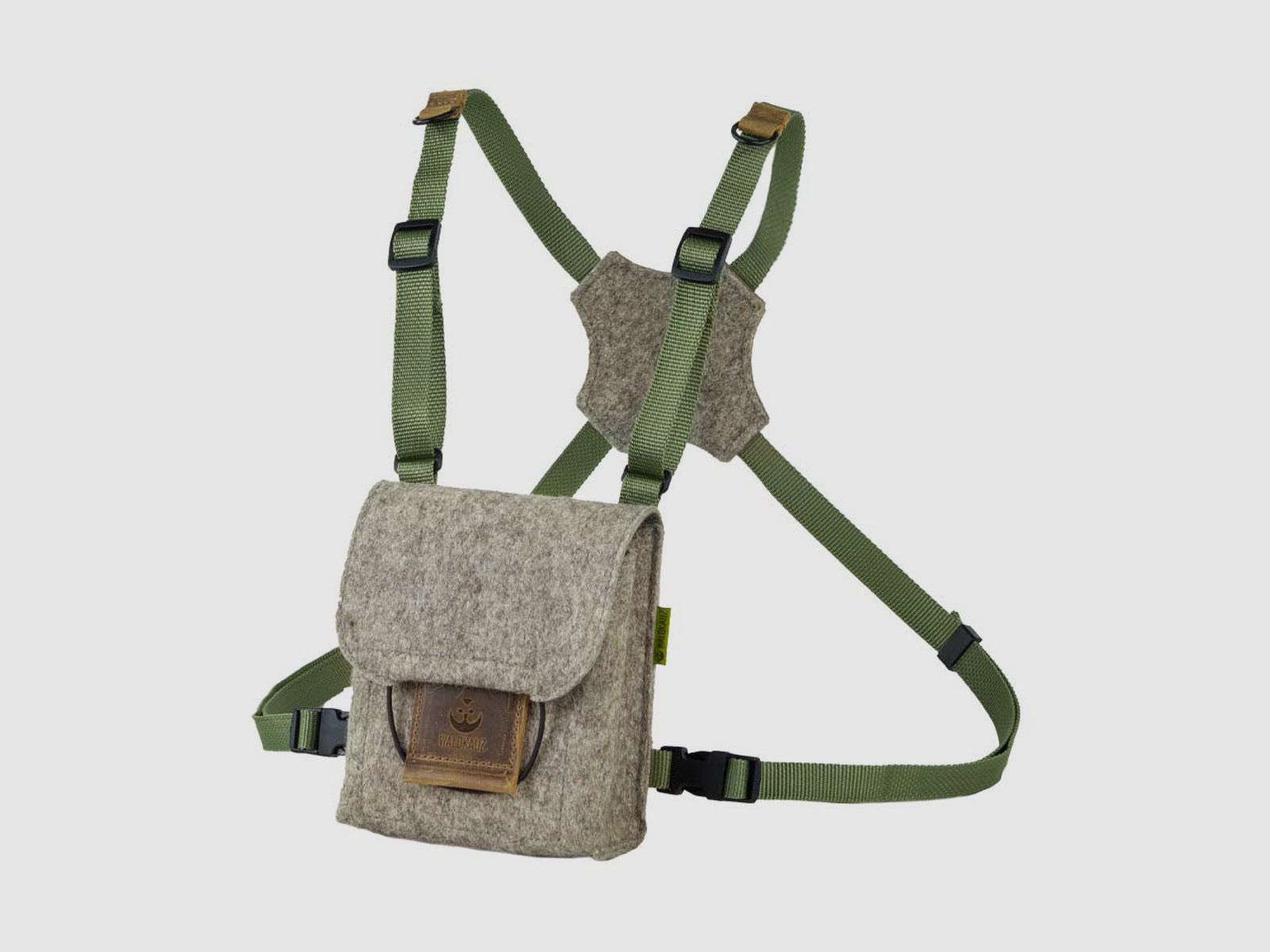
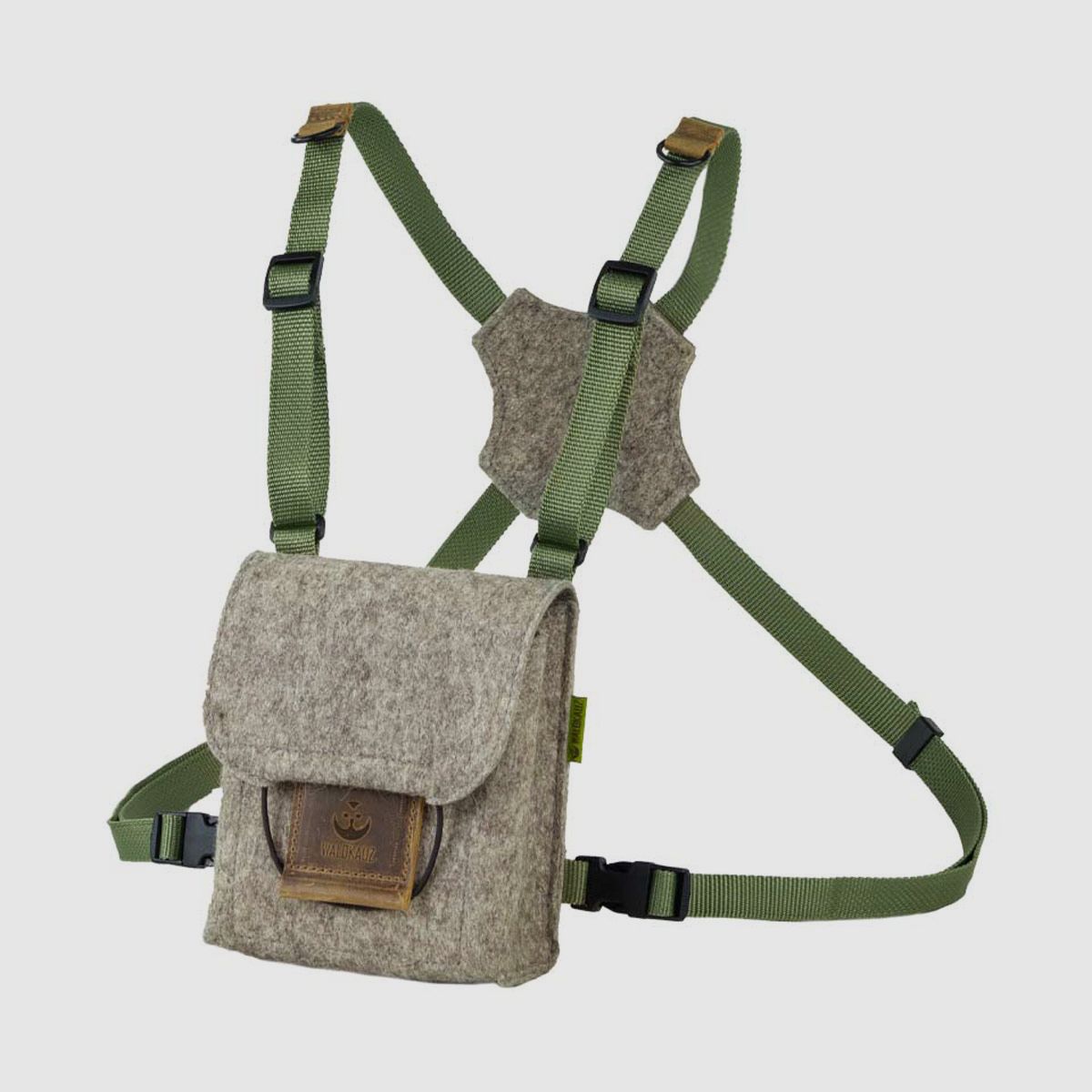
The lens pouch is a well-padded felt bag with a silent leather closure that can hold a binocular or a thermal imaging device, or indeed all sorts of other hunting "lenses" (e.g., night vision attachments, add-on devices, small spotting scopes, or even a small camera) depending on its size. With an additional insert available for purchase, a variable division and thus padded separation of the different lenses is possible.
The optics case is worn in front of the chest, allowing for immediate access to the optics. When moving in difficult terrain, it fits snugly to the body and does not dangle around. Its fit is extremely variable and can be adjusted to one's body size at four points via the carrying straps. Side buckles allow for quick putting on and taking off. On the back, there is a leather trim that keeps the straps apart, preventing strap or lens tangling.
When used as a WBK bag, an optional accessory is the insert – a double-sided open felt cylinder – which is placed in the main compartment using Velcro. This insert can be positioned freely to the sides or in the middle of the main compartment. This separates the optics from the rest of the bag and creates some space for additional items, such as a flashlight, a hunting knife, reading glasses, or in the best case even a night vision attachment.
On the front and back of the bag, there are two additional flat pockets for small items. The body-side pocket also houses rubber loops that can hold either ball or shotgun cartridges or batteries. These are positioned centrally so that they can rest in the recess on the underside of the binoculars without adding extra bulk.
To secure binoculars, thermal imaging cameras, or night vision devices, there are two D-rings on both sides of the carrying strap to which additional, length-adjustable attachment loops can be attached. This optional accessory has a clip at the end that can be fastened to the optics. This way, the respective device is not only extra secured but can also be quickly released from its attachment with a swift motion. This "holding strap for the lens cap" is available separately as an optional accessory.
In addition to the appearance, the lens pot can of course also be "misused" for other hunting utensils and used as a small storage or material bag for various purposes. And here we are back at the beginning of this text and the personal little soup. Which lenses we put in the pot and whether we prefer it with or without an insert is up to each individual.
The lens pouch comes in various sizes and can be customized to individual needs with the optional insert and straps. The elastic closure creates a play area of about 3-4 cm in height for each size. When using different devices, one should always start with the device that has the largest overall height. In terms of basic dimensions, all common night vision devices, thermal cameras, and binoculars (with the exception of old Porro prism glasses!) actually fit into the pouches. The height is crucial for the choice of model.
Wenn es um die Befestigung und das Tragen unser immer vielfältiger werdenden Jagdoptik geht, kocht jeder Waidmann und jede Waidfrau ihr ganz eigenes Süppchen. Wo früher beim nächtlichen Sauenjäger ein Fernglas hing (nämlich um den Hals), baumelt heute meist eine Wärmebildkamera. Die temperaturempfindliche Linse macht das Ansprechen von Schwarzwild bei nächtlichen Verhältnissen viel einfacher. Das Fernglas hat aber bei Licht nicht im geringsten an Bedeutung verloren und wird zu „normalen“ Jagdzeiten immer noch das bevorzugte Mittel zum Ansprechen unseres Wildes bleiben.
Besonders am Berg, aber auch auf der Pirsch und selbst beim Angehen zum Ansitz sind zwei Faktoren für alle Arten von jagdlicher Beobachtungsoptik entscheidend: Möglichst ermüdungsfreies Tragen und dabei ein schneller Zugriff auf das Gerät. Es bringt nichts, wenn die Optik hinten im Rucksack liegt, während vorne auf der Wiese die Sauen stehen. Und wenn das schwere Fernglas in den Nacken schneidet oder die Wärmebildkamera vor der Brust hin und her baumelt, landen selbige Utensilien über kurz oder lang doch wieder hinten im eben erwähnten Rucksack.
Also braucht es, egal um welche Art von Jagdoptik es sich handelt, eine ergonomische, leise und möglichst funktionelle Aufbewahrung, die sofortigen Zugriff erlaubt. Dabei sollte sie, so flexibel wie möglich, je nach Jagdart und Tageszeit, unsere unterschiedlichen Gerätschaften aufnehmen können.
Wäre es nicht großartig, wenn wir einfach alle unsere unterschiedlichen Tag- und Nachtlinsen im selben Behältnis führen könnten? „Ja“, finden wir und haben nun extra dafür den Linsentopf gebaut!
Was ist denn jetzt schon wieder der WALDKAUZ Linsentopf?
Der Linsentopf ist eine gut gepolsterte Filztasche mit einem lautlosen Lederverschluss, die je nach Größe ein Fernglas oder eine WBK oder eben alle möglichen anderen jagdlichen „Linsen“ aufnehmen kann (z.B. Nachtsicht-Vorsatzgeräte, Nachsatzgeräte, kleine Spektive oder auch eine kleine Kamera). Durch eine zusätzlich zu erwerbende Einlage ist eine variable Unterteilung und somit gepolsterteTrennung der verschiedenen Linsen möglich.
Das Optik-Futteral wird vor der Brust getragen und ermöglicht so einen sofortigen Zugriff auf die Optik. Beim Bewegen in schwierigem Gelände liegt es eng am Körper und baumelt nicht herum. Sein Sitz ist extrem variabel und wird über die Tragriemen an vier Punkten auf die eigene Körpergröße angepasst. Seitliche Steckschnallen ermöglichen ein schnelles An- und Abnehmen. Auf dem Rücken befindet sich ein Lederbesatz, der die Riemen so außeinander hält, dass es keinen Riemen- bzw. Linsensalat gibt.
Beim Einsatz als WBK-Tasche wird als optionale Zubehör die Einlage – ein beidseitig offener Filzzylinder – im Hauptfach per Klett eingesetzt. Diese Einlage lässt sich beliebig zu den Seiten oder in der Mitte des Hauptfachs platzieren. Die Optik wird so vom Rest der Tasche getrennt und schafft etwas Platz für weitere Gegenstände, wie z.B. eine Taschenlampe, ein Jagdmesser, die Lesebrille oder im günstigsten Fall sogar noch das Nachtsicht-Vorsatzgerät.
Auf der Vorder- und Rückseite der Tasche befinden sich zwei weitere, flache Fächer für Kleinigkeiten. Das körperseitige Fach beherbergt zudem Gummischlaufen, die wahlweise Kugel - und Schrotpatronen oder Batterien aufnehmen können. Diese liegen mittig, so dass sie sich beim Fernglas in die Mulde auf der Unterseite des Glases legen und nicht zusätzlich auftragen.
Zur Sicherung von Fernglas, Wärmebildkamera oder Nachtsichtgerät befinden sich an beiden Seiten des Trageriemens zwei D-Ringe, an die man zusätzliche, längenverstellbare Befestigungsschlaufen anbringen kann. Dieses optionale Zubehör hat am Ende einen Clip, der an der Optik befestigt werden kann. So ist das jeweilige Gerät nicht nur extra gesichert, sondern kann auch mit einem schnellen Handgriff aus seiner Sicherung gelöst werden. Dieses "Halteband für den Linsentopf" ist separat als optionales Zubehör zu erwerben.
Neben der Optik kann man den Linsentopf natürlich beliebig auch für andere Jagdutensilien „missbrauchen“ und ihn als kleine Vorrats- oder Materialtasche für diverse Zwecke einsetzen. Und da sind wir wieder beim Anfang dieses Textes und dem eigenen Süppchen. Welche Linsen wir in den Topf packen und ob wir ihn mit oder ohne Einlage bevorzugen, das bleibt jedem selbst überlassen.
Den Linsentopf gibt es in verschiedenen Größen und er kann durch die optionale Einlage und Haltebänder an die eigenen Bedürfnisse angepasst werden. Durch den Gummizug am Verschluss bildet sich bei jeder Größe ein Spielraum von etwa 3-4 cm in der Höhe. Bei der Verwendung von unterschiedlichen Geräten, sollte man daher immer vom Gerät mit der größten Gesamthöhe ausgehen. Von den Grundmaßen her passen eigentlich alle gängigen Nachtsichtgeräte, Wärmebildkameras und Ferngläser (mit Ausnahme der alten Porroprismen-Gläser!) in die Taschen. Entscheidend für die Wahl des Modells ist die Höhe.





 A-TEC
A-TEC
 AEA Airguns
 AKAH
AKAH
 ASG
ASG
 Aimpoint
 Alpen Optics
 Alpha Industries
 Anschütz
 Antonio Zoli
 Ares
Ares
 B&T Schalldämpfer
 Baikal
 Ballistol
 Balzer
 Barbour
 Barnes
 Barnett
 Benelli
 Beretta
 Bergara
 Blaser
 Brandit
 Bremer Tresor
 Brenneke




 Classified ad