Magnification
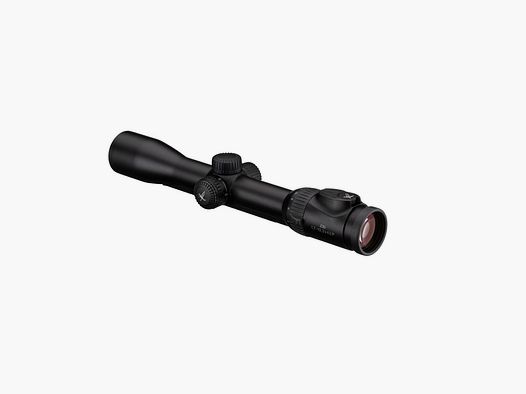
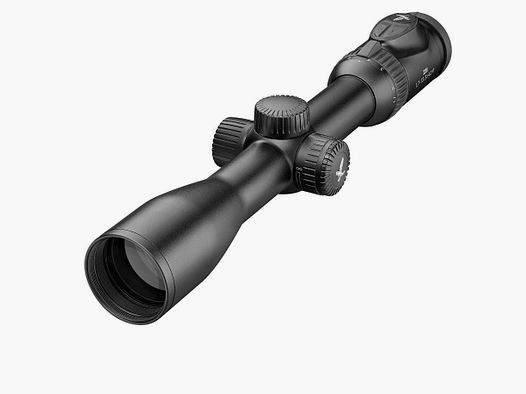
The magnification indicates how many times an object appears closer. The higher the magnification, the closer the object appears and the smaller the field of view becomes. Scopes usually have a variable magnification (zoom), e.g., 2-16x. This means that you can zoom continuously from 2 times to 16 times magnification.
Point of Impact Adjustment
To aim at the point of aim at different distances, the reticle is adjusted so that the point of impact aligns with the point of aim. The point of aim refers to the point on the target object that you are aiming at. The reticle adjustment in the turrets on the scope is operated via a click mechanism. Each click changes the point of impact.
Adjustment Range
The adjustment range refers to the area in distance within which you can make point of impact corrections by adjusting the reticle without moving the device. The adjustment range is specified in terms of both elevation and lateral adjustability.
The adjustment range is indicated in meters per 100 meters (m/100m) or inches per 100 yards (in/100yd) in our case. Other manufacturers may choose to specify it in MRAD (milliradian) or MOA (minutes of angle).
Light Transmission
Transmission describes the light permeability of an optical system. It is expressed as a percentage. The objective diameter determines the amount of light that enters the optics. Thus, it is crucial for performance, especially in twilight. The larger the objective diameter, the more light enters through the objective. The darker the environment, the larger the objective diameter should be. Pay attention to the exact product designation, as the number after the x indicates the objective diameter in millimeters. For example, if a device has the designation 2-16x50, it has an objective with a diameter of 50mm.
Vergrößerung
Die Vergrößerung gibt an, um wievielmal ein Objekt näher erscheint. Je höher die Vergrößerung, desto näher erscheint das Objekt und desto kleiner wird das Sehfeld. Zielfernrohre haben meist eine variable Vergrößerung (Zoom), z.B. 2-16x. Das bedeutet, dass man stufenlos von 2facher bis auf 16fache Vergrößerung zoomen kann.
Treffpunktkorrektur
Um auf unterschiedliche Distanzen stets auf den Visierpunkt zielen zu können, wird das Absehen so verstellt, dass die Treffpunktlage mit dem Haltepunkt übereinstimmt. Unter Haltepunkt versteht man den Punkt auf dem Zielobjekt, den man anvisiert. Die Absehenverstellung in den Türmen am Zielfernrohr wird über die Klickrasterung betätigt. Jeder Klick verändert dabei die Treffpunktlage.
Stellweg
Der Stellweg bezeichnet jenen Bereich in der Entfernung, im Rahmen dessen man durch das Verstellen des Absehens die Treffpunktkorrektur vornehmen kann, ohne das Gerät zu bewegen. Der Stellweg wird sowohl in Bezug auf die Höhe als auch in Bezug auf die seitliche Verstellbarkeit angegeben.
Der Stellweg wird bei uns in Meter pro 100 Meter (m/100m) oder Inch pro 100 Yards (in/100yd) angegeben. Andere Hersteller entscheiden sich für eine Angabe in MRAD (Milliradiant) oder MOA (Winkelminuten).
Lichttransmission
Die Transmission beschreibt die Lichtdurchlässigkeit eines optischen Systems. Sie wird in Prozent angegeben. Der Objektivdurchmesser bestimmt die Lichtmenge, die in die Optik gelangt. Somit ist er maßgebend für die Leistung, v.a. in der Dämmerung. Je größer der Objektivdurchmesser, desto mehr Licht tritt durch das Objektiv ein. Je dunkler die Umgebung, umso größer sollte der Objektivdurchmesser sein. Achten Sie auf die genaue Produktbezeichnung, denn die Zahl nach dem x gibt den Objektivdurchmesser in Millimeter an. Trägt ein Gerät den Zusatz 2-16x50 so hat dieses beispielweise ein Objektiv mit 50mm Durchmesser.





 A-TEC
A-TEC
 AEA Airguns
 AKAH
AKAH
 ASG
ASG
 Aimpoint
 Alpen Optics
 Alpha Industries
 Anschütz
 Antonio Zoli
 Ares
Ares
 B&T Schalldämpfer
 Baikal
 Ballistol
 Balzer
 Barbour
 Barnes
 Barnett
 Benelli
 Beretta
 Bergara
 Blaser
 Brandit
 Bremer Tresor
 Brenneke








 Classified ad