Revolver vs. Pistol: A Comparison for Hunters

Revolver or pistol? This question occupies many hunters. Both types of firearms have specific advantages and disadvantages that can be crucial depending on the hunting situation:
- Revolver: Simple design, high reliability, suitable for difficult conditions such as moisture or dirt. Typically 5–7 shots, ideal for follow-up shots or tracking. Popular calibers: .357 Magnum, .44 Magnum.
- Pistols: Higher magazine capacity (10–17 shots), faster reloading, lighter due to polymer frame, ideal for driven hunts. Examples: Glock 20 (10mm Auto).
Important differences:
- Reliability: Revolvers are considered jam-resistant, pistols require more maintenance.
- Weight: Revolvers are usually heavier, pistols often lighter.
- Reloading speed: Revolvers are slower, pistols are faster.
Conclusion: Revolvers are robust and low-maintenance – perfect for solitary hunts or tracking. Pistols excel in driven hunts with faster shot sequences and higher capacity. The choice depends on the hunting situation.
Main Differences Between Revolvers and Semi-Automatic Pistols
Functionality
Revolvers and semi-automatic pistols fundamentally differ in their mechanics. In a revolver, the rotating cylinder serves both as the magazine and the cartridge chamber. By cocking the hammer or pulling the trigger, the cylinder rotates and brings the next cartridge into firing position [5].
Semi-automatic pistols, on the other hand, operate with a fixed chamber that is directly connected to the barrel. The recoil from a fired shot causes the bolt to move backward, ejecting the empty casing and loading a new cartridge from the magazine [5]. This more complex mechanism makes pistols more susceptible to malfunctions, while revolvers are considered more robust due to their simple design [1].
Another difference lies in the ammunition: Revolvers typically use rimmed cartridges, while semi-automatic pistols rely on rimless or semi-rimmed cartridges [5]. These differences in mechanics and ammunition also affect handling and reliability in practice.
Ammunition Capacity and Reloading Speed
The capacity and speed of reloading are crucial factors for application. Revolvers typically hold 5 to 7 cartridges, which is also common for many hunting models [1]. Semi-automatic pistols, on the other hand, have a significantly larger capacity. Depending on the model, they can hold 6 to 20 cartridges, with modern hunting pistols often allowing 10 to 17 shots [5].
When it comes to reloading, pistols have a clear advantage: magazine changes are quick and allow for a higher rate of fire. This is particularly practical during fast shooting sequences while hunting [5]. Nevertheless, the first, precise shot often remains crucial, especially for the follow-up shot.
Weight and Handling Characteristics
Weight plays an important role, especially during longer deployments. Modern semi-automatic pistols often use polymer frames, making them lighter and easier to carry in the field, such as during sitting or stalking [1]. Revolvers are usually made of metal, which makes them heavier but also more robust.
Handling is significantly influenced by barrel length. Shorter barrels improve maneuverability and are advantageous in rough terrain, while they hardly affect bullet energy. Revolvers score points for their simple operation and low susceptibility to malfunctions. Semi-automatic pistols, on the other hand, require more practice to master their more complex mechanics safely. Particularly with single-action models of revolvers, safety against unintentional discharges is highly valued [1].
sbb-itb-1cfd233
The Best Handguns for Hunters: Pistol or Revolver?
Advantages and Disadvantages for Hunting
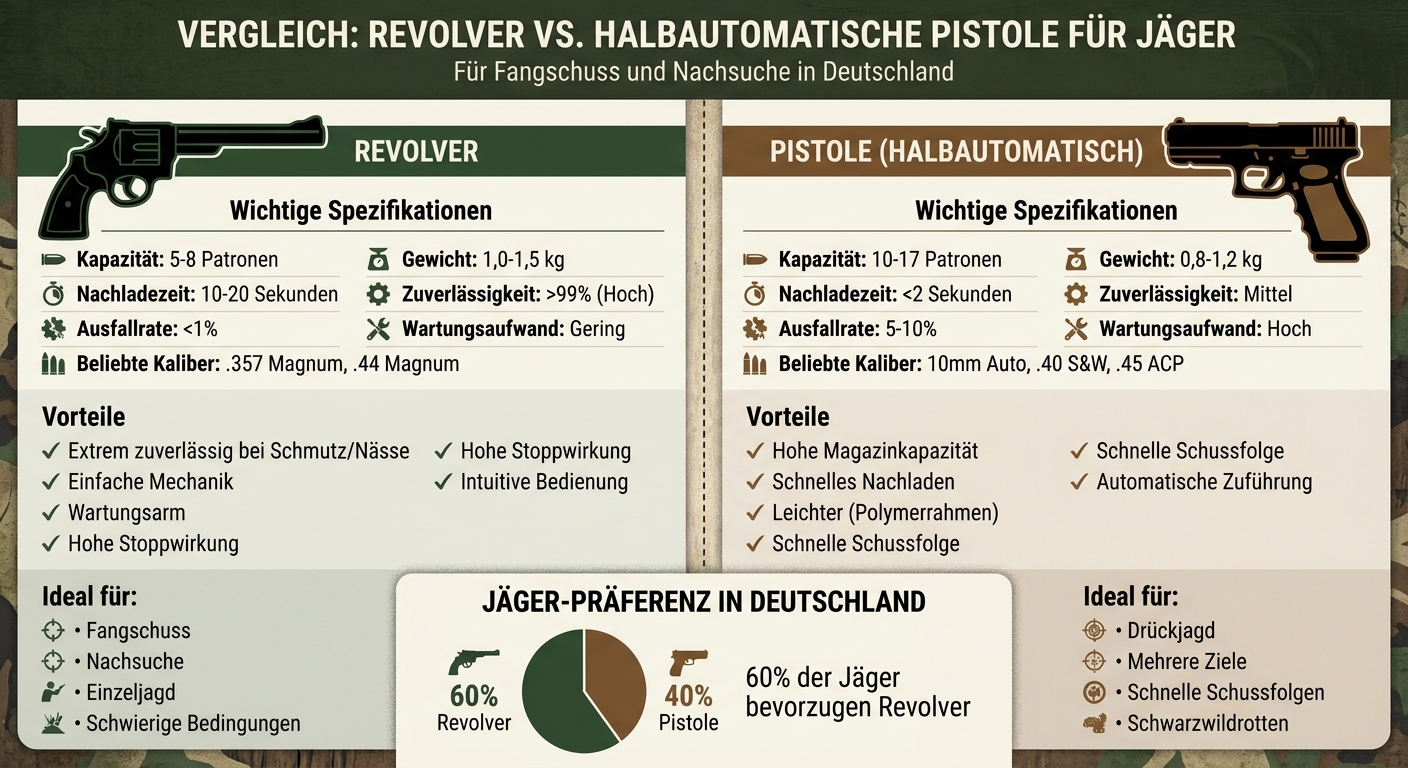
Revolver vs Pistol Comparison for Hunters: Technical Data and Characteristics
Why choose a revolver
Revolvers offer a high reliability, making them an excellent choice for hunting. Their simple mechanics minimize the risk of jams, even under challenging conditions such as dirt, moisture, or cold – typical challenges in the German hunting grounds. An example is the Smith & Wesson Model 686, which functions reliably even without frequent cleaning in rough terrain [3]. Especially during driven hunts, where quick reactions are required, the revolver impresses with its intuitive “Point-and-Shoot” handling: aim and pull the trigger without needing to rack the slide [6].
Another advantage is the caliber variety. Revolvers are compatible with powerful calibers such as .357 Magnum or .44 Magnum, which provide sufficient energy for the finishing shot on wild boar [2][1]. Safety is also a plus, as particularly single-action models virtually eliminate accidental discharges [1]. For hunters operating in remote areas where maintenance can be difficult, this robustness is a crucial factor.
Why choose a semi-automatic pistol
Semi-automatic pistols impress with their high magazine capacity. While revolvers typically hold 5 to 8 rounds, pistols in calibers like 10mm Auto or .45 ACP offer capacities between 10 and 17 cartridges [7]. This is a clear advantage during driven hunts for wild boar herds, where multiple quick shots may be necessary. The Glock 20 in 10mm Auto, for example, is appreciated for its 15-round capacity, which has proven effective in European forests with medium-sized game [4].
Another feature is the automatic feeding of the next cartridge, allowing for quick follow-up shots. This characteristic increases the hit rate, especially with moving game. Pistols are therefore ideal for situations where speed and precision are required.
Comparison
| Criterion | Revolver | Semi-Automatic Pistol |
|---|---|---|
| Reliability | High (hardly prone to malfunctions) | Medium (sensitive to dirt/moisture) |
| Capacity | 5–8 cartridges | 10–17 cartridges |
| Reload Speed | Slow (10–20 seconds) | Fast (under 2 seconds) |
| Weight | 1.0–1.5 kg | 0.8–1.2 kg |
| Maintenance effort | Low | High (regular cleaning required) |
| Best use | Follow-up shot, backup, individual hunting | Driven hunt, multiple targets, rapid fire sequences |
The choice between revolver and pistol heavily depends on the hunting scenario. For stalking in dense forests, for example for roe deer or foxes at distances of up to 30 meters, experts recommend revolvers due to their reliability and low maintenance needs. In open driven hunts for wild boar, however, 60% of members of the Deutscher Jagdverband prefer semi-automatic pistols, as they are characterized by their versatility [DJV-Daten]. Tests on reliability show that pistols have failure rates of up to 5% in dirty conditions, while revolvers remain below 1% [8].
Choosing the right handgun for hunting
After explaining the technical differences, this section discusses which weapon is best suited for various hunting situations.
Different hunting situations
The decision between revolver and pistol strongly depends on the respective hunting situation. When sitting, that is shooting at stationary game from a distance of about 3 to 5 meters, a compact revolver or a small pistol is often sufficient. Here, a single precise shot is crucial [9].
In tracking, the situation is different, as aggressive wild boar can appear in stressful situations. Tom Hunter describes his choice as follows:
“Since I need a reliable and strong weapon for tracking, I only carry revolvers in .357Mag or .44Mag" [9].
The high stopping power of these Magnum calibers provides additional safety in such situations.
On the stalk, however, every gram saved counts. Modern polymer pistols have an advantage here due to their low weight. David7x64 puts it succinctly:
“Who needs 16 shots? What matters is that the weapon is always ready to hand and handy" [9].
A weapon that is not carried is useless in the field. Besides the intended use, the choice of caliber also plays a central role in achieving the optimal follow-up shot.
Caliber Selection and Game Type
For big game such as wild boar or red deer, sufficient energy is crucial. Revolvers in .357 Magnum or .44 Magnum often provide the necessary reserves for an effective shot [2]. These calibers should ideally be combined with soft point bullets to ensure deep penetration through muscles and bones. For small game like fox or badger, hollow point bullets are suitable, as they impress with their rapid energy release.
Pistol calibers like .40 S&W offer a compromise: they deliver more energy than 9mm Luger while achieving a higher velocity than .45 Auto.
The barrel length also plays a role. Longer barrels (12.7–15.2 cm) increase bullet velocity, while shorter barrels are more maneuverable in the field. However, ammunition specifications are usually tested with barrels of 12.7 or 15.2 cm [1].
Maintenance, Ammunition, and Legal Requirements
Before purchasing a handgun, a pre-entry for the desired caliber in the firearms ownership card (WBK) is required at the responsible authority [2].
In practice, pistols require regular cleaning after use in bad weather, while revolvers are less maintenance-intensive due to their simpler mechanics – an advantage during longer hunting trips [1].
Ammunition for common calibers like .357 Magnum or .40 S&W is readily available. Regular training at approved shooting ranges is essential, as shooting accurately with open sights is significantly more challenging than with a rifle [1].
The costs for revolvers vary: used models start at around €400, while new firearms range between €300 and €800. High-quality premium models can cost up to €2,000 [2].
Find Your Handgun on Gunfinder
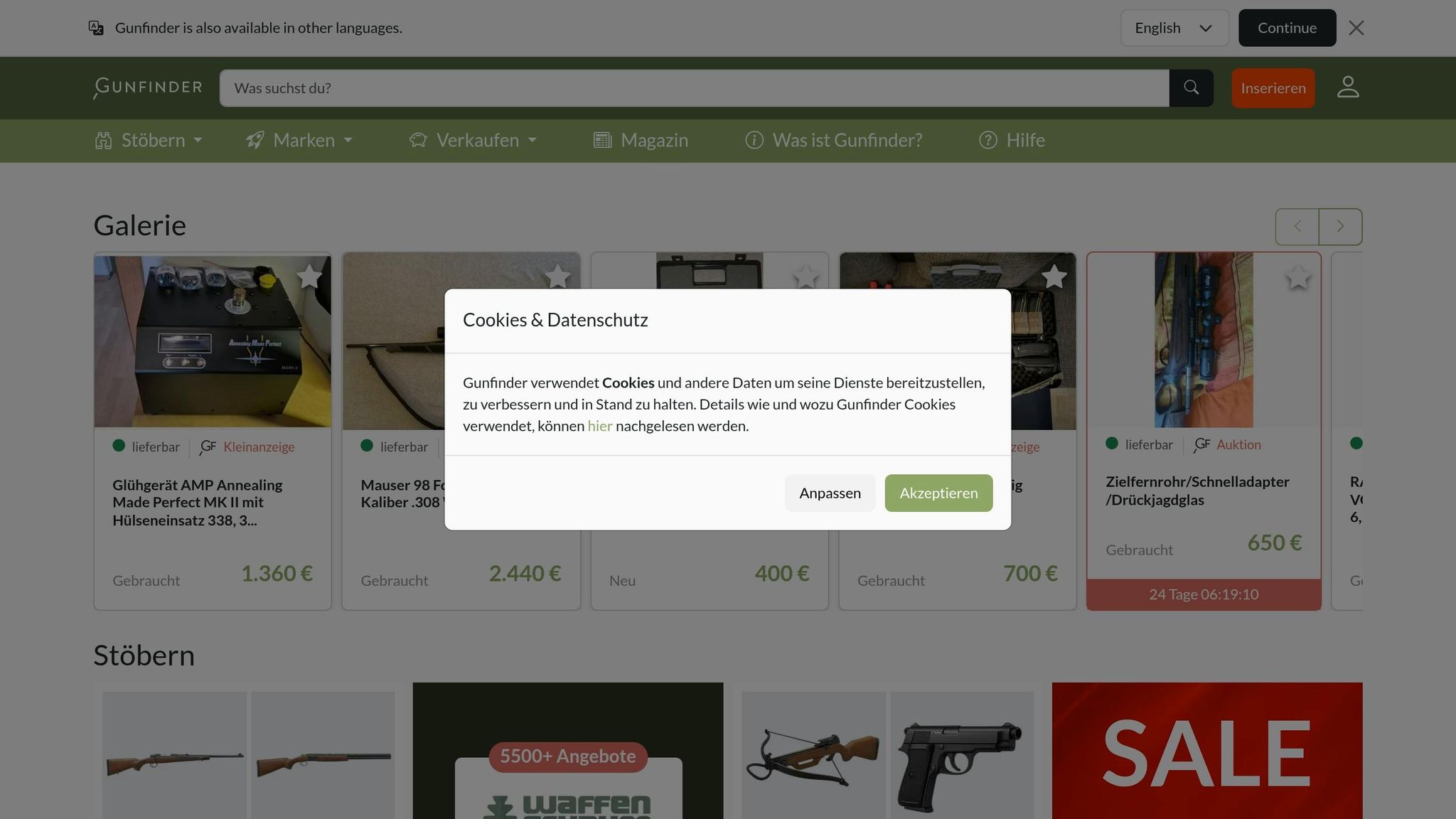
Gunfinder is the ideal platform to discover your perfect handgun. As a specialized online marketplace and search engine for hunters and shooters, it provides access to over 50,000 items – from new and used handguns to suitable accessories.
Thanks to intelligent filters, you can search specifically according to your criteria, such as caliber (e.g., .357 Magnum or .40 S&W), brand, price, or condition. Additionally, there are special categories like “Revolvers for Tracking” or “Revolvers for Young Hunters” that help you quickly find the right model. With the “Search Orders” feature, you stay updated and receive immediate notifications as soon as a suitable offer becomes available.
Gunfinder consolidates offers from various sources: classifieds, auctions, and direct sales from dealers. An identity verification of sellers ensures secure transactions. With over 100,000 registered users and a success rate of 80%, most hunters find their desired weapon often within 24 hours.
Do you want to sell an old handgun? Gunfinder also offers a buyback service. You will quickly receive a price offer and can easily pass your weapon on to partner dealers. In addition, the Gunfinder magazine provides helpful expert articles and comparisons that support you in your decision-making.
Conclusion
Revolver or pistol – which is better suited to your hunting requirements? Revolvers score with their impressive reliability, even under extreme conditions. Field tests show that they achieve an operational reliability of 99%, even in mud or wet conditions. In comparison, pistols have a failure rate of 5–10% under similar conditions[4]. For the finishing shot on big game, Magnum calibers like .357 or .44 Magnum often offer greater penetration power. Pistols, on the other hand, impress with their larger magazine capacity of 10 to over 20 rounds, faster reload times, and lower weight – an advantage, especially during intense driven hunts.
In Germany, about 15% of hunters use handguns, with 60% preferring revolvers – mainly due to their reliability[10]. However, the choice strongly depends on the specific hunting situation: A stainless steel revolver like the model 686 stands for robustness and reliability, while a pistol like the Glock 20 impresses with its mobility. It is important to observe the legal requirements, such as registration in the firearms ownership card (WBK) and the specific requirements for hunting.
If you are now looking for the right weapon, you will find a large selection on Gunfinder. Whether you prefer the reliability of a revolver or the capacity of a pistol – with intelligent filters for caliber, condition, and hunting suitability, you can browse thousands of offers. Start your search today and find the ideal companion for your next hunting adventure!
FAQs
Which handgun is most suitable for tracking?
For tracking, a compact handgun is particularly suitable. Here, revolvers have proven themselves, as they score with their reliability and precision at short distances – qualities that are crucial in such situations. Another advantage: Revolvers are mechanically simpler and therefore less prone to malfunctions.
Pistols, on the other hand, offer the advantage of a higher magazine capacity, but are often larger and less compact. These characteristics make them less suitable for precise operations during tracking. Therefore, hunters generally prefer revolvers when it comes to reliability and handling.
Which caliber is suitable for the finishing shot on wild boar?
For the finishing shot on wild boar, it is crucial to choose a caliber that delivers sufficient energy and precision. Proven calibers include, for example, .30-06 Springfield, .308 Winchester, or 8.4×68 S. It is important that the caliber quickly and humanely takes down the game while the weapon remains well controllable. Additionally, local hunting regulations and recommendations should always be considered.
How often should I clean revolvers or pistols while hunting?
Revolvers and pistols must be carefully cleaned after each use to prevent rust formation and residues. This is especially true in wet weather, as moisture can impair the functionality of the weapon. Thorough maintenance ensures that the reliability and longevity of the weapon are preserved.