ISO standards for night vision devices

The ISO 21094:2008 sets clear requirements for night vision devices to ensure performance, reliability, and quality. It provides buyers and manufacturers with a uniform basis to objectively evaluate and compare devices.
Key Facts:
- Device Types: Monoculars, binoculars, night vision goggles.
- Performance Metrics: Resolution (56–64 lp/mm), signal-to-noise ratio (21–25), light amplification (cd/m²/lx).
- Application Areas: Rescue operations, surveillance, hunting.
- Testing Methods: Standardized tests (ISO 14490-8) ensure compliance with the standard.
ISO-compliant devices offer verified quality and transparent data sheets that document the technical specifications. Buyers should pay attention to these proofs to avoid inferior products.
Device Categories and Application Areas According to ISO 21094
Device Types
The ISO 21094:2008 describes three main categories of night vision devices: Monoculars, Binoculars, and Night Vision Goggles [1]. All three fall under telescopic systems.
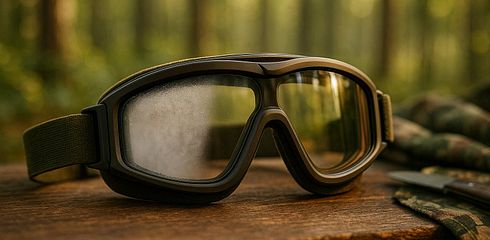
The differences mainly lie in comfort and handling. A Monocular is small, lightweight, and versatile – it can either be handheld or mounted on other optical systems [1][4]. Binoculars have two eyepieces, allowing for better depth perception and are suitable for longer observations [1]. Night Vision Goggles are mounted directly on the head, keeping both hands free – ideal for activities that require mobility [1].
| Device Type | Special Feature | Typical Advantage |
|---|---|---|
| Monocular | Handheld or usable as an attachment | Compact and flexible |
| Binocular | Two eyepieces | Improved depth perception |
| Night Vision Goggles | Head-mounted, hands-free use | Practical for manual tasks |
The choice of the appropriate device strongly depends on the requirements of the respective application.
Use in Poor Light Conditions
The standard also specifies specific areas of application for night vision devices. Different scenarios such as search and rescue operations or repairs in the dark require specific device characteristics. ISO 21094 defines performance parameters that ensure devices are suitable for these applications.
Night vision devices also play an important role in hunting and wildlife management. Whether observing wild boar or rescuing fawns – the choice of technology is crucial [4]. While image intensifiers provide more detailed images, thermal imaging devices are particularly effective in complete darkness and large-scale search operations [4].
For tested night vision devices that meet these requirements, it is worth taking a look at Gunfinder. There you will find suitable models for your needs.
sbb-itb-1cfd233
Technical Core Requirements of ISO 21094
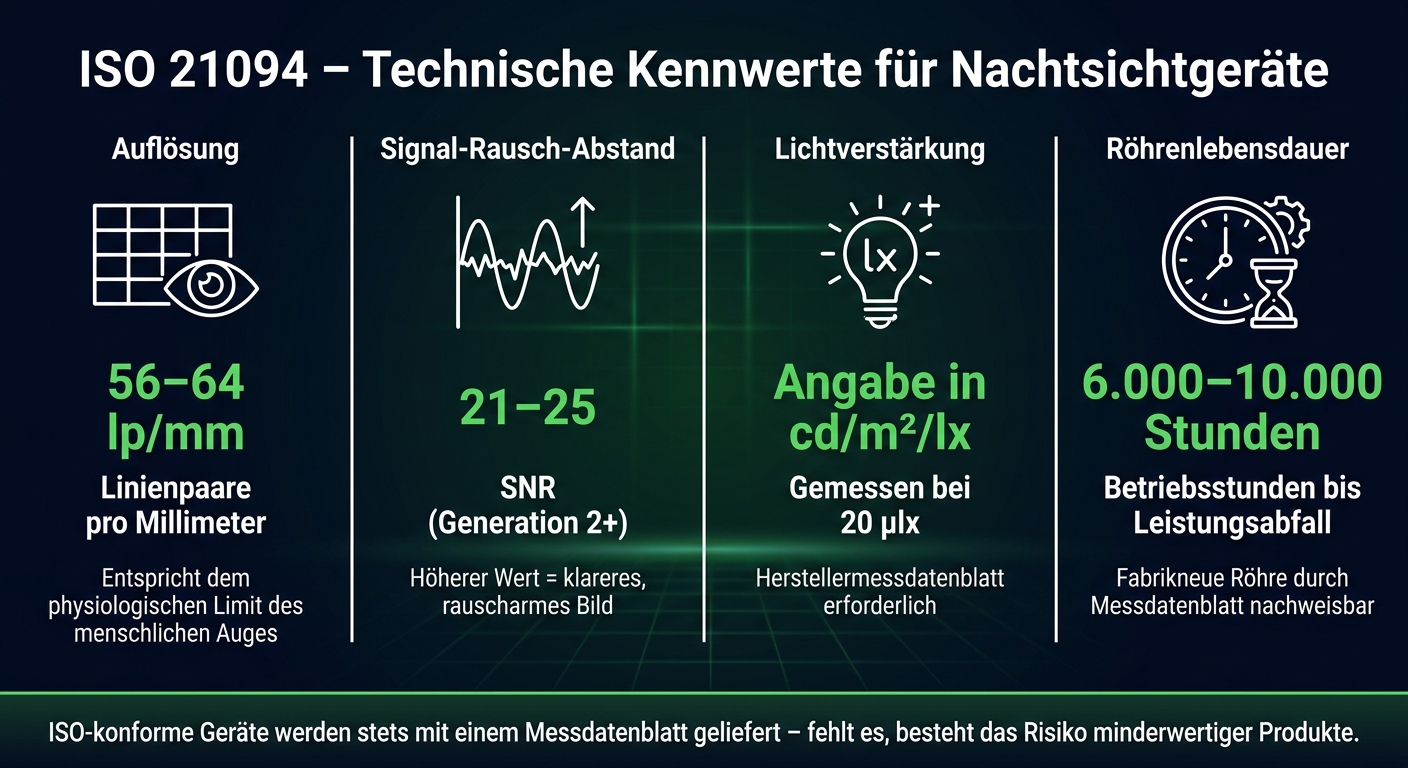
ISO 21094 Night Vision Devices: Technical Specifications at a Glance
Important Performance Parameters
ISO 21094:2008 establishes the technical requirements that devices must meet to comply with the standard specifications. The focus is on three main aspects: Image Resolution, Light Amplification, and Image Quality [1][2].
The resolution, specified in line pairs per millimeter (lp/mm), indicates how finely a device can represent details. High-quality image intensifier tubes typically achieve values between 56 and 64 lp/mm, which corresponds to the physiological limit of the human eye [3]. Values that exceed this limit provide no additional practical benefit.
The image quality is assessed based on the optical transfer function (OTF) according to ISO 9334 [2]. This function describes the ability of an optical system to accurately transmit image information and serves as an indicator of the overall performance of the device.
All these parameters are defined by specific minimum values and tolerances to ensure performance and reliability.
Minimum Values and Tolerances
In addition to resolution, the Signal-to-Noise Ratio (SNR) plays a crucial role. For Generation-2+ tubes, the typical benchmark is an SNR of 21 to 25 [3]. A higher SNR ensures clearer and less noisy images, which is particularly important for devices with higher magnification.
The Luminance Gain is measured under standardized conditions at an illumination level of 20 µlx and is specified in cd/m²/lx [3]. General marketing claims such as "70,000-fold amplification" are not very meaningful without this precise specification. Manufacturers are required to provide a data sheet that documents the actual measurements of the installed tube. For example, the manufacturer Photonis provides such detailed data [3].
The operational lifespan of an image intensifier tube typically ranges from 6,000 to 10,000 hours before a noticeable drop in performance occurs [3].
| Parameter | Description | Typical Benchmark |
|---|---|---|
| Resolution | Detail recognition in lp/mm | 56–64 lp/mm [3] |
| Signal-to-Noise Ratio | Image clarity, noise reduction | 21–25 (Gen 2+) [3] |
| Luminance Gain | Light amplification at 20 µlx | Specification in cd/m²/lx [3] |
| Tube Lifespan | Operating hours until performance drop | 6,000–10,000 hours [3] |
Testing Methods and Compliance Verification
After the technical specifications of ISO 21094 have been defined, this section explains how compliance is verified in practice.
Standardized Testing Procedures
The standardized testing procedures ensure that the performance parameters described in ISO 21094 are reliably met. The ISO 14490-8 establishes objective measurement methods to evaluate the performance of night vision devices [2][5]. It relies on additional standards such as ISO 14490-7 (for determining resolution limits), ISO 14490-1 (on basic properties of telescopic systems), and ISO 11664-2 (for standardized light sources) to ensure uniform and comparable results worldwide [2][5].
Verifying Technical Specifications
An essential part of the conformity assessment is the measurement data sheet, which documents the technical specifications of the installed image intensifier tube. This includes the serial number of the tube as well as measurements for resolution, signal-to-noise ratio (SNR), and light gain. It serves as technical proof of the quality and performance of the device [3]. When purchasing, it is essential to ensure that a current and original measurement data sheet is available, confirming that the image intensifier tube is brand new [3].
Additionally, for attachment devices, the point of impact and its repeatability must be verified. The point of impact deviation should be under 1 MOA (approximately 2.91 cm) at 100 meters. To ensure this, test shots are required to confirm compliance with this value [3][4].
| Test Standard | Test Range |
|---|---|
| ISO 14490-8 | Testing methods for night vision devices according to ISO 21094 [2] |
| ISO 14490-7 | Determination of resolution limits [5] |
| ISO 14490-1 | Basic characteristics of telescopic systems [5] |
| ISO 11664-2 | Standardized light sources for measurements [5] |
| ISO 5725-1 | Accuracy and precision of measurement methods [5] |
How ISO 21094 Influences Quality and Certification
The strict testing procedures and clearly defined performance parameters of ISO 21094 have a significant impact on the quality and marketing of night vision devices.
Benefits for Manufacturers
ISO 21094 provides manufacturers with clear guidance in product development. The standard specifies specific performance parameters that are included in the product data sheets. These data sheets are like the "passport" of a device: they contain information such as the serial number, resolution, signal-to-noise ratio (SNR), and light amplification values of the image intensifier tube. This makes the quality of a product measurable and traceable. Manufacturers can thus substantiate their performance promises with concrete figures, giving them an advantage over the competition and strengthening the trust of dealers and end customers. [3]
While manufacturers benefit from this transparency, the benefit for buyers is also significant.
What This Means for Buyers
For buyers, ISO 21094 primarily serves as a protective mechanism. As mentioned in the section on testing methods, the measurement data sheet is an indispensable quality proof. ISO-compliant devices are always delivered with such a document. If it is missing, there is a risk of acquiring inferior products – such as decommissioned military tubes, which often have a shorter lifespan and poorer image quality.
“The data sheet is, in this sense, the passport of a night vision device." – Norbert Klups, weapons expert [3]
However, a measurement data sheet cannot replace practical testing: What convinces on paper must also prove itself in use. On platforms like Gunfinder, you will find devices from trusted dealers who provide both the necessary certificates and guarantees. This makes the search for ISO-compliant optics significantly easier. [3]
Conclusion and Key Insights
The standard ISO 21094:2008 establishes clear, measurable parameters – including resolution (lp/mm), SNR, and luminance gain (cd/m²/lx) – thus enabling an objective comparison of night vision devices without having to rely on inaccurate marketing claims.
For you as a buyer, this provides clear guidance. If you know the key values – such as a resolution of 56–64 lp/mm and an SNR value between 21 and 25 – you can evaluate offers based on solid criteria. The lifespan of the image intensifier tube, which should be between 6,000 and 10,000 hours, is also a significant quality feature.
Manufacturers also benefit from the standard, as it provides a structured quality framework. This not only facilitates product development but also improves the comparability of devices on the market. ISO 21094 is not alone but is part of a larger standards system, which is complemented by ISO 14132 (technical vocabulary) and ISO 9334 (optical transfer functions). This system ensures uniform technical communication across the industry and sets clear standards for quality.
A practical example of the usefulness of the standard is the measurement data sheet. It contains important information such as the serial number, production date, and tested measurement results. This ensures that a device has been tested for ISO compliance and meets the highest quality standards.
If you are looking for certified night vision devices, it is worth taking a look at Gunfinder. There you will find devices for which the measurement data sheets are transparently accessible.
FAQs
How do I recognize a genuine ISO-21094 measurement data sheet?
You can recognize a genuine ISO-21094 measurement data sheet by several important features. These include the serial number of the tube, the measurement date, the technical specifications such as resolution and signal-to-noise ratio, as well as the original designation of the tube. Make sure that the data sheet comes from a reputable dealer and that all information is correct – only then can you ensure authenticity.
Which parameters are most important for my area of application?
The decisive factors for your area of application are the resolution (lp/mm) and the signal-to-noise ratio. These two values determine how clearly details are visible and how good the image quality remains at night.
What should I pay attention to regarding the point of impact with sighting devices?
Ensure that the mounting is done stably and precisely. A loosely attached device can cause the point of impact to shift by 2 to 4 cm. To detect and correct such deviations early, you should definitely test the point of impact of the device before shooting. Even though these shifts are usually minor, they can affect accuracy.