Used Hunting Gear: How Platforms Help

Selling used hunting gear: Check its condition, show any defects, and compare prices for similar listings. You can list items for free and without commission on Gunfinder. Relevant categories and completed search fields help buyers find your listing—but they don’t guarantee a sale.
Here’s what matters:
- Prepare your listing: Include the condition, accessories, and technical details; show any damage in the text and photos.
- Choose a price and sales method: Check comparable listings and clarify any additional shipping or handling costs.
- Make the handover secure: Check payment, identity, and, for items requiring a permit, eligibility to acquire them. Follow current requirements for transfer, shipping, and notification.
Gunfinder does not offer general buyer protection. So make sure payment and handover arrangements are clear in advance.
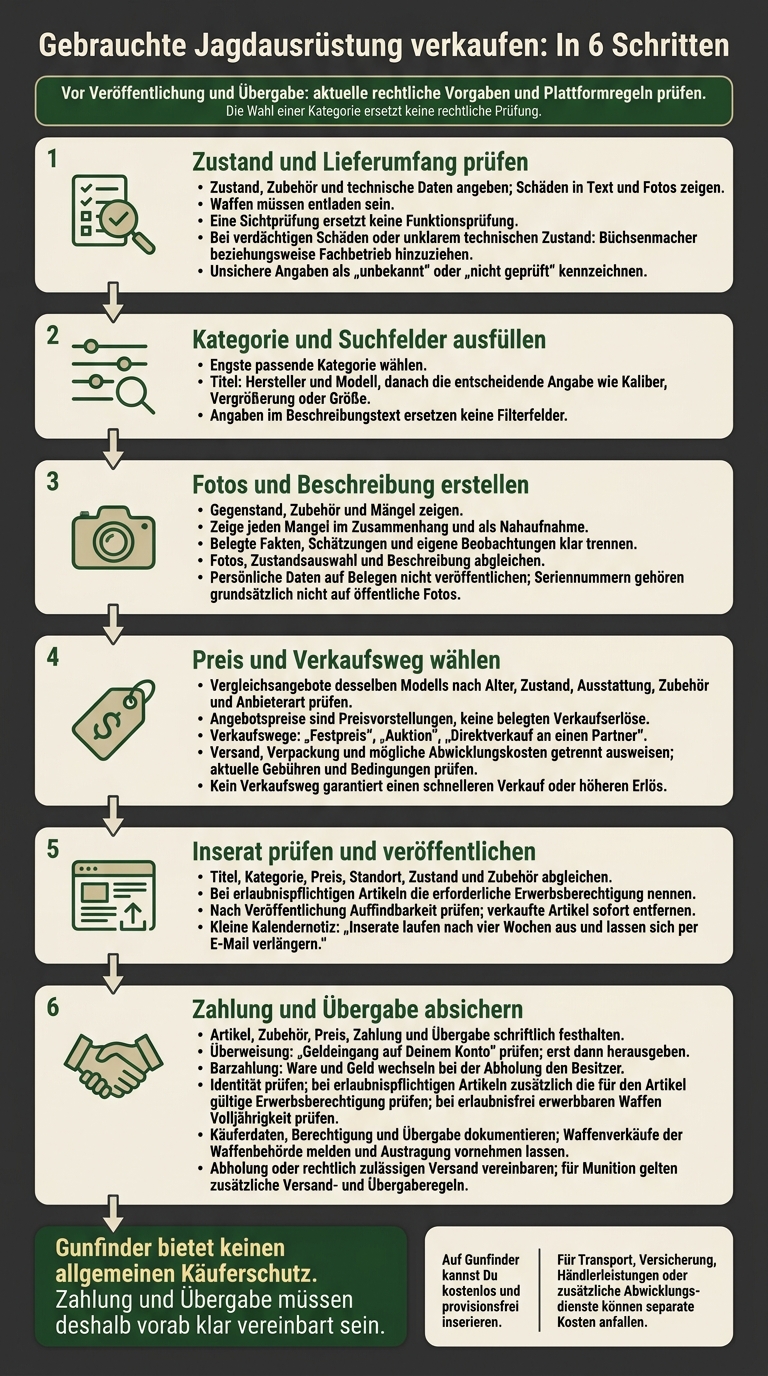
Selling used hunting gear: in 6 steps
Check your gear and choose a category
First, check the condition and what’s included. Then choose the right category for your gear.
Check the condition, accessories, and legal requirements
Check your gear in a safe, well-lit place. Firearms must be unloaded. Look for rust, cracks, loose fittings, and missing parts. For optics, also check the lenses and seals; for clothing, check the seams and fasteners.
A visual inspection is no substitute for a function check. If you find suspicious damage or the technical condition is unclear, contact a gunsmith or specialist business.
List everything included individually: mount, protective caps, sling, case, manual, and purchase or maintenance records. Also note anything that’s missing or not included. State the year of manufacture only if you can verify it. Mark uncertain details as “unknown” or “not checked.” Don’t include personal information from receipts in your public listing.
Before publishing, check the current German requirements for advertising, acquisition, transfer, and shipping, as well as the platform rules. This also applies to essential parts of firearms. Choosing a category does not replace a legal check.
Choose a category and add searchable details
Now add the details buyers will use to find your listing. Choose the most specific category that fits, rather than a general catch-all category.
Start the title with the manufacturer and model, followed by the key detail, such as caliber, magnification, or size. Fill in the available data fields too. Details in the description don’t replace filter fields.
| Category | Important details for buyers |
|---|---|
| Firearms and ammunition | Exact caliber designation; quantity for ammunition; barrel length and documentation for firearms |
| Optics | Magnification, objective lens diameter, reticle, illumination, tube diameter, and mounting compatibility |
| Clothing | Label size, chest, waist, and inseam measurements in cm, material, and wear |
| Accessories | Dimensions, mounting standard, compatible models, and included small parts |
sbb-itb-1cfd233
Take photos and describe the item
Once you’ve filled in the category and required details, it’s time for photos and a description.
Photograph the item, accessories, and defects
Photograph the item in even lighting against a neutral background. Show the front, back, sides, and underside, as well as connections and moving parts. For scopes, include the objective lens, eyepiece, turrets, mount, and model name in the photos. For clothing, show the size and material labels, fasteners, and pockets.
Photograph each included accessory separately and together with the item. Use the available photo slots to show different details rather than nearly identical views.
Show every defect in context and in a close-up. This helps buyers see where scratches, dents, rust, repaired seams, cracked lenses, or missing parts are and how extensive the damage is. Don’t edit photos to hide defects.
When photographing firearms, keep ammunition out of the frame. Point the muzzle in a safe direction. Avoid photos that require unsafe handling. Also check the background and reflections for addresses, faces, and other personal information. As a rule, don’t include serial numbers in public photos.
Describe technical details, use, and condition
Add the technical details relevant to the category. Accurate information helps buyers assess the condition and fit.
For firearms, for example: caliber, condition of the barrel, muzzle, chamber, bolt, trigger, and bluing, as well as any mounts or magazines; for optics: magnification, objective lens diameter, reticle, tube diameter, illuminated reticle, and mounting system; for clothing: size, material, cut, and measurements in centimeters.
Only mention repairs, modifications, care, or maintenance if you know about them for sure. Clearly distinguish verified facts, estimates, and your own observations. If you don’t know the item’s history, say so explicitly.
Describe exactly which functions you tested and where your testing ends:
The zoom ring turns smoothly. The optic was only inspected indoors; it hasn’t been field-tested.
Don’t claim to have tested anything you haven’t. Then check that the photos, condition selection, and description match: every visible defect must also be mentioned in the text. The photos must not give the impression that accessories not included are part of the listing.[9] Accurate photos and details reduce follow-up questions and help the right buyers find your listing through search and filters.
Set a price and choose how to sell
Photos, category, and description are ready? Now set the price and decide how you want to sell.
Compare listings and estimate the price
Compare several listings for the same model on Gunfinder. Pay attention to age, condition, features, accessories, and seller type. Different model generations or accessories can skew the picture. Use suitable comparable listings to work out a realistic asking price for your item.[8] This complements your listing's good visibility with a suitable price.
Important: Asking prices are price expectations, not verified sale prices. If you don't get any inquiries, adjust your price. Clearly state whether it's firm or negotiable. List shipping, packaging, and any handling costs separately. This lets interested buyers see the total cost of the purchase. Then choose the sales method that suits the effort you're willing to put in and your target price.
Check sales methods, fees, and terms
With a fixed price, you set the price. With an auction, the bids determine the outcome. Check the starting price, duration, and reserve price in advance.
For a direct sale to a partner, you submit photos and item details and receive a purchase offer. The dealer factors in inspection costs, business expenses, and the risk of resale. None of these methods guarantees a faster sale or higher proceeds.
Before deciding, check the current fees and whether your item is allowed on the sales channel in question. Separate costs may apply for shipping, insurance, dealer services, or additional handling services.
For a partner sale or handling service, clarify who is responsible for inspection, shipping, and documentation. Also confirm when you'll receive your money and what costs will apply. These services are not the same as general buyer protection: According to Gunfinder, buyers and sellers arrange payments directly with each other. The platform does not offer general buyer protection.[10][11] Agree on the payment method, handover, and, for items requiring a permit, verification of eligibility before you accept.
Publish your listing and arrange the handover
Price and sales method decided? Check all the details once more before your listing goes live.
Check your listing before publishing
Check the title, category, price, location, condition, and accessories: the details should be consistent. For items requiring a permit, state the required acquisition permit.[1][5][7]
After publishing, check whether your listing is easy to find. You can correct errors in manufacturer or model names directly under “My Listings.” Remove sold items right away. Listings expire after four weeks and can be renewed by email.[1][3]
Confirm payment, eligibility to acquire, and handover
Record the item, accessories, price, payment, and handover in writing. For a bank transfer, only the funds received in your account count. Don't hand over the equipment until the money has arrived. For cash payments, the goods and money change hands at pickup.[3]
Check the buyer's identity before the handover. For items requiring a permit, you must also check the acquisition authorization valid for the item, for example by checking the buyer's WBK or hunting license. For firearms that can be acquired without a permit, check that the buyer is of legal age. Document the buyer's details, authorization, and handover. Report firearm sales to your firearms authority and have the firearm removed from your records.[3][4]
Arrange pickup or legally permitted shipping. Ammunition is subject to additional shipping and handover rules.[2][3][6]
Conclusion: Accurate listings bring equipment and buyers together
Accurate details, suitable categories, and honest notes about defects help buyers quickly assess your listing and compare it with other offers.
Gunfinder's search filters match your listing with relevant searches based on these details—for example, by caliber, price, or distance. This doesn't guarantee your asking price or a quick sale.
Before publishing, check all details, the current fees and terms, and the legal requirements for publishing and handover. This is especially important for firearms, ammunition, and essential firearm parts.
FAQs
How can I spot suspicious purchase inquiries?
If you don't hear back or receive payment, give the interested buyer a few days at first. Booking and shipping processes can take some time. If you still don't hear from them, set a final deadline. If it passes without a response or payment, report the user through the Gunfinder system for review.
If you've already shipped the equipment and payment hasn't arrived, you should file a police report. Have all relevant details ready, including the message history and bank details.
Can I exclude the warranty when selling privately?
Yes, when privately selling used hunting equipment through the Gunfinder marketplace, you can generally exclude the statutory warranty. Gunfinder only puts you in touch and isn't a party to the purchase contract. You agree on the contract terms directly with the buyer.
State the warranty exclusion explicitly in the listing or in the subsequent purchase contract. However, the exclusion doesn't apply to defects fraudulently concealed from the buyer.
What can I do if my listing isn't getting any inquiries?
An inaccurate description can make your listing harder to find in search results. So check the spelling and include the manufacturer, model, caliber in parentheses, and scope in the title. Use clear photos to show the wear parts and the overall condition.
Your listing expires after four weeks. You can extend it if needed to keep it visible.